Standing hip extension with band
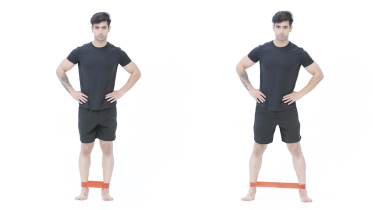
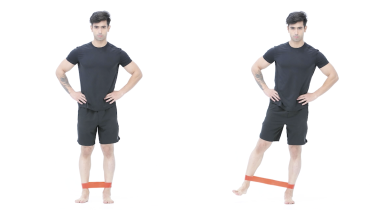
In this exercise you stand with a loop band around your ankles and take one straight leg back behind you. The band adds resistance for the big buttock muscle (gluteus maximus) as it moves the leg back. The leg you stand on works too, holding you steady.
How to do the standing hip extension with band
- Put a light loop band around both ankles and stand tall with your feet hip width apart. The video shows hands on hips, but hold a counter or a sturdy chair if your balance is unsteady.
- Shift your weight onto the leg that stays on the floor and gently tighten your stomach.
- Keeping the knee of the moving leg straight, take that leg back behind you against the band. Think of driving it from your buttock.
- Go only as far as you can without your lower back arching or your body tipping forward. For most people that is a short distance.
- Bring the leg forward slowly, controlling the pull of the band, and repeat. Then change legs.
What you should feel
Work in the buttock of the leg that moves back. The side of the hip on your standing leg also works to hold you level.
Common mistakes
- Arching the lower back or leaning forward to get the leg further back.
- Bending the knee of the moving leg.
- Letting the band snap the leg forward at the end of each rep.
- Turning the foot and hip outward as the leg goes back.
How often
Many programs start with 2 to 3 sets of 10 to 15 on each leg with a light band, once a day. Your physio will adjust this and pick a band that suits you.
Stop and check with your physio if
- Sharp or pinching pain in the lower back.
- Sharp pain at the front of the hip or in the groin, or pain that builds through the set.
- Pain, tingling or numbness running down the leg.
From the clinic
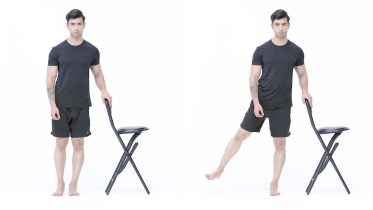
The leg only travels a little way behind you. If it seems to be going a long way back, your lower back is almost always arching to make up the difference. Practice without the band first, as in the standing hip extension at a chair, until your back stays still. Prone hip extension works the same buttock muscle while you lie face down.
If you have had a hip replacement or other hip surgery, get the go-ahead from your surgeon or physio before you try this exercise. Taking the leg back behind you, especially with the foot turned out, stretches the front of the hip, and many surgeons ask you to avoid that for the first months after some operations. This applies mainly after an operation done from the front of the hip (anterior approach). Ask when a band can be added.
Written and checked by the PocketPhysio editorial team. Last updated 2026-09-26.
This page is general education, not a diagnosis or a personal treatment plan. If you have pain, an injury or a health condition, see a physiotherapist or doctor before starting new exercises.