
Reverse lunge to front kick
A reverse lunge to front kick links a backward lunge with a kick. You step back and lower into a lunge, then push up and bring that back leg through into a kick out in front of you, balancing on the other leg for a moment. The thigh and buttock of the front leg drive you up. The kicking leg lifts from the hip and straightens at the knee, while the standing leg holds you steady. It is a fast drill for the whole leg, seen in fitness classes and in later sports rehab once plain lunges feel easy.
How to do the reverse lunge to front kick
- Stand tall with your feet about hip width apart and your fists raised in front of your chest, as in the video. For your first sessions, stand side-on to a kitchen counter with one hand close enough to reach it.
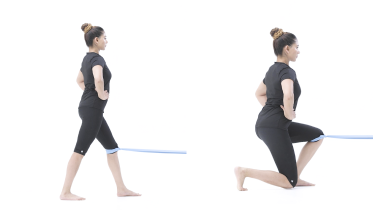
- Step one leg well back and bend both knees to about a right angle, bringing the back knee close to the floor without touching it.
- Push through the front foot to stand, and bring the back leg forward. Lift the knee first, then straighten the knee to push the foot out in front of you.
- In the video the kick reaches above hip height, and the voice guide says to kick with force. Start with kicks at about knee height, build up to no higher than hip height unless your physio suggests more, and never snap the knee hard into straight.
- Bring the foot back down and go straight into the next lunge on the same leg. Change legs only when the set is done.
What you should feel
Work in the thigh and buttock of the front leg as you rise from the lunge, then at the front of the hip and thigh of the kicking leg. Your standing foot and the outside of that hip keep you upright through each kick.
Common mistakes
- Kicking so hard that the knee snaps straight or the kick pulls you off balance.
- Leaning well back as the leg comes up.
- Stepping back too little, which pushes the front knee far ahead of the toes.
- Letting the back knee thump into the floor as you speed up.
How often
Many programs use 6 to 10 reps on each leg for 2 or 3 sets, at a pace where every kick stays controlled and balanced. Your physio will adjust this.
Stop and check with your physio if
- Sharp pain in the knee or hip, or a knee that buckles.
- A sudden pull in the groin as you kick.
- A sudden sharp pain, pop or snap at the back of your thigh. Stop straight away. If you then get large bruising spreading down the back of the thigh, a gap or dip you can feel, a stiff-legged walk, or clear weakness when you bend the knee, get assessed the same day at urgent care or an emergency department, as the tendon may have pulled away from the bone near the buttock.
- Chest pain or pressure, dizziness or feeling faint, a racing or irregular heartbeat, or being far more out of breath than the effort should cause.
From the clinic
Get the reverse lunge steady first, then try the reverse lunge knee drive, which brings the knee up without the kick. The kick adds speed and a long leg out in front at the moment you are on one foot, and that is where balance tends to go. The woman in the video has nothing to hold. At first, keep a counter or rail within reach, and give yourself plenty of room away from furniture you could kick. If you have fallen in the past year or feel unsteady on your feet, keep one hand on the support throughout and check with your physio before you add the kick.
If you have had a hip replacement, get the go-ahead from your surgeon or physio before you try reverse lunge to front kick. A fast kick can swing the hip up to a right angle or past it, and many surgeons ask you to avoid that for the first months after some operations. After a knee fracture or knee surgery, including a knee replacement, follow your surgeon's or physio's plan, and start this exercise only when they have cleared you. With a torn or strained hamstring, or back pain that travels down the leg, keep the kicks low and ask your physio first.
With a heart condition or high blood pressure, check with your doctor before you start. If chest pain, pressure or tightness does not ease quickly when you rest, spreads to your arm, neck, jaw, stomach or back, or comes with sweating, feeling sick, feeling light-headed or being short of breath, call emergency services straight away, as this can be a heart attack. If it eases quickly and none of these happen, get medical advice the same day, and do not exercise again until you have been checked. If you faint while exercising, call emergency services, even if you feel fine again quickly.
Written and checked by the PocketPhysio editorial team. Last updated 2026-09-28.
This page is general education, not a diagnosis or a personal treatment plan. If you have pain, an injury or a health condition, see a physiotherapist or doctor before starting new exercises.
.png)