Lying figure 4 stretch
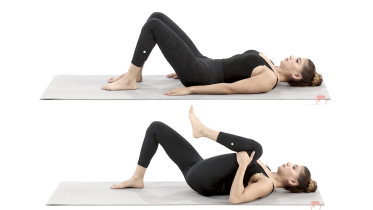
The lying figure 4 stretch works on the buttock and the deep muscles that turn your hip outward, including the piriformis. You lie on your back, rest one ankle across the opposite knee so your legs make a 4, then hold the lower thigh and draw both legs toward your chest. The closer you draw them in, the stronger the stretch. Your back stays on the floor the whole time.
How to do the lying figure 4 stretch
- Lie on your back on a mat with both knees bent and your feet flat on the floor.
- Cross the leg you want to stretch over the other one and rest the outer ankle on that thigh, a little above the knee. Let the crossed knee drop out to the side.
- Lift the lower foot off the floor. Reach one hand through the gap between your legs and the other around the outside, and lace your fingers behind the lower thigh.
- Gently draw that thigh in toward your chest. Stop where the stretch in the buttock of the crossed leg feels firm but comfortable, with your head and shoulders still resting on the mat.
- Hold, breathing slowly. Then put the lower foot back down, uncross your legs and change sides.
What you should feel
A stretch deep in the buttock of the crossed leg, sometimes reaching round to the outside of the hip. It should ease a little with each slow breath out, not build into pain.
Common mistakes
- Lifting your head and shoulders to reach the thigh. Hold lower down the thigh, or loop a towel behind it, so your upper body can stay relaxed on the mat.
- Pulling the legs in hard or bouncing. Draw them in slowly and stop at a comfortable stretch.
- Letting the crossed knee swing back toward the middle, which takes the stretch out of the buttock.
- Holding your breath while you pull.
How often
A common starting point is 2 to 3 holds of 20 to 30 seconds on each side, once or twice a day. Your physio will adjust this.
Stop and check with your physio if
- Pain, numbness or tingling runs down your leg or into your foot.
- A sharp or pinching pain at the front of the hip or in the groin.
- Pain in the crossed knee, rather than a stretch in the buttock.
From the clinic
If you already feel a good stretch once the ankle is crossed, leave the lower foot on the floor and hold there. That is the gentler version. Lift the leg and draw it in only when that first stretch has faded. The voice guide also suggests pressing the elbow on the crossed side lightly into the inside of that thigh for a deeper stretch. Keep that pressure soft, and leave it out if your knee objects.
The seated figure 4 stretch and the piriformis stretch work the same area in different positions. The pigeon stretch is a stronger option your physio may move you on to later. If buttock pain is spreading down your leg, get it checked before you stretch any harder.
If you have had a hip replacement, get the go-ahead from your surgeon or physio before you try this stretch. Crossing the ankle over the other knee and then drawing both legs toward you bends the hip well past a right angle while it is turned outward, and many surgeons ask you to avoid that for the first months after some operations. Once you are past the first three months of pregnancy, ask your physio before stretching flat on your back.
Written and checked by the PocketPhysio editorial team. Last updated 2026-09-26.
This page is general education, not a diagnosis or a personal treatment plan. If you have pain, an injury or a health condition, see a physiotherapist or doctor before starting new exercises.