
Sarcopenia treatment: a staged strength program
Warning signs, and when to get help
Sarcopenia: what the diagnosis actually means
Sarcopenia is low muscle strength and low muscle mass that has reached the point of mattering. Sarcopenia treatment follows from that definition: it goes after strength and function rather than after a number on a scan. The European working group that sets the definition, EWGSOP2, calls it a muscle disease, and in their 2019 revision they made low muscle strength the leading sign rather than low muscle mass, because strength predicts how well people manage better than size does (Cruz-Jentoft and colleagues, 2019).
That is also what separates this program from a general fitness plan, so it is worth knowing which one you want. If you have been given this diagnosis, or a doctor has measured your grip or timed your chair stands and told you the result was low, you are in the right place: this page follows the diagnostic pathway and the treatment that has been tested in people like you. If nobody has measured anything and you simply want to get stronger as you get older, our strength training for older adults program is the better starting point, and the two pages share most of their exercises.
There is one more distinction in the definition, and it explains why a doctor may want to retest you later. EWGSOP2 calls it acute sarcopenia when it has been present for less than 6 months, which usually follows an illness or an injury, and chronic sarcopenia at 6 months or more, which tends to go with a long-term progressive condition and carries a higher risk of dying. That split exists so that worsening gets caught early rather than assumed.
How do you know if you have sarcopenia?
You do not, from the inside, with any confidence. Muscle loss is slow and symmetrical and the body compensates, so people put the changes down to age until something obvious happens.
The signals that bring people in are practical rather than painful: pushing off the arms of the chair every time you stand, taking the stairs one at a time or holding the rail where you never used to, shopping in two trips instead of one.
Jars and bottle tops are the other common one, and so is walking more slowly than the people you walk with, or not getting across the road in the time the lights give you.
The diagnosis itself is made in four steps. A clinician finds the case, often using a short self-reported questionnaire called SARC-F or simply their own suspicion. They then assess muscle strength, by measuring grip with a handheld dynamometer or by timing five rises from a chair without using your arms, and a low result on either means probable sarcopenia. A scan showing low muscle quantity or quality confirms it, and a measure of physical performance such as walking speed decides whether it counts as severe (Cruz-Jentoft and colleagues, 2019).
Our grip strength test at home page explains what the grip figures mean and what the normative data behind them does and does not cover. The 30-second chair stand test is a different test, with its own norms, and it is a simple way to track leg strength over time.
What causes muscle loss with age
Aging alone is enough. EWGSOP2 calls that primary sarcopenia, and it is the form with no other cause to find.
Secondary sarcopenia is when something else is adding to it, and the group names three categories. A systemic illness, particularly an inflammatory one such as a cancer or organ failure. Physical inactivity, whether from a sedentary life or from being immobile because of illness or disability. And not taking in enough energy or protein, for reasons that include a poor appetite, trouble absorbing food, difficulty eating and limited access to healthy food (Cruz-Jentoft and colleagues, 2019). Those three are not mutually exclusive and in the clinic they usually arrive together: two weeks in hospital with a chest infection takes the activity, the appetite and the inflammation all at once.
A spell of bed rest or a hospital stay is one of the fastest ways to lose muscle at any age, which is why standing up and walking in hospital matters so much. A change in appetite or an unplanned drop in weight is not a side issue here; it is part of the condition, and the NHS notes that people aged 65 and over are particularly at risk of malnutrition. If you are losing weight without trying, that is on the warning list at the bottom of this page.
Why it matters: falls, fractures and getting out of a chair
Sarcopenia is on the list of diagnoses because of what follows it, not because of how it feels. EWGSOP2 links it to a higher likelihood of falls, fractures, physical disability and death, along with mobility problems, lower quality of life, and loss of independence or a need for long-term care. It also raises the chance of going into hospital and the cost of the stay, and low grip strength specifically is associated with longer hospital stays, more limitation in everyday function and a higher risk of dying (Cruz-Jentoft and colleagues, 2019).
The chair is the test that ties it together. Standing up from a seat is one of the hardest things most people do in a day, it is the movement that fails first, and once it starts to fail everything else shrinks around it: you sit longer, go out less, and lose more muscle. That is why the program here starts with chair work and keeps it going at every stage instead of treating it as a beginner exercise.
Falls deserve their own plan alongside this one. Strength work and balance work do different jobs, and the UK Chief Medical Officers state that evidence-based strength and balance programs reduce the rate and risk of falls. For the balance half, see the balance and falls prevention program, and strength and balance exercises for seniors sets out which side to start with. If weak bones are also part of the picture, the osteoporosis program covers how to load them safely.
Can sarcopenia be reversed, and what does treatment involve?
Partly, and the honest version of the answer depends on which part you ask about.
Strength and function improve dependably. A Cochrane review of 121 trials in about 6,700 older people found that progressive resistance training, meaning strength work that gets harder as you get stronger, had a large effect on muscle strength and a moderate to large effect on getting out of a chair, with most trials training 2 to 3 times a week (Liu and Latham, 2009). An umbrella review of 14 systematic reviews concluded that there is high quality evidence that resistance training improves muscle mass, muscle strength and physical performance, and recommended training the large muscle groups with a total body approach (Beckwée and colleagues, 2019). The international sarcopenia guideline, ICFSR, makes resistance-based physical activity its one strong recommendation (Dent and colleagues, 2018).
Muscle mass is the slower, less reliable half. It does change, but less than strength does and over months rather than weeks, and some of the early improvement in how much you can lift comes from the nervous system learning the movement rather than from new muscle. If you are being retested, expect your chair stand time and your grip to move before a scan does.
What the guideline does not recommend is worth knowing too, because these get sold hard. ICFSR makes no recommendation for vitamin D supplementation and no recommendation for prescribing anabolic hormones in sarcopenia (Dent and colleagues, 2018). EWGSOP2's own position is that sarcopenia can be prevented or delayed, and that interventions including nutrition and exercise training appear to slow or reverse the process.
The umbrella review raised a caveat about itself, and it is a fair one: very few of the reviews it examined clearly reported whether their participants actually had sarcopenia at the start. So most of the evidence above is about older adults in general, applied to a diagnosed group.
How much protein, and who decides
Not us, and not an internet figure. How much protein you need depends on your body size, your kidney function, your other conditions and what you are already eating, so this page gives no number and your doctor or a dietitian is the right person to set one.
The evidence supports a direction and not a dose. ICFSR makes a conditional recommendation for protein supplementation or a protein rich diet, weaker than its strong recommendation for exercise (Dent and colleagues, 2018). A review of 15 nutrition reviews found that leucine, an amino acid, had the best supporting evidence for muscle mass in people with sarcopenia, recommended protein alongside resistance training, and noted the benefit particularly in programs running 24 weeks or more, while rating the evidence low to moderate because the underlying reviews were few and of modest quality (Gielen and colleagues, 2021). The umbrella review of exercise found that adding nutritional supplements to resistance training had limited extra effect on muscle function (Beckwée and colleagues, 2019).
So the training is the part that does the work, food is what lets it work, and a supplement without the training does very little. If your appetite is small, you are losing weight, or eating has become difficult, tell your doctor rather than buying a powder.
Warning signs that need checking
The list at the bottom of this page covers the signs that need attention, and each line says how fast to act. Read it once before you start.
A few of the lines in it are easy to explain away at this age, so they are worth naming here. Losing weight without meaning to, which belongs with your doctor rather than with an exercise program. Any fall, even one where you were not hurt, because a doctor can look for a treatable cause and refer you to a falls service. And feeling dizzy or light-headed on standing up, which is common, has causes including medicines, and is one of the ways people end up on the floor.
While you exercise, stop straight away if you get chest pain or pressure, feel dizzy or faint, notice a racing or irregular heartbeat, or become far more out of breath than the effort should cause. What to do next is in that list.
How to use this program
Pick the stage that matches you today. If you are not sure, start at stage 1. Move up when the current stage feels easy and you have recovered by the next day.
Progress in this program comes in two forms, and the order matters. First take help away: fewer hands on the chair, a lower seat, a lighter touch on the counter or the rail. Then add load. Change one thing at a time, and add repetitions before you add weight. The umbrella review found that low intensity resistance training at 50 percent of a one repetition maximum or less is enough to produce strength gains, while 80 percent is recommended if you want the largest gains (Beckwée and colleagues, 2019), which in plain terms means a light weight you can control is worth a great deal and a harder one is worth more if you are ready for it. The one rep max calculator estimates that figure from a set you can already do, so nobody needs to attempt a maximal lift.
Each exercise page gives a typical starting dose. As a rough guide, most of the strength exercises here start at 2 to 3 sets of 5 to 15 repetitions, with the harder weighted work on 2 to 3 days a week and a rest day between sessions, and the hand exercises at 5 to 15 repetitions once to three times a day. Both the WHO and the UK Chief Medical Officers advise muscle strengthening on at least 2 days a week, and for people aged 65 and over the WHO adds varied activity focused on balance and strength on 3 or more days a week (Bull and colleagues, 2020). Your physio will adjust the exercises and the numbers to suit you.
Soreness for a day or two after a new exercise is normal. Sharp pain during an exercise means stop that exercise for today, and a joint that is more painful or swollen the next day means the load was too much for now, so do less next time rather than stopping altogether. A calf or thigh that is swollen, warm or red is not ordinary soreness and is on the warning list below.
Before you start, check with your doctor if you have a heart or lung condition or blood pressure that is not under control, and breathe steadily through every repetition rather than holding your breath. If you have broken a bone that is still healing or had an operation recently, follow the plan from your surgical team or fracture clinic instead of this one, because a healing bone and a repaired tendon each run to their own timetable, and that timetable comes from the team looking after it rather than from how the limb feels.
If you have had a hip or knee replacement, or a broken hip fixed with screws, a nail or a plate, get the go-ahead from your surgeon or physio before the sit to stand exercises, the chair squat, standing hip abduction, the goblet squat, step ups, the split squat, the single leg deadlift or stair climbing. Some operations limit this kind of work for the first months, so the timing depends on your surgery. With low bone density (osteoporosis) or a past spinal fracture, check with your physio before the bent over band row and the single leg deadlift, because both load the spine in a forward bent position.
If you have fallen in the past year, feel unsteady on your feet, or take medicines that make you dizzy, keep a hand on a counter for everything done standing, practice when someone else is at home, and ask your doctor or physio about a falls check.
Some people should have the first sessions watched rather than done alone. The UK Chief Medical Officers advise that in older adults with frailty, moderate to severe dementia, or a history of broken bones in the spine or regular falls, it may be better for any new exercise to be supervised by a trained professional at first, so that it works and the technique is safe. If that is you, or the person you are helping, book the start of this program with a physio rather than beginning it on your own.
The exercise program
Stage 1: Load you can control
For anyone starting out, coming back after an illness or a hospital stay, or unsteady on their feet. The point of this stage is not the effort, it is learning each movement well enough that you can safely add weight to it later. The armrests take part of your weight as you stand, the row and the knee extension are done sitting, and wall push-ups keep most of your body weight on your feet. Hold a kitchen counter for the calf raises. The grip work is here because grip is one of the two measures a doctor uses to diagnose this.
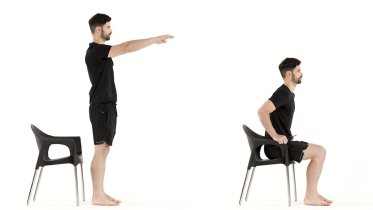 Sit to stand using armrests
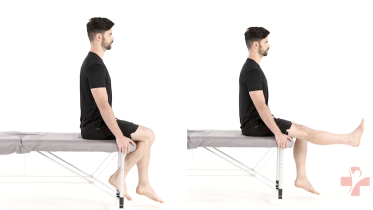 Seated knee extension
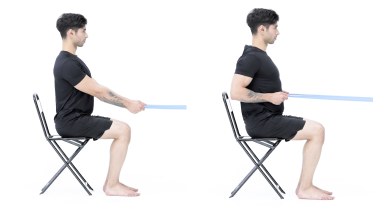 Seated row with band
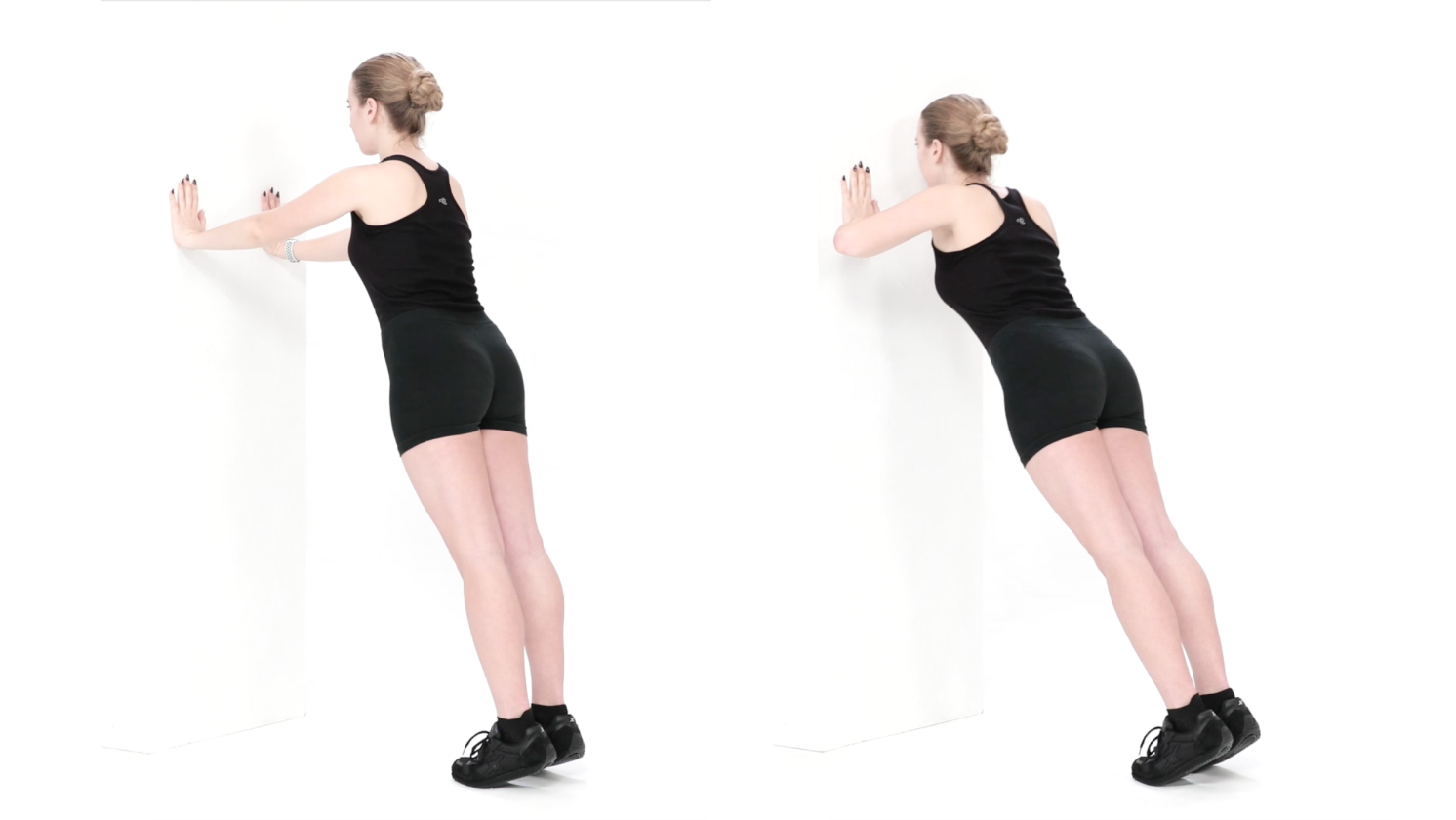 Wall push-ups
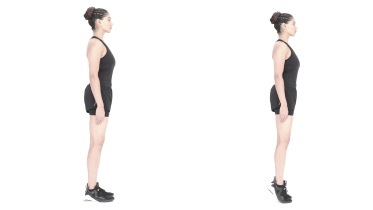 Calf raises
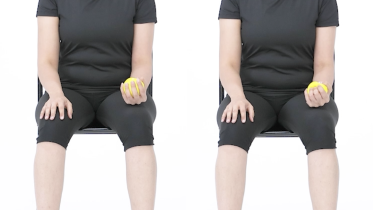 Hand grip squeeze
Stage 2: Take the help away, then add weight
When stage 1 feels easy and you have recovered by the next day. The first progression is not a heavier weight, it is less help: standing up without pushing off the armrests, then from a lower seat. Once that is steady, the press, the curl and the band row start adding load to the upper body. Begin with a light weight or none at all, and keep a sturdy chair or a counter within reach for anything done standing.
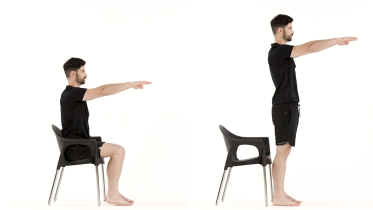 Sit to stand
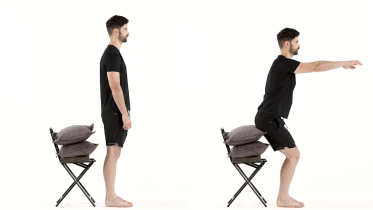 Chair squat
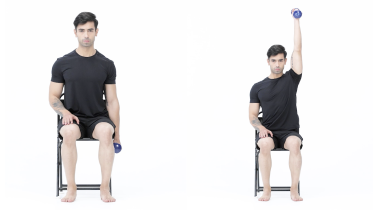 Seated dumbbell shoulder press
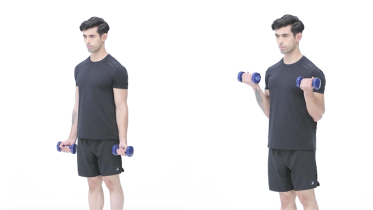 Biceps curl
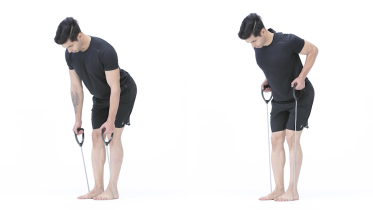 Bent-over band row
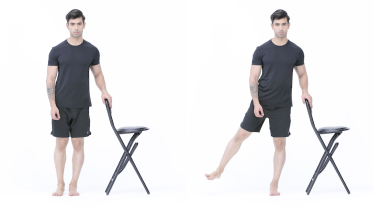 Standing hip abduction
Stage 3: Keep the load going up
When stage 2 feels easy and your balance is steady. This is the stage that separates a program for a diagnosed condition from general activity: the weight has to keep rising, in small steps, or strength stops improving. The split squat and single leg deadlift load one leg at a time, so do them with a hand on a chair back at first. Use a handrail for the stairs and the step ups. If you have fallen in the past year or feel unsteady, go through the single leg exercises with a physio before you do them alone.
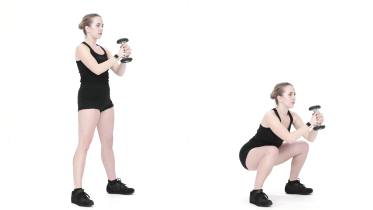 Goblet squat
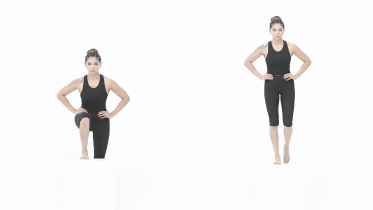 Step up
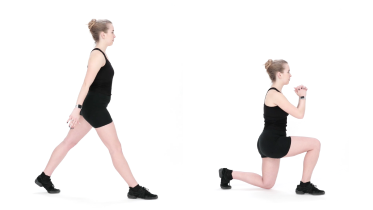 Split squat
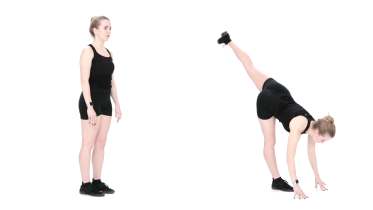 Single leg deadlift
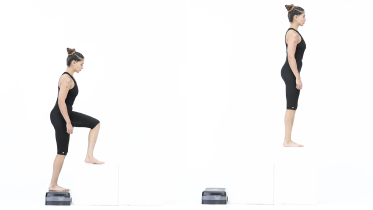 Stair climbing
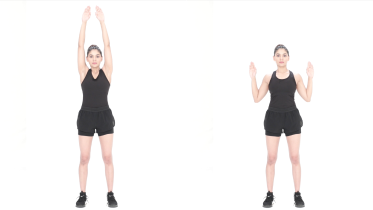 Lat pulldown
Sarcopenia alongside another condition
Most people with this diagnosis have something else going on, and a few combinations change the plan enough to mention.
Sarcopenia with obesity is common and easy to miss, because the scales look reassuring while strength and function are poor. EWGSOP2 treats it as a separate condition, outside the scope of its own definition, and notes that obesity appears to worsen sarcopenia, increase fat inside the muscle, reduce physical function and raise the risk of dying (Cruz-Jentoft and colleagues, 2019). The training is the same. What changes is that weight loss without resistance training takes muscle along with fat.
That is also the reason this page matters to anyone losing weight quickly on a GLP-1 medicine, and strength training on GLP-1 medicines covers that situation in detail. Never stop or change a prescribed medicine on your own.
A spell in hospital, a course of chemotherapy, a chest infection or a flare of an inflammatory condition can all produce acute sarcopenia within weeks, and the route back is the same route, started from a lower stage. Painful joints are the other common limiter: if an arthritic knee rather than weakness is what stops you, the knee osteoarthritis program is written around that, and the two programs overlap happily. Around the menopause, muscle and bone change at the same time, and muscle and bone loss in menopause covers what is measured and what is assumed.
When to see a physio or doctor
See a physio or your doctor if everyday jobs like getting out of a chair, climbing the stairs or carrying shopping are getting harder, if you feel unsteady, if your appetite or weight has dropped, or if you are not sure which stage suits you. A physio can measure where you are now, which is worth having before you start rather than afterwards, and can set the load and the progression for you. Your doctor can look for the secondary causes above and can arrange the tests that confirm or rule out the diagnosis.
Ask for help sooner rather than later if you are recovering from a hospital stay, because that is the window where muscle is lost fastest and regained most easily. If you have fallen or are worried about falling, say so: a falls service exists for exactly this, and getting up from the floor is worth practicing before you ever need it.
For physiotherapists
Run the EWGSOP2 pathway rather than treating this as general conditioning. Find, assess, confirm, severity: SARC-F or clinical suspicion to find the case; grip strength or a chair stand measure to assess, with either low result giving probable sarcopenia, which EWGSOP2 says is enough to begin treatment and look for causes; low muscle quantity or quality to confirm; and physical performance to grade severity, at a gait speed of 0.8 m/s or less, an SPPB of 8 or less, a Timed Up and Go of 20 s or more, or non-completion of a 400 m walk or 6 minutes or more to complete it (Cruz-Jentoft and colleagues, 2019). The five times chair stand cutoff is over 15 s for five rises. Grip cutoffs and the normative data behind them are set out on the grip strength test page, and the Timed Up and Go tool carries the age norms.
For prescription, ICFSR's strong recommendation for resistance-based physical activity is the anchor, with its conditional recommendation on protein and its no-recommendation positions on vitamin D and anabolic hormones worth quoting to patients who arrive with supplements (Dent 2018). Beckwée 2019 supports a total body approach and reports that 50 percent of 1RM or less produces strength gains while 80 percent is needed for maximal gains, which is a useful frame for a patient who cannot yet tolerate heavy loading. The NSCA position statement gives the fuller periodized target of 2 to 3 sets of 1 to 2 multijoint exercises per major muscle group at 70 to 85 percent of 1RM, 2 to 3 times a week, plus power work at 40 to 60 percent, and says low intensity, low volume programs are the appropriate starting point for people with frailty or cardiovascular disease, with its own frailty section starting at 20 to 30 percent of 1RM and progressing upward (Fragala 2019). Power training deserves attention in this group, since rate of force development falls faster than maximal strength and is what a chair rise and a trip recovery actually demand.
Retest strength and performance rather than relying on self-report, because the acute and chronic distinction in EWGSOP2 is built on repeat measurement. And screen nutrition and weight actively: inadequate energy or protein intake is a named cause, not a comorbidity, and a referral to a dietitian belongs in the plan rather than at the end of it.
Warning signs
Get emergency help now
- Emergency: if chest pain, pressure or tightness does not ease quickly when you rest, spreads to your arm, neck, jaw, stomach or back, or comes with sweating, feeling sick, feeling light-headed or being short of breath, call emergency services straight away, as this can be a heart attack. If it eases quickly and none of these happen, get medical advice the same day, and do not exercise again until you have been checked.
- Emergency: any sign of a stroke, even if it goes away. That means a face that droops on one side, an arm you cannot lift or keep up, slurred or muddled speech, weakness or numbness on one side of your body or face, sudden blurred vision, double vision or loss of sight, trouble swallowing, sudden dizziness with unsteadiness or falling over, a sudden severe headache, or a sudden fall where your legs give way but you do not black out (a drop attack). Call emergency services straight away.
- Emergency: a racing, pounding, fluttering or irregular heartbeat that does not settle when you rest, or that comes with dizziness, feeling faint or fainting, chest pain or shortness of breath. Call emergency services straight away. If it has already stopped, get medical advice the same day.
- Emergency: you have just fallen and cannot get up, or you think you may have hurt your head, neck, back or hip. Stay where you are, keep warm and call emergency services, or get someone to call for you. If you got up and walked without trouble and only notice pain later, use the same-day lines in this list instead.
- Emergency: you fell and cannot remember the fall or how it happened. Go to an emergency department straight away, and do not drive yourself. You may have blacked out or hit your head without knowing it.
- Emergency: after a knock to the head, being very drowsy or finding it hard to keep your eyes open, confusion, a fit (seizure), new weakness or numbness anywhere in your body, new trouble understanding, speaking, walking or keeping your balance, new problems seeing or hearing, clear fluid coming from your ears or nose, bleeding from your ears or bruising behind them, a black eye when your eye was not hit, a dent in your head or a wound with something stuck in it, or a change in behavior. Call emergency services straight away. These can be signs of an injury to the brain.
- Emergency: after a knock to the head, you were knocked out, even for a moment, you cannot remember what happened just before or after, you have had a headache ever since, or you are being sick (vomiting). The same applies, even if you feel fine, if you take medicine that thins your blood, other than aspirin on its own, have a bleeding or clotting condition, have had brain surgery in the past, or had been drinking alcohol or taking drugs when it happened. Go to an emergency department straight away, and do not drive yourself.
- Emergency: after a knock to the head, swelling, a deep cut or severe pain at the exact spot that was hit. Call emergency services or go to an emergency department straight away, and do not drive yourself. These can be signs of a broken skull.
- Emergency: you have had a fall or an injury and now have severe hip pain, or you cannot walk or put weight on the leg. Call emergency services or go to an emergency department. This can be a sign of a broken hip (hip fracture).
- Emergency: you have had a hip replacement and have sudden severe pain in your hip or groin, sometimes with a clunk or pop, and you cannot move the leg or put weight on it, or the leg suddenly looks shorter or turned in or out. Do not try to walk on it or push it back into place. Keep still and call emergency services or go to an emergency department, and do not drive yourself. Your new hip may have come out of its socket (dislocated), and a medical team needs to put it back.
- Emergency: after a fall or a knock, a wrist, hand or arm that has changed shape or sits at an odd angle, that goes numb, tingles or has pins and needles, that turns pale, blue or cold, that has a bone showing through the skin, or that has a cut bleeding heavily. Go to an emergency department straight away, or call emergency services, and do not drive yourself. Do not try to straighten the arm or push the bone back yourself.
- Emergency: new neck or back pain after a fall, a knock or a jolt, even a minor one such as a trip or a sudden stop in a car, if you have a condition that stiffens the spine, such as ankylosing spondylitis. Call emergency services or go to an emergency department straight away, do not drive yourself, and tell the staff about your spine condition, so they keep your neck and back in their usual position. A stiff spine can break after a small injury, and the break is easy to miss at first. If the pain started straight after the injury, or you also have numbness, tingling or weakness in your arms or legs, keep still and call emergency services.
- Emergency: sudden, severe pain in your lower back or tummy that is not like your usual back pain, if you have been told you have a swelling of the main blood vessel in your tummy (abdominal aortic aneurysm), you are over 60, you smoke or used to smoke, or you have high blood pressure. The same applies if sudden, severe back or tummy pain comes with feeling faint or passing out, pale, sweaty or clammy skin, a racing heartbeat or being short of breath. Call emergency services straight away. This can be a sign of an aneurysm bursting, which needs treatment in hospital at once.
- Emergency: you, or the person you care for, suddenly collapse, faint or nearly faint, and any of these is still there after a few minutes of lying down: feeling faint, looking pale or gray, cold, sweaty or clammy skin, a racing heartbeat, shortness of breath, or being muddled or much drowsier than usual. Call emergency services straight away, even if there is no pain. Conditions that affect the nerves or the brain can make pain in the chest, back or tummy hard to feel or to describe, so a heart attack, a burst blood vessel or bleeding inside the body may show only in this way.
- Emergency: severe neck pain after a knock to the head, whatever the fall or the knock was like. Keep still and call emergency services, and do not let anyone move you until someone trained has checked your neck. If the neck pain only starts later and nobody has checked your neck since, go to an emergency department straight away, and do not drive yourself.
Get help today
- Same day: after a fall or a knock, a wrist, hand or arm that is very painful, that you cannot use because of the pain, that is badly swollen or bruised, or that is very stiff or hard to move, with no change of shape, no numbness or tingling, no pale, blue or cold skin, no bone showing and no cut that is bleeding heavily. Get it checked the same day at an urgent care center or an emergency department, and do not exercise that arm until it has been seen. A fall onto an outstretched hand often breaks a bone near the wrist, and an X-ray is the only way to be sure.
- Same day: you blacked out or fainted, even for a moment. Get medical advice the same day. Call emergency services instead if the person is not breathing, cannot be woken within 1 minute, has not fully recovered or has trouble speaking or moving, has chest pain or a pounding, fluttering or irregular heartbeat, fainted while exercising or lying down, is shaking or jerking, or was badly hurt.
- Same day: dizziness, lightheadedness, blurred vision or feeling faint when you stand up that is new for you, does not pass within a minute or two, keeps happening, or has made you fall. Sit or lie down, and get medical advice the same day. This can be a drop in blood pressure on standing (postural hypotension), a type of low blood pressure, which the NHS lists among the causes of falls, and your doctor can check it. Tell them about your medicines, because some can cause it. If it does not settle within a few minutes of sitting or lying still, call emergency services. If you faint, use the fainting line above.
- Same day: dizziness or feeling faint during or after exercise, other than the brief lightheadedness as you stand up covered in the line above, without any of the emergency signs above. Stop the exercises and get medical advice the same day. If you faint, it does not settle within a few minutes of sitting still, or you cannot stand or walk steadily, call emergency services.
- Same day: after a fall, you are in pain, have hurt yourself or feel unwell, or you were on the floor for an hour or more, without any of the emergency signs above. Get medical advice the same day, even if you managed to get up.
- Same day: a calf or thigh that is newly swollen or getting more swollen, warm, tender, red or darker than usual, has swollen veins that are sore to touch, or has a throbbing or cramping pain that does not fit your injury or condition, or that feels different from normal muscle soreness after exercise. This can be a sign of a blood clot (deep vein thrombosis), especially after surgery, an injury, time in a cast or boot, a long trip or a spell of being much less mobile than usual. Get medical advice the same day. If you are also short of breath or have chest pain, call emergency services.
- Same day: new hip or groin pain after a fall, even a small one, if you are older, have low bone density (osteoporosis) or have taken steroid tablets for a long time, even if you can still walk. Get medical advice the same day. A broken hip is not always obvious at first.
- Same day: since an operation, the wound is red, hot, swollen, leaking fluid or opening up, you have a fever or feel hot and shivery, or the pain in that area is new or getting worse quickly. Contact your surgical team or the ward you went home from the same day rather than waiting for your physio appointment, and if you cannot reach them, go to an emergency department the same day. This can be an infection in the wound or deeper, around a repair or a new joint.
- Same day: you have had a hip replacement and, after a fall or a knock, even a small one, your hip, groin or thigh is newly painful, bruised or swollen, even if you can still walk and your leg looks normal. Stop the exercises, go back to your crutches or frame and keep your full weight off that leg, and contact your surgical team or get medical advice the same day. A break in the bone around a new hip is not always obvious at first, and walking normally on one can move the broken ends apart.
- Same day: you have had a hip replacement and your hip clunks and feels as if it partly slipped out of place and went back, even if it settles straight away and your leg looks normal. Stop the exercises, avoid the movement that brought it on, go back to your crutches or frame, and keep away from deep bending, crossing your legs and twisting on that leg until you have been seen. Contact your surgical team or get medical advice the same day. If the leg then looks shorter or turned, or you cannot move it or put weight on it, call emergency services.
- Same day: back pain after a minor fall or strain if you are older, have low bone density (osteoporosis) or have taken steroid tablets for a long time. Get medical advice the same day. Until it has been checked, stop the exercises and keep away from lifting, bending forward and twisting, because those load a bone in the spine that may be broken.
- Neck pain after a car accident or a fall, even a minor one, if you are 65 or older, have low bone density (osteoporosis) or have taken steroid tablets for a long time. Get your neck checked by a doctor the same day, for example at an emergency department, before you start these exercises. At 65 or older, doctors usually want an X-ray or scan of the neck after an accident.
- Losing weight without trying. If you are being treated for cancer now, contact your cancer team the same day.
- Losing weight without trying. If you also have new back or neck pain, get medical advice the same day.
Book an appointment
- A new fall, even if you were not hurt. If none of the lines above apply, book an appointment with your doctor within a few days and tell your physio before your next session. A doctor can check for causes such as muscle weakness, weak bones or eyesight problems, and may refer you to a falls service.
- Losing weight without trying. See your doctor within a day or two and mention it.
Common questions
What is the main cause of sarcopenia?
Aging on its own is enough, and that is what EWGSOP2 calls primary sarcopenia. When something else is adding to it, they call it secondary, and they name three groups of causes: a systemic illness, particularly an inflammatory one such as a cancer or organ failure; physical inactivity, whether from a sedentary life or from being immobile through illness; and not taking in enough energy or protein, for example through a poor appetite, trouble absorbing food, trouble eating or difficulty getting hold of healthy food (Cruz-Jentoft and colleagues, 2019).
Is sarcopenia the same as frailty?
No, although they overlap a great deal and many people have both. Sarcopenia is specifically about muscle: low strength, confirmed by low muscle mass or quality. Frailty is broader, covering things like weight loss, exhaustion, slow walking and low activity across several body systems. EWGSOP2 lists enough protein, vitamin D and physical exercise among the treatment options the two conditions share (Cruz-Jentoft and colleagues, 2019).
What is the best exercise for sarcopenia?
Resistance exercise, done for the whole body rather than for one area. That is the one treatment the international sarcopenia guideline recommends strongly (Dent and colleagues, 2018), and an umbrella review of 14 systematic reviews found high quality evidence that resistance training improves muscle mass, muscle strength and physical performance, recommending a total body approach (Beckwée and colleagues, 2019). Walking and other aerobic activity is worth keeping up for your heart and lungs, but it is not a substitute for lifting something.
Can you build muscle after 70?
Strength, yes, and dependably. A Cochrane review pooled 121 trials of about 6,700 older people and found that strength training which got harder over time had a large effect on muscle strength and a moderate to large effect on getting out of a chair (Liu and Latham, 2009). Size is the slower half: muscle mass does change, but less than strength does and over months rather than weeks. Most of those trials ran 2 to 3 sessions a week for months, which is the honest caveat, and the gains come from where you start rather than from how old you are.
How is sarcopenia diagnosed?
By testing strength first and then confirming it. A doctor or physio measures grip strength or times how long it takes you to stand up from a chair 5 times without using your arms, and a low result on either means probable sarcopenia. A scan showing low muscle quantity or quality confirms the diagnosis, and a slow walking speed or a poor score on a performance test marks it as severe (Cruz-Jentoft and colleagues, 2019). The grip strength test page explains what the numbers mean.
Do protein supplements help sarcopenia?
Less than the marketing suggests. The international guideline makes only a conditional recommendation for protein supplementation or a protein rich diet, because the evidence is weaker than for exercise (Dent and colleagues, 2018), and the umbrella review found that adding nutritional supplements on top of resistance training had limited extra effect on muscle function (Beckwée and colleagues, 2019). An umbrella review of 15 nutrition reviews found leucine had the best supporting evidence and that protein alongside resistance training was worth recommending, while rating the overall quality of evidence as low to moderate (Gielen and colleagues, 2021). How much protein you need depends on you and your kidney health, so that is a question for your doctor or a dietitian.
References
- Cruz-Jentoft AJ, Bahat G, Bauer J, et al. Sarcopenia: revised European consensus on definition and diagnosis (EWGSOP2). Age and Ageing. 2019;48(1):16-31. https://doi.org/10.1093/ageing/afy169
- Dent E, Morley JE, Cruz-Jentoft AJ, et al. International Clinical Practice Guidelines for Sarcopenia (ICFSR): screening, diagnosis and management. Journal of Nutrition, Health and Aging. 2018;22(10):1148-1161. https://doi.org/10.1007/s12603-018-1139-9
- Beckwée D, Delaere A, Aelbrecht S, et al. Exercise interventions for the prevention and treatment of sarcopenia. A systematic umbrella review. Journal of Nutrition, Health and Aging. 2019;23(6):494-502. https://doi.org/10.1007/s12603-019-1196-8
- Gielen E, Beckwée D, Delaere A, et al. Nutritional interventions to improve muscle mass, muscle strength, and physical performance in older people: an umbrella review of systematic reviews and meta-analyses. Nutrition Reviews. 2021;79(2):121-147. https://doi.org/10.1093/nutrit/nuaa011
- Liu CJ, Latham NK. Progressive resistance strength training for improving physical function in older adults. Cochrane Database of Systematic Reviews. 2009;(3):CD002759. https://doi.org/10.1002/14651858.CD002759.pub2
- Fragala MS, Cadore EL, Dorgo S, et al. Resistance training for older adults: position statement from the National Strength and Conditioning Association. Journal of Strength and Conditioning Research. 2019;33(8):2019-2052. https://doi.org/10.1519/JSC.0000000000003230
- Bull FC, Al-Ansari SS, Biddle S, et al. World Health Organization 2020 guidelines on physical activity and sedentary behaviour. British Journal of Sports Medicine. 2020;54(24):1451-1462. https://doi.org/10.1136/bjsports-2020-102955
- UK Chief Medical Officers. UK Chief Medical Officers' physical activity guidelines. Department of Health and Social Care. 2019, updated 10 July 2026. https://www.gov.uk/government/publications/physical-activity-guidelines-uk-chief-medical-officers-report
- NHS. Physical activity guidelines for older adults. https://www.nhs.uk/live-well/exercise/physical-activity-guidelines-older-adults/
- NHS. Malnutrition. https://www.nhs.uk/conditions/malnutrition/
- NHS. Unintentional weight loss. https://www.nhs.uk/symptoms/unintentional-weight-loss/
- NHS. Falls. https://www.nhs.uk/conditions/falls/
- NHS. Head injury and concussion. https://www.nhs.uk/conditions/head-injury-and-concussion/
- National Institute for Health and Care Excellence (NICE). Head injury: assessment and early management. NICE guideline NG232. 2023. https://www.nice.org.uk/guidance/ng232
- NHS. Low blood pressure (hypotension). Page last reviewed 11 July 2023. https://www.nhs.uk/conditions/low-blood-pressure-hypotension/
- NHS. Fainting. https://www.nhs.uk/symptoms/fainting/
- NHS. Symptoms of a stroke. https://www.nhs.uk/conditions/stroke/symptoms/
- NHS. Broken arm or wrist. Page last reviewed 26 May 2023. https://www.nhs.uk/conditions/broken-arm-or-wrist/
- NHS. Deep vein thrombosis (DVT). https://www.nhs.uk/conditions/deep-vein-thrombosis-dvt/
- NHS. Complications of a hip replacement. Page last reviewed 6 March 2024. https://www.nhs.uk/tests-and-treatments/hip-replacement/complications-of-a-hip-replacement/
- NHS. Abdominal aortic aneurysm. https://www.nhs.uk/conditions/abdominal-aortic-aneurysm/
- National Institute for Health and Care Excellence. Abdominal aortic aneurysm: diagnosis and management (NG156). 2020. https://www.nice.org.uk/guidance/ng156
- National Institute for Health and Care Excellence. Transient loss of consciousness ('blackouts') in over 16s (CG109). 2010. https://www.nice.org.uk/guidance/cg109
Written and checked by the PocketPhysio editorial team. Last updated 2026-10-24.
This page is general education, not a diagnosis or a personal treatment plan. See a physiotherapist or doctor for advice about your own situation.