Levator scapulae stretch
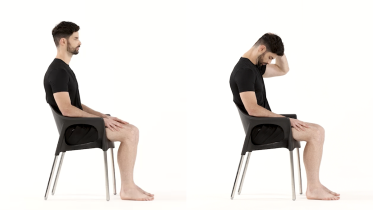
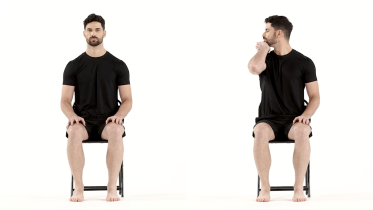
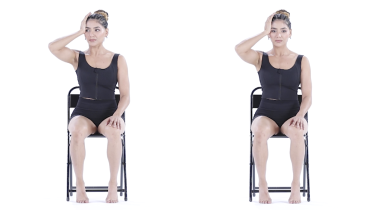
The levator scapulae stretch is for the muscle running from the side of your upper neck to the top inner corner of your shoulder blade (levator scapulae). You sit with one hand tucked behind your back and use the other to guide your head down and diagonally away. It turns up in a lot of programs for a stiff neck and upper shoulder.
How to do the levator scapulae stretch
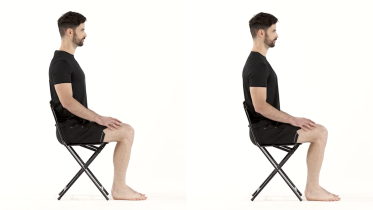
- Sit tall on a chair with your feet flat on the floor.
- Place the hand on the side you want to stretch behind your back, resting it against your lower back. This helps keep that shoulder down.
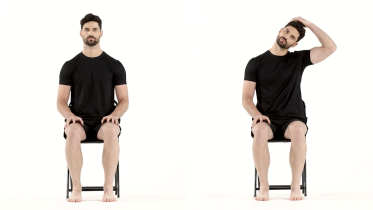
- Lift your other hand over the top of your head and rest it on the back of your head.
- Turn your nose toward the armpit of your free arm, then let the hand gently guide your head forward and down at that angle.
- Stop when you feel a stretch from the base of your skull down toward the shoulder blade, on the side of the arm behind your back. Hold, then slowly lift your head and relax.
What you should feel
A stretch that runs from the back of your head, down the side of your neck and into the top of your shoulder blade, on the side of the hand behind your back.
Common mistakes
- Pulling hard with the hand on your head. It only guides.
- Letting the shoulder on the stretching side lift or roll forward.
- Slumping in the chair, which lets the stretch fade.
How often
A typical plan is a 15 to 30 second hold, 2 to 3 times on each side, once or twice a day. Your physio will tell you if yours should be different.
Stop and check with your physio if
- You feel dizzy, faint or unsteady. Stop and get medical advice the same day. If you faint, it does not settle within a few minutes of sitting still, or you cannot stand or walk steadily, call emergency services.
- Things look double, your vision suddenly blurs or goes, your speech slurs or becomes muddled, swallowing becomes hard, your face or lips go numb, one side of your face droops or one side of your body goes weak or numb, you suddenly become so dizzy or unsteady that you fall or cannot stand or walk, your legs suddenly give way but you do not black out (a drop attack), or you get a sudden severe headache. Stop and call emergency services, even if it goes away.
- Numbness, tingling or pain runs down into the arm or hand.
- It hurts sharply in the neck instead of pulling.
- An electric shock feeling runs down your back or into your arms or legs as your head bends forward. Stop and get medical advice the same day.
From the clinic
The angle is what makes this stretch work. Aim your nose at the opposite armpit, or at the pocket on that side. Straight forward and you will mostly feel the back of the neck. Straight sideways and it turns into the upper trapezius stretch.
Reaching behind your back can be uncomfortable if your shoulder is sore. A common alternative is to hold the edge of the chair seat with that hand instead, which still keeps the shoulder anchored.
After neck surgery or a broken bone in the neck, check with your surgeon or physio before you start. If you have had a recent neck injury, or have been told your upper neck may be unstable (for example with rheumatoid arthritis), ask your physio before using your hand to guide your head. They may want you to skip the hand at first.
Reviewed by the PocketPhysio by VirtueLife expert physiotherapy team. Last reviewed 2026-09-25.
This page is general education, not a diagnosis or a personal treatment plan. If you have pain, an injury or a health condition, see a physiotherapist or doctor before starting new exercises.