Isometric wrist extension
Isometric wrist extension works the muscles on the back of your forearm that lift the hand (wrist extensors), while the wrist itself stays still. You sit at a table with your forearm flat on it and the palm down, rest your other hand on the back of the working hand, and try to lift against it. Physios often use it as the first strengthening step in wrist rehab, for example once a healed fracture is ready for some load. It also turns up in programs for pain on the outer side of the elbow (tennis elbow).
How to do the isometric wrist extension
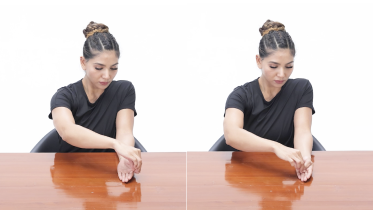
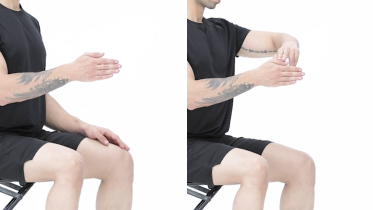
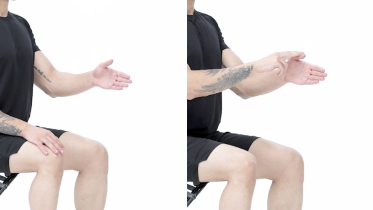
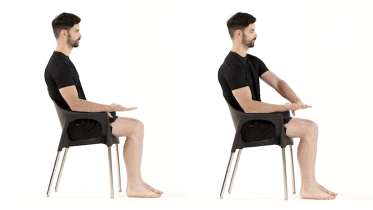
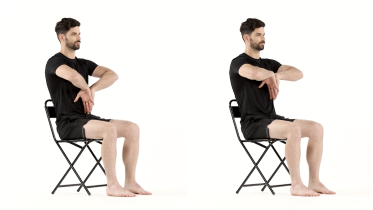
- Sit on a chair at a table with your feet flat on the floor. Rest the forearm of the wrist you are working on the table, palm down, with the hand lying flat.
- Place your other hand across the back of the working hand, just behind the knuckles, as in the video.
- Try to raise the working hand off the table by bending the wrist back. The top hand presses down just enough that the hand does not actually rise.
- Keep the forearm in contact with the table and build the effort up gradually. Hold that steady push for a few seconds and keep breathing.
- Let the effort go slowly, relax both hands for a moment, then go again.
What you should feel
A steady tightening in the muscles along the top of your forearm, below the outer elbow. It should feel like work in the muscle, not pain in the wrist.
Common mistakes
- Letting the working hand lift off the table, which means the top hand is not matching the push.
- Raising the forearm or elbow to help, instead of working from the wrist.
- Clenching the fingers rather than keeping the working hand relaxed and flat.
- Pushing hard straight away instead of building up.
How often
Many programs start with 5 to 10 holds of 5 to 10 seconds, once or twice a day, at a gentle effort that builds over the following days. Your physio will adjust this.
Stop and check with your physio if
- Sharp pain in the wrist or at the outer elbow while you push.
- Your fingers go numb or start to tingle. If one side of your face or body suddenly goes numb or weak, or your speech becomes slurred or muddled, call emergency services, even if it goes away.
- The wrist aches more, or looks more swollen, by that evening or the next morning.
- Since the fracture or cast, the hand is getting more painful rather than less, the skin becomes very sensitive to light touch, or the hand changes color, temperature, swelling or sweating compared with the other one, or looks shiny. See your doctor or physio as soon as you can, within a few days at most, as this can be complex regional pain syndrome (CRPS) and early treatment may help.
From the clinic
The video uses a plain table and chair. A desk works just as well. Keep the push gentle at first, an effort you could hold without straining, and raise it over the next few days only if the wrist stays calm. If you have high blood pressure, breathe steadily through every hold and never hold your breath.
After a broken wrist, hand or forearm, or surgery on any of them such as a tendon repair, start only when your doctor, surgeon, physio or hand therapist says the bone or repair is ready for this, and follow their plan for how much to do. Once these holds feel easy, many programs move on to lifting the hand against light resistance, as in wrist extension with band or wrist extension with weight. The matching hold in the opposite direction is isometric wrist flexion.
Written and checked by the PocketPhysio editorial team. Last updated 2026-09-28.
This page is general education, not a diagnosis or a personal treatment plan. If you have pain, an injury or a health condition, see a physiotherapist or doctor before starting new exercises.