Finger bends around a small ball
Finger bends around a small ball give stiff fingers something to wrap around. Sitting with your elbow bent and the hand held over your lap, you curl the fingers and thumb around a small soft ball, add a light squeeze at the end, then let them open part way again. The app lists it as a range of movement exercise, so the aim is to get the finger joints bending, not to build a hard grip.
How to do the finger bends around a small ball
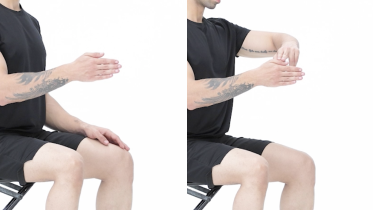
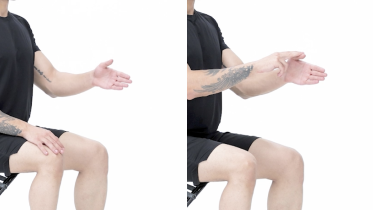
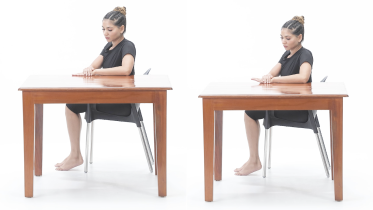
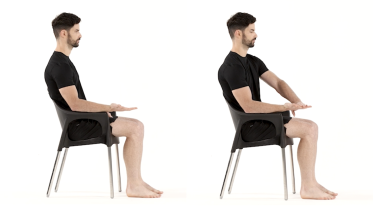
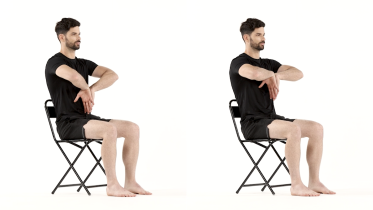
- Sit upright in a chair with your feet on the floor. Bend the elbow of the arm you are working to about a right angle, upper arm by your side, and hold the hand in front of you over your lap, palm facing up and slightly in. Your free hand can rest on your thigh. If the arm tires, you can rest the forearm on your thigh instead.
- Place a small, soft ball in that palm. The video uses a small ball that sits inside the hand, so the fingertips can reach over it.
- Curl all four fingers and the thumb around the ball, bending every finger joint, and give it a light squeeze at the end of the bend.
- Relax your grip so the fingers open part way, leaving the ball resting in your palm, as in the video.
- Keep the pace slow and even, then repeat. If your program covers both hands, do the same on the other side.
What you should feel
Movement through the finger joints, with light work in the palm and along the front of the forearm. Stiff fingers may feel tight as they wrap around the ball, but it should not hurt.
Common mistakes
- Crushing the ball as hard as you can. This is a movement exercise, so a light squeeze at the end is enough.
- Bending only the big knuckles and leaving the fingertips straight.
- Using a ball so large that the fingers cannot wrap over it.
- Curling the wrist in or letting it bend back to help the fingers.
How often
A common starting point is 10 to 15 slow bends, 2 or 3 times a day. Your physio will adjust this.
From the clinic
The ball is a shape to bend around, not something to crush. A small soft one lets the fingertips reach over the top so every joint in the finger has to fold, which is the part that gets lost when fingers have been stiff. A ball that is too big stops the fingers short and turns the exercise into a knuckle bend.
The voice guide says to squeeze and release, and the video does it at an easy pace with the hand held over the lap. If your physio wants grip strength rather than movement, the hand grip squeeze uses a firmer squeeze with a hold, and ball grip and release is done with the hand raised, which suits a swollen hand.
With hand osteoarthritis or rheumatoid arthritis, keep the squeeze very light on days when the finger joints are hot or swollen, and ask your physio what suits you.
Fingers that tingle or go numb at night or when you wake are worth getting checked rather than exercised through. The carpal tunnel syndrome page explains one common cause.
Before you start
- After a broken wrist, hand or forearm, or surgery on any of them such as a tendon repair, start only when your doctor, surgeon, physio or hand therapist says the bone or repair is ready for this, and follow their plan for how much to do.
When to stop and get help
- A sharp pain in the palm, the wrist or any finger joint.
- Numbness or tingling in your fingers as you bend them. If one side of your face or body suddenly goes numb or weak, or your speech becomes slurred or muddled, call emergency services, even if it goes away.
- Your fingers end up puffier, warmer or stiffer than when you started.
- Since the fracture or cast, the hand is getting more painful rather than less, the skin becomes very sensitive to light touch, or the hand changes color, temperature, swelling or sweating compared with the other one, or looks shiny. See your doctor or physio as soon as you can, within a few days at most, as this can be complex regional pain syndrome (CRPS) and early treatment may help.
Written and checked by the PocketPhysio editorial team. Last updated 2026-10-10.
This page is general education, not a diagnosis or a personal treatment plan. If you have pain, an injury or a health condition, see a physiotherapist or doctor before starting new exercises.