Fingers down prayer stretch
The fingers down prayer stretch works on the muscles on the palm side of the forearm that bend the wrist and fingers (wrist and finger flexors). Sitting up, you press your palms together, turn the hands so the fingers point down, then part the palms while the fingertips stay touching and press the bases of the fingers back together. It is a moving stretch, repeated a few times rather than held for long. It is handy when your wrists and fingers feel tight after a long spell of gripping, typing or working with tools.
How to do the fingers down prayer stretch
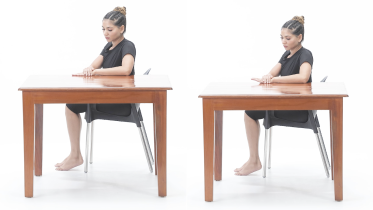
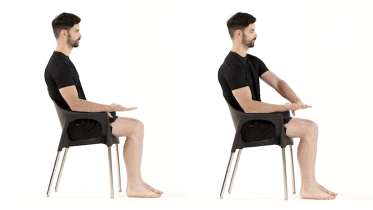
- Sit tall on a chair with both feet flat on the floor.
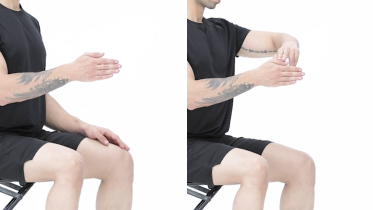
- Press your palms and fingers together in front of your chest, fingers pointing up, as if in prayer.
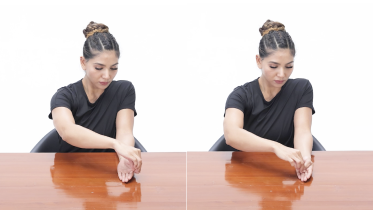
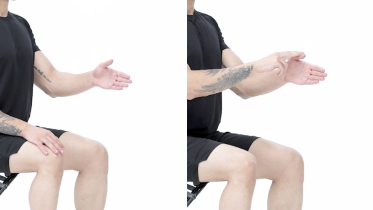
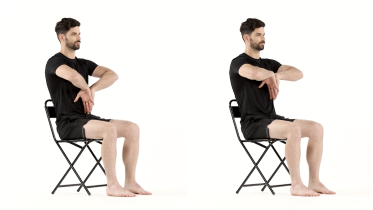
- Keeping the hands together, turn them so the fingers point down toward the floor, with the hands in front of your stomach. Your elbows move out to the sides and your forearms end up close to level.
- Keep your fingertips and thumbs touching and let the palms move apart, spreading the fingers wide.
- With the palms still slightly apart, press the bases of your fingers back together, so the fingers lie flat against each other. You should feel the stretch across the front of your wrists and hands.
- Ease the fingers apart again, then repeat the apart and together movement slowly.
What you should feel
A stretch across the palms, the bases of the fingers and the front of the wrists, sometimes spreading up into the forearms. It should feel like a stretch, not pain.
Common mistakes
- Letting the fingertips come apart, which loses the stretch on the fingers.
- Forcing the finger bases together hard. Press only until you feel a stretch.
- Hunching the shoulders or holding your breath.
- Moving quickly instead of easing in and out of each position.
How often
Many programs use 5 to 10 slow repetitions, pausing for a few seconds in each stretch, 2 or 3 times a day. Your physio will adjust this.
Stop and check with your physio if
- Sharp pain in a wrist, a finger joint or the thumb, rather than a stretch.
- Tingling or numbness in your fingers or thumb as the wrists bend back. If it stays after you stop, or keeps getting worse, get medical advice the same day. If one side of your face or body suddenly goes numb or weak, or your speech becomes slurred or muddled, call emergency services, even if it goes away.
- Pain on the inner side of the elbow that grows with each repetition.
From the clinic
The video and the voice guide match here: palms together, a turn so the fingers point down, then the palms part and the finger bases press back together, a few times in a row. It is a relative of the prayer stretch, where the fingers point up and the elbows lift. The wrist flexor stretch stretches the same muscles one arm at a time. Your physio will say which version suits you.
Bending the wrists back this far can squeeze the nerve at the front of the wrist (the median nerve), which is why tingling is a stop sign on this page. If your hands already tingle or go numb, especially at night, check with your physio before adding this stretch. The carpal tunnel syndrome page covers one common cause.
After a broken wrist, hand or forearm, or surgery on any of them such as a tendon repair, start only when your doctor, surgeon, physio or hand therapist says the bone or repair is ready for this, and follow their plan for how much to do. With a painful or arthritic wrist, or rheumatoid arthritis, start with a smaller range and ask your physio how far to go.
Written and checked by the PocketPhysio editorial team. Last updated 2026-09-28.
This page is general education, not a diagnosis or a personal treatment plan. If you have pain, an injury or a health condition, see a physiotherapist or doctor before starting new exercises.