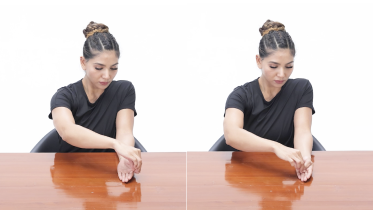
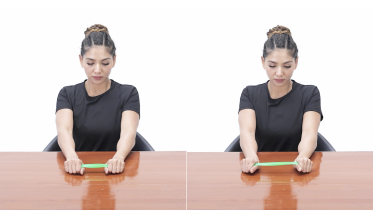
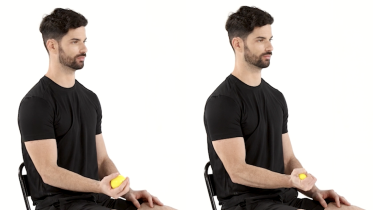
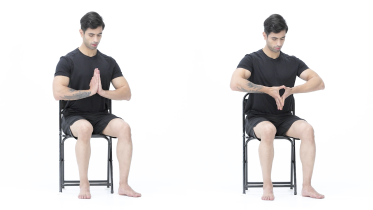
Isometric thumb abduction
Isometric thumb abduction strengthens the muscles that move your thumb away from your index finger, without the thumb actually moving. Sitting on a chair, you hold the thumb of the hand you are working with your other hand, then push the thumb up against that grip, hold, and relax. Moving the thumb away from the index finger is part of spreading your hand wide. Physios often start thumb strengthening this way when moving against resistance is still sore.
How to do the isometric thumb abduction
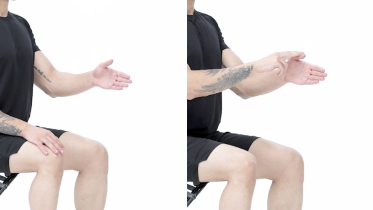
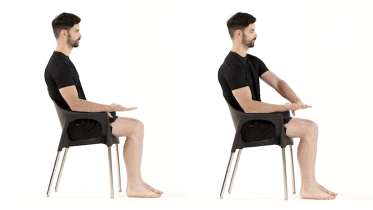
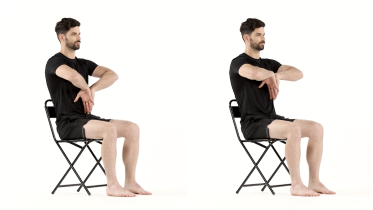
- Sit upright on a chair and bring both hands up in front of your body with the elbows bent, as in the video. Hold the hand you are working with the thumb on top and the palm facing in.
- Keep the fingers of the hand you are working together and relaxed, with the thumb resting alongside the index finger. With the thumb and index finger of your other hand, take hold of the working thumb from above, around its middle joint.
- Try to lift the thumb up, away from your index finger. Your other hand stops it, so the thumb stays where it is.
- Build the push up slowly, hold it steady for a few seconds and keep breathing.
- Ease off gently, rest both hands in your lap for a moment, then repeat.
What you should feel
Effort in the fleshy pad at the base of the thumb and along the thumb side of the wrist. It should feel like firm work, never a sharp pain.
Common mistakes
- Letting the thumb slide out of your grip, so it moves instead of holding.
- Pushing the thumb toward the fingers or bending its tip instead of lifting it away from the index finger.
- Starting with a sudden hard push rather than building up.
- Bending the wrist or lifting the shoulders as you push.
How often
Many programs start with 5 to 10 gentle holds of about 5 seconds, working up toward 10 seconds, once or twice a day. Your physio will adjust this, along with how firmly you push.
Stop and check with your physio if
- Sharp pain at the base of the thumb or on the thumb side of the wrist.
- Numbness or tingling in the thumb, fingers or hand. If one side of your face or body suddenly goes numb or weak, or your speech becomes slurred or muddled, call emergency services, even if it goes away.
- Thumb pain that is clearly worse that evening or the next morning.
- Since the fracture or cast, the hand is getting more painful rather than less, the skin becomes very sensitive to light touch, or the hand changes color, temperature, swelling or sweating compared with the other one, or looks shiny. See your doctor or physio as soon as you can, within a few days at most, as this can be complex regional pain syndrome (CRPS) and early treatment may help.
From the clinic
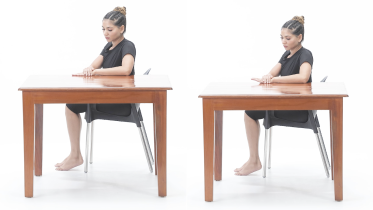
The voice guide describes pressing the side of the thumb against a table while standing beside it. The video is set up differently, sitting on a chair with the other hand holding the thumb still, and the steps on this page are written from the video. Push gently at first. Build up over several days rather than going hard in the first session.
Arthritis at the base of the thumb and de Quervain's tenosynovitis, where the tendons on the thumb side of the wrist are painful, can both be stirred up by pushing against resistance, so ask your physio how hard to press. After a broken wrist, hand or forearm, or surgery on any of them such as a tendon repair, start only when your doctor, surgeon, physio or hand therapist says the bone or repair is ready for this, and follow their plan for how much to do. If you have high blood pressure, breathe steadily through every hold and never hold your breath. For a hold that straightens the thumb instead, see isometric thumb extension, and thumb opposition moves the thumb across to each fingertip.
Written and checked by the PocketPhysio editorial team. Last updated 2026-09-28.
This page is general education, not a diagnosis or a personal treatment plan. If you have pain, an injury or a health condition, see a physiotherapist or doctor before starting new exercises.