Passive wrist flexion
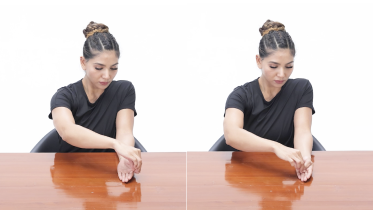
Passive wrist flexion is a stretch in which your other hand bends the wrist down for you. Sitting upright, you lift the arm in front of you with the elbow bent and the palm facing down, place the other hand over the back of it and gently press the hand down until you feel a stretch along the top of the forearm. Passive means the wrist being stretched stays relaxed and lets the other hand move it. Physios often give it for a wrist that has gone stiff after a cast, and as a stretch for tight muscles on the back of the forearm.
How to do the passive wrist flexion
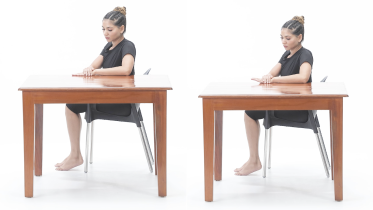
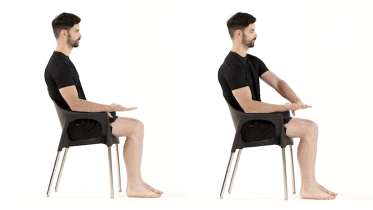
- Sit up tall on a chair, both feet flat on the floor.
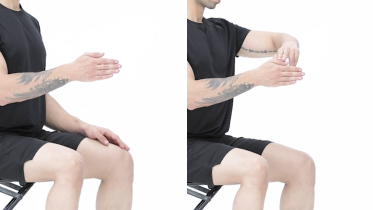
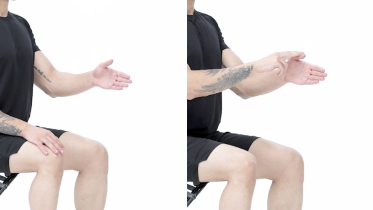
- Lift the arm you want to stretch in front of you with the elbow bent to about a right angle, so the forearm lies across the front of your body at about lower chest height, palm facing down. Let that hand go loose.
- Place the palm of your other hand over the back of the relaxed hand, across the knuckles.
- Gently press the hand down, bending the wrist, until you feel a stretch along the top of the forearm. Keep the arm itself still.
- Hold the stretch and breathe normally, then ease off slowly and lower both arms to rest.
What you should feel
A gentle pull across the back of the wrist and along the top of the forearm, sometimes reaching toward the outer elbow. It should ease a little as you hold, and never turn sharp.
Common mistakes
- Letting the arm sink or the elbow swing down as you press, so the wrist barely bends.
- Pressing hard or bouncing at the end of the stretch.
- Tensing the hand being stretched instead of letting it hang loose.
- Pressing only on the fingers, so they curl but the wrist hardly bends.
How often
Many programs hold each stretch for 15 to 30 seconds, repeated 2 to 4 times, a few times a day. Your physio will adjust this.
Stop and check with your physio if
- Sharp pain in the wrist or at the outer elbow, rather than a stretch.
- Tingling or numbness in your thumb and first fingers while the wrist is bent. If it stays after you stop, or keeps getting worse, get medical advice the same day. If one side of your face or body suddenly goes numb or weak, or your speech becomes slurred or muddled, call emergency services, even if it goes away.
- Since the fracture or cast, the hand is getting more painful rather than less, the skin becomes very sensitive to light touch, or the hand changes color, temperature, swelling or sweating compared with the other one, or looks shiny. See your doctor or physio as soon as you can, within a few days at most, as this can be complex regional pain syndrome (CRPS) and early treatment may help.
From the clinic
The voice guide calls this a stretch for the wrist flexors. Bending the wrist down actually stretches the muscles on the back of the forearm (wrist extensors), the ones that lift the hand, and that is where most people feel it. The video shows one steady hold with the arm raised in front and the elbow bent, so the steps follow that. Straightening the elbow makes the stretch stronger, because these muscles start at the outer side of the elbow. Keep the elbow bent unless your physio has asked you to straighten it.
After a broken wrist, hand or forearm, or surgery on any of them such as a tendon repair, start only when your doctor, surgeon, physio or hand therapist says the bone or repair is ready for this, and follow their plan for how much to do. After a tendon repair on the back of the hand or wrist, bending the wrist down pulls on the repair, so leave this stretch out until your surgeon or hand therapist clears it. After a recent wrist sprain, ask your physio how far to bend before you stretch to the end of the range.
After a broken or dislocated elbow, or elbow surgery such as a tendon repair, follow your surgeon's or physio's plan, and start this exercise only when they have cleared you. If you have just hurt your arm and have severe pain, cannot move the elbow or heard a snap, do not exercise it. Go to an urgent care center or emergency department the same day. If the arm looks a different shape or sits at an odd angle, a bone is showing, or your arm or hand tingles, feels numb or turns cold, pale or blue, go to an emergency department straight away or call emergency services, and do not drive yourself.
To move the wrist down with its own muscles, see seated wrist flexion. The wrist extensor stretch is a standing version that uses a table. If you have tennis elbow and the stretch is sore at the outer elbow, ease off and tell your physio.
Written and checked by the PocketPhysio editorial team. Last updated 2026-09-28.
This page is general education, not a diagnosis or a personal treatment plan. If you have pain, an injury or a health condition, see a physiotherapist or doctor before starting new exercises.