Band ulnar deviation
Band ulnar deviation strengthens the muscles that tip your hand sideways toward the little finger (ulnar deviation). You sit at a table with both forearms resting on it, palms down, and a resistance band held between your hands. Keeping the forearms still, you bend both wrists outward so the hands move apart against the band, then let them come back together slowly. Both wrists work at once. The band is a light load, usually added once the wrist tips this way comfortably without one.
How to do the band ulnar deviation
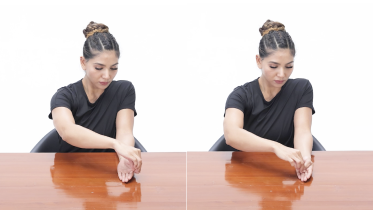
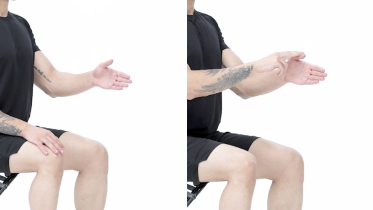
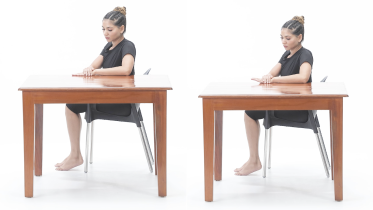
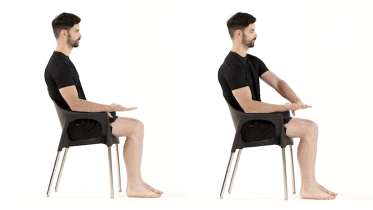
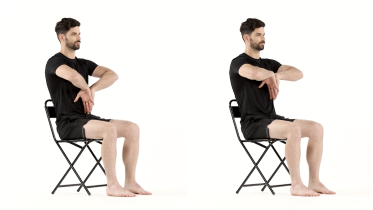
- Sit on a chair at a table and rest both forearms on it, side by side in front of you, with the palms facing down.
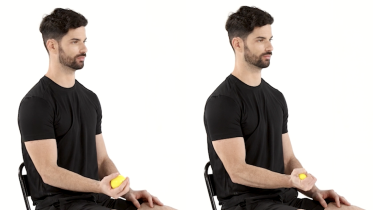
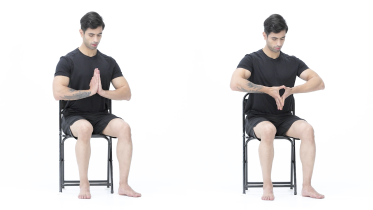
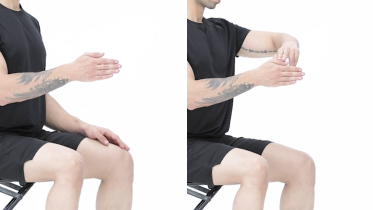
- Hold a light resistance band in loose fists, with the thumb sides of your hands facing each other and a short length of band between them, as in the video. Start with the hands in line with the forearms and a little tension in the band.
- Keeping your forearms flat and still, bend both wrists so the hands tip outward, toward the little finger side. The hands move apart and stretch the band.
- Keep it small. Stop where the wrists still feel comfortable.
- Let the hands come back to the middle slowly, against the pull of the band, and repeat.
What you should feel
Work along the little finger side of both forearms, between the wrist and the elbow. The band pulls hardest at the end of each movement, when the hands are farthest apart.
Common mistakes
- Sliding the forearms or elbows apart instead of bending at the wrists.
- Lifting the forearms off the table or rolling the hands onto their sides.
- Letting the band snap the hands back to the middle.
- Gripping the band much harder than you need to hold it, which stiffens the wrists and shortens the movement.
- Choosing a band so strong that the movement turns jerky.
How often
Start with the lightest band you have. Many programs use 2 or 3 sets of 10 to 15 slow repetitions, most days of the week. Your physio will adjust this.
Stop and check with your physio if
- A sharp pain, click or clunk on the little finger side of either wrist.
- Tingling or numbness in either hand, especially in the ring and little fingers. If it stays after you stop, or keeps getting worse, get medical advice the same day. If one side of your face or body suddenly goes numb or weak, or your speech becomes slurred or muddled, call emergency services, even if it goes away.
- Wrist pain that builds through the day or is worse the following morning.
- Since the fracture or cast, the hand is getting more painful rather than less, the skin becomes very sensitive to light touch, or the hand changes color, temperature, swelling or sweating compared with the other one, or looks shiny. See your doctor or physio as soon as you can, within a few days at most, as this can be complex regional pain syndrome (CRPS) and early treatment may help.
From the clinic
In the video both wrists work together, so each side gets the same load. If one wrist is sore or weaker, you can hold one end of the band still with the other hand, flat on the table, and move only the working hand. More band between the hands makes each pull easier, and a shorter length or a firmer band makes it harder. Check the band for nicks and thin patches before each set, because a band that snaps can flick up toward your face.
Tipping the hand toward the little finger presses on the cartilage and ligaments on that side of the wrist (the triangular fibrocartilage complex, or TFCC). If your pain sits there, check with your physio before you add a band. After a broken wrist, hand or forearm, or surgery on any of them such as a tendon repair, start only when your doctor, surgeon, physio or hand therapist says the bone or repair is ready for this, and follow their plan for how much to do.
Wrist radial and ulnar deviation is the same sideways movement with no band, and isometric ulnar deviation works these muscles while the wrist stays still. For a harder, one-hand version, see wrist ulnar deviation with a dumbbell.
Written and checked by the PocketPhysio editorial team. Last updated 2026-09-28.
This page is general education, not a diagnosis or a personal treatment plan. If you have pain, an injury or a health condition, see a physiotherapist or doctor before starting new exercises.