Wrist flexor stretch
The wrist flexor stretch targets the muscles on the palm side of your forearm, the ones that bend your wrist and curl your fingers (wrist flexors). You hold one arm straight out in front with the palm facing up, then use your other hand to ease the fingers down toward the floor. It often turns up in programs for elbow and wrist problems, and for forearms that feel tight from gripping or typing.
How to do the wrist flexor stretch
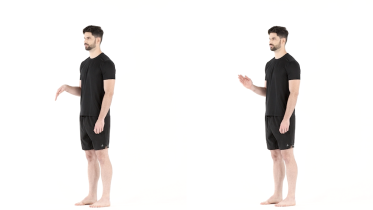
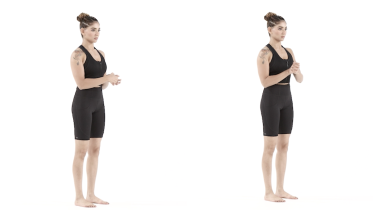
- Stand tall with your arms relaxed by your sides.
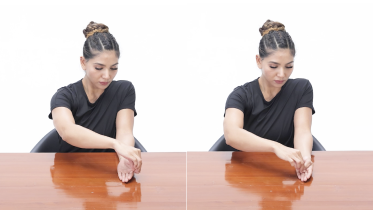
- Lift one arm straight out in front of you to about shoulder height. Keep the elbow straight and turn the palm to face up.
- Take hold of the fingers of that hand with your other hand.
- Gently pull the fingers down and back toward you, so the wrist bends back, until you feel a stretch along the inside of your forearm.
- Hold it while you breathe normally, elbow straight and shoulder relaxed. Then let go slowly, lower the arm and repeat on the other side if both are in your program.
What you should feel
A stretch along the palm side of your forearm, from the wrist toward the inside of the elbow. Some people feel it in the palm and fingers too.
Common mistakes
- Bending the elbow, which takes much of the stretch away.
- Yanking the fingers back hard or bouncing. Ease into the stretch and hold it.
- Hitching the shoulder up toward your ear.
How often
Many programs hold the stretch for about 15 to 30 seconds and repeat it 2 to 4 times, a few times a day. Your physio will adjust this for you.
Stop and check with your physio if
- Numbness, tingling or pins and needles in your hand or fingers. If one side of your face or body suddenly goes numb or weak, or your speech becomes slurred or muddled, call emergency services, even if it goes away.
- Sharp pain in the wrist, thumb or elbow rather than a stretch.
From the clinic
You do not need much force. Most people feel a good stretch well before the wrist is fully bent back. If holding your arm at shoulder height tires your shoulder, the stretch works the same way with the arm a little lower, as long as the elbow stays straight.
If tingling comes on during the stretch, ease off and mention it to your physio, because it can mean a nerve at the wrist or elbow is being irritated rather than a muscle being stretched. After a broken wrist, hand or forearm, or surgery on any of them such as a tendon repair, start only when your doctor, surgeon, physio or hand therapist says the bone or repair is ready for this, and follow their plan for how much to do.
After a broken or dislocated elbow, or elbow surgery such as a tendon repair, follow your surgeon's or physio's plan, and start this exercise only when they have cleared you. If you have just hurt your arm and have severe pain, cannot move the elbow or heard a snap, do not exercise it. Go to an urgent care center or emergency department the same day. If the arm looks a different shape or sits at an odd angle, a bone is showing, or your arm or hand tingles, feels numb or turns cold, pale or blue, go to an emergency department straight away or call emergency services, and do not drive yourself.
Written and checked by the PocketPhysio editorial team. Last updated 2026-09-28.
This page is general education, not a diagnosis or a personal treatment plan. If you have pain, an injury or a health condition, see a physiotherapist or doctor before starting new exercises.