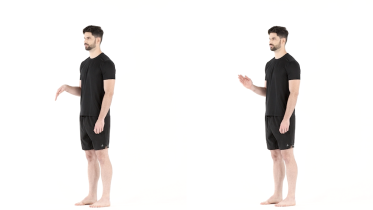
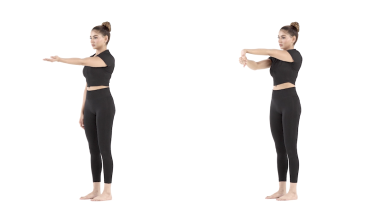
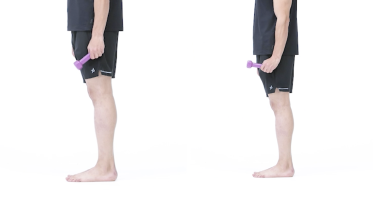
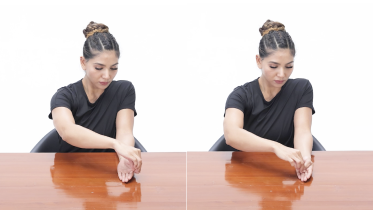
Wrist figure 8
The wrist figure 8 is a gentle mobility exercise for both wrists at once. You stand with your fingers interlaced in front of your waist and draw a slow, smooth figure 8 in the air with your clasped hands, so the wrists bend and turn in every direction. Physios often give it to loosen a stiff wrist, for example in the weeks after a cast comes off, and to practice moving the wrist smoothly again.
How to do the wrist figure 8
- Stand up tall with your feet about hip width apart and your shoulders relaxed, as in the video. If standing is tiring or you feel unsteady, sit upright on a chair instead.
- Bend your elbows and lace your fingers together in front of your waist, elbows close to your sides.
- Slowly draw a figure 8 in the air with your joined hands. Let the wrists do the work, so the forearms stay fairly still.
- Keep the loops smooth and only as big as feels comfortable. Breathe easily as you go.
- After a few loops, trace the figure 8 the other way round.
What you should feel
Easy movement around both wrists, with a light stretch at the edges of each loop. A stiff wrist may feel tight at first and loosen after a few rounds.
Common mistakes
- Swinging the arms from the shoulders instead of moving at the wrists.
- Squeezing the fingers together hard, which makes the wrists stiff.
- Rushing, so the loops turn into small, jerky shapes.
- Letting the stronger wrist do all the moving while the stiff one just goes along.
How often
Many programs use 5 to 10 slow figure 8s in each direction, 2 to 3 times a day. Your physio will adjust this.
Stop and check with your physio if
- Sharp pain in either wrist or in the hand.
- Numbness or tingling in your fingers. If one side of your face or body suddenly goes numb or weak, or your speech becomes slurred or muddled, call emergency services, even if it goes away.
- Your wrist swells up or stays stiffer for hours afterward.
- Since the fracture or cast, the hand is getting more painful rather than less, the skin becomes very sensitive to light touch, or the hand changes color, temperature, swelling or sweating compared with the other one, or looks shiny. See your doctor or physio as soon as you can, within a few days at most, as this can be complex regional pain syndrome (CRPS) and early treatment may help.
From the clinic
Clasping the hands means both wrists move together, which many people find easier than moving a stiff wrist on its own. Keep the figure 8 small to begin with. Once it runs smoothly, let the loops grow a little. Never push into pain to make them bigger.
After a broken wrist, hand or forearm, or surgery on any of them such as a tendon repair, start only when your doctor, surgeon, physio or hand therapist says the bone or repair is ready for this, and follow their plan for how much to do. If you have rheumatoid arthritis, keep the figure 8 small during a flare and check with your physio how much to do. To move one wrist on its own, try wrist circles or wrist flexion and extension.
Written and checked by the PocketPhysio editorial team. Last updated 2026-09-28.
This page is general education, not a diagnosis or a personal treatment plan. If you have pain, an injury or a health condition, see a physiotherapist or doctor before starting new exercises.