
Mallet finger treatment and exercises
What is mallet finger?
A tendon runs along the back of each finger to the bone at the tip, and its job is to straighten the end joint. In a mallet finger this tendon tears, or pulls off a small piece of the bone it attaches to, which is called a mallet fracture or bony mallet (BSSH). The fingertip then droops and you cannot lift it straight on your own, although OrthoInfo notes it will straighten if you push it up with your other hand.
It usually happens when something hits the tip of a straight finger and bends it further than it should go, such as a ball in sport. BSSH says it can also follow a small knock, like catching the finger while tucking in bed sheets. OrthoInfo describes the finger as usually painful, swollen and bruised at first. The same injury can happen to the thumb.
Mallet finger or something else?
A mallet finger follows a knock or jam and the fingertip hangs down straight away. Trigger finger is different: the finger catches, clicks or locks as you bend it, usually without an injury, and it has its own trigger finger program. An end joint that has slowly become stiff, knobbly or bent over months, with no injury, is more likely arthritis, covered in the hand osteoarthritis program.
If you fell onto your hand and the wrist also hurts, have the wrist checked as well. The wrist sprain program explains which wrist signs after a fall need an X-ray.
How is mallet finger treated?
A splint that holds the end joint straight is the usual treatment. BSSH says it is worn continuously for 6 to 8 weeks, or sometimes a shorter period for mallet fractures, and that it is very important the end joint does not bend at all during that time. One NHS hand therapy service uses 6 weeks for a bony mallet and 8 weeks for a tendon-only mallet, then 2 weeks at night only (North Tees and Hartlepool). A review of adult injuries found the same pattern in most studies (Salazar Botero 2016).
The splint comes off only for washing the finger and checking the skin, and only with the fingertip held straight. Rest the finger flat on a table, or support the tip with the pad of your thumb, while the splint is off (CUH). A review describes any bend of the end joint during this time as resetting the injury (Khera 2021), and OrthoInfo says a droop means wearing the splint for longer. Keep rings off that hand until the finger has healed (CUH).
Which splint works best is not clear. A Cochrane review found only four small trials of different splints and could not say that one type beat another. It stressed that the splint must be sturdy enough for daily life and that sticking with it matters (Handoll 2004). In one study of 44 people, those who wore the splint as advised did far better than those who did not (Groth 1994).
For the first day, keep the hand raised and move all the joints except the splinted one (CUH). NHS advice for a broken finger includes an ice pack wrapped in a cloth for 15 to 20 minutes at a time, unless you have chilblains or Raynaud's, and paracetamol (acetaminophen) for the pain. Not sure a painkiller suits you, or pregnant? A pharmacist can check.
Do exercises help mallet finger?
Exercises do not heal the tendon. The splint and time do that. What exercise does is stop the rest of the hand stiffening while one joint is held still, and bring back bending and grip once the splint is off.
A review and a Canadian primary care guide both advise keeping the middle joint of the injured finger moving through the splinting weeks, to prevent stiffness (Khera 2021; Dinh 2026). Studies of how the tendons move show that bending the middle joint does not pull on the healing tendon at the tip, so it no longer needs to be held still (Salazar Botero 2016). None of the sources on this page gives a tested exercise program for after the splint, so the stages below follow their splinting plans rather than trial evidence.
How to use this program
Stage 1 runs through the full-time splint weeks and stage 2 starts only when your doctor or hand therapist says the splint can come off. Stage 3 follows once the night splint has stopped and the fingertip holds straight. This order matters more than any number of repetitions. If you are not sure which stage you are in, stay in the earlier one and ask.
Typical starting amounts look like this. In the splint, open and close the hand slowly 5 to 10 times, 3 to 4 times a day. The two thumb exercises (bending and straightening) are each 2 to 3 sets of 10 slow movements, 2 to 3 times a day. The wrist bends up and down in 2 to 3 sets of 10 to 15, 1 to 3 times a day.
In stage 2, run through the tendon glides 5 to 10 times with a hold of about 3 to 5 seconds in each position, 2 to 4 times a day, and do 5 to 10 rounds of thumb opposition, 2 to 3 times a day. With a mallet finger the hook and full fist positions and the fingertip touches stop where your hand therapist says.
In stage 3 the band and the putty usually begin at 2 to 3 sets of 10 to 15, once or twice a day. The ball starts at 10 to 15 squeezes of about 3 to 5 seconds each, 1 to 3 times a day. Your physio will adjust this. The exercise pages linked below give the range for each one.
The movements you do in the splint should cause no pain. Later on, a mild ache that fades soon after you stop is acceptable, provided the finger is no worse the next morning. Pain matters less than shape here: a fingertip that looks more bent than it did the day before is the sign to watch for.
Night splinting after the day splint stops varies. BSSH says 1 to 2 weeks at night and whenever the finger might be at risk of injury, while OrthoInfo describes 3 to 4 weeks of wearing it less and less. A review notes that one randomized trial found a night splint made no difference to the result (Salazar Botero 2016), but follow the plan your own clinic gives you.
This program is for mallet finger treated in a splint. If you had an operation, such as pinning of the joint, your surgeon's plan comes first, and these stages apply only if they say so. A child or teenager with a fingertip injury should see a doctor first, because in children the injury can involve the growing part of the bone (OrthoInfo). If you are pregnant, ask your midwife or doctor before you start.
The exercise program
Stage 1: In the splint, move everything else
This stage covers the 6 to 8 weeks of full-time splinting. The splint stays on for every exercise, and the end joint of the injured finger stays straight the whole time. Opening and closing the hand bends the middle joint and the big knuckle of the injured finger inside the splint, which keeps them from stiffening. Close the hand only as far as the splint allows, without pressing the fingertip into your palm. The thumb and wrist movements keep the rest of the hand working. If it is your thumb that is injured, keep its splint on for the thumb movements too, so the end joint of the thumb stays straight. If your splint covers the middle joint, or you have a bony mallet, ask your hand therapist which of these to do first. None of this should hurt.
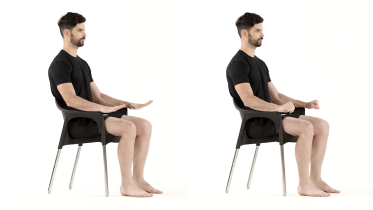 Open and close the hands
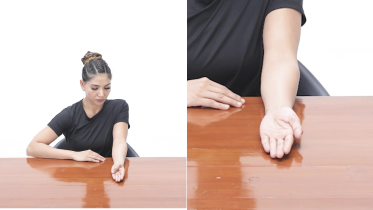 Thumb flexion
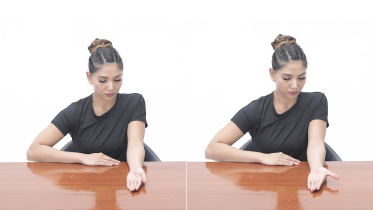 Thumb extension
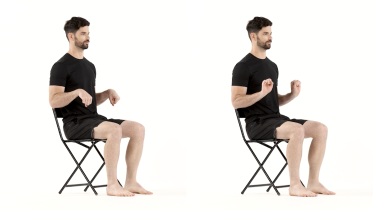 Wrist flexion and extension
Stage 2: Out of the splint, bend the fingertip gently
Start only when your doctor or hand therapist has checked the fingertip and told you it can come out of the splint. Most plans then keep a splint on at night, and for any task or sport where the finger could be knocked, for a few more weeks. The tendon glides and the thumb-to-fingertip touches ask the end joint to bend again, a little more each week. Go only as far as your hand therapist allows, and never push the fingertip down with your other hand. Keep doing the stage 1 movements alongside. If the fingertip starts to droop again, put the splint back on and contact your hand therapist.
 Tendon glides
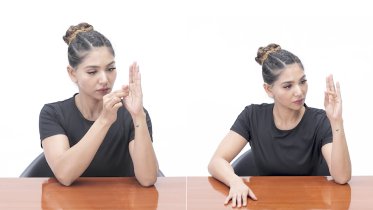 Thumb opposition
Stage 3: Grip and finger strength
Move on when the night splint has stopped, the fingertip still holds straight on its own, and your hand therapist agrees. The rubber band exercise works the muscles that straighten the fingers, the putty spread works the small hand muscles, and the soft ball squeeze brings back grip. Start with the lightest band, the softest putty and a soft ball. Some ache during the work is fine if it eases soon after you finish and the finger feels no worse when you wake up. A fingertip that droops more after this work is a reason to stop and get it checked.
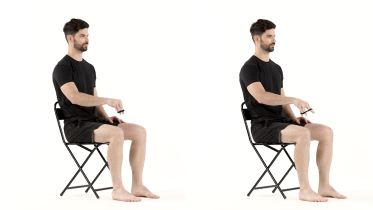 Finger extension with a rubber band
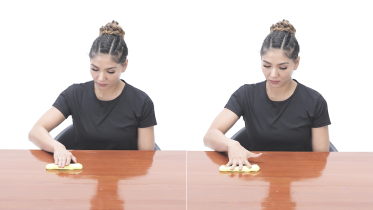 Finger spread with putty
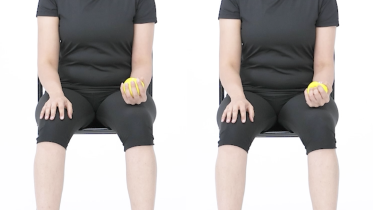 Hand grip squeeze
When does mallet finger need a specialist?
Most do not. Reviews comparing surgery with a splint found similar results for most injuries, with similar complication rates (Lin and Samora 2018; Peng 2023). Surgery is usually considered when a large piece of bone has come off or the joint has slipped out of line, according to OrthoInfo and BSSH. The Canadian guide adds open injuries and fingers that have not healed with a splint to the reasons to see a hand surgeon (Dinh 2026).
OrthoInfo also mentions surgery for people who are unable or unwilling to wear a splint for 8 weeks. Experts do not agree on exactly how large a piece of bone needs an operation (Salazar Botero 2016). An X-ray at the start shows the size of any fragment and whether the joint lines up, so it is worth having one. After surgery, rehab follows your surgeon's plan and is not covered on this page.
Returning to work, sport and daily tasks
Ask your hand therapist which tasks are fine with the splint on. The rule is that nothing may bend the fingertip. Skin problems under the splint, such as soggy, sore or broken skin, are common with this treatment (Salazar Botero 2016), so check the skin each time you change the tape, and keep the finger straight while you dry it. For ball sports or any job where the finger could be knocked, BSSH advises wearing the splint whenever the finger might be at risk, even after full-time splinting ends. Your hand therapist will tell you when it is safe to play without it.
When to see a physio or doctor
See a doctor, urgent care center or minor injuries service soon after any injury that leaves a fingertip drooping. OrthoInfo says most doctors recommend treatment within a week, but an early check means the splint goes on sooner and an X-ray can show whether bone has come off. A hand therapist or physical therapist (physiotherapist) can fit the splint, teach you to change it without the tip bending, and take you through the stages after it. The warning signs below need faster help.
For physiotherapists
The patient program above assumes a closed mallet finger treated in an orthosis. The Canadian primary care guide (Dinh 2026) recommends 6 to 8 weeks of uninterrupted DIP extension splinting with PIP range of motion encouraged. It suggests referral for joint subluxation on X-ray, open injuries and failed conservative care, notes that splinting remains appropriate for large avulsion fragments if joint congruency is kept, and flags Seymour fractures in children as a mimic with a risk of osteomyelitis. It also reports good outcomes with splinting in delayed presentation beyond 4 weeks, and a small persistent extensor lag (mean 11 degrees) in up to 12% of acute and 25% of delayed cases.
Salazar Botero and colleagues (2016) found most studies recommend 6 weeks for bony and 8 weeks for tendinous injuries, and report that PIP mobilization does not move the terminal extensor tendon. They report that a level I study found night splinting did not change the outcome, list skin lesions such as maceration and nail dystrophy as common with conservative care, and note no consensus on the fragment size that needs surgery. Khera and colleagues (2021) describe gradual weaning over about 2 weeks after 6 to 8 weeks of immobilization. Weaning advice differs between patient sources (BSSH 1 to 2 weeks of night wear; OrthoInfo 3 to 4 weeks of reducing wear; North Tees 2 weeks at night).
The Cochrane review (Handoll 2004; four trials, 278 participants, 283 injuries) found insufficient evidence to choose between splint types and no evidence on when surgery is indicated. Lin and Samora (2018; 44 studies) reported mean DIP extensor lag of 5.7 degrees after surgery and 7.6 degrees after nonsurgical care, with comparable complication rates (14.5% and 12.8%). Peng and colleagues (2023; 13 studies, three of them RCTs) found no high-level evidence that surgery outperforms orthoses for bony or tendinous mallet finger. Groth and colleagues (1994; 44 patients) reported excellent outcomes in 61.5% of compliant and 9.1% of noncompliant patients.
Screen for open injuries and nail bed involvement, subluxation on the lateral X-ray, a delayed or chronic presentation, and early swan-neck posture. Dose post-orthosis DIP flexion gradually and watch for a returning extensor lag, which usually means going back into the orthosis and reviewing.
See a doctor promptly if
- Emergency: after an injury, a finger or thumb that points at an odd angle, looks blue or feels numb, or has a cut with bone showing or poking out. Go to an emergency department straight away, and do not drive yourself. The finger may be broken.
- Emergency: in the splint or out of it, your fingertip turns blue, white or pale, feels cold or goes numb. Go to an emergency department straight away, and do not drive yourself. The splint or its tape may be too tight, or the blood supply to the fingertip may be affected.
- After an injury to the fingertip, there is blood under the nail, the nail has come loose, or there is a cut over the end joint. Go to an urgent care center or emergency department straight away. These need checking quickly, and an open injury may need a hand specialist.
- Same day: a fingertip that droops after a knock or a jam and has not been checked yet. Get medical advice the same day and ask about an X-ray, as the tendon may have pulled off a piece of bone. Until it is checked, do not test it by bending the fingertip.
- A child or teenager with a fingertip that droops or hurts after an injury should see a doctor the same day, before any splint or exercise.
- The fingertip bent while the splint was off, or the splint came off and you are not sure the tip stayed straight. Put the splint back on with the fingertip straight, and contact your hand therapist or clinic within a day or two. Healing may need to start again, so the splint may be needed for longer.
- The skin under the splint becomes sore, broken, blistered or soggy and white, or the splint is damaged, feels too tight or no longer fits. Contact your hand therapist or clinic the same day, and keep the fingertip straight on a table whenever the splint is off.
- Since the splint came off, the fingertip has started to droop again or will not straighten on its own. See your hand therapist or doctor within a few days, and wear the splint in the meantime.
- The finger becomes red, hot, swollen and more painful, a cut on it leaks, or you have a high temperature or feel hot, cold or shivery. Get medical advice the same day, and go to an emergency department if you feel very unwell. If you have a very high or very low temperature, shivering you cannot control, you are breathing very fast or finding it hard to breathe, you are confused or your speech is slurred, your skin, lips or tongue look blue, gray, pale or blotchy (on brown or black skin this can be easier to see on the palms of the hands or soles of the feet), or you have a rash that does not fade when you press it, call emergency services, as this can be sepsis.
- Since an operation on the finger, your wound becomes more red, hot, swollen or painful, or starts to leak. Contact your medical team the same day.
- The pain is there at night or at rest and keeps getting worse. See your doctor within a few days. If you have had cancer, now or in the past, or are losing weight without trying, see your doctor sooner, within a day or two, and mention it. This applies even if the pain is not getting worse. If you are being treated for cancer now, contact your cancer team the same day.
Common questions
How long does mallet finger take to heal?
Most plans use 6 to 8 weeks in a splint worn day and night, then a few more weeks of wearing it at night. UK hand surgeons say 1 to 2 weeks at night (BSSH), and OrthoInfo describes 3 to 4 weeks of wearing it less and less, perhaps only at night. One NHS hand therapy leaflet puts the whole recovery at about 12 weeks (North Tees and Hartlepool). BSSH adds that some redness, swelling and tenderness over the joint can last 3 or 4 months after the injury.
What happens if I bend my finger while it is in the splint?
Bending the end joint during the splinting weeks can undo the healing. OrthoInfo says that if the fingertip droops at all, healing is disrupted and you will need to wear the splint for longer, and a review describes a bend as resetting the injury (Khera 2021). If it happens, put the splint back on with the fingertip straight and tell your hand therapist or clinic within a day or two. They will tell you how long to add.
Can I take the splint off to wash?
Usually yes, but only in a careful way. Rest the finger flat on a table or support the fingertip with the pad of your thumb, so the end joint stays straight the whole time the splint is off (CUH; North Tees and Hartlepool). Many clinics show you how to do this and how often. If you cannot keep the tip straight on your own, ask someone to help, or leave the splint on.
Is it too late to treat mallet finger after a few weeks?
Often not. OrthoInfo says most doctors recommend treatment within a week of the injury, but describes cases treated up to a month later that still healed completely. A Canadian primary care guide says splinting can still give good results in people who come in more than 4 weeks after the injury (Dinh 2026). Get it checked as soon as you can rather than waiting.
Do I need surgery for mallet finger?
Most people do not. Reviews comparing surgery with a splint found similar results for most injuries (Lin and Samora 2018; Peng 2023). Surgery is considered when a large piece of bone has come off, the joint has slipped out of line, the injury is an open wound, or a splint is not possible for you (OrthoInfo; Dinh 2026). If that applies to you, a hand surgeon will go through the options.
Will my finger be completely straight again?
For most people it works normally again. BSSH says most injuries treated with a splint heal well, though some people are left with a slight loss of full straightening at the fingertip. A Canadian guide reports that a small droop can remain in some people, more often when treatment started late (Dinh 2026). Wearing the splint exactly as advised matters most: in one study, people who did so had far better results than those who did not (Groth 1994).
References
- British Society for Surgery of the Hand. Mallet finger injury. Patient information. https://www.bssh.ac.uk/patients/conditions/28/mallet_finger_injury
- American Academy of Orthopaedic Surgeons. Mallet finger (baseball finger). OrthoInfo. https://www.orthoinfo.org/en/diseases--conditions/mallet-finger-baseball-finger/
- Cambridge University Hospitals NHS Foundation Trust. Mallet finger. Patient information, version 5, approved 7 January 2026. https://www.cuh.nhs.uk/patient-information/mallet-finger/
- North Tees and Hartlepool NHS Foundation Trust. Hand therapy: mallet finger injury. Patient leaflet PIL1121, review date January 2027. https://www.nth.nhs.uk/resources/hand-therapy-mallet-finger/
- Dinh V, Market M, Cheung K. Approach to mallet finger injury: practical guide for Canadian primary care physicians. Canadian Family Physician. 2026;72(2):93-97. https://doi.org/10.46747/cfp.720293
- Handoll HH, Vaghela MV. Interventions for treating mallet finger injuries. Cochrane Database of Systematic Reviews. 2004;(3):CD004574. https://doi.org/10.1002/14651858.CD004574.pub2
- Salazar Botero S, Hidalgo Diaz JJ, Benaïda A, Collon S, Facca S, Liverneaux PA. Review of acute traumatic closed mallet finger injuries in adults. Archives of Plastic Surgery. 2016;43(2):134-144. https://doi.org/10.5999/aps.2016.43.2.134
- Khera B, Chang C, Bhat W. An overview of mallet finger injuries. Acta Biomedica. 2021;92(5):e2021246. https://doi.org/10.23750/abm.v92i5.11731
- Lin JS, Samora JB. Surgical and nonsurgical management of mallet finger: a systematic review. Journal of Hand Surgery (American Volume). 2018;43(2):146-163.e2. https://doi.org/10.1016/j.jhsa.2017.10.004
- Peng C, Huang RW, Chen SH, Hsu CC, Lin CH, Lin YT, Lee CH. Comparative outcomes between surgical treatment and orthosis splint for mallet finger: a systematic review and meta-analysis. Journal of Plastic Surgery and Hand Surgery. 2023;57(1-6):54-63. https://doi.org/10.1080/2000656X.2022.2164291
- Groth GN, Wilder DM, Young VL. The impact of compliance on the rehabilitation of patients with mallet finger injuries. Journal of Hand Therapy. 1994;7(1):21-24. https://doi.org/10.1016/S0894-1130(12)80037-8
- NHS. Broken finger. Page last reviewed 20 November 2025. https://www.nhs.uk/conditions/broken-finger/
- NHS. Sepsis. Page last reviewed 14 May 2026. https://www.nhs.uk/conditions/sepsis/
Written and checked by the PocketPhysio editorial team. Last updated 2026-09-28.
This page is general education, not a diagnosis or a personal treatment plan. See a physiotherapist or doctor for advice about your own situation.