
Pain at the base of the thumb: causes, exercises and what helps
Where the pain sits
Put one fingertip on the sorest spot before you read any further. Thumb base pain sorts itself over a very short distance, so where that fingertip lands already tells you something.
The joint itself lies at the fleshy base of the thumb, where the thumb column meets the wrist. Its name is the carpometacarpal joint, usually shortened to CMC. Press there and you are on joint and bone, and OrthoInfo describes pain in that spot with gripping, pinching or turning activities such as turning a key or opening a jar.
Now slide the fingertip toward the forearm, onto the thumb side of the wrist. You are over two tendons instead, the ones that take the thumb out to the side and straighten it, and they are the pair involved in De Quervain's tenosynovitis. The British Society for Surgery of the Hand names lifting the thumb, as in a hitchhiker's sign, and using scissors as classic triggers.
One more landmark is worth finding. Give a thumbs-up and a small hollow appears at the base of the thumb between two tight cords: the anatomical snuffbox. Tenderness there after a fall onto the hand is the finding that changes what happens next, and it has its own line in the warning signs below.
What causes pain at the base of the thumb?
Read what follows as patterns, not labels. Naming one takes an examination, and sometimes an X-ray, so use this to describe your thumb to a clinician, not to settle the question at home.
Arthritis of the thumb base
The usual reason for a thumb base that has hurt for months without an injury. Cartilage in the CMC joint wears thin, and OrthoInfo describes gradual pain, weakness, swelling and loss of movement in that joint, brought on by the same pinching and turning tasks. The NHS lists the thumb base among the three places hand osteoarthritis usually shows up and says it can make writing, opening jars and turning keys hard. A UK review describes flares that last a few days, often after heavy use, and reports that many people improve over 2 to 5 years (Watt and colleagues, 2025). The hand osteoarthritis program covers the whole hand, thumb base included.
De Quervain's tenosynovitis
Higher up, and more of a catching, pulling pain than a deep ache. The two thumb tendons share a narrow tunnel on the thumb side of the wrist, and in De Quervain's they no longer fit well or glide freely inside it (OrthoInfo). Lifting a kettle, wringing out a cloth and tipping the wrist toward the little finger are the movements people report, and the sore spot is usually tender to touch and sometimes a little swollen. OrthoInfo links it with pregnancy, the weeks after having a baby and rheumatoid arthritis, and BSSH says mothers of small babies seem particularly prone to it. The De Quervain's tenosynovitis program goes through splints, injections, lifting a baby and what exercise can and cannot do here.
A broken bone after a fall onto the hand
This one carries a different urgency, so read it even if your thumb feels only mildly sore. OrthoInfo says a scaphoid fracture usually happens when you fall onto an outstretched hand with your weight landing on the palm, and that the symptoms often sit in the anatomic snuffbox at the base of the thumb. It adds that with some scaphoid fractures the pain is not severe and may be mistaken for a wrist sprain.
Imaging is the catch. A scaphoid break does not always show on the first X-ray, so a doctor who still suspects one may splint or cast the wrist for 2 to 3 weeks and X-ray it again. Missing it matters, because this bone has a poor blood supply and a missed break can fail to heal.
A sprained thumb ligament
This is a fall story too, usually a louder one. OrthoInfo describes a sprained thumb as an injury to the ligament on the inside of the joint where the thumb meets the palm, caused by force that bends the thumb backward away from the palm, most commonly a fall onto an outstretched hand. It is nicknamed skier's thumb, because a hand strapped to a ski pole is a common way to do it. The clues are bruising, tenderness and swelling around the base of the thumb near the palm, a joint that feels loose or unstable, and trouble grasping something between thumb and index finger. OrthoInfo advises seeing a doctor if pain and swelling continue for more than 48 hours, and says even a mild thumb sprain should be evaluated if it does not improve quickly.
Pain referred from a nerve or the neck
Not everything felt at the thumb base starts there. The median nerve carries feeling from the thumb, index and middle fingers. Squeeze it at the wrist and the symptoms turn up in the hand, not at the point of pressure, which is what the carpal tunnel syndrome program is about. Tingling and numbness, plus a hand that wakes you at night, fit the nerve better than the joint or the tendons. Pain traveling down from the neck can also land in the thumb, which is why a physio checks neck movements and nerve tests even when the complaint sounds purely local.
A thumb that clicks or locks
Keep this one separate, because the treatment is its own. A thumb that clicks, catches or locks as it bends, often with a tender nodule in the palm at the base of the thumb, fits trigger finger, which turns up in the thumb often enough that trigger thumb is a name in its own right.
What helps at home
Adjust the load before you adjust anything else. Joint protection means taking force off the joints in everyday tasks, not resting the hand (Watt and colleagues, 2025). Use both hands for heavy jobs, a jar opener or key turner in place of a tight pinch, and thicker handles on pens, cutlery or garden tools. On a long job such as gardening or chopping, take your breaks before the thumb complains, not after.
The other standard step is a splint, and the guidelines do not agree about it. The American College of Rheumatology strongly recommends a hand orthosis for arthritis at the base of the thumb (Kolasinski and colleagues, 2020). NICE advises against offering splints and supports as routine unless a joint is unstable or loaded unevenly, exercise alone is not enough, and the splint is likely to help you move and use the joint better (NG226). Both can be right, for different thumbs, so have one fitted by a physio or hand therapist and judge it by what it does for your hand. For De Quervain's the splint is a different shape, because BSSH says it has to hold the thumb still as well as the wrist.
Medicines and warmth are comfort measures, not repairs. The European recommendations for hand osteoarthritis prefer treatments rubbed on the skin, with anti-inflammatory gels as the first choice, over tablets (Kloppenburg and colleagues, 2019). Soaking the hands in warm, not hot, water suits some people before they move them, although the review that describes it puts the idea behind warmth as a theory rather than a tested treatment (Watt and colleagues, 2025). Ask a pharmacist whether a medicine suits you, and say so if you are pregnant or breastfeeding, because that changes the answer.
Exercises for pain at the base of the thumb
Gentle movement is where both common causes start, though the reasons differ. In hand osteoarthritis a Cochrane review found that exercise eased pain and stiffness and helped hand function, all by small amounts and on low quality evidence, and the gains had faded by later follow-up (Østerås and colleagues, 2017). For De Quervain's the honest answer is that exercise has barely been tested: a 2026 review of non-surgical treatments called for trials of gradually loading the tendon, because there are none to report (Cuenca-Zaldívar and colleagues, 2026). So the list below keeps the thumb and hand working while the splint, the load changes and time do most of the work.
Mild aching while you work, and for a while afterward, is acceptable, so long as the thumb is no stiffer and no more swollen the next morning. A sharp pain inside a joint means that one comes off the list for today. Thumb extension travels along the path of the De Quervain's tendons, so ask your physio how far to take it if that is where your pain lives, and keep the ball squeeze well short of your hardest, because forceful gripping flares both problems. Leave out anything that reproduces your pain for now instead of pushing through it. If you have high blood pressure, breathe steadily through every hold and never hold your breath.
If your pain started with a fall, get the thumb and wrist checked before you start any of these. After a broken wrist, hand or forearm, or surgery on any of them such as a tendon repair, start only when your doctor, surgeon, physio or hand therapist says the bone or repair is ready for this, and follow their plan for how much to do. Stretches that tuck the thumb into the fist and bend the wrist toward the little finger are left off this page on purpose, because they pull hard on the sore tendons in De Quervain's.
Exercises that can help
These five keep the thumb and the finger tendons moving and add a light grip, without loading the thumb base hard. Common starting points are 5 to 10 rounds of the thumb touches, 2 to 3 times a day, and 5 to 10 runs through the tendon glides, holding each shape for about 3 to 5 seconds, 2 to 4 times a day. Thumb bending and thumb extension usually start at 2 to 3 sets of 10 slow repetitions, and the soft ball at 10 to 15 squeezes held for 3 to 5 seconds. Each exercise page gives its own numbers and how often to do them, and your physio will adjust this.
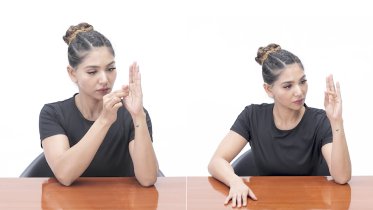 Thumb opposition
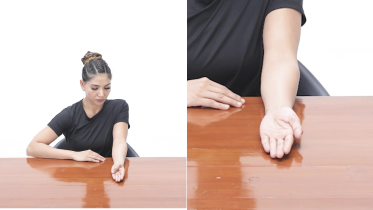 Thumb flexion
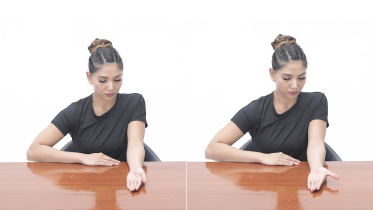 Thumb extension
 Tendon glides
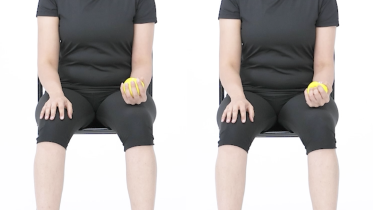 Hand grip squeeze
If several joints in both hands are swollen and stiff for more than half an hour each morning, the picture fits an inflammatory arthritis better, and the rheumatoid arthritis program explains why that needs a doctor rather than a home program.
When to see a physio (physical therapist)
Book an assessment if the pain has not eased after a few weeks of changing what you do, if pinch or grip is getting weaker, or if you cannot tell which of the causes above fits. Anything that began with a fall goes faster than that, as the warning signs explain.
A physio or hand therapist mostly does a sorting job here. They press the joint and the tendons separately, load the thumb in pinch and grip, compare both hands, test the nerves and check your neck, then fit a splint if one suits you and set the exercises to match. NICE says osteoarthritis can be diagnosed without an X-ray in people aged 45 or over whose joint pain comes on with use and whose morning stiffness lasts 30 minutes or less, so a scan is often unnecessary. For De Quervain's that has not settled after about 6 weeks of a well-fitted splint and load changes, the usual next step is a steroid injection. Challoumas and colleagues (2023) rank that ahead of a splint used alone, and a surgical opinion comes later if it does not work.
Related exercise programs
See a doctor promptly if
- Emergency: any sign of a stroke, even if it goes away. That means a face that droops on one side, an arm you cannot lift or keep up, slurred or muddled speech, weakness or numbness on one side of your body or face, sudden blurred vision, double vision or loss of sight, trouble swallowing, sudden dizziness with unsteadiness or falling over, a sudden severe headache, or a sudden fall where your legs give way but you do not black out (a drop attack). Call emergency services straight away.
- Emergency: numbness, tingling or pins and needles in the hand after a fall or injury to the wrist, or a wrist that has changed shape or sits at an odd angle. The same applies to a bone showing through the skin or a cut that is bleeding heavily. Go to an emergency department or call emergency services straight away, and do not drive yourself. The wrist may be broken.
- Emergency: after an injury, a finger or thumb that points at an odd angle, looks blue or feels numb, or has a cut with bone showing or poking out. Go to an emergency department straight away, and do not drive yourself. The finger may be broken.
- Emergency: a finger or thumb that becomes swollen along its length, red, hot and tender, and hurts a lot when you try to straighten it, so you keep it slightly bent, or a palm that becomes red, hot and swollen, especially after a cut, splinter, bite, injection or operation on the hand. Go to an emergency department straight away, and do not wait to see if it settles. An infection in the sheath around the tendon can spread quickly and often needs antibiotics through a drip and an operation.
- Emergency: new problems walking, for example your legs feel stiff, heavy or weak or you have become unsteady on your feet, new trouble controlling your bladder or bowels, or hands that suddenly become clumsy, for example you can no longer do up buttons. Call emergency services straight away. These can be signs of pressure on the spinal cord in the neck.
- Emergency: while you are in a cast or splint, your fingers turn blue, white or pale, or feel cold. Do not wait to see if raising your hand helps. Go to an emergency department straight away, and do not drive yourself. The cast or splint may be cutting off the blood supply, or pressure may be building up inside the forearm (compartment syndrome), and both need checking quickly.
- In a cast or splint, the pain gets worse, your fingers feel numb or tingle or look more swollen, or the cast feels too tight. Stop, raise your hand above your head, keep moving your fingers and contact your fracture clinic or get medical advice straight away. If you cannot move your fingers, the pain is severe even after painkillers, or the numbness, tingling or swelling has not settled within 30 minutes of raising your hand, go to your fracture clinic or an emergency department straight away, and do not drive yourself.
- Same day: after a fall onto your hand, pain, swelling or tenderness on the thumb side of the wrist, especially in the small hollow at the base of the thumb that shows when you give a thumbs-up (the anatomical snuffbox). Get medical advice the same day, even if it feels like a mild sprain, and ask about an X-ray. It can be hard to tell a broken wrist from a bad sprain, and a break in the small wrist bone on the thumb side (scaphoid) does not always show on the first X-ray. If your doctor still suspects one, you may wear a splint or cast and have a repeat X-ray or a scan, so keep that appointment even if the wrist feels better. A missed scaphoid break can fail to heal.
- Same day: a finger or thumb that became painful, swollen, bruised, stiff or hard to move after an injury, rather than slowly over weeks. Get medical advice the same day, and have it checked before you start these exercises.
- Same day: new wrist pain after a fall, even a small one, if you are older, have low bone density (osteoporosis) or have taken steroid tablets for a long time, even if you can still move the wrist. Get medical advice the same day and ask about an X-ray. A broken wrist is not always obvious at first.
- Same day: one finger joint, the base of your thumb or your wrist becomes much more painful, hot, red or swollen than the rest of your hand or than your usual flares, a cyst on the back of a finger bursts or leaks, or you have hand or wrist pain with a high temperature or feel hot, cold or shivery. Get medical advice the same day, and go to an emergency department if you feel very unwell. This can be a sign of infection in the joint or in the sheath around a tendon, which needs treatment quickly. Gout can look much the same as a joint infection, and a doctor needs to tell the two apart. If you have a very high or very low temperature, shivering you cannot control, you are breathing very fast or finding it hard to breathe, you are confused or your speech is slurred, your skin, lips or tongue look blue, gray, pale or blotchy (on brown or black skin this can be easier to see on the palms of the hands or soles of the feet), or you have a rash that does not fade when you press it, call emergency services, as this can be sepsis.
- Same day: numbness or tingling in both hands together with hands that have slowly become clumsy, for example trouble doing up buttons or dropping things. Get medical advice the same day. These can be signs of pressure on the spinal cord in the neck (cervical myelopathy) rather than a problem at the wrist. If the clumsiness or numbness gets worse quickly, call emergency services straight away.
- Within a few days: numbness in the hand that is there all the time, the fleshy muscle at the base of your thumb looks flatter or thinner than on the other hand, or your thumb is getting weaker and you keep dropping things. See a doctor within a few days rather than waiting for it to settle. If the weakness is getting worse from day to day or spreads beyond the thumb, get medical advice the same day. In long-standing cases the nerve can be damaged for good, and surgery may be recommended to prevent that.
- Within a few days: suddenly being unable to straighten the end of your thumb or lift it back, especially in the weeks after a wrist fracture. A thumb tendon can snap, so stop the thumb exercises and have a doctor check it within a few days.
- Within a few days: a finger or thumb that has locked bent and will not straighten, even with gentle help from your other hand. Do not force it. See your doctor within a few days, because a finger that stays stuck is one of the reasons surgery is considered.
- Within a few days: since the injury, the hand is getting more painful rather than less, the skin becomes very sensitive to light touch, or the hand changes color, temperature, swelling or sweating compared with the other one, or looks shiny. See your doctor or physio as soon as you can, within a few days at most, as this can be complex regional pain syndrome (CRPS) and early treatment may help.
- Within a few days: morning stiffness in your hands that lasts longer than 30 minutes, soft, puffy swelling over the big knuckles at the base of the fingers or over the wrists, or painful, swollen joints in your feet as well. This is not an emergency, but see your doctor within a few days, because it can be a sign of an inflammatory arthritis such as rheumatoid arthritis rather than osteoarthritis, and early treatment can stop it getting worse.
- Within a few days: the pain is there at night or at rest and keeps getting worse. See your doctor within a few days. If you have had cancer, now or in the past, or are losing weight without trying, see your doctor sooner, within a day or two, and mention it. This applies even if the pain is not getting worse. If you are being treated for cancer now, contact your cancer team the same day.
- Within a week or two: numbness, tingling or pins and needles in your fingers. Arthritis at the base of the thumb and De Quervain's tenosynovitis do not usually cause these, so see a doctor or physio within a week or two to find the cause, such as a trapped nerve at the wrist (carpal tunnel syndrome).
Common questions
Is pain at the base of my thumb arthritis?
It often is, but the spot and the story decide. Osteoarthritis of the thumb base sits in the joint itself, at the fleshy base of the thumb where it meets the wrist, and OrthoInfo describes it as gradual pain with gripping, pinching or turning activities such as turning a key or opening a jar, sometimes with swelling, weakness or a bump at the joint. If your sore spot is higher, on the thumb side of the wrist, and it catches when you lift the thumb or tip the wrist toward the little finger, De Quervain's tenosynovitis fits better. NICE says that in people aged 45 or over whose joint pain comes on with use and whose morning stiffness lasts 30 minutes or less, osteoarthritis can be diagnosed from the symptoms and an examination without an X-ray. A doctor or physio can also do a grind test, where they press through the thumb and rotate it, which OrthoInfo says brings on pain and sometimes a crunching feeling when the joint is arthritic.
Why does the base of my thumb hurt when I grip, pinch or turn a key?
Because those three tasks squeeze the thumb base harder than almost anything else you do. Pinching sends force down the thumb column into the joint at its base, so a worn joint reports it straight away, which is why OrthoInfo lists turning a key and opening a jar among the usual triggers of thumb base arthritis. Gripping also asks the tendons on the thumb side of the wrist to hold the thumb steady, which is why the same tasks can hurt in De Quervain's, a little higher up. Where the pain lands tells you more than which task caused it. Changing how you do the task usually helps faster than avoiding it: both hands for heavy jars, a gadget for lids and taps, and a whole-hand grip instead of a tight pinch.
Can texting or holding a phone cause thumb pain?
Phone use provokes an irritable thumb more often than it starts one. OrthoInfo lists typing, texting and lifting among the movements that can make De Quervain's tenosynovitis worse, and the British Society for Surgery of the Hand says there is little evidence that work causes the condition, even though using the hand at work, at home or at sport can certainly make it hurt. Many cases appear with no obvious cause at all. If your thumb is sore, the cheap experiment is to swap the phone to the other hand for a week and scroll with a finger instead of the thumb, then see whether anything changes. Short breaks during long gripping jobs work on the same principle.
Why does the base of my thumb hurt after a fall?
A fall onto an outstretched hand is the classic way to break the scaphoid, a small wrist bone on the thumb side, and OrthoInfo says the symptoms often sit in the anatomic snuffbox at the base of the thumb and that the pain is sometimes mild enough to be mistaken for a wrist sprain. That is why this one gets medical advice the same day instead of a wait-and-see week. The same fall can also sprain the ligament on the inside of the joint where the thumb meets the palm, which OrthoInfo describes as swelling and tenderness with bruising around the base of the thumb near the palm, sometimes with a joint that feels loose and a pinch that has lost its strength. A scaphoid break does not always show on the first X-ray, so if a doctor still suspects one you may be splinted and X-rayed again or scanned, and that follow-up appointment matters even if the wrist feels better by then.
How do I relieve pain at the base of the thumb?
Start with the load, not the thumb: take force off the joint in the tasks you repeat most, with two hands on anything heavy, a gadget for jars and keys, and fatter handles where you can get them. That is what joint protection means in practice. A splint is the other common step: the American College of Rheumatology strongly recommends one for arthritis at the base of the thumb, while NICE advises against offering splints routinely unless the joint is unstable or unevenly loaded and exercise alone has not been enough, so it is worth having one fitted and judged instead of bought blind. For medicine, the European recommendations for hand osteoarthritis put anti-inflammatory gels rubbed on the skin ahead of tablets, and a pharmacist can check that any of it suits you. Gentle daily movement for the thumb and fingers sits alongside all of that, and the exercise list on this page is where to start.
What exercises help thumb arthritis and De Quervain's?
Movement comes first for both, and strength later, only for the one you have. Daily, easy movement of the thumb and fingers is what the five exercises on this page cover, and after that the two paths split. Thumb base arthritis moves on to light pinch and grip work with the joint protected, and a Cochrane review found hand exercise eased pain and stiffness and helped function, all by small amounts on low quality evidence, with the gains gone at later follow-up, so it is worth keeping up as a habit. De Quervain's is different: exercise has barely been studied for it, while a splint and a steroid injection are the treatments with research behind them, and reviews put the injection ahead of a splint used on its own. Stretches that tuck the thumb into the fist and bend the wrist toward the little finger pull hard on the sore tendons, so they are usually left out.
References
- American Academy of Orthopaedic Surgeons. Arthritis of the thumb. OrthoInfo. https://www.orthoinfo.org/en/diseases--conditions/arthritis-of-the-thumb/
- American Academy of Orthopaedic Surgeons. De Quervain's tenosynovitis. OrthoInfo. https://www.orthoinfo.org/en/diseases--conditions/de-quervains-tendinosis/
- American Academy of Orthopaedic Surgeons. Scaphoid fracture of the wrist. OrthoInfo. https://www.orthoinfo.org/en/diseases--conditions/scaphoid-fracture-of-the-wrist/
- American Academy of Orthopaedic Surgeons. Sprained thumb. OrthoInfo. https://www.orthoinfo.org/diseases--conditions/sprained-thumb/
- British Society for Surgery of the Hand. De Quervain's syndrome. Patient information. https://www.bssh.ac.uk/patients/conditions/19/de_quervains_syndrome
- Kloppenburg M, Kroon FP, Blanco FJ, et al. 2018 update of the EULAR recommendations for the management of hand osteoarthritis. Annals of the Rheumatic Diseases. 2019;78(1):16-24. https://doi.org/10.1136/annrheumdis-2018-213826
- Kolasinski SL, Neogi T, Hochberg MC, et al. 2019 American College of Rheumatology/Arthritis Foundation guideline for the management of osteoarthritis of the hand, hip, and knee. Arthritis Care and Research. 2020;72(2):149-162. https://doi.org/10.1002/acr.24131
- Østerås N, Kjeken I, Smedslund G, et al. Exercise for hand osteoarthritis. Cochrane Database of Systematic Reviews. 2017;(1):CD010388. https://doi.org/10.1002/14651858.CD010388.pub2
- Watt FE, Kennedy DL, Gardiner MD, Vincent TL. Current and future advances in practice: practical management of hand osteoarthritis. Rheumatology Advances in Practice. 2025;9(4):rkaf093. https://doi.org/10.1093/rap/rkaf093
- Challoumas D, Ramasubbu R, Rooney E, Seymour-Jackson E, Putti A, Millar NL. Management of de Quervain tenosynovitis: a systematic review and network meta-analysis. JAMA Network Open. 2023;6(10):e2337001. https://doi.org/10.1001/jamanetworkopen.2023.37001
- Cuenca-Zaldívar JN, Martínez-Pozas O, Riba E, et al. Conservative treatments for De Quervain's tenosynovitis: a systematic review and network meta-analysis. Journal of Hand Therapy. 2026;39(3):479-495. https://doi.org/10.1016/j.jht.2025.09.001
- National Institute for Health and Care Excellence. Osteoarthritis in over 16s: diagnosis and management (NG226). 2022. https://www.nice.org.uk/guidance/ng226
- NHS. Symptoms: Osteoarthritis. Page last reviewed 20 March 2023. https://www.nhs.uk/conditions/osteoarthritis/symptoms/
- NHS. Carpal tunnel syndrome. Page last reviewed 17 April 2024. https://www.nhs.uk/conditions/carpal-tunnel-syndrome/
- NHS. Broken arm or wrist. Page last reviewed 26 May 2023. https://www.nhs.uk/conditions/broken-arm-or-wrist/
- NHS. Septic arthritis. Page last reviewed 3 September 2026. https://www.nhs.uk/conditions/septic-arthritis/
- NHS. Sepsis. Page last reviewed 14 May 2026. https://www.nhs.uk/conditions/sepsis/
- NHS. Symptoms of a stroke. Page last reviewed 12 September 2024. https://www.nhs.uk/conditions/stroke/symptoms/
Written and checked by the PocketPhysio editorial team. Last updated 2026-09-30.
This page is general education, not a diagnosis or a personal treatment plan. See a physiotherapist or doctor for advice about your own situation.