Wrist twist with a flexible bar
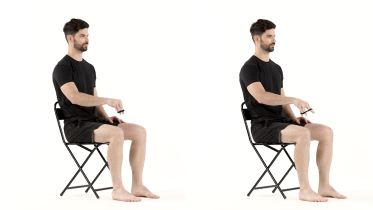
This exercise strengthens the muscles that bend the wrist forward (wrist flexors) and back (wrist extensors) with a flexible rubber bar. You sit and hold the bar upright in front of your chest, one hand at the bottom and the other over the top, twist it by bending the top wrist down while the bottom wrist bends back, then reach both arms forward and let the bar untwist slowly. It is an upright variation of the Tyler twist, a bar exercise often used for pain on the outer side of the elbow (tennis elbow).
How to do the wrist twist with a flexible bar
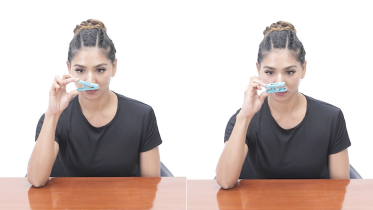
- Sit on a chair with your back tall and your feet flat. Hold the bottom of the bar in one hand so it stands upright in front of your chest.
- Take hold of the top of the bar with your other hand, palm down over the end, so that elbow lifts out to the side, as in the video.
- Twist the bar by bending the top wrist down while the bottom wrist bends back, a little like wringing out a towel.
- Keep the twist and the bar upright as you reach both arms forward, elbows as straight as is comfortable.
- Keep your arms forward while you let the bar untwist slowly under control, taking a few seconds instead of letting it spring back. Then bring your arms back in and repeat.
What you should feel
Work in both forearms, on the top and the underside, just below the elbows. Some tiredness there by the end of a set is normal.
Common mistakes
- Shrugging your shoulders up toward your ears as you reach forward.
- Twisting with the shoulders or trunk rather than at the wrists.
- Letting the bar spring back on its own.
- Using a bar too stiff to twist smoothly. Start with the lightest one.
How often
Many programs start with the lightest bar and 2 to 3 sets of 10 to 15 slow twists, once a day. Your physio will adjust this, including how stiff the bar is.
Stop and check with your physio if
- Sharp pain at the outer or inner elbow while you twist.
- Pins and needles or numbness in the fingers. If one side of your face or body suddenly goes numb or weak, or your speech becomes slurred or muddled, call emergency services, even if it goes away.
- Elbow or wrist pain that is clearly worse when you get up the next day.
From the clinic
The classic Tyler twist for tennis elbow is set up differently. The sore hand holds the bottom of the bar with the wrist bent back, the good hand twists the top, both arms then reach forward with the bar turned sideways, and the sore wrist lets the bar untwist slowly on its own. The video keeps the bar upright and both wrists work.
If you use this version for tennis elbow, put the sore arm's hand at the bottom, so that its wrist bends back as you twist. For golfer's elbow (pain on the inner side of the elbow) it is the other way round: the sore arm's hand goes on top, because the top wrist bends forward. Ask your physio which version suits you.
With tennis elbow or golfer's elbow, some discomfort at the sore part of the elbow during the exercise is often accepted, provided it eases within a few hours and is no worse the following morning. Your physio can tell you how much is fine for you. After a broken wrist, hand or forearm, or surgery on any of them such as a tendon repair, start only when your doctor, surgeon, physio or hand therapist says the bone or repair is ready for this, and follow their plan for how much to do. No bar at home? Wrist extension with weight works the muscles on the back of the forearm with a light dumbbell.
After a broken or dislocated elbow, or elbow surgery such as a tendon repair, follow your surgeon's or physio's plan, and start this exercise only when they have cleared you. If you have just hurt your arm and have severe pain, cannot move the elbow or heard a snap, do not exercise it. Go to an urgent care center or emergency department the same day. If the arm looks a different shape or sits at an odd angle, a bone is showing, or your arm or hand tingles, feels numb or turns cold, pale or blue, go to an emergency department straight away or call emergency services, and do not drive yourself.
Written and checked by the PocketPhysio editorial team. Last updated 2026-09-28.
This page is general education, not a diagnosis or a personal treatment plan. If you have pain, an injury or a health condition, see a physiotherapist or doctor before starting new exercises.