
Biceps tendon rupture: what to do about a shoulder or elbow tear
Warning signs, and when to get help
What is a biceps tendon rupture?
The biceps is the muscle at the front of your upper arm, and it is held on at both ends. At the top it has two tendons: the long head, which runs up over the ball of the shoulder and into the joint, and the short head, which anchors to a bony knob at the front of the shoulder blade. At the bottom, one thick tendon crosses the front of the elbow and fixes to the inner forearm bone. A biceps tendon rupture means one of those has torn right through or pulled off the bone, and almost all of them involve either the long head at the shoulder or the single tendon at the elbow.
The two tear for different reasons. OrthoInfo describes a long head tear at the shoulder coming either from an injury, such as a hard fall on an outstretched arm or lifting something far too heavy, or from slow fraying with age, with older age, heavy or repetitive overhead work and sport, smoking and corticosteroid medicine among the things that make it more likely. At the elbow, OrthoInfo says the tendon usually goes when the elbow is forced straight against resistance, and less often when it is forced to bend against a heavy load, with men over 30 most often affected and smoking and steroid use again on the list. A narrative review puts it as a spectrum: proximal tears happen in tissue that is already degenerate and poorly supplied with blood and often sit alongside rotator cuff problems, while distal tears come from a sudden overload as the elbow is forced straight. The same review is careful to say that both ends usually have some quiet collagen breakdown behind them before they fail, so a distal tear is not simply a strong tendon meeting a strong force (Elgendy and colleagues, 2025).
That difference is why this page is split in two. A worn tendon that has already failed at the shoulder is rarely an emergency. A tendon ripped off the forearm bone in a single moment has a repair window, and the clock starts at the injury.
Proximal biceps tendon rupture: the tear at the shoulder
This is the one that produces the famous bulge. OrthoInfo explains that a torn tendon can no longer keep the biceps muscle tight, so you may see a lump in the upper arm above the elbow, with the muscle sitting closer to the elbow than on the other side. People call it a Popeye muscle or a Popeye deformity, and OrthoInfo says a complete tear is often obvious from the shape of the arm alone. It commonly comes with sudden sharp pain, sometimes a pop you hear, cramping when you use the arm hard, and bruising that spreads down toward the elbow.
What surprises most people is how well the arm works afterward. The short head is still attached, the shoulder has other muscles to lift with, and OrthoInfo says the pain goes away over time for most people. Its non-surgical list is modest: ice for about 20 minutes at a time, several times a day and never straight onto the skin, anti-inflammatory tablets such as ibuprofen or naproxen, a rest from heavy lifting and overhead work with perhaps a short spell in a sling, and physical therapy for movement and strength.
The catch is what else the shoulder has wrong with it. This tendon usually fails because it was already worn, and the same wear sits on the rotator cuff next door, so the stiffness, night pain and weakness that bring people in afterward are usually cuff problems, with the torn biceps as a bystander. If your pain came on gradually and nothing changed shape, you are more likely looking at biceps tendinopathy or rotator cuff tendinopathy, both of which have their own programs.
Does a proximal biceps rupture need surgery?
Usually not. OrthoInfo is direct about it: tears of the long head rarely need surgery, and surgery is almost never done for the look of the arm on its own. The reasons it lists for considering an operation are symptoms that do not settle with non-surgical care, disabling cramping of the biceps, significant shoulder pain, and arm weakness that stops you working or managing everyday jobs such as bathing, dressing, cooking, cleaning and shopping.
Where an operation is done, there are two ways to deal with the tendon. A tenodesis anchors the remaining tendon to bone or nearby soft tissue, which keeps the muscle under tension. A tenotomy simply releases it, which is quicker and accepts the bulge.
That has a consequence worth holding on to while you read the rest of this section. A complete long head rupture has already done what a tenotomy does, so the choice between the two operations comes up while the tendon is still attached, or alongside other shoulder surgery, and not after a rupture. If a ruptured long head is operated on, OrthoInfo says it is uncommon to put the tendon back on the top of the socket and more usual to fix it to the arm bone, which is a tenodesis in all but name. The trials comparing tenodesis with tenotomy were done in people having surgery for long head of biceps problems in general, often alongside a rotator cuff repair, rather than in people whose tendon had already snapped, so read what follows as the nearest available evidence and not as a direct answer to your own question.
The reviews agree about the bulge and argue about the rest. A meta-analysis of nine randomized trials covering 572 patients found tenodesis better for elbow bending strength at 12 months, by a weighted mean of 3.67 kg (about 8 lb), better for supination strength by 0.36 kg (about 0.8 lb), and much less likely to leave a deformity at 24 months, while tenotomy gave less pain at 3 months (Vajda and colleagues, 2022). A separate meta-analysis of nine trials found the same advantage on deformity, a small and statistically fragile advantage on the Constant score, and no difference at all in pain, bending strength, supination strength or cramping (Zhou and colleagues, 2021). An earlier review of seven studies did find less cramping pain after tenodesis (Ge and colleagues, 2015). So the honest summary is that tenodesis leaves a better looking arm, the strength and cramping findings do not hold up consistently, and the choice is a conversation with your surgeon about what you want from the arm.
Distal biceps tendon rupture: the tear at the elbow
This is the urgent one, and it is the half that gets missed. OrthoInfo says there is often a pop at the elbow as the tendon ruptures, that the pain is severe at first and may ease after a week or two, and that the other signs are swelling at the front of the elbow, bruising in the elbow and forearm, weaker bending, weaker turning of the forearm, a bulge or bunched muscle nearer the shoulder, and a gap at the front of the elbow. Notice the second of those. Pain that fades after ten days reads like good news, and it is the single most common reason somebody presents at six weeks instead of six days.
Timing is the whole point. OrthoInfo says the ideal repair is within the first 2 to 3 weeks after the injury, that repair can sometimes still be done up to 6 weeks, and that beyond 3 weeks a reconstruction using a donor tendon becomes more common and may be necessary. The same split appears in the review literature, where delayed ruptures are described as generally needing anatomic repair or a graft (Elgendy and colleagues, 2025). A straightforward reattachment and a graft reconstruction are not the same operation, so a late diagnosis can cost you the simpler one.
If your own injury was weeks ago and nobody has examined the elbow, that is how this most often arrives in a clinic, and it is still worth being seen now rather than deciding the chance has gone. The route is the same-day one in the warning list further down.
Not every distal tear is a complete one, and a partial tear is a different conversation. OrthoInfo says an MRI can show a partial tear as well as a complete rupture, and the Royal Berkshire leaflet describes rest, anti-inflammatory medicine and physiotherapy as the usual first route for a partial tear or a less active person, with an operation recommended for a complete rupture or for someone who needs the strength back. Worth knowing if you are offered a scan: the hook test, which is what usually makes this diagnosis, reads as normal in a partial tear, so the scan is doing real work there in a way it often is not when the tear is complete. The strength figures below come from complete ruptures and do not transfer to a partial tear.
Not everybody has surgery, and that is a legitimate choice, not a failure. OrthoInfo says non-surgical care may be considered for older or less active people, for an injury to the non-dominant arm where reduced function is acceptable, for someone whose health makes surgery risky, and for someone who cannot commit to the rehabilitation afterward.
What you trade is strength, mainly in turning the palm up. OrthoInfo quotes about a 30 to 40% drop, and that figure traces back to a biomechanical study of 10 patients, only 3 of whom were treated without surgery. Those 3 lost a mean of 40% of their supination strength, and their flexion loss varied and averaged 30% (Morrey and colleagues, 1985). Three people is a very small base for a number quoted this often. Worth knowing before you let it carry much weight in your own decision.
One thing applies to every figure on this page. This injury happens mostly to men in middle age, so that is who the research was done on: the randomized trial behind the early movement advice was 101 men with an average age of 45 (Bergman and colleagues, 2021), and the strength figures come from small series of the same kind. If you are a woman, or a good deal older than that, read these numbers as the nearest available evidence rather than as a measurement of your own arm, and give your own surgeon's judgment more weight than any of them.
The larger comparisons point the same way with the same caveat. A systematic review of 62 studies and 2,481 cases found surgery associated with higher flexion strength by a mean of 25.67% and higher supination strength by 27.56%, along with better DASH and Mayo elbow scores (Looney and colleagues, 2022). Only 79 of those cases were treated without surgery, so one side of that comparison is thin. Pulling the other way, a cohort of 72 patients found more complications after surgery, including nerve injuries and wound problems, while the 20 treated without it returned to their previous activities with only minor strength complaints. That study was retrospective and collected no validated scores (Quzli and colleagues, 2025).
What are the signs of a distal biceps rupture, and how is it tested?
The examination makes this diagnosis, not the scan. OrthoInfo describes the clinician feeling for a gap at the front of the elbow, hooking a finger under the tendon from the outer side, and comparing how strongly you can turn the palm up against the other arm. In 45 patients who went on to surgery, that hook test was abnormal in all 33 complete tears and normal in all 12 partial tears, giving 100% sensitivity and specificity in that series, against 92% and 85% for MRI (O'Driscoll and colleagues, 2007). In 48 patients, using the hook test together with a passive forearm pronation test and a measurement of the biceps crease matched the surgical or imaging finding every time all three agreed (Devereaux and ElMaraghy, 2013). Those authors are careful to add that no single test, MRI included, has ever shown 100% accuracy.
Imaging has a narrower job than people expect. OrthoInfo says X-rays cannot show the tendon and are there to rule out other causes of elbow pain, ultrasound can show the retracted free end, MRI may show partial as well as complete tears, and imaging may not be needed at all when the examination makes the answer obvious. That matters practically: waiting several weeks for a scan appointment can use up the repair window that an examination on day one would have protected. The examination also gets harder with time. A narrative review points out that once the bruising has settled and the tendon has pulled up the arm, a chronic tear can look unremarkable and the hook test can read as normal when it is not, which is the point at which a scan stops being optional (Elgendy and colleagues, 2025).
None of this is a self-test. Squeezing your own elbow or hooking a finger under it is no substitute for being examined. The useful thing you can do is describe it accurately. Say when it happened, what you were lifting, whether you heard or felt a pop, and that turning your palm upward feels weak.
Is a ruptured biceps tendon painful?
At first, usually yes, and then often much less, which is the part that misleads people. OrthoInfo describes sudden sharp pain in the upper arm for a long head tear at the shoulder, sometimes with an audible pop or snap, with cramping on hard use and bruising spreading down toward the elbow, and says the pain goes away over time for most people. For the elbow it says the pain is severe at first and may ease after a week or two.
A settling pain tells you the inflammation is calming down. It tells you nothing about whether the tendon is attached. At the shoulder that distinction does not usually cost you anything. At the elbow it can cost you the simpler operation, which is why the warning sign at the end of this page asks you to be examined even once the pain has gone quiet.
How long does a ruptured biceps tendon take to heal?
For a repaired distal tendon, OrthoInfo says full healing takes more than 3 to 4 months, so activity has to stay restricted through that period, and that return to heavy activities and manual labor is typically possible at about 4 to 6 months. Light activity can begin soon after surgery, and heavy lifting and vigorous activity are avoided for several months. It also reports that almost all patients have full movement and full or nearly full strength at final follow-up, which is the most encouraging line on either OrthoInfo page.
For a long head tear at the shoulder, OrthoInfo gives no timeframe. It says a sling may be used for a brief period after surgery and that rehabilitation is a slow process, and that is all. That gap is left as a gap here instead of being filled with the elbow's numbers, because the two injuries are not comparable and an invented timeline is worse than none.
How to use this program
These stages are a framework, not a protocol, and they sit underneath whatever your surgeon or physio told you. If you have had surgery on the elbow, follow the program your surgeon or physio gives you rather than this one. If you tore the tendon at the elbow and are being treated without surgery, there is no repair to protect: OrthoInfo's plan there is rest from heavy lifting and overhead work, perhaps a short spell in a sling, and exercises once the pain has settled, so the pace comes from your symptoms rather than from a protocol. The 6 weeks in stage 3 and the 8 to 12 weeks in stage 4 are there to protect a repair, so they are not your dates, and what limits you is how the arm is the next morning. Start a stage only when the person looking after your arm says you are ready for it, and begin an individual exercise only once you have been cleared for that movement, even if its own page does not mention this.
Every exercise page gives a typical starting dose. Across programs, early movement work is often done 1 to 3 times a day, holds run 5 to 10 seconds, and strength work sits at 2 to 3 sets of 8 to 15 a few days a week. Your physio will adjust the exercises and the numbers to your arm and to the job, sport or daily tasks you are working back toward.
Stage 1 should be free of pain at the elbow and at the front of the shoulder. From stage 2 onward, mild discomfort while you work is acceptable as long as it settles soon after you stop and the arm is no worse the next morning. Sharp pain at the front of the elbow, pain that climbs with every repetition, or an arm that is clearly sorer or more swollen the next day means the load was too much, so drop back a step and tell your physio.
Check with your doctor before you start if you have a heart or lung condition, or blood pressure that is not under control. If you have high blood pressure, breathe steadily through every repetition and never hold your breath. A child or teenager with a suspected biceps tendon injury needs to see a doctor or physio, who will plan any rehabilitation.
Read the warning signs at the end of this page before your first session. The ones to know now: a pop at the front of the elbow with a weak palm turn needs examining the same day, and after a repair, a bulge that reappears or a sudden drop in strength means contacting your surgical team the same day. If you are in a cast or splint and your fingers turn blue, white or pale or feel cold, that is an emergency, and raising the hand is not the answer to it.
The exercise program
The exercises below carry their own stop signs and precautions. Open the line under an exercise and read them before you try it.
Stage 1: Protect the repair and keep everything else moving
For the first weeks after a distal repair, while the arm is in a splint, brace or sling, and for the first sore days after a tear at the shoulder. Nothing here pulls on the biceps. You open and close the hand, tip the wrist up and down, lift and lower the shoulder blades, and squeeze them gently back, all with nothing in your hands. The shrug video shows dumbbells, and this is the stage not to use them, because holding a weight with the arm hanging pulls on a healing biceps and the UK leaflets for this operation keep weights out of the first weeks entirely. A common start is 5 to 10 hand opens and closes 3 to 4 times a day, 10 to 15 wrist movements 1 to 3 times a day, 10 to 15 shoulder blade squeezes once or twice a day, and about 10 shrugs alongside them, kept small because both UK leaflets draw the blades back and down rather than up. In the first two weeks one of those leaflets asks you to use the hand for nothing but the exercises in its own booklet, so this is not the stage to find out what the arm can do. Keep this stage free of pain at the elbow or the front of the shoulder, and take the arm out of a splint only if your surgeon or physio has said you may.
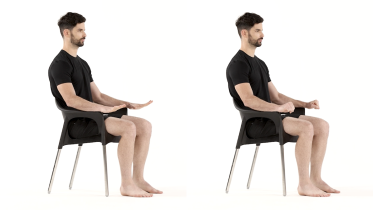 Open and close the hands
Stop signs and precautions for the open and close the hands
Before you start
- After a broken hand or finger, a tendon repair or other hand surgery, how far you may move the fingers and thumb is often limited for several weeks, so do only the movements your surgeon or hand therapist has shown you.
- After a wrist fracture, keep moving your fingers and thumb as far as the cast or splint allows, unless your fracture clinic has told you otherwise.
When to stop and get help
- Sharp pain in a finger joint, the palm or the wrist.
- Tingling or numbness in the fingers that comes on as you work. If one side of your face or body suddenly goes numb or weak, or your speech becomes slurred or muddled, call emergency services, even if it goes away.
- Your fingers puff up or feel stiffer once you have finished.
- Emergency: while you are in a cast or splint, your fingers turn blue, white or pale, or feel cold. Do not wait to see if raising your hand helps. Go to an emergency department straight away, and do not drive yourself. The cast or splint may be cutting off the blood supply, or pressure may be building up inside the forearm (compartment syndrome), and both need checking quickly.
- In a cast or splint, the pain gets worse, your fingers feel numb or tingle or look more swollen, or the cast feels too tight. Stop, rest your hand at about the level of your heart, keep moving your fingers and contact your fracture clinic or get medical advice straight away. Do not lift the hand higher than your heart and do not put ice on it, because if pressure is building up inside the forearm both of those cut down the blood reaching it. If you cannot move your fingers, the pain is severe even after painkillers, or the numbness, tingling or swelling has not settled within 30 minutes, go to your fracture clinic or an emergency department straight away, and do not drive yourself.
- Since the fracture or cast, the hand is getting more painful rather than less, the skin becomes very sensitive to light touch, or the hand changes color, temperature, swelling or sweating compared with the other one, or looks shiny. See your doctor or physio as soon as you can, within a few days at most, as this can be complex regional pain syndrome (CRPS) and early treatment may help.
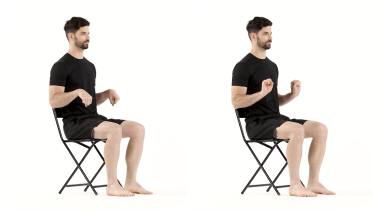 Wrist flexion and extension
Stop signs and precautions for the wrist flexion and extension
Before you start
- After a broken wrist, hand or forearm, or surgery on any of them such as a tendon repair, start only when your doctor, surgeon, physio or hand therapist says the bone or repair is ready for this, and follow their plan for how much to do.
When to stop and get help
- Sharp or catching pain in the wrist.
- Numbness or tingling in the hand or fingers that builds as you go. If one side of your face or body suddenly goes numb or weak, or your speech becomes slurred or muddled, call emergency services, even if it goes away.
- The wrist is more swollen, hot or stiff after the session.
- Since the fracture or cast, the hand is getting more painful rather than less, the skin becomes very sensitive to light touch, or the hand changes color, temperature, swelling or sweating compared with the other one, or looks shiny. See your doctor or physio as soon as you can, within a few days at most, as this can be complex regional pain syndrome (CRPS) and early treatment may help.
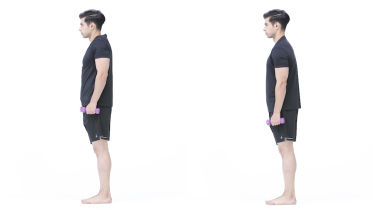 Shoulder shrugs
Stop signs and precautions for the shoulder shrugs
Before you start
- If you have had shoulder or neck surgery, ask your surgeon or physio before you pick up weights.
- After surgery or a tendon repair at the elbow or in the upper arm, such as a biceps tendon repair, do not hold weights for these until your surgeon or physio says you may lift. Holding a dumbbell with the arm hanging pulls on a healing repair. Shrug with nothing in your hands instead.
When to stop and get help
- The shoulder catches or gives a sharp pain during the lift.
- Pain or tingling spreads into the arm.
- Pins and needles in your arm or hand that do not go away after you stop, or part of your arm or hand goes numb. Get medical advice the same day. If one side of your face or body suddenly goes numb or weak, or your speech becomes slurred or muddled, call emergency services, even if it goes away.
- A headache or dizziness comes on while you are doing them. If you faint while exercising, call emergency services, even if you feel fine again quickly.
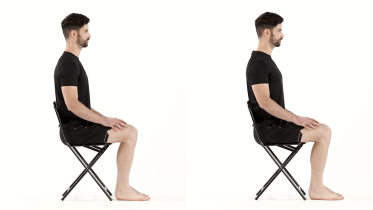 Scapular squeeze
Stop signs and precautions for the scapular squeeze
When to stop and get help
- Pain, numbness or tingling spreads into the arm or hand.
- Pins and needles in your arm or hand that do not go away after you stop, or part of your arm or hand goes numb. Get medical advice the same day. If one side of your face or body suddenly goes numb or weak, or your speech becomes slurred or muddled, call emergency services, even if it goes away.
- Neck or shoulder pain gets sharper during the squeeze instead of settling.
Stage 2: Get the elbow, forearm and shoulder moving
Start each of these only once your surgeon or physio has cleared that movement. After a distal repair the usual limits are on forcing the elbow straight and on any resisted bending or resisted turning of the palm, while gentle active bending and gentle palm turning are often encouraged from the first weeks. The elbow and forearm movements are for both locations. The pendulum and the stick-assisted shoulder lift are not for a repaired elbow in these weeks at all: the arm hangs fully straight and relaxed in the pendulum, and the stick is lifted with the elbow held straight and the palm turned down, so each of them takes the reattached tendon to its longest position under the weight of the arm. If your repair was at the elbow, leave both out until your surgeon or physio has cleared the elbow to straighten fully, and do not take the arm out of a sling or brace, or change a brace setting, to let it hang. After a tenodesis at the shoulder both also wait for your surgeon's go-ahead. Set the forearm turns up the way both UK leaflets show them, sitting with the elbow bent and tucked in at your side, rather than the face-down position in the video where the elbow is almost straight, and keep the turn gentle instead of pushing it into a stretch. If you need the other hand to help the turn, use it only to take the forearm as far as it will go without pain, never to push past that. Both leaflets ask for short sets done often rather than long ones, so copy that shape: 5 to 10 slow bends and 5 to 10 forearm turns each way, several times a day, with 1 to 2 minutes of pendulum swings and 10 to 15 stick-assisted lifts once or twice a day for a tear at the shoulder. Grip work can usually start early and keeps the forearm from switching off, often 5 to 10 squeezes held for 3 to 5 seconds, several times a day. Mild discomfort is fine if it fades soon after you stop and the arm is no worse the next morning.
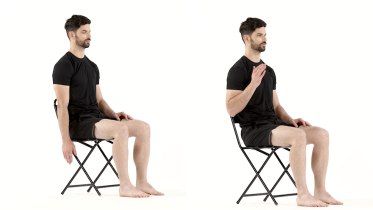 Elbow flexion and extension
Stop signs and precautions for the elbow flexion and extension
Before you start
- After a broken or dislocated elbow, or elbow surgery such as a tendon repair, follow your surgeon's or physio's plan, and start this exercise only when they have cleared you. They may also set limits on how far you bend or straighten, and those limits come first. If you have just hurt your arm and have severe pain or cannot move the elbow, do not exercise it. Go to an urgent care center or emergency department the same day. If you heard a snap or a crack at the moment of the injury, the arm looks a different shape or sits at an odd angle, a bone is showing, or your arm or hand tingles, feels numb or turns cold, pale or blue, go to an emergency department straight away or call emergency services, and do not drive yourself.
When to stop and get help
- Sharp pain at the elbow, or pain that climbs with each repetition.
- New or growing swelling, heat or redness around the elbow.
- The elbow is hot, red and swollen, or you have elbow pain with a high temperature or feel hot, cold or shivery. Get medical advice the same day, and go to an emergency department if you feel very unwell. This can be a sign of infection in the joint, which needs treatment quickly. If you have a very high or very low temperature, shivering you cannot control, you are breathing very fast or finding it hard to breathe, you are confused or your speech is slurred, your skin, lips or tongue look blue, gray, pale or blotchy (on brown or black skin this can be easier to see on the palms of the hands or soles of the feet), or you have a rash that does not fade when you press it, call emergency services, as this can be sepsis.
- Numbness, tingling or weakness in the hand or fingers.
- Pins and needles in your arm or hand that do not go away after you stop, or part of your arm or hand goes numb. Get medical advice the same day. If one side of your face or body suddenly goes numb or weak, or your speech becomes slurred or muddled, call emergency services, even if it goes away.
- Since the elbow injury or an operation on it, your hand is getting weaker or clumsier, you are dropping things, you cannot pinch or grip as you could, the ring and little fingers feel numb or tingly all the time rather than only while you exercise, or the muscle between your thumb and index finger looks hollowed out. Contact your fracture clinic or surgical team the same day. The nerve that runs behind the elbow (the ulnar nerve) can be pressed on by swelling, by the healing bone or by metalwork, and a nerve that is losing power needs looking at quickly, because weakness left to run on may not fully recover.
- Emergency: while you are in a cast or splint, your fingers turn blue, white or pale, or feel cold. Do not wait to see if raising your hand helps. Go to an emergency department straight away, and do not drive yourself. The cast or splint may be cutting off the blood supply, or pressure may be building up inside the forearm (compartment syndrome), and both need checking quickly.
- In a cast or splint, the pain gets worse, your fingers feel numb or tingle or look more swollen, or the cast feels too tight. Stop, rest your hand at about the level of your heart, keep moving your fingers and contact your fracture clinic or get medical advice straight away. Do not lift the hand higher than your heart and do not put ice on it, because if pressure is building up inside the forearm both of those cut down the blood reaching it. If you cannot move your fingers, the pain is severe even after painkillers, or the numbness, tingling or swelling has not settled within 30 minutes, go to your fracture clinic or an emergency department straight away, and do not drive yourself.
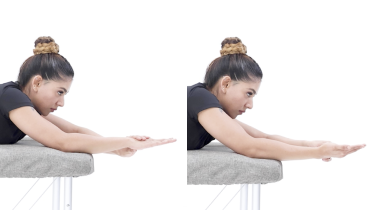 Forearm rotation lying face down
Stop signs and precautions for the forearm rotation lying face down
Before you start
- After a broken wrist, hand or forearm, or surgery on any of them such as a tendon repair, start only when your doctor, surgeon, physio or hand therapist says the bone or repair is ready for this, and follow their plan for how much to do. After a broken or dislocated elbow, or elbow surgery such as a tendon repair, follow your surgeon's or physio's plan, and start this exercise only when they have cleared you. If you have just hurt your arm and have severe pain or cannot move the elbow, do not exercise it. Go to an urgent care center or emergency department the same day. If you heard a snap or a crack at the moment of the injury, the arm looks a different shape or sits at an odd angle, a bone is showing, or your arm or hand tingles, feels numb or turns cold, pale or blue, go to an emergency department straight away or call emergency services, and do not drive yourself.
- After a biceps tendon repair at the elbow, do these turns sitting with the elbow bent and tucked in at your side instead of in the face-down position shown, which holds the elbow almost straight. UK hospital leaflets for that operation set the turns up with the elbow at the side, and they ask you to keep the movement gentle rather than pushing it into a stretch. If you use the other hand to help, use it only to take the forearm as far as it will go without pain.
- After recent heart or chest surgery, get your surgeon's or surgical team's okay first, because lying face down presses on the healing breastbone. Until they have cleared it, do these turns sitting at a table instead. If the breastbone clicks, grinds, shifts or feels as if it is moving while you do it, stop, and contact your surgical team the same day.
- If you are pregnant, lying on your stomach usually stops being comfortable as the bump grows, so do these turns sitting at a table instead.
When to stop and get help
- Sharp pain in the forearm, wrist or elbow, or a painful click or clunk as the hand turns.
- The elbow is hot, red and swollen, or you have elbow pain with a high temperature or feel hot, cold or shivery. Get medical advice the same day, and go to an emergency department if you feel very unwell. This can be a sign of infection in the joint, which needs treatment quickly. If you have a very high or very low temperature, shivering you cannot control, you are breathing very fast or finding it hard to breathe, you are confused or your speech is slurred, your skin, lips or tongue look blue, gray, pale or blotchy (on brown or black skin this can be easier to see on the palms of the hands or soles of the feet), or you have a rash that does not fade when you press it, call emergency services, as this can be sepsis.
- Pain or pinching in the shoulder from reaching forward, or your neck or lower back aches more as you go.
- Tingling, pins and needles or numbness in your hand, most often in the ring and little fingers (from the nerve behind the elbow, the ulnar nerve) or in the thumb, index and middle fingers (the median nerve).
- Pins and needles in your arm or hand that do not go away after you stop, or part of your arm or hand goes numb. Get medical advice the same day. If one side of your face or body suddenly goes numb or weak, or your speech becomes slurred or muddled, call emergency services, even if it goes away.
- Since the elbow injury or an operation on it, your hand is getting weaker or clumsier, you are dropping things, you cannot pinch or grip as you could, the ring and little fingers feel numb or tingly all the time rather than only while you exercise, or the muscle between your thumb and index finger looks hollowed out. Contact your fracture clinic or surgical team the same day. The nerve that runs behind the elbow (the ulnar nerve) can be pressed on by swelling, by the healing bone or by metalwork, and a nerve that is losing power needs looking at quickly, because weakness left to run on may not fully recover.
- Since the fracture or cast, the hand is getting more painful rather than less, the skin becomes very sensitive to light touch, or the hand changes color, temperature, swelling or sweating compared with the other one, or looks shiny. See your doctor or physio as soon as you can, within a few days at most, as this can be complex regional pain syndrome (CRPS) and early treatment may help.
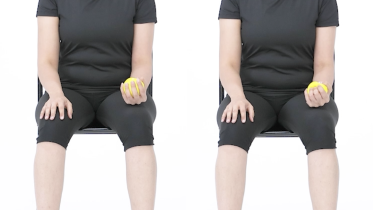 Hand grip squeeze
Stop signs and precautions for the hand grip squeeze
Before you start
- After a broken wrist, hand or forearm, or surgery on any of them such as a tendon repair, start only when your doctor, surgeon, physio or hand therapist says the bone or repair is ready for this, and follow their plan for how much to do.
- Arthritis at the base of the thumb and rheumatoid arthritis can both flare with hard gripping. Ask your physio how firm to go, and skip it on days when the joints are hot and swollen.
- Keep breathing through each hold, because holding your breath while you strain can push your blood pressure up.
When to stop and get help
- Sharp pain in the wrist, a finger joint or at the base of the thumb.
- Your hand or fingers go numb or start to tingle. If one side of your face or body suddenly goes numb or weak, or your speech becomes slurred or muddled, call emergency services, even if it goes away.
- Hand joints that are more swollen, hot or stiff afterward.
- Since the fracture or cast, the hand is getting more painful rather than less, the skin becomes very sensitive to light touch, or the hand changes color, temperature, swelling or sweating compared with the other one, or looks shiny. See your doctor or physio as soon as you can, within a few days at most, as this can be complex regional pain syndrome (CRPS) and early treatment may help.
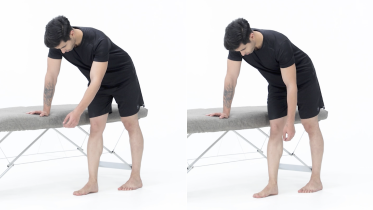 Pendulum exercise for the shoulder
Stop signs and precautions for the pendulum exercise for the shoulder
Before you start
- It is common for frozen shoulder and in the first weeks after some shoulder operations. Do it only if your own team has said it is right for you.
- After shoulder surgery, including a rotator cuff repair, or after a shoulder fracture or dislocation, follow your surgeon's or physio's plan, and do only the movements and range they have cleared. Many plans allow only passive movement at first, where the arm is moved for you and its muscles stay relaxed.
- After a repair of the biceps tendon at the elbow, or another repair, break or operation at the elbow or forearm, leave this one out until your surgeon or physio has cleared the elbow to straighten fully. There is no smaller version of it. The arm hangs fully straight and relaxed, so the elbow goes to its full straight position under the weight of the arm and the hand, which puts a tendon repaired at the elbow in its longest position with nothing of yours holding it back. If your team has set a limit on how far the elbow may straighten, or you are wearing a sling, brace, cast or splint after an operation or a break at the elbow or forearm, this exercise is not yet for you, and taking the arm out of it, or changing a brace setting to let the arm hang, is not the way round that limit. Teams differ on when full straightening is allowed after these operations, so the go-ahead comes from yours.
When to stop and get help
- Shoulder pain gets sharper or keeps building while you swing.
- You feel dizzy when leaning forward. Stand up slowly and sit down. If you faint while exercising, call emergency services, even if you feel fine again quickly.
- Your arm or hand goes numb, tingles or gets pins and needles.
- Pins and needles in your arm or hand that do not go away after you stop, or part of your arm or hand goes numb. Get medical advice the same day. If one side of your face or body suddenly goes numb or weak, or your speech becomes slurred or muddled, call emergency services, even if it goes away.
- A sudden pop or tearing feeling in the shoulder that brings sharp pain, new weakness or trouble lifting the arm. Stop and contact your surgical team the same day, or get medical advice the same day if you have not had surgery.
- The shoulder feels as if it has slipped out of place, looks a different shape or suddenly locks so you cannot move the arm, or your hand turns cold, pale or blue. Go to an emergency department straight away, without driving yourself, and do not try to put the shoulder back in yourself.
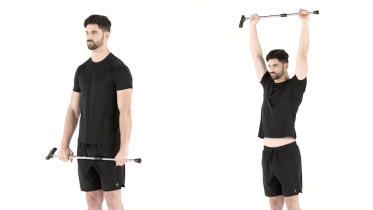 Shoulder flexion with a stick
Stop signs and precautions for the shoulder flexion with a stick
Before you start
- After shoulder surgery, including a rotator cuff repair, or after a shoulder fracture or dislocation, follow your surgeon's or physio's plan, and do only the movements and range they have cleared. Many plans allow only passive movement at first, where the arm is moved for you and its muscles stay relaxed. How high you may lift is often limited for a while.
- After a repair of the biceps tendon at the elbow, or another repair, break or operation at the elbow or forearm, leave this one out until your surgeon or physio has cleared the elbow to straighten fully, and cleared you to hold it straight with the palm turned down and a stick in your hand. There is no smaller version of it. Both elbows stay straight and both palms turn down, and the easier arm supplies the push, so the repaired side is held straight and palm down by a stick it is also gripping and carrying overhead. The biceps turns the palm up as well as bending the elbow, so a straight elbow with the palm turned down is the position that pulls hardest on a tendon repaired there, and the force holding the arm in it comes from your other arm through the stick. Early plans after this repair usually allow gentle bending and straightening, and turning the palm up and down with the elbow bent in at your side, and they keep those two movements apart from each other and from anything held in the hand, which is what this exercise puts together. If your team has set a limit on how far the elbow may straighten or how far the forearm may turn, or you are wearing a sling, brace, cast or splint after an operation or a break at the elbow or forearm, this exercise is not yet for you, and taking the arm out of it, or changing a brace setting, is not the way round that limit. A cast or clinic limit on the wrist or hand does not change that, and leaving the stick out is not a way round it either, because the arm still has to travel overhead. Teams differ on when these movements can be put together, so the go-ahead comes from yours.
- After a broken wrist, hand or forearm, or surgery on any of them, keep the shoulder moving, and do this one only as far as your cast, splint or fracture clinic allows. Both elbows stay straight and both palms turn down, so the injured side has to grip the stick, hold the forearm palm down and carry the stick overhead. Where your fracture clinic, surgeon or hand therapist has limited turning the palm, gripping or taking load through the wrist, that limit comes first. Hold the stick lightly with your fingers. If the cast, or a thumb held still inside it, stops you holding the stick securely, leave the stick out and lift that arm forward and overhead on its own.
- While your hand is in a cast or splint, do not lift it above your head if the hand is painful, tight, more swollen or numb. Rest it at about the level of your heart instead and contact your fracture clinic, as the stop signs for a tight cast describe.
- If you have rheumatoid arthritis or another inflammatory arthritis in your hands or wrists, keep the shoulder moving, and let the state of your wrists decide whether the stick goes in your hands that day. Both elbows stay straight and both palms turn down, so each hand has to grip the stick, hold the forearm palm down and carry the stick overhead. On any day when your wrist or hand joints are hot, swollen or more painful than usual, or you are in a flare, leave the stick out and lift that arm forward and overhead on its own. If you have been told the joints in your wrist are badly damaged or unstable, leave the stick out and lift that arm forward and overhead on its own, on your better days as well, and do not put a stick in that hand unless your physio, hand therapist or rheumatology team has checked that wrist and set the exercise up with you. Hold the stick lightly with your fingers rather than gripping hard, and stop at the height you reach without forcing.
When to stop and get help
- Emergency: while you are in a cast or splint, your fingers turn blue, white or pale, or feel cold. Do not wait to see if raising your hand helps. Go to an emergency department straight away, and do not drive yourself. The cast or splint may be cutting off the blood supply, or pressure may be building up inside the forearm (compartment syndrome), and both need checking quickly.
- In a cast or splint, the pain gets worse, your fingers feel numb or tingle or look more swollen, or the cast feels too tight. Stop, rest your hand at about the level of your heart, keep moving your fingers and contact your fracture clinic or get medical advice straight away. Do not lift the hand higher than your heart and do not put ice on it, because if pressure is building up inside the forearm both of those cut down the blood reaching it. If you cannot move your fingers, the pain is severe even after painkillers, or the numbness, tingling or swelling has not settled within 30 minutes, go to your fracture clinic or an emergency department straight away, and do not drive yourself.
- You get a sharp pain or a catch in the shoulder as the stick goes up.
- Pain or pins and needles spread down the arm.
- Pins and needles in your arm or hand that do not go away after you stop, or part of your arm or hand goes numb. Get medical advice the same day. If one side of your face or body suddenly goes numb or weak, or your speech becomes slurred or muddled, call emergency services, even if it goes away.
- The shoulder stays more painful for hours afterward.
- A sudden pop or tearing feeling in the shoulder that brings sharp pain, new weakness or trouble lifting the arm. Stop and contact your surgical team the same day, or get medical advice the same day if you have not had surgery.
- The shoulder feels as if it has slipped out of place, looks a different shape or suddenly locks so you cannot move the arm, or your hand turns cold, pale or blue. Go to an emergency department straight away, without driving yourself, and do not try to put the shoulder back in yourself.
Stage 3: First strength, holds and light bands
After a distal repair this stage waits until your surgeon or therapist says the reattachment can take load, which is usually around 6 weeks rather than earlier. UK hospital leaflets for this operation keep resisted elbow bending and resisted turning of the palm out of the program for the first 6 weeks, one of the two adds gentle holds in its own 4 to 6 week block, and the same leaflet starts band work for bending the elbow and turning the palm in its 6 to 8 week block. Your own plan decides, and 6 weeks is the earliest those leaflets allow rather than a date to start on, so if your own instruction is a later one, follow it. The triceps hold keeps the elbow bent at your side with nothing moving. The shoulder hold is not what its name suggests: you stand facing a wall with that arm straight out in front and press the flat palm into it, so the effort runs through a straight elbow. Its own page treats a bending elbow as a mistake to correct, which is not the right instruction for a repaired elbow, so press only as hard as you can without the elbow wanting to bend, build that up over days, and add this one last in the stage. The reverse grip curl bends the elbow against the weight of your own forearm and nothing else, and the two band exercises train turning the palm down and up, which is the movement people lose most after a tear at the elbow. Many programs use 5 to 10 holds of about 5 to 10 seconds once or twice a day. For the curl and the two band turns, use the dose the leaflet that prescribes band work uses, which is about 5 slow repetitions at a time, 4 to 5 times a day. Stay on that figure rather than reading it as a first week to get past. The 2 to 3 sets of 10 to 15 on the exercise pages is where this ends up much later, and the person who decides you are ready for it is the physio or surgeon looking after the arm, not the page and not the feeling that the small sets have become easy. Three loaded exercises for one forearm add up fast, so add one of them at a time rather than all three at once, and only while the arm is still settled the next morning. Start lighter than feels necessary.
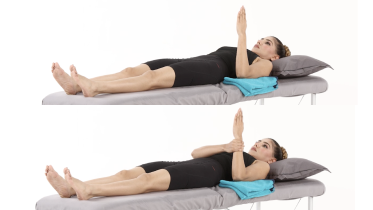 Lying isometric triceps press
Stop signs and precautions for the lying isometric triceps press
Before you start
- After a broken or dislocated elbow, or elbow surgery such as a tendon repair, follow your surgeon's or physio's plan, and start this exercise only when they have cleared you. Pushing the elbow straight against resistance is often held back for several weeks after a break at the point of the elbow (olecranon) or a triceps tendon repair. If you have just hurt your arm and have severe pain or cannot move the elbow, do not exercise it. Go to an urgent care center or emergency department the same day. If you heard a snap or a crack at the moment of the injury, the arm looks a different shape or sits at an odd angle, a bone is showing, or your arm or hand tingles, feels numb or turns cold, pale or blue, go to an emergency department straight away or call emergency services, and do not drive yourself.
- After recent heart or chest surgery, get your surgeon's or surgical team's okay first, because pushing one arm against the other across the front of your chest, and holding it, loads the healing breastbone. If the breastbone clicks, grinds, shifts or feels as if it is moving while you do it, stop, and contact your surgical team the same day.
- If you are pregnant and past the first three months, check with your physio before exercising flat on your back.
- If you have high blood pressure, breathe steadily through every hold and never hold your breath.
When to stop and get help
- Sharp pain at the elbow or in the back of the upper arm, or pain that builds while you hold.
- The elbow is hot, red and swollen, or you have elbow pain with a high temperature or feel hot, cold or shivery. Get medical advice the same day, and go to an emergency department if you feel very unwell. This can be a sign of infection in the joint, which needs treatment quickly. If you have a very high or very low temperature, shivering you cannot control, you are breathing very fast or finding it hard to breathe, you are confused or your speech is slurred, your skin, lips or tongue look blue, gray, pale or blotchy (on brown or black skin this can be easier to see on the palms of the hands or soles of the feet), or you have a rash that does not fade when you press it, call emergency services, as this can be sepsis.
- Tingling, pins and needles or numbness in your hand, most often in the ring and little fingers (from the nerve behind the elbow, the ulnar nerve) or in the thumb, index and middle fingers (the median nerve).
- Pins and needles in your arm or hand that do not go away after you stop, or part of your arm or hand goes numb. Get medical advice the same day. If one side of your face or body suddenly goes numb or weak, or your speech becomes slurred or muddled, call emergency services, even if it goes away.
- Since the elbow injury or an operation on it, your hand is getting weaker or clumsier, you are dropping things, you cannot pinch or grip as you could, the ring and little fingers feel numb or tingly all the time rather than only while you exercise, or the muscle between your thumb and index finger looks hollowed out. Contact your fracture clinic or surgical team the same day. The nerve that runs behind the elbow (the ulnar nerve) can be pressed on by swelling, by the healing bone or by metalwork, and a nerve that is losing power needs looking at quickly, because weakness left to run on may not fully recover.
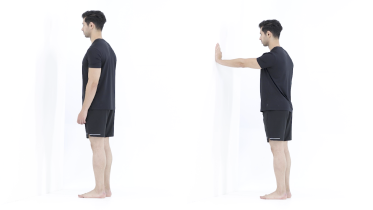 Isometric shoulder flexion
Stop signs and precautions for the isometric shoulder flexion
Before you start
- After shoulder surgery, including a rotator cuff repair, or after a shoulder fracture or dislocation, follow your surgeon's or physio's plan, and do only the movements and range they have cleared. Many plans allow only passive movement at first, where the arm is moved for you and its muscles stay relaxed.
- After surgery or a tendon repair at the elbow or in the upper arm, such as a biceps tendon repair, start this only once your surgeon or physio has cleared pushing through a straight arm, and then keep the press gentle and build it up over days. The arm is held straight out in front here, so the effort runs through a straight elbow, and a bending elbow is a sign to push less hard rather than something to correct.
- After recent heart or chest surgery, get your surgeon's or surgical team's okay first, because pushing your palm hard into a wall with a straight arm works the chest muscles that attach to the breastbone. If the breastbone clicks, grinds, shifts or feels as if it is moving while you do it, stop, and contact your surgical team the same day.
- If your shoulder has ever slipped out toward the back, ask your physio before you start this one, because pushing through a straight arm held in front of you presses the ball of the joint toward the back of the socket.
- If you have high blood pressure, breathe steadily through every hold and never hold your breath.
When to stop and get help
- The shoulder feels like it is slipping out, or suddenly feels loose or gives way.
- You feel a sharp pain or a catch in the shoulder as you push.
- Pain, tingling or numbness runs down the arm into the hand.
- Pins and needles in your arm or hand that do not go away after you stop, or part of your arm or hand goes numb. Get medical advice the same day. If one side of your face or body suddenly goes numb or weak, or your speech becomes slurred or muddled, call emergency services, even if it goes away.
- A sudden pop or tearing feeling in the shoulder that brings sharp pain, new weakness or trouble lifting the arm. Stop and contact your surgical team the same day, or get medical advice the same day if you have not had surgery.
- The shoulder feels as if it has slipped out of place, looks a different shape or suddenly locks so you cannot move the arm, or your hand turns cold, pale or blue. Go to an emergency department straight away, without driving yourself, and do not try to put the shoulder back in yourself.
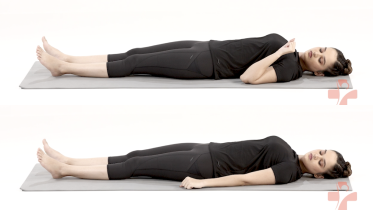 Reverse grip curl
Stop signs and precautions for the reverse grip curl
Before you start
- After a broken or dislocated elbow, or elbow surgery such as a tendon repair, follow your surgeon's or physio's plan, and start this exercise only when they have cleared you. If you have just hurt your arm and have severe pain or cannot move the elbow, do not exercise it. Go to an urgent care center or emergency department the same day. If you heard a snap or a crack at the moment of the injury, the arm looks a different shape or sits at an odd angle, a bone is showing, or your arm or hand tingles, feels numb or turns cold, pale or blue, go to an emergency department straight away or call emergency services, and do not drive yourself.
- If you are pregnant and past the first three months, check with your physio before exercising flat on your back.
- If you have high blood pressure, breathe steadily through every repetition and never hold your breath.
When to stop and get help
- Sharp pain at the elbow, along the forearm or at the wrist.
- The elbow is hot, red and swollen, or you have elbow pain with a high temperature or feel hot, cold or shivery. Get medical advice the same day, and go to an emergency department if you feel very unwell. This can be a sign of infection in the joint, which needs treatment quickly. If you have a very high or very low temperature, shivering you cannot control, you are breathing very fast or finding it hard to breathe, you are confused or your speech is slurred, your skin, lips or tongue look blue, gray, pale or blotchy (on brown or black skin this can be easier to see on the palms of the hands or soles of the feet), or you have a rash that does not fade when you press it, call emergency services, as this can be sepsis.
- A sudden pop or snap at the front of your elbow, sudden sharp pain there, or the muscle at the front of your upper arm bunches up or changes shape. Stop and go to an urgent care center or emergency department the same day, even if you can still bend the elbow, as this can be a torn biceps tendon.
- Tingling, pins and needles or numbness in your hand, most often in the ring and little fingers (from the nerve behind the elbow, the ulnar nerve) or in the thumb, index and middle fingers (the median nerve).
- Pins and needles in your arm or hand that do not go away after you stop, or part of your arm or hand goes numb. Get medical advice the same day. If one side of your face or body suddenly goes numb or weak, or your speech becomes slurred or muddled, call emergency services, even if it goes away.
- Since the elbow injury or an operation on it, your hand is getting weaker or clumsier, you are dropping things, you cannot pinch or grip as you could, the ring and little fingers feel numb or tingly all the time rather than only while you exercise, or the muscle between your thumb and index finger looks hollowed out. Contact your fracture clinic or surgical team the same day. The nerve that runs behind the elbow (the ulnar nerve) can be pressed on by swelling, by the healing bone or by metalwork, and a nerve that is losing power needs looking at quickly, because weakness left to run on may not fully recover.
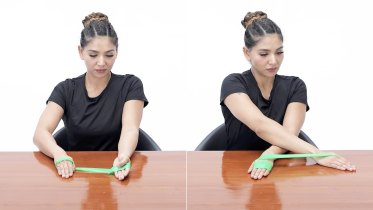 Forearm pronation with band
Stop signs and precautions for the forearm pronation with band
Before you start
- After a broken or dislocated elbow, or elbow surgery such as a tendon repair, follow your surgeon's or physio's plan, and start this exercise only when they have cleared you. If you have just hurt your arm and have severe pain or cannot move the elbow, do not exercise it. Go to an urgent care center or emergency department the same day. If you heard a snap or a crack at the moment of the injury, the arm looks a different shape or sits at an odd angle, a bone is showing, or your arm or hand tingles, feels numb or turns cold, pale or blue, go to an emergency department straight away or call emergency services, and do not drive yourself.
- After a broken wrist, hand or forearm, or surgery on any of them such as a tendon repair, start only when your doctor, surgeon, physio or hand therapist says the bone or repair is ready for this, and follow their plan for how much to do.
When to stop and get help
- Sharp pain in the forearm, wrist or elbow as you turn.
- The elbow is hot, red and swollen, or you have elbow pain with a high temperature or feel hot, cold or shivery. Get medical advice the same day, and go to an emergency department if you feel very unwell. This can be a sign of infection in the joint, which needs treatment quickly. If you have a very high or very low temperature, shivering you cannot control, you are breathing very fast or finding it hard to breathe, you are confused or your speech is slurred, your skin, lips or tongue look blue, gray, pale or blotchy (on brown or black skin this can be easier to see on the palms of the hands or soles of the feet), or you have a rash that does not fade when you press it, call emergency services, as this can be sepsis.
- A painful click or catch on the little finger side of the wrist.
- Your hand or fingers start to tingle or go numb.
- Pins and needles in your arm or hand that do not go away after you stop, or part of your arm or hand goes numb. Get medical advice the same day. If one side of your face or body suddenly goes numb or weak, or your speech becomes slurred or muddled, call emergency services, even if it goes away.
- Since the elbow injury or an operation on it, your hand is getting weaker or clumsier, you are dropping things, you cannot pinch or grip as you could, the ring and little fingers feel numb or tingly all the time rather than only while you exercise, or the muscle between your thumb and index finger looks hollowed out. Contact your fracture clinic or surgical team the same day. The nerve that runs behind the elbow (the ulnar nerve) can be pressed on by swelling, by the healing bone or by metalwork, and a nerve that is losing power needs looking at quickly, because weakness left to run on may not fully recover.
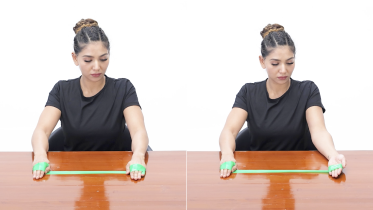 Forearm supination with band
Stop signs and precautions for the forearm supination with band
Before you start
- After a broken or dislocated elbow, or elbow surgery such as a tendon repair, follow your surgeon's or physio's plan, and start this exercise only when they have cleared you. If you have just hurt your arm and have severe pain or cannot move the elbow, do not exercise it. Go to an urgent care center or emergency department the same day. If you heard a snap or a crack at the moment of the injury, the arm looks a different shape or sits at an odd angle, a bone is showing, or your arm or hand tingles, feels numb or turns cold, pale or blue, go to an emergency department straight away or call emergency services, and do not drive yourself.
- After a broken wrist, hand or forearm, or surgery on any of them such as a tendon repair, start only when your doctor, surgeon, physio or hand therapist says the bone or repair is ready for this, and follow their plan for how much to do.
When to stop and get help
- Sharp pain in the wrist, forearm or elbow as you turn.
- The elbow is hot, red and swollen, or you have elbow pain with a high temperature or feel hot, cold or shivery. Get medical advice the same day, and go to an emergency department if you feel very unwell. This can be a sign of infection in the joint, which needs treatment quickly. If you have a very high or very low temperature, shivering you cannot control, you are breathing very fast or finding it hard to breathe, you are confused or your speech is slurred, your skin, lips or tongue look blue, gray, pale or blotchy (on brown or black skin this can be easier to see on the palms of the hands or soles of the feet), or you have a rash that does not fade when you press it, call emergency services, as this can be sepsis.
- A painful click or catch at the wrist.
- Numbness or tingling in the hand.
- Pins and needles in your arm or hand that do not go away after you stop, or part of your arm or hand goes numb. Get medical advice the same day. If one side of your face or body suddenly goes numb or weak, or your speech becomes slurred or muddled, call emergency services, even if it goes away.
- Since the elbow injury or an operation on it, your hand is getting weaker or clumsier, you are dropping things, you cannot pinch or grip as you could, the ring and little fingers feel numb or tingly all the time rather than only while you exercise, or the muscle between your thumb and index finger looks hollowed out. Contact your fracture clinic or surgical team the same day. The nerve that runs behind the elbow (the ulnar nerve) can be pressed on by swelling, by the healing bone or by metalwork, and a nerve that is losing power needs looking at quickly, because weakness left to run on may not fully recover.
- A sudden pop or snap at the front of your elbow, sudden sharp pain there, or the muscle at the front of your upper arm bunches up or changes shape. Stop and go to an urgent care center or emergency department the same day, even if you can still bend the elbow, as this can be a torn biceps tendon.
Stage 4: Strength for lifting, carrying and turning
Move on when stage 3 feels easy, the elbow bends, straightens and turns well enough for daily life, and your surgeon or physio has cleared loaded work. After a repair there is a date as well as a readiness test. One of the UK leaflets works up to taking full weight through the operated arm in its 8 to 12 week block, and the other puts heavy lifting at 3 months or more, so stage 3 feeling easy at 7 weeks is not by itself a reason to be in this stage. Neither leaflet prescribes a dumbbell at any point, so the weight in your hand here is a step your own team signs off. The two curls and the dumbbell forearm turn build the strength you use to lift a kettle, carry a box and turn a screwdriver, often 2 to 3 sets of 8 to 12 curls 2 to 3 days a week and 2 to 3 sets of 10 to 15 turns once a day. The two curls are the same movement with a different grip, so do one of them in a session rather than a full set of each. The seated triceps hold is the one exercise here with no load in the hand, often 5 to 10 holds of about 5 seconds once or twice a day. Wall push-ups put part of your body weight through the arm, so wait until you have been told the arm can take weight. The first weight-bearing step in that same leaflet is gentler than a push-up: both hands flat on a table, elbows straight, leaning forward and holding about 5 seconds, five times. Start there, then move to the wall with your feet close to it. A small water bottle is a sensible first dumbbell. Practice the real tasks you need in small steps, and expect some ache with harder jobs for a few months, though pain that climbs week by week needs checking.
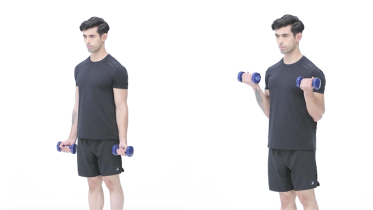 Biceps curl
Stop signs and precautions for the biceps curl
Before you start
- After a broken or dislocated elbow, or elbow surgery such as a tendon repair, follow your surgeon's or physio's plan, and start this exercise only when they have cleared you. If you have just hurt your arm and have severe pain or cannot move the elbow, do not exercise it. Go to an urgent care center or emergency department the same day. If you heard a snap or a crack at the moment of the injury, the arm looks a different shape or sits at an odd angle, a bone is showing, or your arm or hand tingles, feels numb or turns cold, pale or blue, go to an emergency department straight away or call emergency services, and do not drive yourself.
- After a biceps tendon repair or shoulder surgery, curls against resistance usually wait until your surgeon's protocol allows them. Check with your physio before you pick up a weight.
- Keep breathing through each repetition rather than holding your breath, especially if you have high blood pressure.
When to stop and get help
- Sharp pain at the front of the shoulder or at the elbow.
- A sudden pop or snap at the front of your elbow, sudden sharp pain there, or the muscle at the front of your upper arm bunches up or changes shape. Stop and go to an urgent care center or emergency department the same day, even if you can still bend the elbow, as this can be a torn biceps tendon.
- Pain, numbness or tingling that spreads down the arm.
- Pins and needles in your arm or hand that do not go away after you stop, or part of your arm or hand goes numb. Get medical advice the same day. If one side of your face or body suddenly goes numb or weak, or your speech becomes slurred or muddled, call emergency services, even if it goes away.
- Chest pain or pressure, dizziness or feeling faint, a racing or irregular heartbeat, or being far more out of breath than the effort should cause.
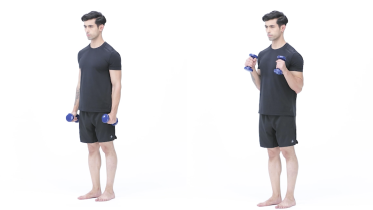 Hammer curl
Stop signs and precautions for the hammer curl
Before you start
- After a broken or dislocated elbow, or elbow surgery such as a tendon repair, follow your surgeon's or physio's plan, and start this exercise only when they have cleared you. If you have just hurt your arm and have severe pain or cannot move the elbow, do not exercise it. Go to an urgent care center or emergency department the same day. If you heard a snap or a crack at the moment of the injury, the arm looks a different shape or sits at an odd angle, a bone is showing, or your arm or hand tingles, feels numb or turns cold, pale or blue, go to an emergency department straight away or call emergency services, and do not drive yourself.
- After a biceps tendon repair or elbow surgery, curls against resistance usually wait until your surgeon's protocol allows them.
- Breathe through every repetition rather than holding your breath. That matters even more with high blood pressure.
When to stop and get help
- Sharp pain at the elbow, along the forearm or at the front of the shoulder.
- A sudden pop or snap at the front of your elbow, sudden sharp pain there, or the muscle at the front of your upper arm bunches up or changes shape. Stop and go to an urgent care center or emergency department the same day, even if you can still bend the elbow, as this can be a torn biceps tendon.
- Pain, numbness or tingling that travels down into the hand.
- Pins and needles in your arm or hand that do not go away after you stop, or part of your arm or hand goes numb. Get medical advice the same day. If one side of your face or body suddenly goes numb or weak, or your speech becomes slurred or muddled, call emergency services, even if it goes away.
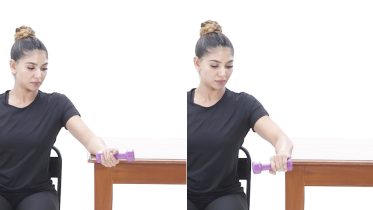 Forearm rotation with a dumbbell
Stop signs and precautions for the forearm rotation with a dumbbell
Before you start
- After a broken or dislocated elbow, or elbow surgery such as a tendon repair, follow your surgeon's or physio's plan, and start this exercise only when they have cleared you. If you have just hurt your arm and have severe pain or cannot move the elbow, do not exercise it. Go to an urgent care center or emergency department the same day. If you heard a snap or a crack at the moment of the injury, the arm looks a different shape or sits at an odd angle, a bone is showing, or your arm or hand tingles, feels numb or turns cold, pale or blue, go to an emergency department straight away or call emergency services, and do not drive yourself.
- After a broken wrist, hand or forearm, or surgery on any of them such as a tendon repair, start only when your doctor, surgeon, physio or hand therapist says the bone or repair is ready for this, and follow their plan for how much to do.
When to stop and get help
- Sharp pain in the wrist, forearm or elbow during a turn.
- The elbow is hot, red and swollen, or you have elbow pain with a high temperature or feel hot, cold or shivery. Get medical advice the same day, and go to an emergency department if you feel very unwell. This can be a sign of infection in the joint, which needs treatment quickly. If you have a very high or very low temperature, shivering you cannot control, you are breathing very fast or finding it hard to breathe, you are confused or your speech is slurred, your skin, lips or tongue look blue, gray, pale or blotchy (on brown or black skin this can be easier to see on the palms of the hands or soles of the feet), or you have a rash that does not fade when you press it, call emergency services, as this can be sepsis.
- A painful click or clunk at the wrist.
- Tingling or numbness in the hand or fingers.
- Pins and needles in your arm or hand that do not go away after you stop, or part of your arm or hand goes numb. Get medical advice the same day. If one side of your face or body suddenly goes numb or weak, or your speech becomes slurred or muddled, call emergency services, even if it goes away.
- Since the elbow injury or an operation on it, your hand is getting weaker or clumsier, you are dropping things, you cannot pinch or grip as you could, the ring and little fingers feel numb or tingly all the time rather than only while you exercise, or the muscle between your thumb and index finger looks hollowed out. Contact your fracture clinic or surgical team the same day. The nerve that runs behind the elbow (the ulnar nerve) can be pressed on by swelling, by the healing bone or by metalwork, and a nerve that is losing power needs looking at quickly, because weakness left to run on may not fully recover.
- A sudden pop or snap at the front of your elbow, sudden sharp pain there, or the muscle at the front of your upper arm bunches up or changes shape. Stop and go to an urgent care center or emergency department the same day, even if you can still bend the elbow, as this can be a torn biceps tendon.
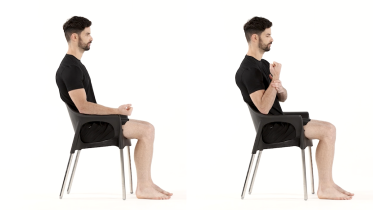 Seated triceps extension
Stop signs and precautions for the seated triceps extension
Before you start
- After a broken or dislocated elbow, or elbow surgery such as a tendon repair, follow your surgeon's or physio's plan, and start this exercise only when they have cleared you. This kind of push against resistance is often held back for several weeks after a break at the point of the elbow (olecranon) or a repair of the triceps tendon. If you have just hurt your arm and have severe pain or cannot move the elbow, do not exercise it. Go to an urgent care center or emergency department the same day. If you heard a snap or a crack at the moment of the injury, the arm looks a different shape or sits at an odd angle, a bone is showing, or your arm or hand tingles, feels numb or turns cold, pale or blue, go to an emergency department straight away or call emergency services, and do not drive yourself.
- After recent heart or chest surgery, get your surgeon's or surgical team's okay first, because pushing one arm against the other in front of your chest, and holding it, loads the healing breastbone. If the breastbone clicks, grinds, shifts or feels as if it is moving while you do it, stop, and contact your surgical team the same day.
- If you have high blood pressure, breathe steadily through every hold and never hold your breath.
When to stop and get help
- Sharp pain at the elbow, the wrist or the back of the upper arm.
- The elbow is hot, red and swollen, or you have elbow pain with a high temperature or feel hot, cold or shivery. Get medical advice the same day, and go to an emergency department if you feel very unwell. This can be a sign of infection in the joint, which needs treatment quickly. If you have a very high or very low temperature, shivering you cannot control, you are breathing very fast or finding it hard to breathe, you are confused or your speech is slurred, your skin, lips or tongue look blue, gray, pale or blotchy (on brown or black skin this can be easier to see on the palms of the hands or soles of the feet), or you have a rash that does not fade when you press it, call emergency services, as this can be sepsis.
- Tingling, pins and needles or numbness in your hand, most often in the ring and little fingers (from the nerve behind the elbow, the ulnar nerve) or in the thumb, index and middle fingers (the median nerve).
- Pins and needles in your arm or hand that do not go away after you stop, or part of your arm or hand goes numb. Get medical advice the same day. If one side of your face or body suddenly goes numb or weak, or your speech becomes slurred or muddled, call emergency services, even if it goes away.
- Since the elbow injury or an operation on it, your hand is getting weaker or clumsier, you are dropping things, you cannot pinch or grip as you could, the ring and little fingers feel numb or tingly all the time rather than only while you exercise, or the muscle between your thumb and index finger looks hollowed out. Contact your fracture clinic or surgical team the same day. The nerve that runs behind the elbow (the ulnar nerve) can be pressed on by swelling, by the healing bone or by metalwork, and a nerve that is losing power needs looking at quickly, because weakness left to run on may not fully recover.
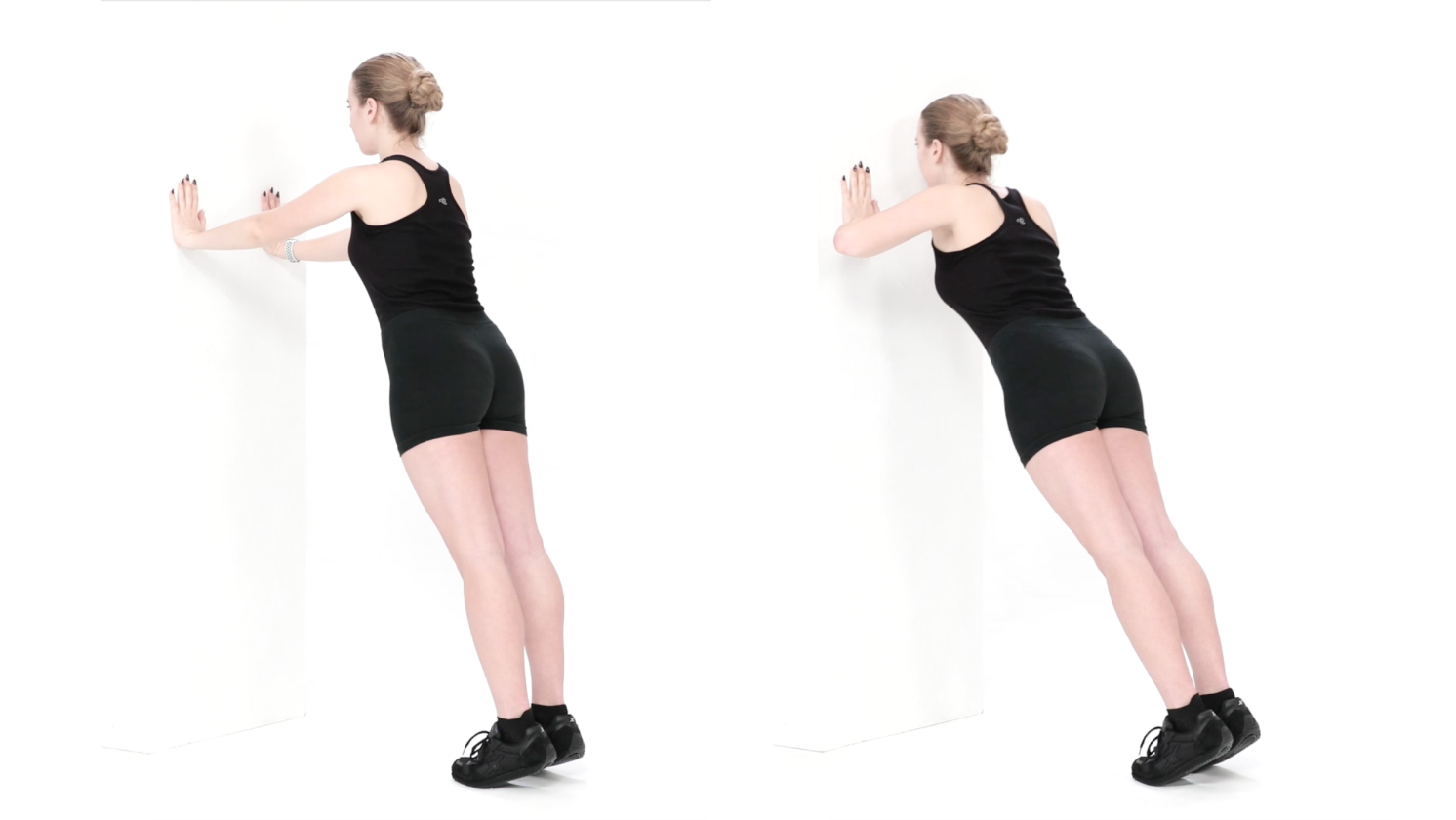 Wall push-ups
Stop signs and precautions for the wall push-ups
Before you start
- After a broken or dislocated elbow, or elbow surgery such as a tendon repair, follow your surgeon's or physio's plan, and start this exercise only when they have cleared you. If you have just hurt your arm and have severe pain or cannot move the elbow, do not exercise it. Go to an urgent care center or emergency department the same day. If you heard a snap or a crack at the moment of the injury, the arm looks a different shape or sits at an odd angle, a bone is showing, or your arm or hand tingles, feels numb or turns cold, pale or blue, go to an emergency department straight away or call emergency services, and do not drive yourself.
- After shoulder surgery, including a rotator cuff repair, or after a shoulder fracture or dislocation, follow your surgeon's or physio's plan, and do only the movements and range they have cleared. Many plans allow only passive movement at first, where the arm is moved for you and its muscles stay relaxed. Putting weight through your arms usually comes later, so check with your physio first.
- After recent heart or chest surgery, get your surgeon's or surgical team's okay first, because leaning your weight into your hands and pressing back off the wall loads the healing breastbone and the front of the chest. If the breastbone clicks, grinds, shifts or feels as if it is moving while you do it, stop, and contact your surgical team the same day.
When to stop and get help
- Sharp pain in the shoulder, elbow or wrist.
- Pain, numbness or tingling spreads down the arm.
- Pins and needles in your arm or hand that do not go away after you stop, or part of your arm or hand goes numb. Get medical advice the same day. If one side of your face or body suddenly goes numb or weak, or your speech becomes slurred or muddled, call emergency services, even if it goes away.
- Your feet start to slip on the floor.
- A sudden pop or tearing feeling in the shoulder that brings sharp pain, new weakness or trouble lifting the arm. Stop and contact your surgical team the same day, or get medical advice the same day if you have not had surgery.
- The shoulder feels as if it has slipped out of place, looks a different shape or suddenly locks so you cannot move the arm, or your hand turns cold, pale or blue. Go to an emergency department straight away, without driving yourself, and do not try to put the shoulder back in yourself.
- Chest pain or pressure, dizziness or feeling faint, a racing or irregular heartbeat, or being far more out of breath than the effort should cause.
After a distal biceps repair
The first question is usually how long the arm stays still, and the answer has shifted. OrthoInfo describes the arm being immobilized in a cast or splint at first and then moved gradually with a brace and physical therapy, with resistance added in stages.
A randomized trial of 101 men whose tendons were fixed with a cortical button compared early movement with 6 weeks of immobilization. It found no difference in when people got back to work, better QuickDASH scores over time and more passive supination in the early movement group, no difference in pain, active movement or strength, and one full-thickness tear in each group at 12 months (Bergman and colleagues, 2021). The authors concluded that early motion after that particular fixation is well tolerated. Your own fixation and your surgeon's judgment decide your plan, so this is useful context for a conversation rather than permission to take the brace off.
What the leaflets agree on, whatever the fixation, is the first 6 weeks. Two UK hospital leaflets for this operation tell you not to force the elbow straight and not to do resisted elbow bending or resisted turning of the palm for 6 weeks, while the sling usually comes off at about 1 to 2 weeks and gentle movement starts straight away. One of them starts gentle holds in the 4 to 6 week block and adds band work for bending the elbow and turning the palm at 6 to 8 weeks (Royal United Hospitals Bath; Royal Berkshire).
The same leaflet says plainly why nothing is lifted in the meantime: the repair is weak for the first 10 days, even though the elbow is being moved from the start. For those first two weeks it asks you to use the hand for nothing except the exercises in its booklet, and only from weeks 2 to 4 does it allow light duties, the sort of thing a knife and fork or a phone asks of it. If you are three days in, the knife and fork line is not yet yours. The Royal Berkshire leaflet allows desk work as soon as you can manage it but no lifting with that arm, and has the sling worn day and night for about 1 to 2 weeks, off only for the exercises and for washing and dressing. A sling worn day and night also leaves you close to one handed, so take stairs slowly and keep the free hand for the rail, because a fall onto the healing elbow is one of the emergency signs further down this page.
A review of current practice describes the same shape, with protected movement in the first week, assisted elbow movement from weeks 2 to 6 with the weight of the forearm taken where it can be, resisted palm turning avoided through that block, and progressive resistance from 6 to 12 weeks (Elgendy and colleagues, 2025). Units run different numbers, so yours come from your own team rather than from this page.
Two complications are worth knowing about, and neither is a reason to be frightened. OrthoInfo says numbness or weakness in the forearm, wrist or hand can happen after this operation and usually settles, and that new bone sometimes forms where the tendon was reattached, which can limit forearm turning and occasionally needs further surgery. It also says re-rupture after full healing is uncommon. Both of the first two have their own warning lines below, and both are better reported early than watched at home.
The practical constraint is the lifting ban. Several months with no heavy lifting changes work, childcare, gym and driving plans, and the time to sort that out is the first week, not the twelfth. Ask your surgical team for your restrictions in writing, because employers act on specifics, not on a diagnosis. Ask as well whether your fixation changes when the brace comes off, since protocols vary between surgeons using different devices.
If you live alone, sort the first fortnight out before the operation rather than after it. The Royal Berkshire leaflet says plainly that you may need help to wash and dress and advises arranging it with family or friends ready for coming home, and the jars, bottles, kettle and shopping need somebody too. If you have nobody to ask, say so to the surgical team before the date, so it is planned rather than improvised on the day you get home.
Dates for ordinary activities are what people ask for first and what varies most between units. The Royal Berkshire leaflet gives its earliest times as driving from 3 to 4 weeks or whenever you can control the car safely, breaststroke from 6 to 8 weeks and front crawl at 3 months, golf from 8 weeks but not on the driving range, contact sports from 3 to 6 months, desk work as soon as you can manage it with no lifting on that arm, and heavier work from 3 months. The Bath leaflet lets you consider driving in its 4 to 6 week block if the arm is comfortable and you can do it safely, and asks you to check before heavy manual work, contact sport and sports that need long periods of holding on, such as climbing. The two differ on heavy lifting and manual work, so this page uses the longer figure, which is OrthoInfo's 4 to 6 months, and your surgeon's date beats both. Read all of these as the earliest a unit will consider rather than as a schedule, and check where you stand with your insurer before you drive.
None of this replaces your post-operative review, and the review is where your own dates come from. One of the two units refers you to physiotherapy about 2 weeks after the operation and sees you in the orthopaedic clinic at 6 weeks with an X-ray taken on arrival, which is also the point at which the first resisted work gets decided (Royal Berkshire). If nobody has booked you a review or a physiotherapy appointment, ring the team that operated instead of working through these stages on your own. If you cannot reach them, because you are away from home or the unit was private or in another country, ask your own doctor to chase it, and stay in the stage you are in rather than starting resisted work on the strength of this page.
After a proximal tenodesis or tenotomy
Which operation you had changes what you are protecting. After a tenotomy the tendon has been deliberately released, so there is no reattachment to guard, and a bulge in the upper arm is the expected result, not a sign that something failed. After a tenodesis the tendon has been fixed to bone or soft tissue, so there is a healing attachment, and resisted elbow bending and resisted turning of the palm usually wait for your surgeon's clearance, which is why stage 3 of this program sits behind that go-ahead. A review of current practice describes shoulder movement starting straight away after a tenodesis, with resisted elbow bending and resisted palm turning left out for the first 4 to 6 weeks and strengthening following once movement is pain free (Elgendy and colleagues, 2025).
Most of these operations are done as part of a larger shoulder procedure, very often a rotator cuff repair. Where that applies, the cuff protocol sets the pace and the biceps work fits inside it, not the other way round. The staged program for that situation is on our rotator cuff repair rehab page, and your surgeon's own sheet overrides both.
Cramping deserves a word, because it is the symptom people are least prepared for and the one the evidence argues about. One review found less cramping pain after tenodesis than after tenotomy (Ge and colleagues, 2015) and another found no difference (Zhou and colleagues, 2021). In the clinic it tends to show up with sustained hard work, not with one heavy lift, so pacing a task and splitting it up often helps more than any exercise does. Mention it to your surgeon if it is limiting what you do, since OrthoInfo lists disabling cramping among the reasons an operation is considered in the first place.
What we notice in the clinic
The distal rupture almost always arrives late, and the reason is nearly always the same sentence: it stopped hurting so I thought it was fine. The second most common is that the person could still bend the elbow and took that as reassurance. Bending the elbow is shared work, so it often looks close to normal, and the giveaway sits in the forearm instead. Jar lids, door handles, screwdrivers, a wine bottle, carrying a tray flat on the palm. People describe those before they describe weakness lifting.
The bulge is the opposite problem. At the shoulder it looks dramatic and does very little, and most of the conversation is reassurance, not rehabilitation. It is worth saying plainly that the arm will probably always look different, because somebody who expects the shape to come back will keep searching for a treatment that does not exist.
With the exercises, two cues earn their keep. In forearm supination with a band and forearm pronation with a band, rest the forearm on a table with the hand just past the edge and keep the elbow tucked against your side, because the moment the elbow drifts out the shoulder takes over and the forearm stops working. In the reverse grip curl the point is that there is no weight: your own forearm is the load, and adding a dumbbell too early is the commonest way people flare a repair that was going well.
Grip work is the quietly useful one. Hand grip squeezes and opening and closing the hand can usually run from the first week, they keep the forearm from wasting while the elbow waits, and they give somebody in a brace something to actually do. People who have a job to do with the arm cope much better with the waiting.
When to see a physio or doctor
Go to an urgent care center or an emergency department the same day if you think you have torn the tendon at the elbow, and say so in those words, even if it happened weeks ago and the pain has gone quiet. That is the one route on this page with a deadline attached. Ask for a referral to a physical therapist (physiotherapist) if nobody has arranged one after an operation, if the arm is not getting steadily stronger, or if you have a physical job or a sport to get back to.
For a long head tear at the shoulder, the useful appointment is usually about the shoulder and not the bulge: persistent pain, night pain, weakness lifting or trouble reaching behind you are the things worth assessing, and they often turn out to involve the rotator cuff. If an injury to the elbow was severe or involved a fall onto the arm, a fracture needs excluding first, and our elbow fracture rehab page covers that situation.
For how fast to act on a particular problem, use the warning signs below. Each one says how quickly to get help.
For physiotherapists
This is a patient-facing framework for the two locations under one search term, deliberately separated because the ranking pages collapse them. Stages are gated by the treating surgeon's protocol, not by week numbers, and the distal post-operative content assumes nothing about fixation type.
The time-critical message rests on OrthoInfo's stated windows, 2 to 3 weeks ideal, up to 6 weeks sometimes possible, graft reconstruction more likely beyond 3 weeks, rather than on a guideline, because no APTA, JOSPT, NICE, Australian or Canadian clinical practice guideline specific to biceps tendon rupture was found while writing this page. Diagnostic content follows O'Driscoll and colleagues (2007), where the hook test reached 100% sensitivity and specificity against 92% and 85% for MRI in 45 surgical patients. It also follows Devereaux and ElMaraghy (2013), whose three-test combination was accurate when all three agreed in 48 patients. Both are single-center series and neither is a guideline-grade diagnostic accuracy study.
Morrey and colleagues (1985) is the primary source of the 30 to 40% figure OrthoInfo quotes for non-operative distal outcomes, and the number should be traced to that paper, not to the later sources that repeat it. The study had 10 patients across four treatment groups, and the 40% supination and 30% flexion losses come from the 3 managed without surgery, which is the n the page now states. Looney and colleagues (2022) pooled 62 studies and 2,481 cases but only 79 non-operative cases, so the effect sizes for flexion (25.67%) and supination (27.56%) strength carry that asymmetry. Quzli and colleagues (2025) is a retrospective cohort of 72 without validated outcome scores and is cited only for the complication direction.
The early mobilization evidence sits in a narrow population. Bergman and colleagues (2021) randomized 101 male participants with a mean age of 44.7 years and cortical button fixation, and that is who the result applies to. The page now states that limit to the reader, because every protocol figure and every strength figure here comes from predominantly male middle-aged series and a woman or an older patient is being given the nearest available evidence rather than her own.
Stage 3 is pegged to the 6 week restriction on resisted elbow flexion and supination that the Royal Berkshire and Royal United Hospitals Bath leaflets both state, with Bath's isometric block at 4 to 6 weeks and band work at 6 to 8 weeks. Elgendy and colleagues (2025) describe progressive resistance from 6 to 12 weeks, and retrospective practice at one UK unit introduced progressive strengthening at weeks 6 to 8 (Quzli and colleagues, 2025).
The earlier draft of this page reasoned a 2 to 3 month figure back from OrthoInfo, which gives no week for resistance at all; the figure is now the restriction the leaflets state rather than an inference. Return to heavy activity and manual work stays on OrthoInfo's 4 to 6 months, the more conservative of the available figures, and not the 3 months the Royal Berkshire leaflet gives for heavier duties. The 6 weeks is written as a floor and not as a start date, because both leaflets describe a straightforward single-incision repair and a reader whose own restriction runs longer, after a late repair, a graft or simply a slower unit protocol, would otherwise read our figure as permission.
The construct question is settled, not left open: 6 weeks is not raised to 8 for a single-incision cortical button repair. Both leaflets are written for that fixation, the Royal Berkshire one naming the endobutton and the single anterior incision, the one randomized trial in that population found early motion well tolerated (Bergman and colleagues, 2021), and no source read for this page states 8 weeks for first resisted work, so an 8 week figure here would be ours rather than anybody's. The bone side of the construct is also not its weak link. In a cadaveric study of 12 arms repaired with all-suture anchors, only 0.7 to 1.3 mm of the unrecoverable elongation under cyclic loading came from anchor seating and suture stretch, the rest from the tendon and the suture-tendon interface, and the authors' caution was about flexion against resistance, not about early motion (Baleani and colleagues, 2025). A stronger fixation therefore buys earlier movement rather than an earlier resisted load, which is why the date tracks tendon-to-bone healing and stays where the units put it.
Two dose figures moved as a result. Stage 3's per-set number is now the Bath leaflet's own starting dose for band work, about 5 repetitions 4 to 5 times daily, building toward the 2 to 3 sets of 10 to 15 the exercise pages give, because the page's upper end was roughly double the daily total Bath prescribes across the same three band exercises in its 6 to 8 week block. Stage 4 now has a floor as well as a clearance gate, since stage 3 feeling easy could otherwise be reached at 7 weeks: Bath works up to maximal weight bearing in its 8 to 12 week block and asks for a check at 12 weeks before heavy manual work, contact sport and sports needing sustained grip, the Royal Berkshire list puts heavy lifting at 3 months or more, and neither leaflet prescribes a dumbbell at any stage. The last two additions are scope, not dose: the distal section now says a partial tear is managed differently and that the hook test reads normal in one, and the post-operative section now says this page does not replace the surgical review at which resisted work is actually authorized.
Three further dose figures moved to the leaflets' own, because both documents prescribe short sets done often rather than long sets. Stage 2 drops from 10 to 15 bends and turns 2 to 3 times a day to 5 to 10 several times a day, and grip work from 10 to 15 to 5 to 10, which is Royal Berkshire's stated 5 to 10 repetitions a few times a day and inside Bath's 10 repetitions 4 to 6 times daily; neither source prescribes 15 in a row at that stage, so the old upper end was ours. Stage 1 gains a shrug figure it did not have, 10 unloaded, with the note that both leaflets set the scapulae back and down rather than up. Stage 3's progression now names the clinician as the gate for moving off the 5 repetition dose rather than leaving the reader with two dose pictures and no rule for choosing between them. Stage 4's first weight-bearing step is Bath's two-handed static table lean, elbows straight, 5 seconds, five times, which precedes a dynamic wall push-up; Bath's own 8 to 12 week wall exercise is a forearm walk and not a push-up.
One more set-up needed stating. Isometric shoulder flexion is performed with the arm straight out in front pressing a flat palm into a wall, and its page lists a bending elbow among the mistakes, which is the wrong cue for a 6 week old distal repair. The stage text now describes the position, caps the effort at the point where the elbow wants to bend, and places it last in the stage. It is not removed: Bath's own first weight-bearing exercise at 4 to 6 weeks is also a straight-elbow load, two-handed on a table, so a submaximal one-arm press after 6 weeks is not out of line with the read sources.
Everyday use between sessions was a permission disguised as a restriction. Bath's knife and fork allowance belongs to its weeks 2 to 4 block, while weeks 0 to 2 permit the hand nothing but the booklet exercises, and the page had been quoting the looser of the two without its week. Both blocks are now stated separately, with Royal Berkshire's sling worn day and night for 1 to 2 weeks and off only for exercises, washing and dressing.
Three of the prescribed exercises needed their set-up stated in the stage text instead of left to the exercise card. Shoulder shrugs is filmed with dumbbells, so stage 1 now says to shrug unloaded and why; the forearm turn is filmed prone with the elbow near full extension, so stage 2 redirects it to the elbow-flexed, tucked-in position both leaflets use; and the stick-assisted lift stays with the proximal reader because it is performed with the elbow held straight in pronation. Stage totals were checked against each exercise page's own dose: stage 3 prescribes three loaded forearm exercises and stage 4 two curl variants of one movement, so both stages now say to build one at a time rather than stack a full prescription of each.
The proximal surgical comparisons (Vajda and colleagues 2022; Zhou and colleagues 2021; Ge and colleagues 2015) were conducted in patients having surgery for long head of biceps lesions broadly, frequently concurrent with cuff repair, not in isolated complete long head ruptures, and the page states that limitation. The page also now says why the comparison cannot be the rupture reader's decision: a complete long head rupture is already the end state a tenotomy produces, and OrthoInfo describes surgery for one as fixation to the humerus, so the tenodesis against tenotomy literature informs the post-operative reader rather than offering her a choice. The three reviews agree on deformity and disagree on cramping and strength, which is why nothing stronger than a shared decision is claimed. Screen each visit for wound problems, lateral antebrachial cutaneous and posterior interosseous nerve symptoms, heterotopic ossification presenting as a hard end-feel and progressive loss of rotation, and a sudden loss of flexion or supination strength that may indicate repair failure.
Warning signs
Get emergency help now
- Chest pain or tightness, which may spread to your arm, neck or jaw, or shoulder or arm pain that comes with shortness of breath, sweating or feeling sick. This can be a heart attack. Call emergency services straight away.
- Emergency: while you are in a cast or splint, your fingers turn blue, white or pale, or feel cold. Do not wait to see if raising your hand helps. Go to an emergency department straight away, and do not drive yourself. The cast or splint may be cutting off the blood supply, or pressure may be building up inside the forearm (compartment syndrome), and both need checking quickly.
- Emergency: sudden, severe pain in your forearm or hand that is much worse than you would expect and keeps getting worse, especially in the first days after an operation on the arm, or with a cast, splint or tight bandage on the arm. It may come with a tight, swollen forearm, pain that gets much worse when your fingers are gently straightened, numbness, pins and needles or weakness, or pain that keeps building and is not settled by painkillers that were working before. Call emergency services or go to an emergency department straight away, and do not drive yourself. This can be acute compartment syndrome, which needs urgent surgery.
- Your arm, hand or fingers turn cold, pale, blue or gray compared with the other side. Call emergency services or go to an emergency department straight away, and do not drive yourself. The blood supply to the arm may be blocked.
- Emergency: a new fall or knock on the healing elbow, followed by a snap or a crack you heard at the moment of it, numbness, tingling or pins and needles in the arm or hand, a hand that turns cold, pale or blue, or an elbow that has changed shape or sits at an odd angle. The same applies to a bone showing through the skin or a cut that is bleeding heavily. Go to an emergency department or call emergency services straight away, and do not drive yourself.
- The shoulder is hot, red and swollen, or you have a fever or feel unwell. This can be a joint infection, which needs treatment quickly. Go to an emergency department the same day, and call emergency services if you feel very unwell.
Get help today
- Same day: sudden pain at the front of the elbow, usually with a pop or a tearing feeling, while lifting, catching or holding something heavy, after which turning your palm upward feels weak. You may also see bruising spreading down the forearm, a soft gap at the front of the elbow, or the biceps muscle bunched up nearer the shoulder than on the other arm. Stop and go to an urgent care center or emergency department the same day, even if the pain settles within a day or two and even if you can still bend the elbow, and say you think the biceps tendon has pulled off at the elbow. This is the one warning sign on this page where waiting a few weeks changes what can be done, because OrthoInfo puts the best window for reattaching the tendon at the first 2 to 3 weeks. If this happened to you weeks ago and nobody has examined the elbow, the same route still applies and it is worth using now rather than waiting, because OrthoInfo says a repair can sometimes still be done up to 6 weeks after the injury.
- Same day: the pain started after a fall, a pull or another injury, especially if the arm has been weak since, for example you cannot lift it out to the side or hold it up. This can be a broken bone or a torn tendon. Get medical advice the same day, and say how it happened and that the arm has been weak since, because UK shoulder surgeons advise urgent referral for a rotator cuff tear caused by an injury.
- Same day: since your operation, the bulge in your upper arm comes back or sits nearer the elbow again, the front of the elbow suddenly becomes more painful or more bruised, or bending the elbow or turning your palm up suddenly feels weaker than it did the week before, with or without a pop and with or without any new injury. Stop the exercises, rest the arm in your sling if you still have one and contact your surgical team the same day, or go to an urgent care center or an emergency department if you cannot reach them. A repair can come apart, and it is dealt with better when it is found early.
- Same day: since an operation, the wound is red, hot, swollen, leaking fluid or opening up, you have a fever or feel hot and shivery, or the pain in that area is new or getting worse quickly. Contact your surgical team or the ward you went home from the same day rather than waiting for your physio appointment, and if you cannot reach them, go to an emergency department the same day. This can be an infection in the wound or deeper, around a repair or a new joint. Redness can be harder to see on brown or black skin. If you have a very high or very low temperature, shivering you cannot control, you are breathing very fast or finding it hard to breathe, you are confused or your speech is slurred, your skin, lips or tongue look blue, gray, pale or blotchy (on brown or black skin this can be easier to see on the palms of the hands or soles of the feet), or you have a rash that does not fade when you press it, call emergency services, as this can be sepsis.
- Same day: since your operation, your arm or hand is getting more swollen instead of settling, or has a new throbbing or cramping pain, warm skin, red or darker skin, or swollen veins that are sore to touch. Some bruising and swelling of the arm is common after this operation and fades over a few weeks, but a blood clot can sometimes form in the arm. Get medical advice the same day. If you are also short of breath or have chest pain, call emergency services.
- Same day: since your operation, new numbness, tingling or burning in your forearm, the back of your hand or your thumb, or a hand or wrist that is getting weaker, for example you cannot lift your wrist or straighten your thumb. Contact your surgical team or get medical advice the same day. Nerves run close to where this tendon is reattached, and OrthoInfo says numbness or weakness in the forearm, wrist or hand after this operation usually settles. Weakness that is getting worse is the one to report quickly, because it points to a nerve that has been injured rather than bruised.
- Pins and needles in your arm or hand that do not go away after you stop, or part of your arm or hand goes numb. Get medical advice the same day. If one side of your face or body suddenly goes numb or weak, or your speech becomes slurred or muddled, call emergency services, even if it goes away.
- Same day: the elbow feels as if it slips, shifts or gives way, or it locks, catches or seems blocked when you bend it or turn your palm. Stop the exercise that does it, rest the arm and contact your surgical team or fracture clinic the same day. If the elbow looks out of shape, or you cannot move it at all, go to an emergency department straight away.
- Same day: pain at night or at rest that keeps getting worse rather than easing as the weeks go by. If you are being treated for cancer now, contact your cancer team the same day.
Book an appointment
- Within a few days: the elbow is getting stiffer week by week instead of looser, you are losing bend, straightening or forearm turn that you had before, or the movement stops at a hard, bony-feeling block rather than at tight, stretchy tissue. Stop pushing the stretch, keep moving the elbow gently inside the range you still have, and contact your surgical team or fracture clinic within a few days for an X-ray. OrthoInfo says new bone can form where the tendon was reattached, which can limit forearm rotation and occasionally needs further surgery, and forcing the stretch is not the answer to it.
- Since the injury or an operation on your arm, the hand is getting more painful rather than less, the skin becomes very sensitive to light touch, or the hand changes color, temperature, swelling or sweating compared with the other one, or looks shiny. See your doctor or physio as soon as you can, within a few days at most, as this can be complex regional pain syndrome (CRPS) and early treatment may help.
- Within a day or two: pain at night or at rest that keeps getting worse rather than easing as the weeks go by. If you have had cancer, now or in the past, or are losing weight without trying, see your doctor sooner, within a day or two, and mention it. This applies even if the pain is not getting worse.
- Within a few days: pain at night or at rest that keeps getting worse rather than easing as the weeks go by. See your doctor within a few days.
- Your arm is still weak at turning the palm up or at bending the elbow, or still aches with ordinary lifting, 4 to 6 months after the injury or the operation. This is not an emergency, but ask your surgeon or physio for a review in the next week or two.
Common questions
How long does a ruptured biceps tendon take to heal?
At the elbow, longer than most people expect. OrthoInfo says full healing after a distal biceps repair takes more than 3 to 4 months, so activity has to be restricted through that time, and that heavy activities and manual work are usually possible at about 4 to 6 months. Light activity can start soon after the operation. At the shoulder, OrthoInfo gives no healing time at all for a long head tear: it says a sling may be used for a brief period after surgery and that rehabilitation is a slow process. The shoulder timeline is left blank here rather than borrowed from the elbow, because the two injuries heal differently.
Is a biceps tendon rupture painful?
Usually yes at first, and often much less later, which is the trap. At the shoulder, OrthoInfo describes sudden sharp pain in the upper arm, sometimes with a pop or snap, cramping with hard use of the arm, and bruising spreading from the upper arm toward the elbow, and says that for most people the pain goes away over time. At the elbow, OrthoInfo says the pain is severe at first and may ease after a week or two. Pain settling does not mean the tendon has reattached itself, and at the elbow it is a common reason the injury gets missed.
Does a proximal biceps tendon rupture need surgery?
Usually not. OrthoInfo says tears of the long head of the biceps tendon rarely need surgery, and that surgery is almost never done for the look of the arm alone. It lists the reasons surgery may be considered: symptoms that do not settle with non-surgical care, disabling biceps cramping, significant shoulder pain, or arm weakness that stops you working or managing things like bathing, dressing, cooking, cleaning and shopping. Because this tendon usually tears in a shoulder that already has other wear, what needs treating is often the shoulder as a whole rather than the biceps.
How is a distal biceps rupture tested for?
By examination first, and imaging second. OrthoInfo describes the clinician looking and feeling for a gap at the front of the elbow, hooking a finger under the tendon, and comparing the strength of turning the palm up against the other arm. In 45 patients going to surgery, the hook test was abnormal in all 33 complete tears and normal in all 12 partial tears, giving 100% sensitivity and specificity in that series, against 92% and 85% for MRI (O'Driscoll and colleagues, 2007). In 48 patients, combining the hook test with a passive forearm pronation test and a biceps crease measurement matched the surgical or imaging finding every time the three agreed, and the authors note that no single test, MRI included, has shown 100% accuracy (Devereaux and ElMaraghy, 2013). None of this is a self-test, and it is a reason to ask for an examination early rather than wait for a scan.
What are the signs of a distal biceps rupture?
OrthoInfo lists a pop at the elbow at the moment it tears, severe pain that may ease after a week or two, swelling at the front of the elbow, bruising in the elbow and forearm, weaker bending of the elbow, weaker turning of the forearm, a bulge or bunched muscle nearer the shoulder, and a gap at the front of the elbow. The one people notice at home is the turning. Bending often still looks almost normal, because other muscles bend the elbow, so a door handle, a jar lid or a screwdriver tends to give it away before lifting does.
Is the Popeye deformity permanent?
At the shoulder it usually is, unless the tendon is surgically reattached. OrthoInfo explains the bulge as the torn tendon no longer holding the biceps muscle tight, so the muscle sits closer to the elbow than on the other arm, and it says surgery is almost never done for that reason alone. Where surgery is done for a long head problem, the bulge is less common after a tenodesis, which anchors the tendon, than after a tenotomy, which releases it: a meta-analysis of randomized trials found an odds ratio of 0.19 for the deformity at 24 months in favor of tenodesis (Vajda and colleagues, 2022), and another put the risk ratio at 0.33 (Zhou and colleagues, 2021).
Can a biceps tendon rupture heal on its own?
Not in the sense of reattaching itself. At the shoulder the body manages without the torn tendon well enough that most people do not need it repaired, and the symptoms settle rather than the tendon healing back (OrthoInfo). At the elbow the torn end pulls away from the bone and stays there, which is why OrthoInfo says reattaching it is what restores full strength, and why the window for a straightforward repair matters. Living without a repaired distal tendon is a reasonable choice for some people, but it is a choice about function, not about healing.
How much strength do you lose without surgery at the elbow?
Mostly in turning the palm up, and the best-known figures come from a very small study. OrthoInfo quotes about a 30 to 40% drop in strength, mainly in twisting the forearm. That traces back to a biomechanical study of 10 patients, of whom only 3 were treated without surgery: those 3 lost a mean of 40% of supination strength, and their flexion loss varied and averaged 30% (Morrey and colleagues, 1985). A later review pooling 62 studies found that surgery was associated with higher flexion strength, by a mean of 25.67%, and higher supination strength, by 27.56%, together with better DASH and Mayo elbow scores (Looney and colleagues, 2022). Only 79 of the 2,481 cases in that review were treated without surgery, so the non-surgical side of the comparison rests on far less data than the surgical side.
Is it too late to repair a distal biceps rupture?
It depends how long it has been, and this is a question for a surgeon rather than for a web page. OrthoInfo says the ideal repair is in the first 2 to 3 weeks, that repair can sometimes be done up to 6 weeks after the injury, and that beyond 3 weeks a reconstruction using a donor tendon becomes more common and may be necessary. A narrative review takes the same line, that delayed distal ruptures generally need anatomic repair or a graft reconstruction (Elgendy and colleagues, 2025). Late is not the same as hopeless, so if you think you tore it weeks ago, ask for a referral now rather than assuming the chance has gone.
Can you still lift weights after a biceps tendon tear?
Many people do, in time and with a plan. After a repair at the elbow, OrthoInfo says heavy lifting and vigorous activity should be avoided for several months and that return to heavy activities and manual work is typically possible at about 4 to 6 months, and your surgeon sets your own dates. After a long head tear at the shoulder that has not been operated on, there is no repair to protect, so what limits lifting is the shoulder's own tolerance and whatever else is wrong in it. Either way the honest answer from the clinic is that the forearm turning strength comes back last, so pulling and carrying usually return before anything that twists a heavy load.
References
- American Academy of Orthopaedic Surgeons. Biceps tendon tear at the shoulder. OrthoInfo. https://www.orthoinfo.org/en/diseases--conditions/biceps-tendon-tear-at-the-shoulder/
- American Academy of Orthopaedic Surgeons. Biceps tendon tear at the elbow. OrthoInfo. https://www.orthoinfo.org/en/diseases--conditions/biceps-tendon-tear-at-the-elbow/
- Morrey BF, Askew LJ, An KN, Dobyns JH. Rupture of the distal tendon of the biceps brachii. A biomechanical study. Journal of Bone and Joint Surgery (American). 1985;67(3):418-421. PMID 3972866. https://pubmed.ncbi.nlm.nih.gov/3972866/
- O'Driscoll SW, Goncalves LB, Dietz P. The hook test for distal biceps tendon avulsion. American Journal of Sports Medicine. 2007;35(11):1865-1869. https://doi.org/10.1177/0363546507305016
- Devereaux MW, ElMaraghy AW. Improving the rapid and reliable diagnosis of complete distal biceps tendon rupture: a nuanced approach to the clinical examination. American Journal of Sports Medicine. 2013;41(9):1998-2004. https://doi.org/10.1177/0363546513493383
- Looney AM, Day J, Bodendorfer BM, et al. Operative versus nonoperative treatment of distal biceps ruptures: a systematic review and meta-analysis. Journal of Shoulder and Elbow Surgery. 2022;31(4):e169-e189. https://doi.org/10.1016/j.jse.2021.12.001
- Bergman JW, Silveira A, Chan R, et al. Is immobilization necessary for early return to work following distal biceps repair using a cortical button technique? A randomized controlled trial. Journal of Bone and Joint Surgery (American). 2021;103(19):1763-1771. https://doi.org/10.2106/JBJS.20.02047
- Vajda M, Szako L, Hegyi P, et al. Tenodesis yields better functional results than tenotomy in long head of the biceps tendon operations: a systematic review and meta-analysis. International Orthopaedics. 2022;46(5):1037-1051. https://doi.org/10.1007/s00264-022-05338-9
- Zhou P, Liu J, Deng X, Li Z. Biceps tenotomy versus tenodesis for lesions of the long head of the biceps tendon: a systematic review and meta-analysis of randomized controlled trials. Medicine (Baltimore). 2021;100(3):e23993. https://doi.org/10.1097/MD.0000000000023993
- Ge H, Zhang Q, Sun Y, Li J, Sun L, Cheng B. Tenotomy or tenodesis for the long head of biceps lesions in shoulders: a systematic review and meta-analysis. PLoS One. 2015;10(3):e0121286. https://doi.org/10.1371/journal.pone.0121286
- Quzli AA, Jouni H, Dekker AP, Amanullah N, Ishaq A, Ashwood N. Operative versus nonoperative outcomes: a cohort study on distal biceps tendon rupture. Cureus. 2025;17(10):e93741. https://doi.org/10.7759/cureus.93741
- Elgendy M, Mersal M, Embaby O, Elsaidy S, Alsonbaty M. Biceps tendon rupture: contemporary evidence, evolving techniques, and a mechanics-to-management clinical framework. Cureus. 2025;17(11):e97718. https://doi.org/10.7759/cureus.97718
- Kulkarni R, Gibson J, Brownson P, Thomas M, Rangan A, Carr AJ, Rees JL. Subacromial shoulder pain. BESS/BOA Patient Care Pathways. Shoulder and Elbow. 2015;7(2):135-143. https://doi.org/10.1177/1758573215576456
- Baleani M, Cavallo M, Fognani R, et al. All-suture anchor arthroscopic repair of the distal biceps tendon: impact of suture cross-section on fixation strength and gap formation resistance. Journal of Orthopaedic Surgery and Research. 2025;20(1):1100. https://doi.org/10.1186/s13018-025-06513-5
- Royal United Hospitals Bath NHS Foundation Trust. Distal Biceps Repair. Hand Therapy patient information. https://www.ruh.nhs.uk/patients/patient_information/HTH004_Distal_Biceps_Repair.pdf
- Royal Berkshire NHS Foundation Trust. Distal biceps tendon repair, advice and exercises. June 2026. https://www.royalberkshire.nhs.uk/media/ctukxdzk/distal-biceps-tendon-repair_jun26.pdf
- NHS. Compartment syndrome. Page last reviewed 4 September 2026. https://www.nhs.uk/conditions/compartment-syndrome/
- NHS. DVT (deep vein thrombosis). Page last reviewed 30 April 2026. https://www.nhs.uk/conditions/deep-vein-thrombosis-dvt/
- NHS. Complex regional pain syndrome. Page last reviewed 27 October 2022. https://www.nhs.uk/conditions/complex-regional-pain-syndrome/
- NHS. Sepsis. Page last reviewed 14 May 2026. https://www.nhs.uk/conditions/sepsis/
Written and checked by the PocketPhysio editorial team. Last updated 2026-10-30.
This page is general education, not a diagnosis or a personal treatment plan. See a physiotherapist or doctor for advice about your own situation.