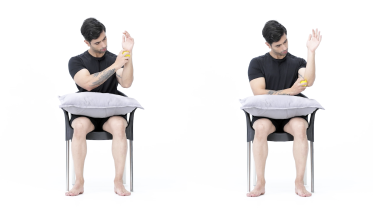
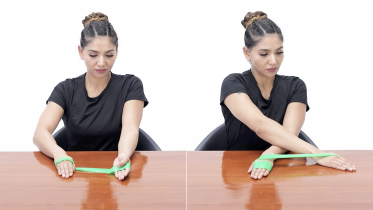
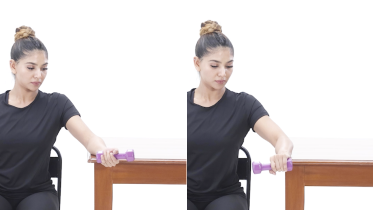
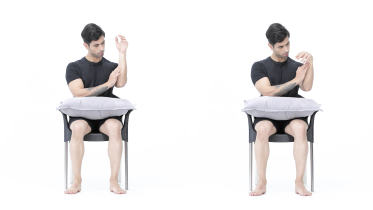
Forearm rotation lying face down
Forearm rotation lying face down is an assisted exercise for turning the palm up (supination) and down (pronation). You lie on your stomach with both arms reaching forward over the end of a bed, so about half of each forearm hangs past the edge, and use your other hand to help turn the working hand from palm down to palm up and back. Physios use assisted turning like this when the forearm has gone stiff, for example after a broken wrist or elbow, and its own muscles cannot yet turn it fully.
How to do the forearm rotation lying face down
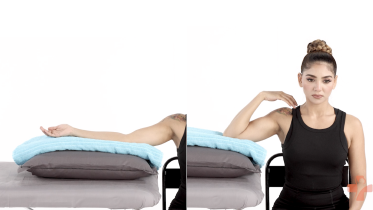
- Lie on your stomach on a firm bed or treatment couch, far enough toward the end that you can reach both arms forward past the edge, as in the video.
- Rest your forearms on the bed so that about half of each one, along with the wrists and hands, reaches out past the edge. Keep the elbows nearly straight.
- Wrap your other hand around the wrist and hand you are working.
- Slowly turn the working hand palm up, with the other hand helping, as far as it comfortably goes. Hold it there briefly.
- Turn it back through the middle until the palm faces down, and pause again. Keep the forearm resting on the bed so the turn comes from the forearm, not from rolling the shoulder.
What you should feel
A gentle stretch deep in the forearm and around the wrist and elbow at the end of each turn, easing as soon as you turn back.
Common mistakes
- Rolling the whole arm from the shoulder instead of turning at the forearm.
- Twisting only the hand at the wrist, or letting it tip up and down, rather than turning the whole forearm.
- Wrenching the hand around with the helping hand into sharp pain.
- Craning your neck up to watch your hands for the whole set.
How often
Many programs use 10 to 15 slow turns each way, 2 to 3 times a day, with a short pause at the end of each turn. Your physio will adjust this.
Stop and check with your physio if
- Sharp pain in the forearm, wrist or elbow, or a painful click or clunk as the hand turns.
- Pain or pinching in the shoulder from reaching forward, or your neck or lower back aches more as you go.
- Tingling, pins and needles or numbness in your hand, most often in the ring and little fingers (from the nerve behind the elbow, the ulnar nerve) or in the thumb, index and middle fingers (the median nerve).
- Pins and needles in your arm or hand that do not go away after you stop, or part of your arm or hand goes numb. Get medical advice the same day. If one side of your face or body suddenly goes numb or weak, or your speech becomes slurred or muddled, call emergency services, even if it goes away.
- Since the fracture or cast, the hand is getting more painful rather than less, the skin becomes very sensitive to light touch, or the hand changes color, temperature, swelling or sweating compared with the other one, or looks shiny. See your doctor or physio as soon as you can, within a few days at most, as this can be complex regional pain syndrome (CRPS) and early treatment may help.
From the clinic
After a broken wrist, hand or forearm, or surgery on any of them such as a tendon repair, start only when your doctor, surgeon, physio or hand therapist says the bone or repair is ready for this, and follow their plan for how much to do. After a broken or dislocated elbow, or elbow surgery such as a tendon repair, follow your surgeon's or physio's plan, and start this exercise only when they have cleared you.
If you have just hurt your arm and have severe pain, cannot move the elbow or heard a snap, do not exercise it. Go to an urgent care center or emergency department the same day. If the arm looks a different shape or sits at an odd angle, a bone is showing, or your arm or hand tingles, feels numb or turns cold, pale or blue, go to an emergency department straight away or call emergency services, and do not drive yourself.
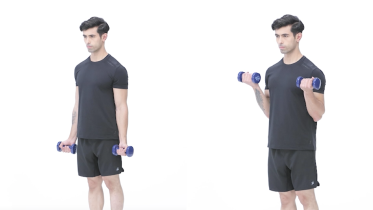
Early on, the helping hand does most of the turning. As the forearm loosens, let its own muscles do more, and your physio may move you on to forearm rotation with a dumbbell or the pronator stretch.
The muscle that turns the palm up starts near the outer elbow, and one of the muscles that turns it down starts near the inner elbow. If you have tennis elbow or golfer's elbow and the turn is sore there, let the helping hand do more of the work and keep the range smaller.
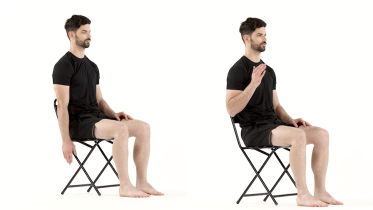
Reaching both arms forward lifts the shoulders well up, and you hold your head up to see your hands. If either bothers you, do the same turns sitting at a table, with your forearm resting on it and your hand just past the edge. If you are pregnant, lying on your stomach usually stops being comfortable as the bump grows, so use the sitting version.
Written and checked by the PocketPhysio editorial team. Last updated 2026-09-28.
This page is general education, not a diagnosis or a personal treatment plan. If you have pain, an injury or a health condition, see a physiotherapist or doctor before starting new exercises.