Forearm ball massage
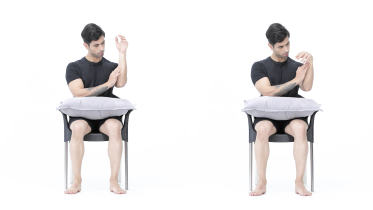
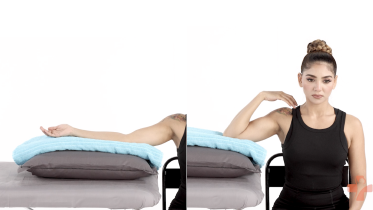
Forearm ball massage uses a soft ball to roll over the muscles on the palm side of your forearm, the ones that bend your wrist and fingers. You sit with a pillow on your lap, prop the elbow on it with the forearm upright, and roll the ball slowly from just above the wrist toward the elbow with your other hand. The app lists it for carpal tunnel syndrome, and some people also use it when the forearm feels tight after a lot of gripping.
How to do the forearm ball massage
- Sit up straight on a chair with your feet flat and a pillow resting across your thighs.
- Prop the elbow of the arm you are treating on the pillow, with the forearm pointing up and the palm facing you. The voice guide has the arm reaching out in front on the pillow, and that position is fine as well.
- Hold a soft ball, such as a stress ball, in your other hand and place it on the palm side of the forearm, a couple of finger widths up from the wrist crease.
- Press lightly and roll the ball up toward the elbow in small circles or short back-and-forth strokes, then bring it back down and go again.
- Stop after a minute or two, let the arm relax and shake it gently.
What you should feel
A comfortable, firm rolling pressure, perhaps with a few tender spots in the forearm muscles that ease as you go. Your fingers should not tingle.
Common mistakes
- Grinding the ball into the crease of the wrist, over the median nerve, which sits just under the skin there.
- Using a hard ball, such as a lacrosse or cricket ball, which is too firm for this.
- Rolling so fast that the ball skims the skin instead of moving the muscle.
- Leaning over the arm so your neck and shoulders stiffen.
How often
A common starting point is 1 to 2 minutes, once or several times a day. Your physio will adjust this.
Stop and check with your physio if
- Your forearm, hand or upper arm becomes swollen, warm, tender, red or darker than usual, has swollen veins that are sore to touch, or has a throbbing or cramping pain that feels different from normal muscle ache. Do not massage it. Stop and get medical advice the same day, as this can be a blood clot. If you are also short of breath or have chest pain, call emergency services.
- Tingling, pins and needles or numbness in your hand, most often in the ring and little fingers (from the nerve behind the elbow, the ulnar nerve) or in the thumb, index and middle fingers (the median nerve).
- Pins and needles in your arm or hand that do not go away after you stop, or part of your arm or hand goes numb. Get medical advice the same day. If one side of your face or body suddenly goes numb or weak, or your speech becomes slurred or muddled, call emergency services, even if it goes away.
- Sharp pain while rolling, or bruising or extra soreness afterward.
From the clinic
Keep the ball off cuts, rashes, broken or infected skin and scars that are still healing, and leave any red, hot or swollen patch alone. If the arm may have a blood clot, do not roll it at all; the stop list says what to do. Ask your doctor or physio before you start if you take blood thinners or bruise easily, have had a clot in the arm before, or have lymphedema or had lymph nodes taken out from the armpit.
After a broken wrist, hand or forearm, or surgery on any of them such as a tendon repair, start only when your doctor, surgeon, physio or hand therapist says the bone or repair is ready for this, and follow their plan for how much to do. Go gently near the wrist crease. If your fingers start to tingle, move the ball higher up the forearm or press more lightly. Near the elbow, roll lightly over the front of the bony point on the inner side, where these muscles share a tendon, and keep the ball out of the groove just behind that bony point, where the ulnar nerve (your funny bone) lies close under the skin.
Rolling can make a tight forearm feel easier for a while, but on its own it is not a treatment for carpal tunnel syndrome. Night splints and easing off the gripping and wrist bending that bring on the tingling come first. If you would rather use your fingers, see forearm self massage, and to stretch the same muscles, try the wrist flexor stretch.
Written and checked by the PocketPhysio editorial team. Last updated 2026-09-28.
This page is general education, not a diagnosis or a personal treatment plan. If you have pain, an injury or a health condition, see a physiotherapist or doctor before starting new exercises.