Triceps dips on a chair
A chair dip strengthens the muscle at the back of your upper arm (triceps). You hold the front edge of a chair seat, hover your bottom just in front of it, then bend and straighten your elbows to lower and lift your body. Your arms take most of your weight, so it is harder than it looks, and it asks a lot of the front of the shoulder.
How to do the triceps dips on a chair
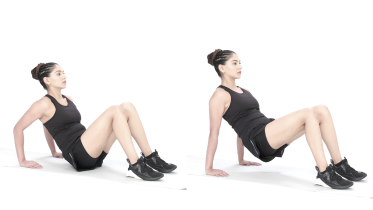
- Push a sturdy chair without wheels back against a wall so it cannot slide. Sit on the front of the seat and grip the front edge with both hands, close to your hips, fingers pointing forward.
- Walk your feet forward and slide your bottom off the seat so it hovers just in front of it. Keep your feet flat and your knees bent to about a right angle, thighs roughly level with the floor.
- Straighten your arms so your body is held up by your hands. Keep your back close to the edge of the chair and your shoulders down, away from your ears.
- Bend your elbows slowly to lower your body toward the floor. Your elbows point straight back, not out to the sides. Stop when your elbows are bent to about a right angle, with your upper arms about level with the floor, as in the video. Do not go lower than that, and stop higher if the front of your shoulder complains.
- Press down through your hands to straighten your arms and lift back up. Repeat at the same steady pace.
What you should feel
The back of your upper arms doing most of the work, with some effort across the front of the chest and shoulders. A pinch or ache deep in the front of the shoulder is not what you want.
Common mistakes
- Dropping too low, so the shoulders roll forward and the front of the shoulder takes the strain.
- Shrugging your shoulders up toward your ears as you lower.
- Letting the elbows flare out to the sides.
- Drifting forward away from the chair, or pushing up with your legs instead of your arms.
How often
Many programs start with 2 to 3 sets of 8 to 12, a few days a week, at a depth you can control. Your physio will adjust the depth and the numbers for you.
Stop and check with your physio if
- Chest pain or pressure, dizziness or feeling faint, a racing or irregular heartbeat, or being far more out of breath than the effort should cause.
- Pain or a pinching feeling at the front of the shoulder.
- The shoulder feels like it slips, clicks painfully or gives way.
- Sharp pain in the wrist or elbow.
- Pins and needles, numbness or pain running down an arm into your hand.
- Pins and needles in your arm or hand that do not go away after you stop, or part of your arm or hand goes numb. Get medical advice the same day. If one side of your face or body suddenly goes numb or weak, or your speech becomes slurred or muddled, call emergency services, even if it goes away.
- A sudden pop or tearing feeling in the shoulder that brings sharp pain, new weakness or trouble lifting the arm. Stop and contact your surgical team the same day, or get medical advice the same day if you have not had surgery.
- The shoulder feels as if it has slipped out of place, looks a different shape or suddenly locks so you cannot move the arm, or your hand turns cold, pale or blue. Go to an emergency department straight away, without driving yourself, and do not try to put the shoulder back in yourself.
From the clinic
Get the chair right before you worry about anything else. In the video it stands on its own, but at home a chair pushed against a wall is safer. If it slides back mid rep, you land on the floor. Folding chairs and office chairs with wheels are a poor choice.
To make it easier, bring your feet closer to the chair so your legs take more of your weight. Straightening the legs out in front makes it harder.
Dips take the arm behind the body while it carries your weight, and that position loads the front of the shoulder. If you have pain at the front or top of the shoulder, or a shoulder that has dislocated or felt unstable before, check with your physio before trying them.
After shoulder surgery, including a rotator cuff repair, or after a shoulder fracture or dislocation, follow your surgeon's or physio's plan, and do only the movements and range they have cleared. Many plans allow only passive movement at first, where the arm is moved for you and its muscles stay relaxed. Dips usually come late in rehab after shoulder surgery, if at all. Many people with shoulder problems are given a different triceps exercise to start with. If your wrists are sore, try gripping the edge with your hands turned slightly outward, and stop if that does not help.
After a broken wrist, hand or forearm, or surgery on any of them such as a tendon repair, start only when your doctor, surgeon, physio or hand therapist says the bone or repair is ready for this, and follow their plan for how much to do. After a broken or dislocated elbow, or elbow surgery such as a tendon repair, follow your surgeon's or physio's plan, and start this exercise only when they have cleared you.
If you have just hurt your arm and have severe pain, cannot move the elbow or heard a snap, do not exercise it. Go to an urgent care center or emergency department the same day. If the arm looks a different shape or sits at an odd angle, a bone is showing, or your arm or hand tingles, feels numb or turns cold, pale or blue, go to an emergency department straight away or call emergency services, and do not drive yourself.
If you have high blood pressure or a heart condition, ask your doctor before starting, and breathe out as you press up rather than holding your breath. If chest pain, pressure or tightness does not ease quickly when you rest, spreads to your arm, neck, jaw, stomach or back, or comes with sweating, feeling sick, feeling light-headed or being short of breath, call emergency services straight away, as this can be a heart attack. If it eases quickly and none of these happen, get medical advice the same day, and do not exercise again until you have been checked. If you faint while exercising, call emergency services, even if you feel fine again quickly.
Written and checked by the PocketPhysio editorial team. Last updated 2026-09-28.
This page is general education, not a diagnosis or a personal treatment plan. If you have pain, an injury or a health condition, see a physiotherapist or doctor before starting new exercises.