Ulnar nerve glide
The ulnar nerve glide is a slow, gentle movement for the ulnar nerve, which runs behind the inner elbow (the funny bone) to the ring and little fingers. Standing, you make a ring with your thumb and index finger, lift the arm out to the side and bring the ring over your eye like a pair of goggles, then ease the elbow back. The aim is a light pull, never strong tingling. Physios sometimes give it for ulnar nerve symptoms at the elbow (cubital tunnel syndrome), although the research on nerve glides for this is limited.
How to do the ulnar nerve glide
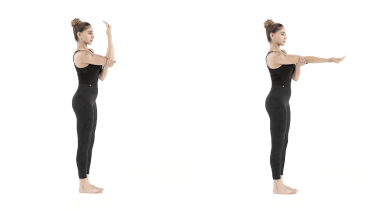
- Stand tall with the arm you are working relaxed by your side. Make a ring by touching the tip of your thumb to the tip of your index finger, and keep the other fingers straight.
- Lift the arm out to the side and up to about shoulder height, or a little above as in the video, then bend the elbow so the hand comes up beside your head.
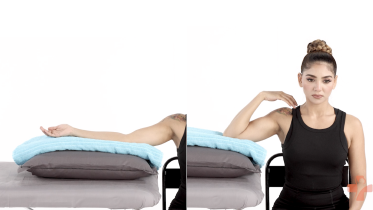
- Turn the hand and bring the ring to your face so it circles your eye like goggles, with the other fingers pointing down along your cheek, as in the video.
- Gently draw the elbow back until you feel a light pull along the inner elbow or forearm. Stop there, well before any tingling, and hold for a second or two.
- Lower the arm slowly to your side and let it rest before the next one.
What you should feel
A light pull along the inside of the elbow or forearm, or toward the little finger side of the hand, that fades as soon as you lower the arm. You should feel no tingling at all.
Common mistakes
- Pulling the elbow back hard, or holding the end position to chase a stronger feeling.
- Hitching the shoulder up toward the ear as the arm lifts.
- Tipping your head toward the hand to meet it, instead of bringing the hand to your face.
- Jerking into the goggles position instead of moving slowly.
How often
A typical start is 5 to 10 slow repetitions, with the end position held for no more than a second or two, once or twice a day. Some people begin with a smaller version that stops before the hand reaches the face. Your physio will adjust this.
Stop and check with your physio if
- Tingling, pins and needles or numbness in your hand, most often in the ring and little fingers (from the nerve behind the elbow, the ulnar nerve) or in the thumb, index and middle fingers (the median nerve).
- Pins and needles in your arm or hand that do not go away after you stop, or part of your arm or hand goes numb. Get medical advice the same day. If one side of your face or body suddenly goes numb or weak, or your speech becomes slurred or muddled, call emergency services, even if it goes away.
- Pain spreading from your neck down the arm, new weakness in your hand, or arm or hand symptoms that are clearly worse that evening or the next morning.
- The shoulder feels as if it has slipped out of place, looks a different shape or suddenly locks so you cannot move the arm, or your hand turns cold, pale or blue. Go to an emergency department straight away, without driving yourself, and do not try to put the shoulder back in yourself.
From the clinic
This is a gentle movement, not a stretch to push. An irritated nerve can flare up if it is pulled hard, and the goggles position with the elbow drawn back asks more of the ulnar nerve than most everyday movements. If even lifting the arm brings on tingling, keep the arm lower, leave out drawing the elbow back, or stop before the hand reaches your face. Tingling that builds, spreads or is still there after you lower the arm means stop, and the stop signs above give the timing.
Physios sometimes add a glide like this for cubital tunnel syndrome, but the research behind nerve glides for it is limited, and changing how you use the elbow comes first. Tingling in the ring and little fingers can also start in the neck, so get it checked if you are not sure where it comes from. See a doctor within a few days if your hand is getting weaker or clumsier, the numbness is there all the time, or the muscles of your hand look thinner. If the weakness is getting worse from day to day, or both hands are affected, get medical advice the same day.
After a broken or dislocated elbow, or elbow surgery such as a tendon repair, follow your surgeon's or physio's plan, and start this exercise only when they have cleared you. If you have just hurt your arm and have severe pain, cannot move the elbow or heard a snap, do not exercise it. Go to an urgent care center or emergency department the same day. If the arm looks a different shape or sits at an odd angle, a bone is showing, or your arm or hand tingles, feels numb or turns cold, pale or blue, go to an emergency department straight away or call emergency services, and do not drive yourself.
With the arm out to the side and the hand up by your head, the shoulder passes through the position in which it most often dislocates. After shoulder surgery, including a rotator cuff repair, or after a shoulder fracture or dislocation, follow your surgeon's or physio's plan, and do only the movements and range they have cleared. Many plans allow only passive movement at first, where the arm is moved for you and its muscles stay relaxed.
The median nerve glide and the radial nerve glide work in a similar way for the other two main nerves of the arm.
Written and checked by the PocketPhysio editorial team. Last updated 2026-09-28.
This page is general education, not a diagnosis or a personal treatment plan. If you have pain, an injury or a health condition, see a physiotherapist or doctor before starting new exercises.