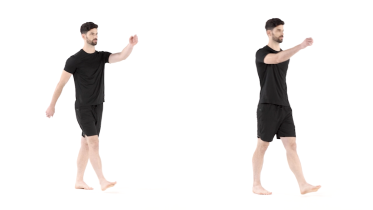
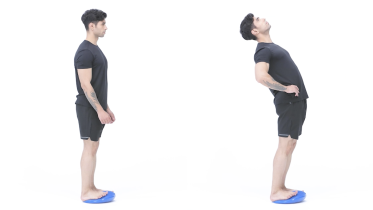
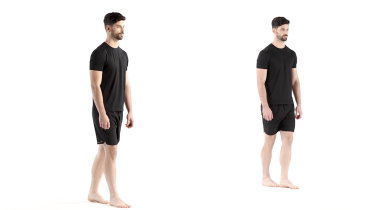
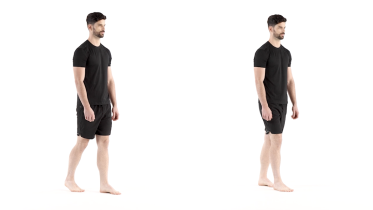
Gaze stabilization x2
Gaze stabilization x2 is a vestibular rehab exercise: you hold your thumb out in front of you, move it one way while you turn your head the other way, and keep your eyes locked on the thumb. Because the target and your head travel in opposite directions, your eyes have to work harder than when only your head moves. Physios use it for some inner ear problems, usually after the simpler version with a still target. Expect some mild dizziness, and start only once a doctor or vestibular physio has diagnosed the cause of your dizziness.
How to do the gaze stabilization x2
- Stand upright beside a kitchen counter or sturdy chair, with your feet a comfortable distance apart and your spare arm relaxed.
- Hold one arm straight out in front of you at eye level, thumb pointing up, and look at your thumbnail.
- Slowly move your thumb to the left while you turn your head to the right. Your eyes stay on the thumb the whole time.
- Now reverse it: turn your head to the left as the thumb moves to the right, still watching the thumb.
- Carry on from side to side at a slow, even pace, with small, slow head turns at first, as in the video.
- Build up how long you can keep going first. Once the thumb stays clear and you feel steady, try a little more speed. Blurred or double vision that stays once your head and thumb are still is a stop sign, not part of the exercise.
What you should feel
Your eyes work hard to keep the thumb in focus, and a mild, short-lived dizzy or swimmy feeling is common. The side of your neck and the arm holding the thumb do light work.
Common mistakes
- Moving the thumb and head the same way, which turns it into a different exercise.
- Carrying on when the thumb looks blurry. Slow down until it stays clear.
- Turning your head so far or so fast that your neck starts to hurt.
- Letting the arm sag as it tires. Change arms if you need to.
How often
Many programs start with 30 seconds to 1 minute at a time, working up to 1 to 2 minutes, 3 to 5 times a day, at a speed where the thumb stays sharp. Your physio will adjust this.
Stop and check with your physio if
- The dizziness becomes severe or stronger than your physio said to expect, you are being sick, or you feel faint. Stop, sit or lie still and get medical advice the same day before you do these exercises again. If you faint, it is no better after 10 minutes of keeping still, you suddenly lose hearing in one or both ears, or you are far more unsteady on your feet than usual, call emergency services.
- Things look double, your vision suddenly blurs or goes, your speech slurs or becomes muddled, swallowing becomes hard, your face or lips go numb, one side of your face droops or one side of your body goes weak or numb, you suddenly become so dizzy or unsteady that you fall or cannot stand or walk, your legs suddenly give way but you do not black out (a drop attack), or you get a sudden severe headache. Stop and call emergency services, even if it goes away.
- The head turns bring on neck pain, or numbness, tingling or pain spreading down an arm.
- You wobble so much that you have to hold the counter or chair to stay on your feet.
From the clinic
Start these exercises only after a doctor or vestibular physio has found the cause of your dizziness. New dizziness, or dizziness that has changed, needs checking first. This is one of the harder gaze exercises, and physios usually start with an easier one where the target stays still. Feeling mildly dizzy while you work is expected, as long as it fades within a few minutes of stopping, so keep within the speed and time your physio sets. Anything stronger is covered by the stop signs on this page.
The video shows it standing with nothing to hold, but keep a counter or chair right beside you on a clear floor. If you have fallen in the last 12 months, feel unsteady on your feet, or take medicines that can make you dizzy, do it sitting in a sturdy chair until your physio says you are ready to stand. Have another adult at home while you practice standing.
A sudden loss of balance is different. Call emergency services straight away for any sign of a stroke, even if it goes away: sudden dizziness with unsteadiness or falling over, a face that droops on one side, an arm you cannot lift or keep up, slurred or muddled speech, weakness or numbness on one side of your body or face, sudden blurred vision, double vision or loss of sight, or a sudden severe headache.
After neck surgery or a broken bone in the neck, check with your surgeon or physio before you start. With any other known neck condition, check with your doctor or physio before you start, and keep the head turns small. Walking with head turns is another head movement exercise your physio may add alongside this one.
Written and checked by the PocketPhysio editorial team. Last updated 2026-09-28.
This page is general education, not a diagnosis or a personal treatment plan. If you have pain, an injury or a health condition, see a physiotherapist or doctor before starting new exercises.