Seated head nods
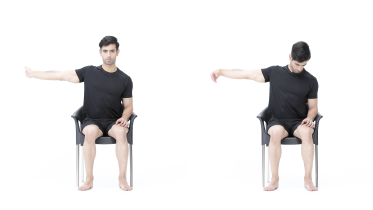
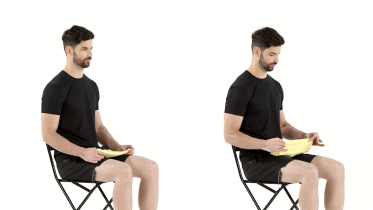
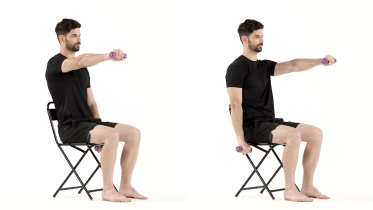
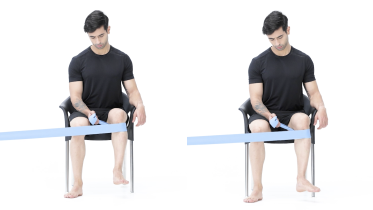
Seated head nods means sitting in a chair and slowly nodding your head up and down, looking down toward your lap and then up, for a set time. It is a habituation exercise. Physios use it in vestibular rehab when looking up and down brings on dizziness, and sitting makes it a safe position to repeat the movement gently. In the video a man sits upright with his hands on his knees, and later in his lap. The voice guide asks you to build up the time first and then the speed.
How to do the seated head nods
- Sit in a steady chair with a backrest. Keep your feet flat, about hip width apart, and rest your hands on your knees or loosely in your lap.
- Let your shoulders drop and look straight ahead.
- Slowly tip your head forward to look down, then lift it to look up, staying within a range that feels comfortable for your neck.
- Keep nodding at a slow, even pace for the time your physio has set, with your shoulders and back still.
- Come back to looking straight ahead and sit quietly until any dizziness has faded before you stand.
What you should feel
Movement at the top of your neck and perhaps mild, passing dizziness or a light swimmy head that settles once you stop.
Common mistakes
- Nodding fast or jerkily instead of slowly and smoothly.
- Rounding your back or shrugging your shoulders as your head moves.
- Pushing your head far back to the end of its range.
- Getting up straight after the last nod.
How often
A usual start is around a minute of slow nodding, 2 or 3 times a day, with the time increased before the speed. Your physio will adjust this.
Stop and check with your physio if
- The dizziness becomes severe or stronger than your physio said to expect, you are being sick, or you feel faint. Stop, sit or lie still and get medical advice the same day before you do these exercises again. If you faint, it is no better after 10 minutes of keeping still, you suddenly lose hearing in one or both ears, or you are far more unsteady on your feet than usual, call emergency services.
- Things look double, your vision suddenly blurs or goes, your speech slurs or becomes muddled, swallowing becomes hard, your face or lips go numb, one side of your face droops or one side of your body goes weak or numb, you suddenly become so dizzy or unsteady that you fall or cannot stand or walk, your legs suddenly give way but you do not black out (a drop attack), or you get a sudden severe headache. Stop and call emergency services, even if it goes away.
- Sharp or growing neck pain, or pain, pins and needles or numbness that runs down an arm.
- An electric shock feeling runs down your back or into your arms or legs as your head bends forward. Stop and get medical advice the same day.
From the clinic
Start these exercises only after a doctor or vestibular physio has found the cause of your dizziness. New dizziness, or dizziness that has changed, needs checking first.
Repeated nodding should give you mild dizziness that passes, dying down within a few minutes of stopping. Keep to the level your physio has agreed with you. Should it take more than about 10 minutes to settle, slow down or cut the time next session and tell your physio. If the dizziness turns severe, the stop signs on this page apply.
Looking up can set off a brief spell of spinning in BPPV (benign paroxysmal positional vertigo), an inner ear problem that needs its own treatment. If a short burst of spinning comes on each time your head goes back, stop and tell your physio before you carry on. If you have had neck surgery or have a neck condition, check with your doctor or physio before you start, and nod only through a small, comfortable range.
Some programs move on to nodding while standing, with support close by, once sitting is comfortable. Side to side eye movements is the seated exercise where only the eyes move, and lying gaze stabilization with head nods adds a fixed target to the same nodding movement.
Written and checked by the PocketPhysio editorial team. Last updated 2026-09-28.
This page is general education, not a diagnosis or a personal treatment plan. If you have pain, an injury or a health condition, see a physiotherapist or doctor before starting new exercises.