
Part of Osteoporosis
Osteoporosis posture: protecting your spine, and the signs of a fracture
Warning signs, and when to get help
What back exercises are safe with osteoporosis?
The muscles that run up either side of your spine, the erector spinae, are the ones this work is aimed at, and the direction is backward rather than forward. That is the whole principle, and it is the mirror image of the bending advice.
The UK consensus statement recommends exercises to improve the strength of the back muscles, to improve posture and support the spine, at 3 to 5 repetitions held for 3 to 5 seconds, at least twice a week. Your physio will adjust this (Brooke-Wavell 2022). The Too Fit To Fracture Delphi panel asks for more: endurance training for the spinal extensor muscles daily, for everyone with osteoporosis, alongside daily balance training (Giangregorio 2015). So twice a week is the floor, and daily is what the expert panel would prefer.
On this site the back extension on elbows is the usual starting point, the seated thoracic extension is the version that needs no floor, and the prone back extension is the harder one. All three are listed below with their starting ranges and their own precautions. The osteoporosis program puts them in stages with videos, and we are not rebuilding that here.
Two sets of numbers appear on this page and they are not the same prescription, so it is worth saying which is which before you pick one. The consensus figure is a held contraction, 3 to 5 lifts with each one held for 3 to 5 seconds. The ranges on the exercise cards go further than that, up to 8 to 12 lifts on the hardest of the three. Both load the back in the same direction and neither is heavy, so the smaller figure is the safer place to begin: start at 3 to 5 held lifts and let the range on the exercise page be where you are going rather than where you start. If you have had a fracture in your spine, or nobody has set your numbers for you, stay at the held version until they have.
A word on the floor, because two of the three need it. The back extension on elbows and the prone back extension are both done lying face down, and for many readers of this page getting down to the floor and back up is the risky part rather than the lift. If the floor is hard or unsafe for you, do the seated thoracic extension and leave the other two until your physio has watched you get down and up, or has given you a way of doing it that does not need the floor. Preventing falls at home covers getting up from the floor as a skill in its own right.
The commonest technique fault in all three is the same: pressing up as high as the arms will go, which bends the lower back rather than working the muscles beside the spine. A small lift you control beats a big one that happens somewhere else.
One check before any of them, and it is the reason for the second half of this page. If you have lost height, your upper back has become more rounded, or you have back pain or pain that wraps around to your ribs with no clear cause, see your doctor before you start. A broken bone in the spine can cause any of them, and it does not always announce itself.
Exercises that can help
Three back extension exercises, easiest first, and all three bend the upper back backward rather than forward. Seated thoracic extension needs no floor and often starts at 5 to 10 slow repetitions with a pause of a few seconds, once or several times a day, for example during breaks from sitting. Back extension on elbows often starts at 1 to 3 sets of 5 to 10 lifts, each held for about 5 seconds, building toward 10 seconds as it gets easier. The prone back extension is the hardest of the three and often starts at 1 to 3 sets of 8 to 12 slow lifts with a pause of a second or two at the top. Each one carries its own check-first line for anyone who has had a fracture in the spine or spine surgery in recent months, and the two you do lying down both add one for a narrowed spinal canal or a slipped vertebra, because bending backward often aggravates either, so open the line under an exercise and read it before you try that exercise. Where this paragraph and an exercise page differ, the exercise page wins. Your physio will adjust this.
The exercises below carry their own stop signs and precautions. Open the line under an exercise and read them before you try it.
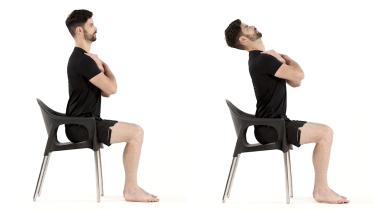 Seated thoracic extension
Stop signs and precautions for the seated thoracic extension
Before you start
- If you have had a fracture in your spine, check with your physio before you start.
- If you have had surgery on your spine in recent months, get the go-ahead from your surgical team or physio first. After neck surgery or a broken bone in the neck, check with your surgeon or physio before you start.
- After recent heart or chest surgery, get your surgeon's or surgical team's okay first, because leaning back stretches across the healing breastbone and the front of the chest. If the breastbone clicks, grinds, shifts or feels as if it is moving while you do it, stop, and contact your surgical team the same day.
When to stop and get help
- Sharp pain in your back or around your ribs, neck pain that builds as you lean back, or pain, numbness or tingling spreading into your arms.
- Pins and needles in your arm or hand that do not go away after you stop, or part of your arm or hand goes numb. Get medical advice the same day. If one side of your face or body suddenly goes numb or weak, or your speech becomes slurred or muddled, call emergency services, even if it goes away.
- You feel dizzy, faint or unsteady. Stop and get medical advice the same day. If you faint, it does not settle within a few minutes of sitting still, or you cannot stand or walk steadily, call emergency services.
- Things look double, your vision suddenly blurs or goes, your speech slurs or becomes muddled, swallowing becomes hard, your face or lips go numb, one side of your face droops or one side of your body goes weak or numb, you suddenly become so dizzy or unsteady that you fall or cannot stand or walk, your legs suddenly give way but you do not black out (a drop attack), or you get a sudden severe headache. Stop and call emergency services, even if it goes away.
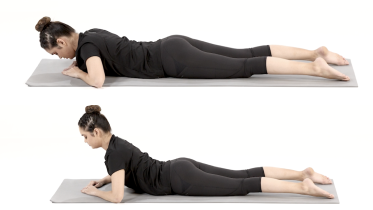 Back extension on elbows
Stop signs and precautions for the back extension on elbows
Before you start
- After recent back surgery, follow your surgeon's plan. If you have had heart or chest surgery in the last few months, check with your surgeon or surgical team before lying face down and pushing up through your arms, as both put pressure on the healing breastbone, and only the team that wired it can say when it will take that. If the breastbone clicks, grinds, shifts or feels as if it is moving while you do it, stop, and contact your surgical team the same day.
- If you have had a fracture in your spine, check with your physio before you begin.
- If you have been told you have narrowing of the spinal canal (spinal stenosis) or a forward-slipped vertebra (spondylolisthesis), ask your physio before you start, because bending backward often aggravates both.
- Lying face down is one to clear with your physio if you are pregnant.
- If you have high blood pressure, breathe steadily through every hold and never hold your breath.
When to stop and get help
- Pain spreads into your buttock or down a leg, or you get numbness or tingling in a leg.
- A sharp or pinching pain in your lower back that does not ease once you lie flat again.
- Neck pain during the lift, or pain, numbness or tingling spreading into an arm.
- Numbness around your genitals or bottom, new trouble with your bladder or bowels, pain, tingling, numbness or weakness in both legs, or loss of feeling in one leg. Call emergency services or go to an emergency department straight away, and do not drive yourself.
- Your leg or foot gets weaker, for example your foot drags, catches on the ground or slaps down when you walk (foot drop). Get medical advice the same day. If the weakness is getting worse by the hour, go to an emergency department.
- Pins and needles in your arm or hand that do not go away after you stop, or part of your arm or hand goes numb. Get medical advice the same day. If one side of your face or body suddenly goes numb or weak, or your speech becomes slurred or muddled, call emergency services, even if it goes away.
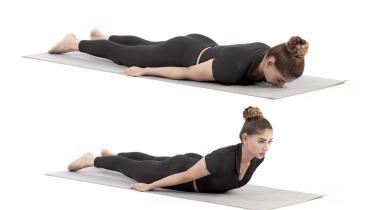 Prone back extension
Stop signs and precautions for the prone back extension
Before you start
- If you have had surgery on your spine in recent months, get the go-ahead from your surgical team or physio first.
- After recent heart or chest surgery, get your surgeon's or surgical team's okay first, because lifting your head and chest off the mat loads the healing breastbone and the front of the chest. If the breastbone clicks, grinds, shifts or feels as if it is moving while you do it, stop, and contact your surgical team the same day.
- If you have been told you have narrowing of the spinal canal (spinal stenosis) or a forward-slipped vertebra (spondylolisthesis), ask your physio before you start, because bending backward often aggravates both.
- If you have had a fracture in your spine, check with your physio before you begin.
- If you are pregnant, check with your physio before you start.
When to stop and get help
- Pain moves into your buttock or down a leg, or you notice numbness or tingling.
- You feel a sharp or pinching pain in your lower back as you lift.
- Your neck starts to hurt during the lift.
- Numbness around your genitals or bottom, new trouble with your bladder or bowels, pain, tingling, numbness or weakness in both legs, or loss of feeling in one leg. Call emergency services or go to an emergency department straight away, and do not drive yourself.
- Your leg or foot gets weaker, for example your foot drags, catches on the ground or slaps down when you walk (foot drop). Get medical advice the same day. If the weakness is getting worse by the hour, go to an emergency department.
How good is the evidence for the back work?
Worth knowing, because it is weaker than the strength recommendation and nobody says so.
The consensus prints a letter beside each recommendation: E where it rests on the evidence the group reviewed, C where it rests on expert agreement because research evidence was limited or absent. Every recommendation in its posture group is marked C, and the document states in its own words that those recommendations are consensus rather than evidence based. So the dose above is expert agreement about a reasonable thing to do, not a tested prescription. The two headline resistance training recommendations in the same document are marked E, which is why strength training for osteoporosis is the part of the advice with the firmer ground under it.
That is not an argument for skipping the back work. It costs a few minutes, it has no realistic downside in the direction it loads, and there is no competing advice telling you not to do it. It is an argument for knowing what you are buying.
What does posture training actually change?
A back that feels better and holds upright with less effort, mostly, and a small change in the measured curve.
The best known trial put adults aged 60 and over, all of whom already had a measured upper-back curve of 40 degrees or more, through physio-led group spine strengthening and posture training for an hour three times a week for six months. The curve on X-ray improved by a modest amount against a comparison group and the participants felt better about how they looked, while physical function did not differ between the groups (Katzman 2017). The figure itself, and what it means, are already set out on our page about a rounded upper back, so kyphosis exercises and physiotherapy is the place to read it rather than here.
The useful conclusion from that trial is about expectations. Three supervised hours a week for six months bought a small change in the angle. So the reason to do the back work is the back, not the mirror, and nobody should judge the program by a photograph after a month.
One more limit belongs here, for the group most likely to be reading. The Cochrane review of exercise after osteoporotic vertebral fracture, covering 9 trials and 749 people, found it could not determine the effects on new fractures, falls or adverse events, and the one function measure that improved did so by an amount its own authors described as not clinically important (Gibbs 2019).
Is a change in posture a sign of a broken bone?
It can be, and often with nothing that felt like an injury behind it.
The Royal Osteoporosis Society lists the signs of a spinal fracture as unexplained back pain and muscle spasms, height loss, and a curved spine or change in posture, and says the symptoms become more noticeable the more broken bones you have. It adds two sentences that change how you should read your own back. You may not always be aware a spinal fracture has occurred. And the pain can be mistaken for a different condition, such as arthritis.
Think about what that means in practice. A broken bone in the spine from osteoporosis does not usually involve a snap and an ambulance. The bone squashes down on itself, sometimes after a cough, a sneeze or lifting a kettle, and sometimes after nothing anybody can name. Several of them add up to a back that is shorter and rounder than it was, which is the thing a reader notices in a photograph two years later and puts down to getting older.
So a new stoop is a symptom. If you have lost height, or your upper back has become more rounded and you are starting to stoop, or you have back pain or pain that wraps around to your ribs with no clear cause, book an appointment with your doctor. If the pain came on suddenly, get medical advice the same day. If the rounding seems to be getting worse over weeks or months, see your doctor within a few days. All three of those routes are in the warning signs at the end of this page, with the rest.
Height loss, and two numbers that are not the same thing
Two different measurements get quoted on this subject and they are routinely run together, which makes both of them useless. They are worth keeping apart.
The first is annual change. The Bone Health and Osteoporosis Foundation advises having your height measured once a year, at the same office each time, and says that height loss equal to or greater than half an inch (1.3 cm) in one year may be a cause for concern. That is a year-on-year comparison, and it depends on being measured the same way twice.
The second is total loss, measured against how tall you used to be. A larger figure is used for that in UK guidance as one of the signs of vertebral fracture, and the clinician-facing section of our osteoporosis program gives it with its source. It is a different measurement over a different period, so the two thresholds are not interchangeable and neither one can be read as the other.
What to do with either of them is the same, and it is simple. Get measured, properly, once a year, and keep the number. Your own height written down is worth more than any threshold, because the comparison is with you.
The reassurance, and what it does not cover
The Royal Osteoporosis Society offers a genuine reassurance about these fractures, and it holds for the ordinary case: spinal fractures caused by osteoporosis do not cause paralysis, because they are what it calls stable, meaning they are not going to move and damage the spinal cord.
That sentence is about one cause of back pain in one group of people, and it is worth saying plainly what it does not cover, because a true sentence is the easiest thing in the world to talk yourself out of an emergency with. Having osteoporosis does not stop you also having something else.
Three of those something elses are emergencies and they have nothing to do with a stable vertebral fracture. Numbness or altered feeling around your genitals, between your inner thighs or around your bottom, or new trouble peeing or controlling your bladder or bowels, can mean pressure on the bundle of nerves at the base of the spine. Back pain with a fever, or feeling hot, shivery or very unwell, together with new weakness, numbness or tingling in your legs, can mean an infection pressing on the nerves in the spine. And if you have had cancer, now or in the past, back or neck pain that feels like a tight band around your body, or new weakness, numbness or trouble walking, can mean cancer pressing on the spinal cord. New problems walking, or new numbness in a band around your chest or tummy, belong in the same category.
There is a fourth route, and this one does come from the fracture itself. Why most of these fractures are stable is a matter of where the bone gives way: the front of the vertebra crushes and shortens while the back of it, the part that forms the tunnel the spinal cord runs through, stays intact. That is how the American Academy of Orthopaedic Surgeons describes the usual pattern, and the same page says that if the fracture is a serious one it can press on nerves and cause symptoms in the legs, which is why surgeons use a CT scan to see whether the break has reached the spinal canal. A small number of these fractures keep collapsing over the weeks and months afterward, or leave a fragment sitting in that canal, and those can press on the spinal cord or a nerve root and need an operation to take the pressure off (Picazo 2014). It is uncommon. It is not impossible, and it does not announce itself as anything other than the symptoms in the next line.
So treat new weakness in a leg, new numbness in a band around your chest or tummy, new trouble walking, or new trouble controlling your bladder or bowels as urgent whether or not anybody has told you your fracture is stable. Every one of those is in the warning signs below, in full, with what to do and how fast. Read them once now. The reassurance stands for the ordinary case, and it is not a reason to wait out any of them.
How to bend, lift and reach in everyday life
The practical half. The exercise lasts ten minutes and the day lasts sixteen hours, so this is where most of the loading actually happens.
Bend from your hips, not your spine. Soft knees, back straight, bottom going backward as though you were pushing a drawer shut with it. Osteoporosis Canada puts it as bending with your hips and knees instead of your spine, and using slow, controlled movements. The osteoporosis program has the hip hinge and the full lifting technique, and exercises to avoid with osteoporosis covers how firm the evidence behind the restriction is.
For the floor, kneel or squat down to it rather than folding over at the waist. For shopping, split it between two bags so it is balanced and close to you, and keep one hand free. For getting out of bed, roll onto your side first and push up with your arms rather than curling straight up from flat. For the high shelf, move the things you use daily down to between hip and shoulder height and ask somebody to do the top cupboard, which is a better use of a visiting relative than letting them carry everything.
The cough and the sneeze catch people out, because neither gives you any notice. The US bone health foundation includes bending forward when coughing and sneezing in its list of movements to avoid, and suggests gently pressing one or both hands against the chest instead. A hand on a worktop or the back of a chair does the same job. It is worth rehearsing once, because a sneeze is not the moment to work out a technique.
Which of these instructions applies to you
This is a real disagreement between national bodies, not a difference of opinion here.
The three national bone bodies in our markets word this differently. The Royal Osteoporosis Society says bending forward and curving your back is normal movement, both in everyday life and when you are keeping active. The Bone Health and Osteoporosis Foundation says people with bone loss in the spine should not bend forward from the waist, and its list of six includes reaching for objects on a high shelf. Osteoporosis Canada applies its limits to a named group, people at high risk of fracture, and the movements on its list for them include repetitive bending and twisting, bending all the way forward, or all the way to the side, and bending or twisting while you hold something heavy.
The Canadian framing is the one that tells you how to use the other two. If you are at high risk of fracture, which usually means a previous fracture from a minor injury, several broken bones, or a very low bone density reading, the stricter version is written for you. If your bone density is low but you have never broken anything, the UK version is closer to your situation, and the Australian position statement's one restriction, that loaded spine flexion is not recommended, is the part everybody agrees on (Beck 2017).
Which group you are in is a question for your own doctor or physio, and it is a short question with a clear answer. It changes more of your daily life than anything else on this page.
Until you have that answer, use the strict version, which is the American one. Not knowing which group you are in is not the same as being in the safer one, and the cost of guessing runs only one way. What to bring to that appointment, and the Canadian advice on who to ask, are set out on exercises to avoid with osteoporosis. The short version: your fracture history, your last bone density reading, and any steroid tablets you take long term.
After a fracture in the spine, and after a procedure for one
Different reader again, and the advice for this group is both stricter and more encouraging than people expect.
The Royal Osteoporosis Society says that if you break a bone in your spine you will not usually need an operation, that it is recommended you aim to stay as active as possible, and that movement does not affect the healing process. Healing takes 6 to 12 weeks, and the bones do not go back to the shape they were before: they heal in their new, compressed shape. It advises waiting until the bone has healed, which can take up to three months, before you build up strength exercises.
For the back work specifically, the consensus keeps going but changes the emphasis. For a reader with a vertebral fracture it recommends daily exercises to strengthen the back muscles with a focus on endurance, exercising at low intensity, at 3 to 5 repetitions held for 3 to 5 seconds, and it recommends individual physiotherapy advice at the start of a new program for this group. Both of those are marked as expert consensus rather than evidence. So the dose is not the thing to take from a page: the person who sets it is.
Some people with a fracture that keeps hurting are offered a cement procedure. In a vertebroplasty the surgeon passes a needle into the broken vertebra under X-ray guidance and injects bone cement into it, with no attempt to change its shape. A balloon kyphoplasty adds a step before the cement: a small balloon goes in through the needle and is inflated to make the bone taller and rounder again, and the space it leaves is then filled. The American Academy of Orthopaedic Surgeons describes both as suited to people with severe pain from a recent fracture, says which one fits depends on the fracture, and sends that decision to your surgeon. If a procedure has been raised with you, the plan from your own surgical team comes first and nothing here replaces it.
What the evidence says is less encouraging than the offer usually sounds, and it is worth knowing before that conversation. The academy also puts most people at feeling better within three months with no surgery at all. For vertebroplasty, the Cochrane review of the five trials that compared it against a dummy procedure, 541 people randomized, found high to moderate quality evidence of no clinically important benefit at one month: pain was 0.7 points better out of 10, where the review took 1.5 points as the smallest difference that matters to a patient (Buchbinder 2018). The orthopaedic surgeons' own clinical practice guideline on these fractures, published in 2011, made a strong recommendation against vertebroplasty, and listed kyphoplasty as a weakly supported option for people with no nerve involvement (Esses 2011). The counterweight came later. The VAPOUR trial took a much narrower group, fractures less than six weeks old with pain of at least 7 out of 10, and found 44 percent got their pain below 4 out of 10 by two weeks against 21 percent after a dummy procedure (Clark 2016).
Surgeons genuinely disagree about this, and the page cannot settle it for you. A 2023 review in the academy's own journal describes exactly that split: historically the data showed no difference between treating these fractures conservatively and injecting cement, while more recent work has shown better outcomes and more mobility after cement (Hoffmann 2023). So the fair summary is that it may help if the fracture is recent and the pain is severe, that the average result across routine practice has been close to nothing, and that your own surgeon is the one who weighs your fracture, your pain and your other conditions against that. Ask what this procedure is expected to change for you, and by when, in those words.
Neither procedure treats the osteoporosis. Neither improves bone strength or lowers your risk of breaking another bone, which is why the bone medicine, the calcium and vitamin D and the exercise all carry on afterward. Side effects are uncommon. The Royal Osteoporosis Society lists cement leaking out, infection, cement blocking the blood vessels in the lungs, allergic reactions, injury to the spinal cord or a nerve root, and the balloon rupturing in a kyphoplasty. The lung one has a mechanism worth understanding, because it is not a clot: a vertebra drains into large veins, and cement that escapes into one while it is still liquid can be carried to the arteries of the lung and set there. A meta-analysis of 13 studies and 6,251 patients found it in 2.3 percent, more often where cement had leaked into a vein, at levels in the upper back, where more cement went into each level, and where more than three vertebrae were done in one sitting (Sun 2022). Much of it turns up on a scan in someone with no symptoms and is only followed up, while a symptomatic one is treated like any other blood clot in the lungs (Krueger 2009). So new breathlessness or chest pain after one of these procedures is an emergency, not something to raise at the follow-up appointment. The trials in the Cochrane review also reported bone infection, pressure on the spinal cord, injury to the lining around the cord and respiratory failure among their serious harms.
The longer-term worry is about the neighbors. The Royal Osteoporosis Society puts it as the treated bone putting pressure on the bones around it and raising the chance of those breaking, and the thinking behind it is that set cement is stiffer than the bone it sits in. The evidence is thinner than that sounds, in both directions. Six trials in the Cochrane review counted new vertebral fractures with symptoms in 95 of every 1,000 people after vertebroplasty against 73 of every 1,000 in the comparison groups, a difference whose range runs from less than half the risk to more than three times it, so the review graded it low quality and said it could not be certain either way (Buchbinder 2018). What is not in doubt is that breaking one vertebra already makes the next one more likely whatever is done about the first. That is an argument for treating the osteoporosis itself, not a score for or against the cement, and it is why the osteoporosis treatment carries on whichever way the procedure decision goes.
One more group, and the one most likely to be handed the wrong number by a page like this one: if you have had screws, rods or a fusion in your spine, or an operation to take pressure off the nerves, do not take your starting point from here. Your limits on bending, lifting and arching backward, and the date each of them lifts, come from the team that operated, and they differ between surgeons and between operations. Ask them, or the physio they refer you to. After a cement procedure the advice is usually the opposite of restrictive, with normal daily activity encouraged as soon as you feel able, but the level for strengthening work still comes from your own team rather than from this page.
The Royal Osteoporosis Society also lists what can follow spinal fractures in the longer term, and it does not make comfortable reading: nerve pain, muscle spasms, pain in the joints and ligaments, arthritis, loss of height and a curved spine. None of that is a reason to stop moving, and the exercise evidence for this group, thin as it is, points toward staying active with the right level set for you. The after-a-fracture section of the osteoporosis program has the sequence, preventing falls at home covers the house, and your own physio sets the starting point.
Related exercise programs
Warning signs
Get emergency help now
- Emergency: if chest pain, pressure or tightness does not ease quickly when you rest, spreads to your arm, neck, jaw, stomach or back, or comes with sweating, feeling sick, feeling light-headed or being short of breath, call emergency services straight away, as this can be a heart attack. If it eases quickly and none of these happen, get medical advice the same day, and do not exercise again until you have been checked.
- Emergency: any sign of a stroke, even if it goes away. That means a face that droops on one side, an arm you cannot lift or keep up, slurred or muddled speech, weakness or numbness on one side of your body or face, sudden blurred vision, double vision or loss of sight, trouble swallowing, sudden dizziness with unsteadiness or falling over, a sudden severe headache, or a sudden fall where your legs give way but you do not black out (a drop attack). Call emergency services straight away.
- Emergency: a racing, pounding, fluttering or irregular heartbeat that does not settle when you rest, or that comes with dizziness, feeling faint or fainting, chest pain or shortness of breath. Call emergency services straight away. If it has already stopped, get medical advice the same day.
- Emergency: you have just fallen and cannot get up, or you think you may have hurt your head, neck, back or hip. Stay where you are, keep warm and call emergency services, or get someone to call for you. Nobody should try to lift you off the floor, and nobody should pull you up by the arms: being hauled upright can move a broken bone that has not slipped yet and can make an injured neck or back worse. Someone helping should call for help, keep you warm and stay with you. If you got up and walked without trouble and only notice pain later, without any of the emergency signs in this list, use the same-day lines in it instead.
- Emergency: you fell and cannot remember the fall or how it happened. Go to an emergency department straight away, and do not drive yourself. You may have blacked out or hit your head without knowing it.
- Emergency: you have had a fall or an injury and now have severe hip pain, or you cannot walk or put weight on the leg. Call emergency services or go to an emergency department. This can be a sign of a broken hip (hip fracture).
- Emergency: numbness, tingling or altered feeling around or under your genitals, between your inner thighs, or around your bottom (anus), for example it feels different when you wipe after using the toilet. Call emergency services or go to an emergency department straight away, and do not drive yourself. This can be a sign of pressure on the bundle of nerves at the base of the spine (cauda equina syndrome), which needs emergency treatment.
- Emergency: you find it hard to start peeing, cannot pee, cannot feel yourself peeing or cannot control when you pee, or you do not notice when you need to poo or cannot control when you poo, and this is not normal for you. The same applies to a new change in how your genitals feel during sex, new trouble getting or keeping an erection, new trouble ejaculating, or new trouble reaching orgasm. Call emergency services or go to an emergency department straight away, and do not drive yourself. These can also be signs of cauda equina syndrome.
- Emergency: sciatica in both legs, or pain, tingling, numbness or weakness in both legs. The same applies if you lose feeling in one leg. Call emergency services or go to an emergency department straight away, and do not drive yourself.
- Emergency: new problems walking, for example your legs feel stiff, heavy or weak or you have become unsteady on your feet, new trouble controlling your bladder or bowels, or new numbness or pins and needles in a band around your chest or tummy, or below it. Call emergency services or go to an emergency department straight away. These can be signs of pressure on the spinal cord in the upper back.
- Emergency: back or leg pain that started after a serious accident, such as a car crash or a fall from a height, or back pain with chest pain. Call emergency services. If the pain started straight after the accident, keep still while you wait.
- Emergency: sudden, severe pain in your lower back or tummy that is not like your usual back pain, if you have been told you have a swelling of the main blood vessel in your tummy (abdominal aortic aneurysm), you are over 60, you smoke or used to smoke, or you have high blood pressure. The same applies if sudden, severe back or tummy pain comes with feeling faint or passing out, pale, sweaty or clammy skin (on brown or black skin this can be easier to see on the palms of the hands or soles of the feet), a racing heartbeat or being short of breath. Call emergency services straight away. This can be a sign of an aneurysm bursting, which needs treatment in hospital at once.
- Emergency: new neck or back pain after a fall, a knock or a jolt, even a minor one such as a trip or a sudden stop in a car, if you have a condition that stiffens the spine, such as ankylosing spondylitis. Call emergency services or go to an emergency department straight away, do not drive yourself, and tell the staff about your spine condition, so they keep your neck and back in their usual position. A stiff spine can break after a small injury, and the break is easy to miss at first. If the pain started straight after the injury, or you also have numbness, tingling or weakness in your arms or legs, keep still and call emergency services.
- Emergency: new shortness of breath, or chest pain that is worse when you breathe in, after a cement procedure on your spine (vertebroplasty or balloon kyphoplasty), whether it starts the same day or weeks later. Call emergency services, and tell them you have had cement injected into a bone in your spine. Cement can escape into the veins and reach the lungs, a blood clot can follow any procedure and a spell of being less mobile, and both are treated as emergencies.
- Emergency: back pain with a fever, or you feel hot, shivery or very unwell, and you also have new weakness, numbness or tingling in one or both legs, or new trouble with your bladder or bowels. Call emergency services or go to an emergency department straight away, and do not drive yourself. This can be an infection pressing on the nerves in the spine (spinal epidural abscess), which needs emergency treatment.
- Emergency: you have had cancer, now or in the past, and your back or neck pain feels like a tight band around your body, or you have new or worsening pain spreading down an arm or leg, weakness, numbness, pins and needles or a loss of feeling in your arms or legs, trouble walking, or trouble controlling your bladder or bowels. Those symptoms count on their own, with or without back or neck pain. Call your cancer team's emergency number straight away, or go to an emergency department if you do not have one or cannot get through, and do not drive yourself. This can be cancer pressing on the spinal cord (metastatic spinal cord compression), which needs treatment straight away.
Get help today
- Same day: back pain after a minor fall or strain if you are older, have low bone density (osteoporosis) or have taken steroid tablets for a long time. Get medical advice the same day. Until it has been checked, stop the exercises and keep away from lifting, bending forward and twisting, because those load a bone in the spine that may be broken.
- Back pain that comes on suddenly after lifting, bending, a cough or a sneeze, even without a fall, if you have low bone density (osteoporosis). Get medical advice the same day. This can be a sign of a broken bone in the spine (vertebral fracture). Stop the exercises until you have been checked, and keep away from lifting, bending forward and twisting in the meantime, because those load a broken vertebra whether you are exercising or not.
- Severe pain that comes on suddenly or is getting worse quickly. Get medical advice the same day.
- Back or leg pain with a fever, or you feel hot, cold, shivery or generally unwell. Get medical advice the same day, and go to an emergency department if you feel very unwell. If you have a very high or very low temperature, shivering you cannot control, you are breathing very fast or finding it hard to breathe, you are confused or your speech is slurred, your skin, lips or tongue look blue, gray, pale or blotchy (on brown or black skin this can be easier to see on the palms of the hands or soles of the feet), or you have a rash that does not fade when you press it, call emergency services, as this can be sepsis.
- Same day: new hip or groin pain after a fall, even a small one, if you are older, have low bone density (osteoporosis) or have taken steroid tablets for a long time, even if you can still walk. Get medical advice the same day, and say that you fell and that your bones are thin. Until it has been checked, stop the exercises and keep as much weight off that leg as you can, using your stick, frame or crutches if you have them and asking someone for help to move about, because a crack in the hip that has not slipped yet can slip when you walk on it, and a hip that has slipped usually needs a bigger operation than one that has not. A broken hip is not always obvious at first, and a first X-ray does not always show it, so if you have been checked and sent home and you still cannot walk on that leg, or the pain is getting worse, go back and say so.
- A leg or foot that is getting weaker, for example your foot drags, catches on the ground or slaps down when you walk (foot drop). Get medical advice the same day. If the weakness is getting worse by the hour, go to an emergency department.
- Same day: a calf or thigh that is newly swollen or getting more swollen, warm, tender, red or darker than usual, has swollen veins that are sore to touch, or has a throbbing or cramping pain that does not fit your injury or condition, or that feels different from normal muscle soreness after exercise. This can be a sign of a blood clot (deep vein thrombosis), especially after surgery, an injury, time in a cast or boot, a long trip or a spell of being much less mobile than usual. Get medical advice the same day. If you are also short of breath or have chest pain, call emergency services.
- You have back pain and have lost weight without trying. Get medical advice the same day and mention the weight loss.
- New back pain and you have had cancer, now or in the past. Get medical advice the same day and mention your cancer history. If you are being treated for cancer now, contact your cancer team the same day.
- Same day: you blacked out or fainted, even for a moment. Get medical advice the same day. Call emergency services instead if the person is not breathing, cannot be woken within 1 minute, has not fully recovered or has trouble speaking or moving, has chest pain or a pounding, fluttering or irregular heartbeat, fainted while exercising or lying down, is shaking or jerking, or was badly hurt.
- Same day: dizziness, lightheadedness, blurred vision or feeling faint when you stand up that is new for you, does not pass within a minute or two, keeps happening, or has made you fall. Sit or lie down, and get medical advice the same day. This can be a drop in blood pressure on standing (postural hypotension), a type of low blood pressure, which the NHS lists among the causes of falls, and your doctor can check it. Tell them about your medicines, because some can cause it. If it does not settle within a few minutes of sitting or lying still, call emergency services. If you faint, use the fainting line above.
- Same day: dizziness or feeling faint during or after exercise, other than the brief lightheadedness as you stand up covered in the line above, without any of the emergency signs above. Stop the exercises and get medical advice the same day. If you faint, it does not settle within a few minutes of sitting still, or you cannot stand or walk steadily, call emergency services.
- Same day: pain that is worse at night, or does not ease at all when you rest. If you have had cancer, now or in the past, or you have lost weight without trying, get medical advice the same day.
Book an appointment
- Within a few days: pain that is worse at night, or does not ease at all when you rest. See your doctor within a few days.
- Your rounding seems to be getting worse quickly, for example over a few weeks or months you stoop further forward, lose height or your clothes hang differently. See your doctor within a few days. If it came on with sudden back pain, get medical advice the same day.
- Routine: you have lost height, or your upper back has become more rounded and you are starting to stoop, or you have back pain, or pain that wraps around to your ribs, with no clear cause. Book an appointment with your doctor. A broken bone in the spine can cause this, and it does not always cause the pain you would expect. If the pain came on suddenly, get medical advice the same day.
- Routine: back pain that comes from the top of your back, between your shoulders, rather than your lower back, and has not been checked, or back pain that is worse when you sneeze, cough or poo, or comes with a lump or swelling, or a back that has changed shape. Book an appointment with your doctor, as the NHS advises, and have it checked. If the pain came on suddenly, get medical advice the same day.
Common questions
How do I improve my posture with osteoporosis?
By strengthening the muscles that hold you up rather than by trying to hold a position all day. The UK consensus recommends exercises to improve the strength of the back muscles to improve posture and support the spine, 3 to 5 repetitions held for 3 to 5 seconds, at least twice a week, and marks that as expert consensus rather than evidence (Brooke-Wavell 2022). The Too Fit To Fracture Delphi panel recommends endurance training for the spinal extensor muscles daily, for everyone with osteoporosis (Giangregorio 2015). Pulling your shoulders back and gripping is not the exercise, and it never lasts past the end of the sentence. If your posture has changed recently, or you have lost height, see your doctor before you start, because a broken bone in the spine can cause both.
What back exercises are safe with osteoporosis?
Extension work, which means the opposite direction to the one the bending advice restricts. On this site the usual starting point is back extension on elbows, often 1 to 3 sets of 5 to 10 lifts held for about 5 seconds, with seated thoracic extension at 5 to 10 slow repetitions once or several times a day if the floor is not an option, and the harder prone back extension at 1 to 3 sets of 8 to 12 slow lifts once it is comfortable. Your physio will adjust this, and the osteoporosis program puts them in order with videos. If you have had a fracture in your spine, get your own physio to set the level before you start any of them.
Is my stoop a broken bone?
It can be, and that is why this page treats a change in posture as a symptom rather than as a cosmetic problem. The Royal Osteoporosis Society lists the signs of a spinal fracture as unexplained back pain and muscle spasms, height loss, and a curved spine or change in posture, and says the symptoms become more noticeable the more broken bones you have. It also says you may not always be aware a spinal fracture has occurred, and that the pain can be mistaken for a different condition such as arthritis. So a new stoop is a reason to book an appointment with your doctor, and a stoop that has come on with sudden back pain is a reason to get medical advice the same day.
How should I bend and lift with osteoporosis?
From the hips, with the load close to you, and without twisting at the same time. Bend forward from your hips with soft knees and your back straight, which is the hip hinge, and the osteoporosis program has it in full with the lifting advice. For everyday jobs: kneel or squat down to reach the floor rather than folding over, split heavy shopping between two bags, and roll onto your side and push up with your arms to get out of bed rather than curling straight up. The Royal Osteoporosis Society says there is not a specific weight that is safe or unsafe, and that it is how you lift rather than how much you lift that matters.
Do posture braces or posture bras help with osteoporosis?
We cannot tell you they do. We read seven Royal Osteoporosis Society pages, two Bone Health and Osteoporosis Foundation pages, Osteoporosis Canada's material, Healthy Bones Australia's exercise page and the full UK consensus statement, and none of them recommends a posture brace or a posture bra for osteoporosis. A brace holds you upright while you have it on, which is a different thing from being able to hold yourself upright, and the exercises above are aimed at the second. If you own one and it makes your day more comfortable, nothing here says to throw it out, as long as it is not standing in for the back strengthening. Our kyphosis page covers bracing for a rounded upper back in more detail.
References
- Brooke-Wavell K, Skelton DA, Barker KL, et al. Strong, steady and straight: UK consensus statement on physical activity and exercise for osteoporosis. British Journal of Sports Medicine. 2022;56(15):837-846. https://doi.org/10.1136/bjsports-2021-104634
- Giangregorio LM, McGill S, Wark JD, et al. Too Fit To Fracture: outcomes of a Delphi consensus process on physical activity and exercise recommendations for adults with osteoporosis with or without vertebral fractures. Osteoporosis International. 2015;26(3):891-910. https://doi.org/10.1007/s00198-014-2881-4
- Giangregorio LM, Papaioannou A, MacIntyre NJ, et al. Too Fit To Fracture: exercise recommendations for individuals with osteoporosis or osteoporotic vertebral fracture. Osteoporosis International. 2014;25(3):821-835. https://doi.org/10.1007/s00198-013-2523-2
- Gibbs JC, MacIntyre NJ, Ponzano M, et al. Exercise for improving outcomes after osteoporotic vertebral fracture. Cochrane Database of Systematic Reviews. 2019;7(7):CD008618. https://doi.org/10.1002/14651858.CD008618.pub3
- Katzman WB, Vittinghoff E, Lin F, et al. Targeted spine strengthening exercise and posture training program to reduce hyperkyphosis in older adults: results from the study of hyperkyphosis, exercise, and function (SHEAF) randomized controlled trial. Osteoporosis International. 2017;28(10):2831-2841. https://doi.org/10.1007/s00198-017-4109-x
- Buchbinder R, Johnston RV, Rischin KJ, et al. Percutaneous vertebroplasty for osteoporotic vertebral compression fracture. Cochrane Database of Systematic Reviews. 2018;11(11):CD006349. https://doi.org/10.1002/14651858.CD006349.pub4
- Esses SI, McGuire R, Jenkins J, et al. The treatment of symptomatic osteoporotic spinal compression fractures. Journal of the American Academy of Orthopaedic Surgeons. 2011;19(3):176-182. https://doi.org/10.5435/00124635-201103000-00007
- Hoffmann J, Preston G, Whaley J, Khalil JG. Vertebral augmentation in spine surgery. Journal of the American Academy of Orthopaedic Surgeons. 2023;31(10):477-489. https://doi.org/10.5435/JAAOS-D-22-00958
- Clark W, Bird P, Gonski P, et al. Safety and efficacy of vertebroplasty for acute painful osteoporotic fractures (VAPOUR): a multicentre, randomised, double-blind, placebo-controlled trial. Lancet. 2016;388(10052):1408-1416. https://doi.org/10.1016/S0140-6736(16)31341-1
- Sun HB, Jing XS, Shan JL, et al. Risk factors for pulmonary cement embolism associated with percutaneous vertebral augmentation: a systematic review and meta-analysis. International Journal of Surgery. 2022;101:106632. https://doi.org/10.1016/j.ijsu.2022.106632
- Krueger A, Bliemel C, Zettl R, Ruchholtz S. Management of pulmonary cement embolism after percutaneous vertebroplasty and kyphoplasty: a systematic review of the literature. European Spine Journal. 2009;18(9):1257-1265. https://doi.org/10.1007/s00586-009-1073-y
- Picazo DR, Villaescusa JR, Martinez EP, Perez FD. Late collapse osteoporotic vertebral fracture in an elderly patient with neurological compromise. European Spine Journal. 2014;23(12):2696-2702. https://doi.org/10.1007/s00586-013-2751-3
- American Academy of Orthopaedic Surgeons. OrthoInfo. Osteoporosis and spinal fractures. https://orthoinfo.aaos.org/en/diseases--conditions/osteoporosis-and-spinal-fractures/
- Royal Osteoporosis Society. Symptoms of osteoporosis. Page last reviewed 17 September 2026. https://theros.org.uk/information-and-support/about-osteoporosis-and-osteopenia/osteoporosis-symptoms/
- Royal Osteoporosis Society. Spinal fractures (vertebral fractures). Page last reviewed 1 April 2022, and marked on the page as under review. https://theros.org.uk/information-and-support/living-with-osteoporosis-and-broken-bones/spinal-fractures-vertebral-fractures/
- Royal Osteoporosis Society. How to exercise safely for bones. https://theros.org.uk/information-and-support/exercise/how-to-exercise-safely-for-bones/
- Bone Health and Osteoporosis Foundation. Protecting your spine. https://www.bonehealthandosteoporosis.org/patients/treatment/exercisesafe-movement/protecting-your-spine/
- Bone Health and Osteoporosis Foundation. Exercise and safe movement. https://www.bonehealthandosteoporosis.org/patients/treatment/exercisesafe-movement/
- Osteoporosis Canada. Too Fit To Fracture. https://osteoporosis.ca/too-fit-to-fracture/
- Beck BR, Daly RM, Singh MA, Taaffe DR. Exercise and Sports Science Australia (ESSA) position statement on exercise prescription for the prevention and management of osteoporosis. Journal of Science and Medicine in Sport. 2017;20(5):438-445. https://doi.org/10.1016/j.jsams.2016.10.001
- NHS. Osteoporosis. https://www.nhs.uk/conditions/osteoporosis/
- NHS. Back pain. https://www.nhs.uk/conditions/back-pain/
- NHS. Falls. https://www.nhs.uk/conditions/falls/
- NHS. Symptoms of a stroke. https://www.nhs.uk/conditions/stroke/symptoms/
- NHS. Heart attack. https://www.nhs.uk/conditions/heart-attack/
- NHS. Fainting. https://www.nhs.uk/symptoms/fainting/
- NHS. Low blood pressure (hypotension). Page last reviewed 11 July 2023. https://www.nhs.uk/conditions/low-blood-pressure-hypotension/
- NHS. Deep vein thrombosis (DVT). Page last reviewed 30 April 2026. https://www.nhs.uk/conditions/deep-vein-thrombosis-dvt/
- NHS. Sepsis. Page last reviewed 14 May 2026. https://www.nhs.uk/conditions/sepsis/
- NHS. Abdominal aortic aneurysm. https://www.nhs.uk/conditions/abdominal-aortic-aneurysm/
- Darouiche RO. Spinal epidural abscess. New England Journal of Medicine. 2006;355(19):2012-2020. https://doi.org/10.1056/NEJMra055111
- Cancer Research UK. Spinal cord compression. https://www.cancerresearchuk.org/about-cancer/coping/physically/spinal-cord-compression
Written and checked by the PocketPhysio editorial team. Last updated 2026-11-06.
This page is general education, not a diagnosis or a personal treatment plan. See a physiotherapist or doctor for advice about your own situation.