
Part of Osteoporosis
Best exercises for osteoporosis: the three kinds and what each one is for
Warning signs, and when to get help
What are the best exercises for osteoporosis?
The question nearly always arrives as a request for a list, and a list is the one thing that does not help. What helps is knowing that there are three separate jobs, and that most people are doing one of them and have never been told about the other two.
The UK consensus statement on exercise for osteoporosis sorts its own recommendations into three groups and gives them three plain names: Strong, Steady and Straight (Brooke-Wavell 2022). Strong is resistance and impact work, and it is aimed at bone. Steady is strength and balance work, and it is aimed at not falling. Straight is back strengthening, and it is aimed at posture. Different exercises, different purposes, different quality of evidence behind each.
That split is the whole page. A woman of 60 who has just been given a diagnosis after a wrist fracture and walks the dog twice a day is usually missing the Strong half. A man of 84 who has fallen in his own hallway twice this year is missing the Steady half, and loading his bones harder is not the first thing he needs. The osteoporosis program puts all three into stages with videos, so this page sticks to what each one is for.
How the three kinds differ, and what the letters mean
The three groups are not all backed the same way, and the consensus marks which is which in its own text. Beside each recommendation it prints E if the recommendation came from the evidence the group reviewed, or C if it came from expert consensus where there was limited or no research evidence. These are not grades on a scale. They tell you where a recommendation came from, and almost nothing written about the topic repeats them.
| Kind | What it is aimed at | Marked E (evidence reviewed) or C (expert consensus) |
|---|---|---|
| Progressive resistance (strength) | Bone strength, muscle strength | E on the two headline recommendations, C on two more in the same box |
| Impact (jogging, skipping, hopping) | Bone strength | C |
| Strength and balance for falls | Fewer falls | A mixture of E and C |
| Back strengthening for posture | Posture, spine support | C throughout |
What the consensus says about the C group is unambiguous, because it says it in words as well as letters: the recommendations in its posture group are consensus rather than evidence based. Its headline resistance recommendations are marked E. That is not a reason to skip the back work, which every body we read recommends and which costs you very little. It is a reason to know that the strength recommendation and the posture recommendation are not the same kind of claim, and to spend your limited patience accordingly.
Weight bearing and impact are not the same thing
This is where most readers get muddled, and the muddle has a consequence. Weight bearing means your legs are carrying you: standing, walking, climbing stairs. Impact means your feet land with some force, so a jog, a skip, a hop or a heel drop. The Royal Osteoporosis Society describes impact as one type of weight-bearing exercise and then separates low, moderate and high impact within it, which is the right way round.
The practical difference is that walking is weight bearing and is low impact, and low impact is the gentlest thing on the bone list. For impact, the Royal Osteoporosis Society suggests building up to 50 moderate impacts on most days of the week, counting one jump as one impact and allowing you to spread them through the day, if you have not had a spinal fracture. For someone who has had a spinal fracture or several broken bones, its advice is low impact only, building up to 20 minutes on most days.
Higher is not automatically better. The same organization says high-impact exercise is not specifically recommended for osteoporosis, because there is not enough evidence that it gives extra benefit. The Australian position statement goes further on dose than the UK one does, and the UK group looked at both and deliberately chose moderate impact, on the grounds that greater benefit from high intensity over moderate had not been shown (Brooke-Wavell 2022). Two national bodies, the same evidence, and a deliberate difference in how hard they push.
Is walking good for osteoporosis?
Yes, with a caution attached that most pages on the subject leave out.
Walking is low-impact weight-bearing exercise, it is free, and people keep doing it, which is worth more than any theoretical advantage. What it will not do on its own is much for bone, and the Cochrane falls review was uncertain whether walking programs reduce falls at all (Sherrington 2019). So walking is the floor rather than the plan.
Now the caution. The UK consensus reports some evidence of increased fracture risk from brisk walking in a population already at risk of falls and fracture, and says those people may need strength and balance exercise to improve stability first, before they start brisk walking or fatiguing exercise (Brooke-Wavell 2022). Read that clause rather than the headline: it is not a statement that walking harms bone. It is a statement about order.
If you are unsteady, the balance and leg strength come first, and the brisk walking is what you build up to. Preventing falls at home and the balance and falls prevention program are the two pages for that reader.
Brisk walking has its own page here, with its starting range and its own stop signs, and it is listed last among the exercises below for the reason in the paragraph above.
How much difference does it actually make?
A small amount to the scan, a larger amount to the falling. It is the falling that breaks bones.
For bone, the best known trial is LIFTMOR. It trained 101 postmenopausal women with low bone mass twice a week for 8 months, in 30-minute supervised sessions, and bone density rose by a few percent at the lower spine and held steady at the hip, while a home-based low-intensity comparison group lost a little at both (Watson 2018). Every one of those women was screened for conditions and medications that affect bone, and the paper's own conclusion ties its result to highly supervised conditions. That is a real effect in a specific group under specific circumstances, and strength training for osteoporosis goes through what that means for someone training alone.
For falls, the evidence is both stronger and in a different population. A Cochrane review of 108 trials and 23,407 older people living at home, average age 76, found that exercise reduced the rate of falls by about 23 percent and the number of people who fell by about 15 percent, both at high certainty, and the clearest of those results came from programs built mainly on balance and functional exercise, where the 24 percent cut in the rate of falls was rated high certainty (Sherrington 2019). Those people were not selected for osteoporosis, so the figure describes older adults generally rather than this diagnosis specifically. The Too Fit To Fracture authors put it plainly: the outcome for which the evidence is strongest is falls (Giangregorio 2014).
There is one group for whom the picture is thinner still. For people who have already had a vertebral fracture, a separate Cochrane review of 9 trials and 749 participants concluded that there was not enough evidence to determine the effects of exercise on new fractures, falls or adverse events, and the one function measure that improved did so by an amount the authors themselves described as not clinically important (Gibbs 2019). That is not a reason to do nothing. It is the reason the advice for that group is individual rather than general.
Is exercise safe, given what bones do?
Fear of breaking something is the commonest reason a program never gets started, so here is what was actually measured.
The UK consensus looked for harm across 62 trials. Eleven of them reported fractures over the course of the study, rarely from the intervention itself, and the totals ran the other way from what people expect: 5.8 percent of participants in the exercise groups fractured against 9.6 percent in the control groups. It concluded that exercise is unlikely to cause a fracture, including a vertebral fracture, and does not need to be adapted according to fracture risk or a low bone density reading (Brooke-Wavell 2022).
Read alongside that, the same document still recommends changing postures that bend the spine a long way forward. The two sit together rather than contradicting each other: one is about not grading your whole program by a scan result, the other is about specific positions. Exercises to avoid with osteoporosis is the page that sorts out which movements have a real basis and which got onto the list by repetition.
Three setup rules go with all of it. Do balance work beside a kitchen counter or a sturdy chair that cannot slide, on a clear floor, in flat shoes that grip. If you have high blood pressure, breathe steadily through every repetition and never hold your breath. And on the strength work, put the weight down if you feel the strain in your back, which is the Royal Osteoporosis Society's own rule, then drop the load or change your technique before you try again.
Where to start, in practice
If you are missing the strength half, start there, because it is the recommendation on the firmest footing and it is also the half that makes you able to get off a low chair. A weight or band you can lift 8 to 12 times, building to 3 sets, on 2 to 3 days a week, is the published dose. Your physio will adjust this.
If you are missing the balance half, start there instead, with something narrow and dull like semi-tandem stance. For people who are already having falls the consensus asks for more than that: highly challenging balance and muscle strength training, supervised by a trained professional, for 3 hours a week over at least 4 months, which works out at about 25 minutes a day, and that is one of the recommendations it marks E (Brooke-Wavell 2022). The strength program for older adults is the better starting place if your real problem is weakness rather than bone.
Back strengthening goes in alongside either, at least twice a week, and the back extension on elbows is the usual first version of it. A rounded upper back has its own program on our kyphosis page if that is what brought you here.
Two things are not here. The stages are set out in the osteoporosis program instead. And if you have had a fracture in a bone of your spine, or think you may have, this page does not tell you where to begin: the program has an after-a-fracture section, the Royal Osteoporosis Society puts spinal fracture healing at 6 to 12 weeks with up to three months before building strength work, and the consensus recommends individual physiotherapy advice at the start of a new program for that group. See your doctor or a physio first, and take the starting level from them rather than from here.
Exercises that can help
One exercise for each of the three jobs, with the impact one last for a reason. The chair squat is the strength example and often starts at 2 to 3 sets of 8 to 12, once a day or on most days, at a seat height you can manage with control. Semi-tandem stance is the balance example, often 10 to 30 seconds a hold, 3 to 5 holds with each foot forward, once or twice a day. Back extension on elbows is the posture example, often 1 to 3 sets of 5 to 10 lifts held for about 5 seconds, building toward 10 seconds as it gets easier. Brisk walking is the impact example and often starts at 10 to 20 minutes on most days with a few minutes of slow walking at each end, adding time before adding speed, but it is last here on purpose: the UK consensus reports some evidence of increased fracture risk from brisk walking in a population already at risk of falls and fracture, and says those people may need strength and balance exercise to improve stability first, so if you have fallen in the past year or feel unsteady, build the first three before you add it. Where this paragraph and an exercise page differ, the exercise page wins. Your physio will adjust this.
The exercises below carry their own stop signs and precautions. Open the line under an exercise and read them before you try it.
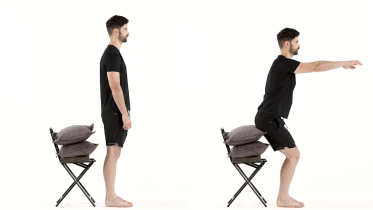 Chair squat
Stop signs and precautions for the chair squat
Before you start
- After a knee fracture or knee surgery, including a knee replacement, follow your surgeon's or physio's plan, and start this exercise only when they have cleared you.
- Knee pain on the way down is a sign to put a cushion back rather than push through it, and after knee surgery your physio will tell you how deep to go. If you have had a hip replacement, get the go-ahead from your surgeon or physio before you try chair squats. A low seat makes the hip bend past a right angle, and many surgeons ask you to avoid that for the first months after some operations. Ask them what seat height suits you.
- Osteoporosis, a recent fall or shaky balance are all reasons to keep a kitchen counter within reach for every rep, and to ask your physio before you take a cushion away.
When to stop and get help
- A sharp pain in your knees, hips or low back, or knee pain that builds rep by rep.
- A knee buckles, or you start to lose your balance.
- You feel dizzy, lightheaded or faint as you get up. Sit back down and wait for it to pass. If it does not pass within a minute or two, or it keeps happening, get medical advice the same day before you practice again. If you faint, or it does not settle within a few minutes of keeping still, call emergency services.
- Chest pain or pressure, dizziness or feeling faint, a racing or irregular heartbeat, or being far more out of breath than the effort should cause.
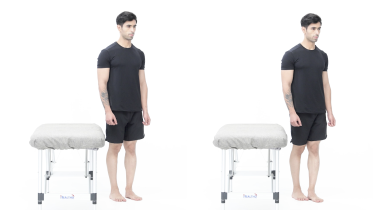 Semi-tandem stance
Stop signs and precautions for the semi-tandem stance
Before you start
- If you have had a hip replacement or other hip surgery, get the go-ahead from your surgeon or physio before you try semi-tandem stance. Some operations limit this kind of work for the first months, so the timing depends on your surgery.
- Clear the floor of rugs, cables and clutter before you start. Wear flat shoes that fit well and grip the floor, not socks, tights or bare feet.
- If you have fallen in the past year, feel unsteady on your feet, or take medicines that make you dizzy, keep a hand on the support throughout, practice only when someone else is at home, and ask your doctor or physio about a falls check.
When to stop and get help
- You feel dizzy, lightheaded, faint or sick, or the room seems to spin. Hold your support, sit down and get medical advice the same day before you practice again. If you faint, it does not settle within a few minutes of sitting still, your vision suddenly blurs or goes double, or you cannot stand or walk steadily, call emergency services.
- You tip out of position and have to grab the support hard to stop yourself falling.
- New pain in your feet, ankles or knees while you stand.
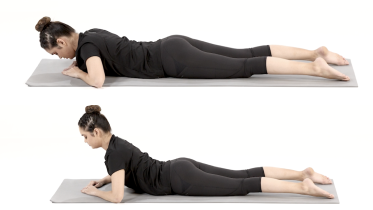 Back extension on elbows
Stop signs and precautions for the back extension on elbows
Before you start
- After recent back surgery, follow your surgeon's plan. If you have had heart or chest surgery in the last few months, check with your surgeon or surgical team before lying face down and pushing up through your arms, as both put pressure on the healing breastbone, and only the team that wired it can say when it will take that. If the breastbone clicks, grinds, shifts or feels as if it is moving while you do it, stop, and contact your surgical team the same day.
- If you have had a fracture in your spine, check with your physio before you begin.
- If you have been told you have narrowing of the spinal canal (spinal stenosis) or a forward-slipped vertebra (spondylolisthesis), ask your physio before you start, because bending backward often aggravates both.
- Lying face down is one to clear with your physio if you are pregnant.
- If you have high blood pressure, breathe steadily through every hold and never hold your breath.
When to stop and get help
- Pain spreads into your buttock or down a leg, or you get numbness or tingling in a leg.
- A sharp or pinching pain in your lower back that does not ease once you lie flat again.
- Neck pain during the lift, or pain, numbness or tingling spreading into an arm.
- Numbness around your genitals or bottom, new trouble with your bladder or bowels, pain, tingling, numbness or weakness in both legs, or loss of feeling in one leg. Call emergency services or go to an emergency department straight away, and do not drive yourself.
- Your leg or foot gets weaker, for example your foot drags, catches on the ground or slaps down when you walk (foot drop). Get medical advice the same day. If the weakness is getting worse by the hour, go to an emergency department.
- Pins and needles in your arm or hand that do not go away after you stop, or part of your arm or hand goes numb. Get medical advice the same day. If one side of your face or body suddenly goes numb or weak, or your speech becomes slurred or muddled, call emergency services, even if it goes away.
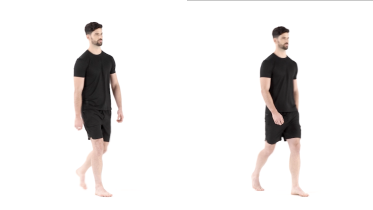 Brisk walking
Stop signs and precautions for the brisk walking
Before you start
- With a heart or lung condition, high blood pressure, or after a recent operation, ask your doctor or physio how much to walk and how fast before you start. If you are pregnant, check with your midwife or physio before you start.
When to stop and get help
- Chest pain or pressure, dizziness or feeling faint, a racing or irregular heartbeat, or being far more out of breath than the effort should cause.
- You feel dizzy, lightheaded, faint or sick, or the room seems to spin. Stop, sit down and get medical advice the same day before you exercise again. If you faint, it does not settle within a few minutes of sitting still, your vision suddenly blurs or goes double, or you cannot stand or walk steadily, call emergency services.
- A sharp pain in a foot, ankle, knee or hip that changes the way you walk.
- Aching, cramping or tightness in a calf, thigh or buttock that comes on at about the same walking distance every time and clears within a few minutes of standing still, and a doctor has not checked it yet. Keep the walk gentle and book an appointment with your doctor before you build up any further, as narrowed arteries in the legs (peripheral arterial disease) can cause this and are managed differently. If leg pain carries on while you are resting or in bed, or wakes you at night, get medical advice the same day. If a foot or leg suddenly turns cold, pale or blue, or suddenly becomes very painful, numb or weak, call emergency services and do not drive yourself, because the blood supply to the leg may be blocked and a leg that has gone numb or weak with it can be impossible to save if it is not treated within about six hours.
- Your calf or thigh becomes swollen, warm, tender, red or darker than usual, or has a throbbing or cramping pain that feels different from normal muscle ache. Stop and get medical advice the same day, as this can be a blood clot. If you are also short of breath or have chest pain, call emergency services.
- You feel unsteady on your feet or close to falling.
- You are pregnant and notice bleeding or fluid leaking from your vagina, regular painful tightenings, tummy pain that does not settle when you rest or comes with lower back pain, or a change in your baby's usual movements, such as moving less than usual. Stop and contact your midwife or maternity unit straight away. Do the same for a severe headache, problems with your vision such as blurring or flashing lights, pain just below your ribs, or sudden swelling of your face, hands or feet, which can be signs of pre-eclampsia. Call emergency services if the bleeding is heavy, the tummy pain is severe, bleeding or tummy pain comes with pain in your shoulder or feeling sick, faint or dizzy, or a headache comes on suddenly and is very severe.
Related exercise programs
Warning signs
Get emergency help now
- Emergency: if chest pain, pressure or tightness does not ease quickly when you rest, spreads to your arm, neck, jaw, stomach or back, or comes with sweating, feeling sick, feeling light-headed or being short of breath, call emergency services straight away, as this can be a heart attack. If it eases quickly and none of these happen, get medical advice the same day, and do not exercise again until you have been checked.
- Emergency: any sign of a stroke, even if it goes away. That means a face that droops on one side, an arm you cannot lift or keep up, slurred or muddled speech, weakness or numbness on one side of your body or face, sudden blurred vision, double vision or loss of sight, trouble swallowing, sudden dizziness with unsteadiness or falling over, a sudden severe headache, or a sudden fall where your legs give way but you do not black out (a drop attack). Call emergency services straight away.
- Emergency: a racing, pounding, fluttering or irregular heartbeat that does not settle when you rest, or that comes with dizziness, feeling faint or fainting, chest pain or shortness of breath. Call emergency services straight away. If it has already stopped, get medical advice the same day.
- Emergency: you have just fallen and cannot get up, or you think you may have hurt your head, neck, back or hip. Stay where you are, keep warm and call emergency services, or get someone to call for you. Nobody should try to lift you off the floor, and nobody should pull you up by the arms: being hauled upright can move a broken bone that has not slipped yet and can make an injured neck or back worse. Someone helping should call for help, keep you warm and stay with you. If you got up and walked without trouble and only notice pain later, without any of the emergency signs in this list, use the same-day lines in it instead.
- Emergency: you fell and cannot remember the fall or how it happened. Go to an emergency department straight away, and do not drive yourself. You may have blacked out or hit your head without knowing it.
- Emergency: you have had a fall or an injury and now have severe hip pain, or you cannot walk or put weight on the leg. Call emergency services or go to an emergency department. This can be a sign of a broken hip (hip fracture).
- Emergency: numbness, tingling or altered feeling around or under your genitals, between your inner thighs, or around your bottom (anus), for example it feels different when you wipe after using the toilet. Call emergency services or go to an emergency department straight away, and do not drive yourself. This can be a sign of pressure on the bundle of nerves at the base of the spine (cauda equina syndrome), which needs emergency treatment.
- Emergency: you find it hard to start peeing, cannot pee, cannot feel yourself peeing or cannot control when you pee, or you do not notice when you need to poo or cannot control when you poo, and this is not normal for you. The same applies to a new change in how your genitals feel during sex, new trouble getting or keeping an erection, new trouble ejaculating, or new trouble reaching orgasm. Call emergency services or go to an emergency department straight away, and do not drive yourself. These can also be signs of cauda equina syndrome.
- Emergency: sciatica in both legs, or pain, tingling, numbness or weakness in both legs. The same applies if you lose feeling in one leg. Call emergency services or go to an emergency department straight away, and do not drive yourself.
- Emergency: new problems walking, for example your legs feel stiff, heavy or weak or you have become unsteady on your feet, new trouble controlling your bladder or bowels, or new numbness or pins and needles in a band around your chest or tummy, or below it. Call emergency services or go to an emergency department straight away. These can be signs of pressure on the spinal cord in the upper back.
- Emergency: back or leg pain that started after a serious accident, such as a car crash or a fall from a height, or back pain with chest pain. Call emergency services. If the pain started straight after the accident, keep still while you wait.
- Emergency: sudden, severe pain in your lower back or tummy that is not like your usual back pain, if you have been told you have a swelling of the main blood vessel in your tummy (abdominal aortic aneurysm), you are over 60, you smoke or used to smoke, or you have high blood pressure. The same applies if sudden, severe back or tummy pain comes with feeling faint or passing out, pale, sweaty or clammy skin (on brown or black skin this can be easier to see on the palms of the hands or soles of the feet), a racing heartbeat or being short of breath. Call emergency services straight away. This can be a sign of an aneurysm bursting, which needs treatment in hospital at once.
- Emergency: new neck or back pain after a fall, a knock or a jolt, even a minor one such as a trip or a sudden stop in a car, if you have a condition that stiffens the spine, such as ankylosing spondylitis. Call emergency services or go to an emergency department straight away, do not drive yourself, and tell the staff about your spine condition, so they keep your neck and back in their usual position. A stiff spine can break after a small injury, and the break is easy to miss at first. If the pain started straight after the injury, or you also have numbness, tingling or weakness in your arms or legs, keep still and call emergency services.
- Emergency: back pain with a fever, or you feel hot, shivery or very unwell, and you also have new weakness, numbness or tingling in one or both legs, or new trouble with your bladder or bowels. Call emergency services or go to an emergency department straight away, and do not drive yourself. This can be an infection pressing on the nerves in the spine (spinal epidural abscess), which needs emergency treatment.
- Emergency: you have had cancer, now or in the past, and your back or neck pain feels like a tight band around your body, or you have new or worsening pain spreading down an arm or leg, weakness, numbness, pins and needles or a loss of feeling in your arms or legs, trouble walking, or trouble controlling your bladder or bowels. Those symptoms count on their own, with or without back or neck pain. Call your cancer team's emergency number straight away, or go to an emergency department if you do not have one or cannot get through, and do not drive yourself. This can be cancer pressing on the spinal cord (metastatic spinal cord compression), which needs treatment straight away.
Get help today
- Same day: back pain after a minor fall or strain if you are older, have low bone density (osteoporosis) or have taken steroid tablets for a long time. Get medical advice the same day. Until it has been checked, stop the exercises and keep away from lifting, bending forward and twisting, because those load a bone in the spine that may be broken.
- Back pain that comes on suddenly after lifting, bending, a cough or a sneeze, even without a fall, if you have low bone density (osteoporosis). Get medical advice the same day. This can be a sign of a broken bone in the spine (vertebral fracture). Stop the exercises until you have been checked, and keep away from lifting, bending forward and twisting in the meantime, because those load a broken vertebra whether you are exercising or not.
- Severe pain that comes on suddenly or is getting worse quickly. Get medical advice the same day.
- Back or leg pain with a fever, or you feel hot, cold, shivery or generally unwell. Get medical advice the same day, and go to an emergency department if you feel very unwell. If you have a very high or very low temperature, shivering you cannot control, you are breathing very fast or finding it hard to breathe, you are confused or your speech is slurred, your skin, lips or tongue look blue, gray, pale or blotchy (on brown or black skin this can be easier to see on the palms of the hands or soles of the feet), or you have a rash that does not fade when you press it, call emergency services, as this can be sepsis.
- Same day: new hip or groin pain after a fall, even a small one, if you are older, have low bone density (osteoporosis) or have taken steroid tablets for a long time, even if you can still walk. Get medical advice the same day, and say that you fell and that your bones are thin. Until it has been checked, stop the exercises and keep as much weight off that leg as you can, using your stick, frame or crutches if you have them and asking someone for help to move about, because a crack in the hip that has not slipped yet can slip when you walk on it, and a hip that has slipped usually needs a bigger operation than one that has not. A broken hip is not always obvious at first, and a first X-ray does not always show it, so if you have been checked and sent home and you still cannot walk on that leg, or the pain is getting worse, go back and say so.
- A leg or foot that is getting weaker, for example your foot drags, catches on the ground or slaps down when you walk (foot drop). Get medical advice the same day. If the weakness is getting worse by the hour, go to an emergency department.
- Same day: a calf or thigh that is newly swollen or getting more swollen, warm, tender, red or darker than usual, has swollen veins that are sore to touch, or has a throbbing or cramping pain that does not fit your injury or condition, or that feels different from normal muscle soreness after exercise. This can be a sign of a blood clot (deep vein thrombosis), especially after surgery, an injury, time in a cast or boot, a long trip or a spell of being much less mobile than usual. Get medical advice the same day. If you are also short of breath or have chest pain, call emergency services.
- You have back pain and have lost weight without trying. Get medical advice the same day and mention the weight loss.
- New back pain and you have had cancer, now or in the past. Get medical advice the same day and mention your cancer history. If you are being treated for cancer now, contact your cancer team the same day.
- Same day: you blacked out or fainted, even for a moment. Get medical advice the same day. Call emergency services instead if the person is not breathing, cannot be woken within 1 minute, has not fully recovered or has trouble speaking or moving, has chest pain or a pounding, fluttering or irregular heartbeat, fainted while exercising or lying down, is shaking or jerking, or was badly hurt.
- Same day: dizziness, lightheadedness, blurred vision or feeling faint when you stand up that is new for you, does not pass within a minute or two, keeps happening, or has made you fall. Sit or lie down, and get medical advice the same day. This can be a drop in blood pressure on standing (postural hypotension), a type of low blood pressure, which the NHS lists among the causes of falls, and your doctor can check it. Tell them about your medicines, because some can cause it. If it does not settle within a few minutes of sitting or lying still, call emergency services. If you faint, use the fainting line above.
- Same day: dizziness or feeling faint during or after exercise, other than the brief lightheadedness as you stand up covered in the line above, without any of the emergency signs above. Stop the exercises and get medical advice the same day. If you faint, it does not settle within a few minutes of sitting still, or you cannot stand or walk steadily, call emergency services.
- Same day: pain that is worse at night, or does not ease at all when you rest. If you have had cancer, now or in the past, or you have lost weight without trying, get medical advice the same day.
Book an appointment
- Within a few days: pain that is worse at night, or does not ease at all when you rest. See your doctor within a few days.
- Routine: you have lost height, or your upper back has become more rounded and you are starting to stoop, or you have back pain, or pain that wraps around to your ribs, with no clear cause. Book an appointment with your doctor. A broken bone in the spine can cause this, and it does not always cause the pain you would expect. If the pain came on suddenly, get medical advice the same day.
Common questions
What are the best exercises for osteoporosis?
A mix, and the mix matters more than any single exercise. The UK consensus statement groups its recommendations under three headings it calls Strong, Steady and Straight: progressive resistance exercise and impact exercise for bone, strength and balance work for falls, and back strengthening for posture (Brooke-Wavell 2022). The Too Fit To Fracture recommendations make a strong recommendation for a program with more than one component, including resistance and balance training, and advise against doing aerobic exercise instead of those two, while calling the rest of their recommendations conditional (Giangregorio 2014). So if you are only doing one of the three, the best thing you can add is one of the other two.
What is the best exercise for osteoporosis of the spine?
Back strengthening and the way you move, rather than a single exercise. The UK consensus recommends exercises for the muscles of the back to improve posture and support the spine, 3 to 5 repetitions held for 3 to 5 seconds, at least twice a week, and it marks that recommendation as expert consensus rather than evidence (Brooke-Wavell 2022). The same consensus advises changing postures that bend the spine a long way forward. Our page on osteoporosis posture and protecting your spine covers the back work and the daily bending and lifting, and the osteoporosis program has the exercises in stages.
What are the best exercises for osteoporosis in the hips?
Loading through the legs, which means resistance work and impact rather than anything hip-specific. In the LIFTMOR trial, bone density at the femoral neck, the narrow part at the top of the thigh bone, held steady in the supervised training group and fell slightly in the comparison group over 8 months (Watson 2018). Impact is the other half: the Royal Osteoporosis Society suggests building up to 50 moderate impacts on most days of the week if you have not had a spinal fracture, and each jog or skip counts as one. How heavy and how closely supervised are the real questions, and strength training for osteoporosis answers them.
Is walking good for osteoporosis?
Walking is good for you and it counts as low-impact exercise, but on its own it is the weakest of the options for bone, and for one group it is not even the first step. The UK consensus reports some evidence of increased fracture risk from brisk walking in a population already at risk of falls and fracture, and that those people may need strength and balance exercise to steady them before they start brisk walking or fatiguing exercise (Brooke-Wavell 2022). The Cochrane falls review was also uncertain whether walking programs reduce falls (Sherrington 2019). If you have fallen in the past year or feel unsteady, the strength and balance work comes first and the walking builds up from there.
Can exercise increase bone density?
A little, and much less than osteoporosis medicine does, which is the consensus statement's own framing rather than ours. In the LIFTMOR trial, 8 months of supervised twice-weekly high-intensity training raised lumbar spine bone density by a few percent against a small loss in the comparison group (Watson 2018). Those are single-figure percentage changes in a closely supervised trial, not a reversal of a diagnosis. The reason to exercise is broader than the scan: the same movement that loads bone also lowers your chance of the fall that breaks it (Sherrington 2019).
References
- Brooke-Wavell K, Skelton DA, Barker KL, et al. Strong, steady and straight: UK consensus statement on physical activity and exercise for osteoporosis. British Journal of Sports Medicine. 2022;56(15):837-846. https://doi.org/10.1136/bjsports-2021-104634
- Giangregorio LM, Papaioannou A, MacIntyre NJ, et al. Too Fit To Fracture: exercise recommendations for individuals with osteoporosis or osteoporotic vertebral fracture. Osteoporosis International. 2014;25(3):821-835. https://doi.org/10.1007/s00198-013-2523-2
- Giangregorio LM, McGill S, Wark JD, et al. Too Fit To Fracture: outcomes of a Delphi consensus process on physical activity and exercise recommendations for adults with osteoporosis with or without vertebral fractures. Osteoporosis International. 2015;26(3):891-910. https://doi.org/10.1007/s00198-014-2881-4
- Watson SL, Weeks BK, Weis LJ, et al. High-intensity resistance and impact training improves bone mineral density and physical function in postmenopausal women with osteopenia and osteoporosis: the LIFTMOR randomized controlled trial. Journal of Bone and Mineral Research. 2018;33(2):211-220. https://doi.org/10.1002/jbmr.3284
- Sherrington C, Fairhall NJ, Wallbank GK, et al. Exercise for preventing falls in older people living in the community. Cochrane Database of Systematic Reviews. 2019;1(1):CD012424. https://doi.org/10.1002/14651858.CD012424.pub2
- Gibbs JC, MacIntyre NJ, Ponzano M, et al. Exercise for improving outcomes after osteoporotic vertebral fracture. Cochrane Database of Systematic Reviews. 2019;7(7):CD008618. https://doi.org/10.1002/14651858.CD008618.pub3
- Beck BR, Daly RM, Singh MA, Taaffe DR. Exercise and Sports Science Australia (ESSA) position statement on exercise prescription for the prevention and management of osteoporosis. Journal of Science and Medicine in Sport. 2017;20(5):438-445. https://doi.org/10.1016/j.jsams.2016.10.001
- Royal Osteoporosis Society. Exercise for bones. https://theros.org.uk/information-and-support/exercise/exercise-for-bones/
- Royal Osteoporosis Society. Impact exercise to help make your bones stronger. https://theros.org.uk/information-and-support/exercise/exercise-for-bones/impact-exercise-to-help-make-your-bones-stronger/
- Royal Osteoporosis Society. Strength exercise to help make your bones stronger. https://theros.org.uk/information-and-support/exercise/exercise-for-bones/strength-exercise-to-help-make-your-bones-stronger/
- Royal Osteoporosis Society. Exercise to help your balance. https://theros.org.uk/information-and-support/exercise/exercise-to-help-your-balance/
- Royal Osteoporosis Society. How to exercise safely for bones. https://theros.org.uk/information-and-support/exercise/how-to-exercise-safely-for-bones/
- Osteoporosis Canada. Too Fit To Fracture. https://osteoporosis.ca/too-fit-to-fracture/
- NHS. Osteoporosis. https://www.nhs.uk/conditions/osteoporosis/
- NHS. Falls. https://www.nhs.uk/conditions/falls/
- NHS. Back pain. https://www.nhs.uk/conditions/back-pain/
- NHS. Symptoms of a stroke. https://www.nhs.uk/conditions/stroke/symptoms/
- NHS. Heart attack. https://www.nhs.uk/conditions/heart-attack/
- NHS. Fainting. https://www.nhs.uk/symptoms/fainting/
- NHS. Low blood pressure (hypotension). Page last reviewed 11 July 2023. https://www.nhs.uk/conditions/low-blood-pressure-hypotension/
- NHS. Deep vein thrombosis (DVT). Page last reviewed 30 April 2026. https://www.nhs.uk/conditions/deep-vein-thrombosis-dvt/
- NHS. Sepsis. Page last reviewed 14 May 2026. https://www.nhs.uk/conditions/sepsis/
- NHS. Abdominal aortic aneurysm. https://www.nhs.uk/conditions/abdominal-aortic-aneurysm/
- Darouiche RO. Spinal epidural abscess. New England Journal of Medicine. 2006;355(19):2012-2020. https://doi.org/10.1056/NEJMra055111
- Cancer Research UK. Spinal cord compression. https://www.cancerresearchuk.org/about-cancer/coping/physically/spinal-cord-compression
Written and checked by the PocketPhysio editorial team. Last updated 2026-11-06.
This page is general education, not a diagnosis or a personal treatment plan. See a physiotherapist or doctor for advice about your own situation.