Quadruped arm lift
The quadruped arm lift is a trunk control exercise done on your hands and knees. You lift one arm straight out in front of you to about the height of your back, lower it, then lift the other, while your back, hips and shoulders stay as still as you can keep them. Taking a hand off the floor leaves three points of support, so the muscles around your stomach and spine have to work to stop you tipping or twisting. Physios often use it as an early step before exercises that add a leg reach.
How to do the quadruped arm lift
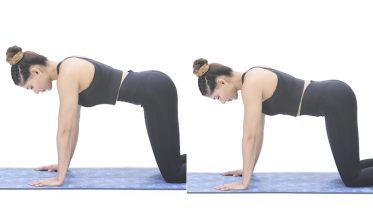
- Get onto your hands and knees on a mat, with your hands under your shoulders and your knees under your hips.
- Let your back settle level from your neck to your tailbone, with your head in line and your eyes on the mat.
- Tighten your stomach gently, then lift your right arm straight out in front of you until it is level with your body.
- Lower that hand back to the mat under your shoulder without letting your hips or back shift.
- Lift the left arm in the same way, and keep alternating at a steady pace.
What you should feel
Steady work in your stomach and along your back, and in the shoulder of the arm you are leaning on. From the side, only the arm should seem to move.
Common mistakes
- Rocking your body toward the supporting arm as the other one lifts.
- Letting your lower back sag or arch.
- Raising the arm above the level of your back.
- Letting the supporting shoulder collapse so your chest sinks toward the floor.
- Holding your breath.
How often
Many programs start with 1 to 3 sets of 6 to 10 lifts on each arm, pausing for 2 to 5 seconds at the top, once a day or on most days. Your physio will adjust this.
Stop and check with your physio if
- Back pain that builds during the set or does not settle after you stop.
- Pain in a wrist, knee or shoulder from taking your weight.
- Pain, numbness or tingling spreading down an arm or leg.
- Pins and needles in your arm or hand that do not go away after you stop, or part of your arm or hand goes numb. Get medical advice the same day. If one side of your face or body suddenly goes numb or weak, or your speech becomes slurred or muddled, call emergency services, even if it goes away.
From the clinic
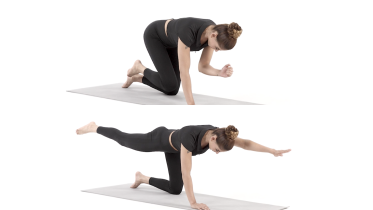
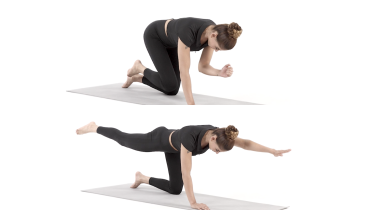
In the video the woman's hips and back stay level while each arm comes up to the height of her body, so the arm is the only thing that moves. If you cannot keep that still yet, lift the hand just a few inches, or slide it forward along the mat. Sore knees? Kneel on a thicker mat or a folded towel. When both arms lift cleanly, the bird dog adds the opposite leg.
If your wrists ache in this position, ask your physio about resting on your forearms or on your fists instead. After shoulder surgery, a dislocation or a broken arm, check with your physio before you take your weight through one hand. After back surgery, start only when your surgeon or physio has said this is fine.
If you have had a hip or knee replacement, get the go-ahead from your surgeon or physio before you try the quadruped arm lift. Some operations limit this kind of work for the first months, so the timing depends on your surgery. Kneeling on a replaced knee often stays uncomfortable for a long time, so ask your physio about extra padding under that knee.
If you are pregnant, check with your midwife or physio before you start. If you have recently given birth, including by cesarean section, or you have a gap down the middle of your stomach muscles (diastasis recti), ask your physio, midwife or doctor first.
Written and checked by the PocketPhysio editorial team. Last updated 2026-09-28.
This page is general education, not a diagnosis or a personal treatment plan. If you have pain, an injury or a health condition, see a physiotherapist or doctor before starting new exercises.