Decline push-ups
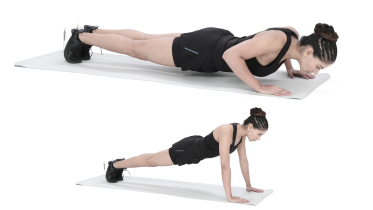
A decline push-up is a push-up with your feet raised on a sturdy chair and your hands on the floor, so your body slopes downward from your heels to your head. With your feet up, more of your weight moves onto your hands than in a floor push-up, so the pushing muscles carry more load, with extra work for the upper chest and the fronts of the shoulders. Your stomach has to stop your hips sagging. It is one of the harder push-up versions, added after regular push-ups feel comfortable.
How to do the decline push-ups
- Put a sturdy, solid chair on a non-slip floor with its back pressed against a wall. The voice guide mentions a bench, but the video uses a chair, and either works as long as it cannot move.
- Kneel on a mat facing away from the chair. Place your hands on the floor slightly wider than your shoulders, with your shoulders over your wrists.
- Lift one foot onto the seat, then the other, so you rest on your toes with your body straight from your heels to your head.
- Tighten your stomach, buttocks and thighs. Breathe in and bend your elbows to lower your chest toward the floor, elbows angled back at about 45 degrees and your neck in line with your back.
- Stop a little above the floor, as in the video, then breathe out and press through your hands to straighten your arms.
- When you finish, lower your knees to the mat before you take your feet off the chair one at a time.
What you should feel
Strong effort across the upper chest, at the fronts of your shoulders and in the backs of your arms. Your stomach and thighs work to keep your body in one line.
Common mistakes
- Setting your feet on a folding, wheeled or rocking seat.
- Letting the hips sag so the lower back arches.
- Leading with the head or dropping the face toward the floor.
- Placing the hands too far forward, so the shoulders end up behind the wrists.
- Holding your breath through the push.
How often
Once floor push-ups are comfortable, many programs use 2 to 3 sets of 5 to 10, on 2 to 3 days a week with a rest day between, ending each set before your hips start to drop. Your physio will adjust this.
Stop and check with your physio if
- Chest pain or pressure, dizziness or feeling faint, a racing or irregular heartbeat, or being far more out of breath than the effort should cause.
- Sharp pain at the front of the shoulder, in the elbow or in the wrist, or pins and needles in the fingers.
- Pins and needles in your arm or hand that do not go away after you stop, or part of your arm or hand goes numb. Get medical advice the same day. If one side of your face or body suddenly goes numb or weak, or your speech becomes slurred or muddled, call emergency services, even if it goes away.
- The chair shifts, tips or your feet start to slide off the seat.
From the clinic
The chair matters more than anything else here. Set it with the back flat against a wall so it cannot slide away from you, and check that the seat is solid and level. Skip folding chairs, office chairs on wheels and anything that rocks, because a seat that gives way leaves you falling face first. If you are unsure about any chair, a low, solid step or the bottom stair is a safer place for your feet.
Work up to this version. Once standard push-ups with a straight body feel easy, try your feet on something low, such as a step, before you move up to a chair seat. Incline push-ups and a still plank are easier options for building the same strength. If your shoulder has been operated on, has dislocated, or hurts on most days, ask your physio before you start.
With your feet up, your head sits lower than your hips. If your blood pressure runs high, you have heart trouble or glaucoma, or you have had recent eye surgery, get your doctor's advice before trying this, and breathe out on each press instead of straining. If chest pain, pressure or tightness does not ease quickly when you rest, spreads to your arm, neck, jaw, stomach or back, or comes with sweating, feeling sick, feeling light-headed or being short of breath, call emergency services straight away, as this can be a heart attack. If it eases quickly and none of these happen, get medical advice the same day, and do not exercise again until you have been checked. If you faint while exercising, call emergency services, even if you feel fine again quickly.
Written and checked by the PocketPhysio editorial team. Last updated 2026-09-28.
This page is general education, not a diagnosis or a personal treatment plan. If you have pain, an injury or a health condition, see a physiotherapist or doctor before starting new exercises.