
Elbow bursitis (olecranon bursitis): what to do about a swollen elbow
Warning signs, and when to get help
What is elbow bursitis?
A bursa is a thin sac that sits between a bone and the soft tissue over it, with a little lubricating fluid inside, and there is one over the point of your elbow. OrthoInfo says that normally this one is flat, and that it fills with extra fluid when it becomes irritated or inflamed. That is elbow bursitis, and the clinical name for it is olecranon bursitis, after the bony point itself.
Swelling is usually the first thing people notice, often before any pain. OrthoInfo explains why the early swelling is easy to miss: the skin at the back of the elbow is loose, so a small amount of extra fluid may not be noticed right away. Pain tends to come with direct pressure on the elbow or with bending it, and a swelling big enough can limit how far the elbow moves.
Where it sits is the most useful thing to check first. This swelling is at the very back of the elbow, on the part you lean on. Pain on the outer side with gripping is more likely tennis elbow, and pain on the inner side with gripping is more likely golfer's elbow. Our page on swelling, lumps and bruising at the elbow walks through the other things that can swell there, and the bony bump on the inner side that most people find when they go looking for a sore spot.
Is my elbow bursitis infected?
Everything on this page turns on this question, and the answer decides both the treatment and the timing. An infected bursa needs antibiotics and usually draining, starting the same day. A bursa that is not infected needs the pressure taken off it and some patience. Treating the first as though it were the second is the mistake with consequences, which is why infection comes before exercise here.
Start with how bacteria get in, because it is simpler than people expect. OrthoInfo describes bacteria entering through a break in the skin at the tip of the elbow, such as an insect bite, a scrape or a puncture wound, and then the infected bursa producing fluid, redness, swelling and pain, with the skin over it going red and warm. It also says the sac can become infected without any obvious injury to the skin, so a clean, unbroken elbow proves nothing. Left untreated, the fluid can turn to pus, and the bursa occasionally opens on its own and drains it.
Now the part no patient page seems to say out loud. There is no sign you can check at home that rules infection in or out. A study of 91 adults treated surgically for an infected elbow bursa at a US specialist center between 2000 and 2022 puts it plainly: there is no established clinical or laboratory finding that is specific for the diagnosis. That is its reading of the published evidence as much as of its own patients, and its own patients made the same point, because only 13 of those 91 had a fever and most did not have a raised white cell count (El Zein and colleagues, 2024).
Time was no guide either: in that group the symptoms had been going on for a median of 13 days before anyone looked at the elbow, and for a quarter of them more than seven weeks. Those were people who went on to surgery at a referral center, so the figures describe that group rather than everyone with a swollen elbow. The lesson travels anyway: neither a normal temperature nor a few quiet days is reassurance.
What raises the suspicion enough to be seen today is a short list worth reading twice. Heat and redness in the skin over the swelling. Pain out of proportion to a soft lump. A graze, bite, cut or puncture anywhere near the elbow tip, however small and however long ago, and that includes the mark a needle left if the swelling has been drained or injected. Anything leaking from it. Feeling unwell in yourself, with or without a measured temperature. Add to those a reason your body fights infection less well than usual, such as rheumatoid arthritis, medicines that suppress the immune system, or diabetes, all of which were common in the group El Zein and colleagues described.
The same-day line on the warning list at the foot of this page is the one to use for any of that. Same day means today rather than tomorrow morning, so in the evening or at night use an urgent care center or an out of hours service rather than waiting for a surgery to open, and an emergency department if you feel very unwell. The way the question gets settled is a needle rather than an opinion: OrthoInfo describes drawing off a small sample of the fluid and testing it, which also tells infection from gout. Redness is also harder to see on brown and black skin, as both the NHS bursitis and NHS gout pages note, so judge heat, pain and how unwell you feel alongside it rather than waiting for a color change.
How do you get elbow bursitis?
Four routes cover most of it, and OrthoInfo names them all. A single hard blow to the point of the elbow can make the sac swell. Prolonged pressure, from leaning on hard surfaces over weeks and months, does it more slowly, and the trades OrthoInfo names are plumbers and heating and air conditioning technicians, along with athletes who hold long planks on their forearms. Infection is the third, as above. The fourth is a medical one: rheumatoid arthritis and gout are both associated with elbow bursitis.
The pressure route is the one most people recognize as soon as it is described. A desk edge under the elbow, a car door ledge on a long commute, an armrest leaned on through every meeting, the floor of a van, a crawl space, a sofa arm while reading. None of it hurts at the time, which is exactly why it goes on for months.
Gout reaches the elbow too. The NHS lists the elbow among the joints gout can affect after the big toe, describes an attack as sudden severe pain in a joint with hot, swollen, red skin over it, and says to see a GP if you have symptoms of gout for the first time. It also treats sudden joint pain and swelling that is getting worse, or that comes with a very high temperature, feeling hot, cold or shivery, feeling sick or being unable to eat, as a reason to get urgent help, because those symptoms can mean an infection inside the joint. A first attack of gout and an infected bursa cannot be told apart at the kitchen table, so if the elbow is hot, red and swollen, use the same-day line in the warning list below whichever of the two you think it is, and let the needle and the laboratory separate them. If you are under a team for rheumatoid arthritis or another inflammatory condition, a new elbow swelling is something to tell them about rather than work out alone.
Repeated episodes have one more explanation. OrthoInfo says an X-ray may be taken to look for a foreign body or a bone spur at the tip of the elbow, which it describes as common in people who have had repeated bouts.
What the treatment ladder looks like
For a bursa that is not infected, the first rung is mechanical. OrthoInfo lists elbow pads to cushion the elbow, avoiding direct pressure on it, a splint to keep the elbow straight, and anti-inflammatory tablets, and says that if there has been no improvement after 3 to 6 weeks a doctor may drain the bursa and inject a corticosteroid, which helps some people and not others. The NHS home version is rest, avoiding activities that press on the joint, an ice pack wrapped in a tea towel for about 10 minutes at a time every few hours, painkillers and padding at night. healthdirect frames the same self-care as protection, rest, ice, compression and elevation.
The evidence on the next rungs, still for a bursa that is not infected, is worth having before you are offered them. Sayegh and Strauch (2014) reviewed 29 studies covering 1,278 patients and found that non-surgical management was more effective and safer than surgery: surgery was less likely to resolve the problem and brought more complications, more persistent drainage and more infection of the bursa. In cases that were not infected, drawing fluid off did not raise the risk of infecting the bursa, while corticosteroid injection was associated with more complications overall and with thinning of the skin, with no improvement in outcome. The authors are clear that most of this rests on low-level evidence, so read it as a direction of travel rather than a verdict.
Thinning of the skin counts for more at this spot than the words suggest, which is the surgeon's reason for being careful rather than the review's. The skin at the back of the elbow lies straight on a bare bony point, and El Zein and colleagues describe its blood supply there as a watershed down the midline, so a thin patch over it is slow to heal. An open wound or a leak that will not close over the elbow tip is what sent 37 of their 91 patients to the operating room. Nobody has shown that injections caused wounds like those, and that is not the argument. The argument is that this is the one place where the complication the review did find is hardest to get back from.
For an infected bursa the ladder is different and faster. OrthoInfo describes drawing the fluid off, sending it to a laboratory to identify the bacteria, and starting antibiotics, sometimes before the organism is known, to stop the infection progressing. The NHS says antibiotics for an infected bursa are usually given for at least 7 days, and that a steroid injection is not used when infection is the cause. If antibiotics and drainage do not work, OrthoInfo says the whole bursa may be removed, with further antibiotics, and that the bursa usually grows back over several months as a normal sac.
One figure from the surgical literature is useful for understanding why antibiotics run on longer than people expect. Of the 91 patients El Zein and colleagues (2024) studied after surgery for an infected bursa, 84 were given antibiotics afterward, and for those the median course was 21 days, leaving aside a few who also had the infection in the blood or the bone. Staphylococcus aureus grew in 58 of the 91. Again, that is a surgical group at one referral center, not a description of every infected elbow.
How to use this program
Nothing below replaces the steps above. The exercises are for the elbow once infection has been ruled out or is being treated, and they exist because the mechanical side of this problem is the part that gets left out everywhere else. No trial of an exercise program for elbow bursitis was found when this page was written, so this one is reasoned from what the condition does rather than copied from a protocol, and your physio will shape it to your elbow and your job.
Four checks come before the first repetition, and each one has its own line in the warning signs at the foot of the page. Do not start, and get advice the same day instead, if the elbow is hot, red and swollen, if you have a fever or feel unwell with it, if the skin over the swelling is broken or leaking, or if the pain began with a fall or a blow and is severe. Same day means today, so in the evening or at night that is an urgent care center or an out of hours service rather than tomorrow morning.
Whose plan comes first is the other thing to settle before you start. If you have had the bursa drained, injected or removed, follow the plan from the team who did it, and treat their limits on bending and loading as coming before anything here. That applies just as much to any other recent operation on the elbow, wrist or forearm, and to a break or a dislocation anywhere in the elbow, wrist, hand or forearm: if you are still under a fracture clinic or a surgical team, start nothing here until they have cleared you, and their limits on how far you bend and straighten come first. A splint is the same kind of instruction: if you have been given one to hold the elbow straight, that is the plan to follow, and the bending work starts when the person who gave it to you says so.
Then there is the rule that runs through the whole program, and it is not an exercise. Nothing presses on the point of the elbow. Not a desk edge, not a car door, not an armrest, not a plank on the forearms, not a hand under the chin while reading. A pad on the elbow and a cushion under the forearm at work are doing as much of the treatment as the repetitions are.
As a rough guide, the range of movement work runs at 10 to 15 slow repetitions 2 to 3 times a day, the grip squeezes at 10 to 15 holds of about 3 to 5 seconds 1 to 3 times a day, and the band turns at 2 to 3 sets of 10 to 15 slow repetitions once a day. Those numbers are each exercise on its own rather than a total, and they are not meant to be stacked at the top of their ranges. Do the day's work in the same 2 to 3 short sessions instead of making a separate trip for each exercise, and if you are still doing the stage 1 bending when you add the stage 2 straightening, take the lower end of both rather than the top of each. Otherwise the elbow does roughly twice the end-of-range bending the program intends, and the end of the bend is the part that pulls the skin tight over the swelling.
If you have high blood pressure, breathe steadily through every hold and never hold your breath, and ask your doctor or physio before you add longer holds. Your physio will adjust the numbers.
Judge all of it by the swelling and the soreness the next morning. Swelling builds over hours rather than during the exercise, so a session that felt fine can show up the following day. If it does, cut the amount rather than stopping: keep the gentle bending and straightening going, drop the band work for a few days, and look again at what the elbow has been resting on.
The exercise program
The exercises below carry their own stop signs and precautions. Open the line under an exercise and read them before you try it.
Stage 1: Keep the elbow moving while the pressure stays off it
For a swollen elbow that infection has been ruled out of, or that a doctor is treating. Neither exercise presses on the point of the elbow, which is the whole idea. Bending and straightening is usually 10 to 15 slow repetitions, 2 to 3 times a day, and you go only as far as the elbow comfortably bends. Bending pulls the skin tight over the swollen tip, which is why OrthoInfo describes a splint to hold the elbow straight as one way of stopping the skin getting tight as the elbow bends up, and why the end of the bend is often the sorest part of the range. Stop short of the point where the skin over the lump feels tight or stretched rather than working through it, and if a doctor has given you a splint to keep the elbow straight, their plan comes first and the bending waits until they say. The grip squeeze keeps the hand and forearm working while the elbow is being left alone, with a soft ball, 10 to 15 squeezes held about 3 to 5 seconds, 1 to 3 times a day, and the forearm resting on your thigh rather than propped on the elbow. Keep breathing through each squeeze. Your physio will adjust this.
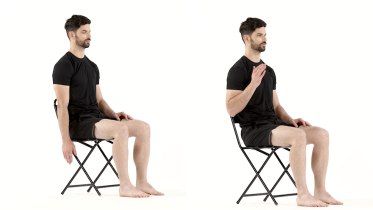 Elbow flexion and extension
Stop signs and precautions for the elbow flexion and extension
Before you start
- After a broken or dislocated elbow, or elbow surgery such as a tendon repair, follow your surgeon's or physio's plan, and start this exercise only when they have cleared you. They may also set limits on how far you bend or straighten, and those limits come first. If you have just hurt your arm and have severe pain or cannot move the elbow, do not exercise it. Go to an urgent care center or emergency department the same day. If you heard a snap or a crack at the moment of the injury, the arm looks a different shape or sits at an odd angle, a bone is showing, or your arm or hand tingles, feels numb or turns cold, pale or blue, go to an emergency department straight away or call emergency services, and do not drive yourself.
When to stop and get help
- Sharp pain at the elbow, or pain that climbs with each repetition.
- New or growing swelling, heat or redness around the elbow.
- The elbow is hot, red and swollen, or you have elbow pain with a high temperature or feel hot, cold or shivery. Get medical advice the same day, and go to an emergency department if you feel very unwell. This can be a sign of infection in the joint, which needs treatment quickly. If you have a very high or very low temperature, shivering you cannot control, you are breathing very fast or finding it hard to breathe, you are confused or your speech is slurred, your skin, lips or tongue look blue, gray, pale or blotchy (on brown or black skin this can be easier to see on the palms of the hands or soles of the feet), or you have a rash that does not fade when you press it, call emergency services, as this can be sepsis.
- Numbness, tingling or weakness in the hand or fingers.
- Pins and needles in your arm or hand that do not go away after you stop, or part of your arm or hand goes numb. Get medical advice the same day. If one side of your face or body suddenly goes numb or weak, or your speech becomes slurred or muddled, call emergency services, even if it goes away.
- Since the elbow injury or an operation on it, your hand is getting weaker or clumsier, you are dropping things, you cannot pinch or grip as you could, the ring and little fingers feel numb or tingly all the time rather than only while you exercise, or the muscle between your thumb and index finger looks hollowed out. Contact your fracture clinic or surgical team the same day. The nerve that runs behind the elbow (the ulnar nerve) can be pressed on by swelling, by the healing bone or by metalwork, and a nerve that is losing power needs looking at quickly, because weakness left to run on may not fully recover.
- Emergency: while you are in a cast or splint, your fingers turn blue, white or pale, or feel cold. Do not wait to see if raising your hand helps. Go to an emergency department straight away, and do not drive yourself. The cast or splint may be cutting off the blood supply, or pressure may be building up inside the forearm (compartment syndrome), and both need checking quickly.
- In a cast or splint, the pain gets worse, your fingers feel numb or tingle or look more swollen, or the cast feels too tight. Stop, rest your hand at about the level of your heart, keep moving your fingers and contact your fracture clinic or get medical advice straight away. Do not lift the hand higher than your heart and do not put ice on it, because if pressure is building up inside the forearm both of those cut down the blood reaching it. If you cannot move your fingers, the pain is severe even after painkillers, or the numbness, tingling or swelling has not settled within 30 minutes, go to your fracture clinic or an emergency department straight away, and do not drive yourself.
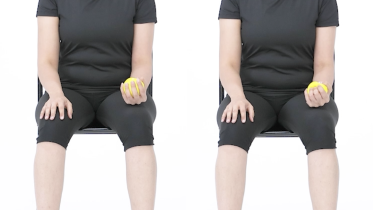 Hand grip squeeze
Stop signs and precautions for the hand grip squeeze
Before you start
- After a broken wrist, hand or forearm, or surgery on any of them such as a tendon repair, start only when your doctor, surgeon, physio or hand therapist says the bone or repair is ready for this, and follow their plan for how much to do.
- Keep breathing through each hold, because holding your breath while you strain can push your blood pressure up.
When to stop and get help
- Sharp pain in the wrist, a finger joint or at the base of the thumb.
- Your hand or fingers go numb or start to tingle. If one side of your face or body suddenly goes numb or weak, or your speech becomes slurred or muddled, call emergency services, even if it goes away.
- Hand joints that are more swollen, hot or stiff afterward.
- Since the fracture or cast, the hand is getting more painful rather than less, the skin becomes very sensitive to light touch, or the hand changes color, temperature, swelling or sweating compared with the other one, or looks shiny. See your doctor or physio as soon as you can, within a few days at most, as this can be complex regional pain syndrome (CRPS) and early treatment may help.
Stage 2: Get the last of the straightening back
Move up when the swelling is settling and stage 1 is comfortable. Losing the last few degrees of straightening is common after an elbow has been sore or swollen for weeks, and keeping the joint moving is why OrthoInfo has movement exercises typically permitted within a few days of the bursa being removed. Many programs use 10 to 15 slow repetitions with a hold of about 5 seconds at the straightest point, 2 to 3 times a day. Change one thing from the exercise page for a swollen bursa. It shows the free hand cupped under the elbow, and with the arm held forward the point of the elbow faces downward, so a hand cupped there is sitting straight on the swelling. Support the upper arm just above the elbow instead, which holds it level and keeps your palm off the sore part. Stop just short of pain rather than hauling into it, and if holding the arm up tires your shoulder, rest the upper arm on a pillow on a table, with the point of the elbow clear of it, instead of ending the session. Your physio will adjust this.
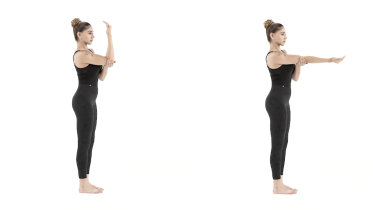 Standing elbow extension
Stop signs and precautions for the standing elbow extension
Before you start
- After a broken or dislocated elbow, or elbow surgery such as a tendon repair, follow your surgeon's or physio's plan, and start this exercise only when they have cleared you. If you have just hurt your arm and have severe pain or cannot move the elbow, do not exercise it. Go to an urgent care center or emergency department the same day. If you heard a snap or a crack at the moment of the injury, the arm looks a different shape or sits at an odd angle, a bone is showing, or your arm or hand tingles, feels numb or turns cold, pale or blue, go to an emergency department straight away or call emergency services, and do not drive yourself.
- If the point of your elbow is swollen or tender, has a wound or a scar that is still healing, or has metalwork you can feel under the skin, keep the supporting hand on the upper arm and off the elbow tip, and rest the upper arm rather than the elbow if you use a pillow. With the arm held forward, the point of the elbow faces downward, so a hand cupped there presses straight on it.
- After a repair of the biceps tendon at the elbow, how far the elbow may straighten is often limited for the first weeks, and in this position the repaired muscle controls the forearm as it lowers, so ask how far you may go and when to start.
When to stop and get help
- Sharp pain in the elbow, or pain that climbs with each repetition and lingers afterward.
- The elbow is hot, red and swollen, or you have elbow pain with a high temperature or feel hot, cold or shivery. Get medical advice the same day, and go to an emergency department if you feel very unwell. This can be a sign of infection in the joint, which needs treatment quickly. If you have a very high or very low temperature, shivering you cannot control, you are breathing very fast or finding it hard to breathe, you are confused or your speech is slurred, your skin, lips or tongue look blue, gray, pale or blotchy (on brown or black skin this can be easier to see on the palms of the hands or soles of the feet), or you have a rash that does not fade when you press it, call emergency services, as this can be sepsis.
- Tingling, pins and needles or numbness in your hand, most often in the ring and little fingers (from the nerve behind the elbow, the ulnar nerve) or in the thumb, index and middle fingers (the median nerve).
- Pins and needles in your arm or hand that do not go away after you stop, or part of your arm or hand goes numb. Get medical advice the same day. If one side of your face or body suddenly goes numb or weak, or your speech becomes slurred or muddled, call emergency services, even if it goes away.
- Since the elbow injury or an operation on it, your hand is getting weaker or clumsier, you are dropping things, you cannot pinch or grip as you could, the ring and little fingers feel numb or tingly all the time rather than only while you exercise, or the muscle between your thumb and index finger looks hollowed out. Contact your fracture clinic or surgical team the same day. The nerve that runs behind the elbow (the ulnar nerve) can be pressed on by swelling, by the healing bone or by metalwork, and a nerve that is losing power needs looking at quickly, because weakness left to run on may not fully recover.
- A sudden pop or snap at the front of your elbow, sudden sharp pain there, or the muscle at the front of your upper arm bunches up or changes shape. Stop and go to an urgent care center or emergency department the same day, even if you can still bend the elbow, as this can be a torn biceps tendon.
Stage 3: Forearm strength for tools, lifting and a full day
For getting back to work with the arm, once the elbow bends and straightens freely and the swelling has stopped coming back after use. Both band turns are done sitting at a table with the forearm resting on it, starting with a light band at 2 to 3 sets of 10 to 15 slow turns once a day, controlling the way back rather than letting the band snap the hand round. Turning the palm up is the one most jobs need for a screwdriver or a door handle, and turning it down is the one for pouring and pressing. Keep the elbow off the tabletop and off its point throughout, and sit close enough that the whole forearm is supported and the table edge is not pressing under the elbow or just below it, with a folded towel under the forearm if the edge is hard. A desk edge under the elbow is one of the things that starts this problem, so the table is there for the forearm and never for the elbow. Begin at the bottom of those ranges and add to them over a week or two rather than starting at the top. If the swelling returns the day after a session, that is the load to cut rather than something to push through. Your physio will set the band and the numbers.
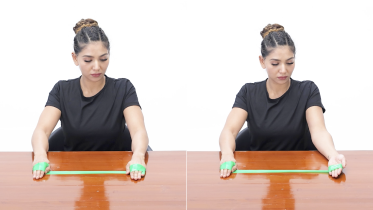 Forearm supination with band
Stop signs and precautions for the forearm supination with band
Before you start
- After a broken or dislocated elbow, or elbow surgery such as a tendon repair, follow your surgeon's or physio's plan, and start this exercise only when they have cleared you. If you have just hurt your arm and have severe pain or cannot move the elbow, do not exercise it. Go to an urgent care center or emergency department the same day. If you heard a snap or a crack at the moment of the injury, the arm looks a different shape or sits at an odd angle, a bone is showing, or your arm or hand tingles, feels numb or turns cold, pale or blue, go to an emergency department straight away or call emergency services, and do not drive yourself.
- After a broken wrist, hand or forearm, or surgery on any of them such as a tendon repair, start only when your doctor, surgeon, physio or hand therapist says the bone or repair is ready for this, and follow their plan for how much to do.
When to stop and get help
- Sharp pain in the wrist, forearm or elbow as you turn.
- The elbow is hot, red and swollen, or you have elbow pain with a high temperature or feel hot, cold or shivery. Get medical advice the same day, and go to an emergency department if you feel very unwell. This can be a sign of infection in the joint, which needs treatment quickly. If you have a very high or very low temperature, shivering you cannot control, you are breathing very fast or finding it hard to breathe, you are confused or your speech is slurred, your skin, lips or tongue look blue, gray, pale or blotchy (on brown or black skin this can be easier to see on the palms of the hands or soles of the feet), or you have a rash that does not fade when you press it, call emergency services, as this can be sepsis.
- A painful click or catch at the wrist.
- Numbness or tingling in the hand.
- Pins and needles in your arm or hand that do not go away after you stop, or part of your arm or hand goes numb. Get medical advice the same day. If one side of your face or body suddenly goes numb or weak, or your speech becomes slurred or muddled, call emergency services, even if it goes away.
- Since the elbow injury or an operation on it, your hand is getting weaker or clumsier, you are dropping things, you cannot pinch or grip as you could, the ring and little fingers feel numb or tingly all the time rather than only while you exercise, or the muscle between your thumb and index finger looks hollowed out. Contact your fracture clinic or surgical team the same day. The nerve that runs behind the elbow (the ulnar nerve) can be pressed on by swelling, by the healing bone or by metalwork, and a nerve that is losing power needs looking at quickly, because weakness left to run on may not fully recover.
- A sudden pop or snap at the front of your elbow, sudden sharp pain there, or the muscle at the front of your upper arm bunches up or changes shape. Stop and go to an urgent care center or emergency department the same day, even if you can still bend the elbow, as this can be a torn biceps tendon.
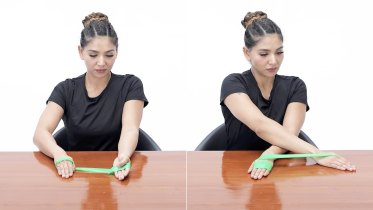 Forearm pronation with band
Stop signs and precautions for the forearm pronation with band
Before you start
- After a broken or dislocated elbow, or elbow surgery such as a tendon repair, follow your surgeon's or physio's plan, and start this exercise only when they have cleared you. If you have just hurt your arm and have severe pain or cannot move the elbow, do not exercise it. Go to an urgent care center or emergency department the same day. If you heard a snap or a crack at the moment of the injury, the arm looks a different shape or sits at an odd angle, a bone is showing, or your arm or hand tingles, feels numb or turns cold, pale or blue, go to an emergency department straight away or call emergency services, and do not drive yourself.
- After a broken wrist, hand or forearm, or surgery on any of them such as a tendon repair, start only when your doctor, surgeon, physio or hand therapist says the bone or repair is ready for this, and follow their plan for how much to do.
When to stop and get help
- Sharp pain in the forearm, wrist or elbow as you turn.
- The elbow is hot, red and swollen, or you have elbow pain with a high temperature or feel hot, cold or shivery. Get medical advice the same day, and go to an emergency department if you feel very unwell. This can be a sign of infection in the joint, which needs treatment quickly. If you have a very high or very low temperature, shivering you cannot control, you are breathing very fast or finding it hard to breathe, you are confused or your speech is slurred, your skin, lips or tongue look blue, gray, pale or blotchy (on brown or black skin this can be easier to see on the palms of the hands or soles of the feet), or you have a rash that does not fade when you press it, call emergency services, as this can be sepsis.
- A painful click or catch on the little finger side of the wrist.
- Your hand or fingers start to tingle or go numb.
- Pins and needles in your arm or hand that do not go away after you stop, or part of your arm or hand goes numb. Get medical advice the same day. If one side of your face or body suddenly goes numb or weak, or your speech becomes slurred or muddled, call emergency services, even if it goes away.
- Since the elbow injury or an operation on it, your hand is getting weaker or clumsier, you are dropping things, you cannot pinch or grip as you could, the ring and little fingers feel numb or tingly all the time rather than only while you exercise, or the muscle between your thumb and index finger looks hollowed out. Contact your fracture clinic or surgical team the same day. The nerve that runs behind the elbow (the ulnar nerve) can be pressed on by swelling, by the healing bone or by metalwork, and a nerve that is losing power needs looking at quickly, because weakness left to run on may not fully recover.
How do you get rid of elbow bursitis at home?
Change the contact first. Every hour the elbow spends propped on something hard is working against the rest of this, and the swelling behaves like a tap you have not turned off. Find the three or four places it happens in your own day, then pad them or move the arm. A folded towel under the forearm at a desk, an elbow pad for work, and a cushion on the chair arm where you read are the practical versions, and OrthoInfo names elbow pads and avoiding direct pressure as the first non-surgical steps for exactly this reason.
Ice is for comfort rather than cure, and the NHS gives a usable dose: an ice pack or a bag of frozen peas wrapped in a tea towel, about 10 minutes at a time, repeated every few hours through the day. Keep something between the pack and your skin. Never put it on skin that cannot feel properly, and take it off before you fall asleep. If you have had an aspiration, an injection or an operation on the elbow, ask the team who did it before you put ice over the wound or the dressing, because teams differ on that.
There is one situation where ice comes off altogether, and it is the one you will see in the stop signs under the bending and straightening exercise above: if you are in a cast or a splint and the pain gets worse, your fingers feel numb or tingle or look more swollen, or it feels too tight, rest your hand at about the level of your heart, keep moving your fingers and get medical advice straight away. Do not lift the hand higher than your heart and do not put ice on it, because if pressure is building up inside the forearm both of those cut down the blood reaching it.
Painkillers are on the same NHS list, and OrthoInfo names anti-inflammatory tablets such as ibuprofen too. If you are pregnant, the NHS advises avoiding ibuprofen unless a doctor or pharmacist tells you to take it. Check with your doctor or pharmacist that they are safe for you to take, as healthdirect advises, because they do not suit everyone.
Keep the elbow moving while you do all that. An elbow that is held still for weeks goes stiff, and stiffness is a second problem on top of the swelling. The gentle bending and straightening in stage 1 is there to prevent that, and it asks nothing of the bursa because there is no weight and no pressure on the tip.
Two things not to do. Do not squeeze or try to burst the swelling, and do not keep draining it yourself with anything. Breaking the skin over an inflamed bursa is how bacteria get in, which is the route OrthoInfo describes for an infection, and the elbow you are trying to settle is then a different and more urgent problem. The NHS also advises cleaning any cuts on a joint to prevent infection, which is the same thinking from the other direction.
After an aspiration, an injection or surgery to remove the bursa
If a doctor has drawn the fluid off, expect it to be sent for testing, and follow whatever they said about the dressing and about keeping pressure off the elbow. An aspiration is doing two jobs at once, and OrthoInfo names both: taking the fluid away relieves the symptoms, and it gives the laboratory a sample that shows whether bacteria are there and which antibiotic is needed. The fluid can come back, which is one of the reasons the padding and the habits matter as much afterward as before. If nobody gave you a plan for moving the elbow afterward, the gentle bending and straightening in stage 1 asks nothing of a needle mark, but keep the dressing dry, keep everything off the point of the elbow, and ask the team before you add the band work.
A needle is still a way in. Sayegh and Strauch found no rise in bursal infection after drawing fluid off a bursa that was not infected, so this is not a reason to turn an aspiration down, but the risk is not nil either: healthdirect names having had a procedure on the joint, such as an aspiration or a corticosteroid injection, among the things that make a joint infection more likely. So an elbow that turns hot, red, more swollen or more painful over the days after an aspiration or an injection, or a temperature alongside it, has its own same-day line in the warning list below, written for a needle rather than for an operation. Use it, and do not put it down to the old problem flaring. After an operation to remove the bursa, use the wound line in that list instead, which goes to your surgical team the same day.
After a bursectomy, which is removal of the whole bursa, the thing that goes wrong is the wound rather than a repair. OrthoInfo says the operation, in the version done for a bursa that is not infected, does not disturb any muscle, ligament or joint structure, so there is nothing stitched inside the elbow that a movement could pull apart. What has to heal is a cut across a bare bony point, in skin El Zein and colleagues describe as having a watershed blood supply down the midline, which is the explanation they give for healing there being slow in smokers. Among their 91 patients, all of them operated on for an infected bursa, 21 had a complication of some kind, 12 had delayed wound healing and 6 needed a flap to get the skin closed. That is infected surgery at a referral center and not a straightforward planned bursectomy, so read it as where the trouble sits rather than as your own odds.
That is also why the timings OrthoInfo gives are permissions and not a calendar. Movement exercises are typically permitted within a few days of the operation. The skin should be well healed within 12 to 16 days. After 3 to 4 weeks your doctor may allow you to use the elbow fully. Padding or protection may be needed for several months to stop the problem coming back.
A splint may be put on after the operation to protect the skin, and casts or long spells of holding the elbow still are usually not needed. Every one of those is a decision your surgeon makes about your elbow, not a date to read off this page.
There is one thing to know if your bursa was taken out because it was infected. Those timings, like the sentence above about muscle, ligament and joint structures, sit in OrthoInfo's account of surgery for a bursa that is not infected. When the bursa is infected, how much tissue has to come out with it is decided in the operating room, and the complication figures above are what that wound can do, so those are not your dates and your surgeon's are. For an infected bursa the removal is also done alongside further antibiotics.
Two restrictions are worth asking about by name, because surgeons set them differently and both are about the skin, not about the elbow joint. The first is how far to bend. Bending pulls the skin at the back of the elbow tight, which is the reason OrthoInfo gives for offering a straight-elbow splint in bursitis that has not been operated on, and after surgery that tightening crosses a fresh wound at the end of the bend. So ask whether you have a limit on how far to bend it and for how long, and until the wound has healed, work where the movement is easy rather than pushing into the end of the bend.
The second is leaning. Nothing rests on the point of the elbow at all while the wound is healing, and after it has healed the pad is what protects it, which is why OrthoInfo expects protection to carry on for months.
The window in which a bursectomy can still go wrong is longer than most people expect, and it is worth knowing before you are signed off. Of those same 91 patients, 12 were counted as treatment failures within 90 days of the operation, 8 of them with the bursa infected again and 4 with infection in the bone that nobody had suspected at the start. Among those given antibiotics after surgery, the failures turned up a median of 44 days after the antibiotics stopped. So an elbow that was settling and then turns painful, red, swollen or leaky weeks later, once the course has finished and the clinic has discharged you, is a reason to ring the surgical team rather than to start the self-care again from the beginning. The wound line in the warning list is the one for that, and it goes to your surgical team the same day.
If you smoke and a bursectomy is being planned, there is a practical reason to bring it up yourself, and it is about how the wound closes rather than about how you got the bursitis. Active smokers in that group had around four and a half times the odds of the surgery failing compared with people who had never smoked, with a wide margin of uncertainty around the figure, and smoking was the only thing about the patients themselves that the analysis picked out. What the paper asks for is not that anyone be lectured but that every smoker is offered support to quit around the time of the operation, so this is a request to make rather than something to admit. The systematic review of surgical wound healing it leans on for the reason reports that stopping for four weeks or more restores part of the healing response, though not all of it (Sorensen 2012), which is the reason to raise it as soon as an operation is mentioned rather than the week before.
Your surgeon's plan comes before this page, and the stages above are a shape to discuss with them, not a protocol to follow on your own. OrthoInfo says formal physical therapy is not usually needed after this operation, and that the surgeon will instead recommend specific movement exercises, so treat the stages here as the kind of thing to ask them about. In practice stage 1 is where most people start after the dressing comes off, stage 2 is the one that matters because the last part of straightening is what gets lost, and stage 3 waits until the wound is healed and comfortable, by which we mean closed and dry, with nothing weeping and no part of it opening up. If you are not sure whether it counts as healed, that is a question for your wound check rather than a judgement to make on your own. Keep the wound check or clinic appointment you have been given even if the elbow feels fine, because somebody looking at the wound is the only way the slow-healing ones are picked up early, and nothing on this page replaces that visit.
Going back to work, tools and the gym
The job usually has to change in one specific way, and it is not about how heavy the work is. It is about what the elbow rests on. Plumbers, electricians, heating engineers, mechanics, floorers and anyone who works in a confined space spend hours with the point of the elbow on something solid, and OrthoInfo names that prolonged pressure as a cause in its own right. What stops this coming back is a proper elbow pad, a knee pad repurposed under the forearm, a mat in the van, and the habit of resting on the forearm instead of the elbow tip.
Desk work is the quiet version of the same problem. The elbow parks on the desk edge or the chair arm for six hours a day without anybody noticing. Drop the armrests or pad them, bring the mouse close enough that the forearm rests rather than the elbow, and get up often enough that nothing is leaned on for an hour at a stretch.
In the gym, take out what presses on the elbow and keep the rest. Forearm planks and side planks are the obvious ones, and OrthoInfo specifically names athletes who perform planks for long periods among those at risk. Leaning on your elbows on a bench between sets is worse than the sets. Hands and knees work with the elbow down, and any machine where the arm rests on a pad at the elbow, come out for now. Build back by the swelling the next morning rather than by the calendar.
When to see a physio or doctor
See a doctor the same day if the elbow is hot, red and swollen, if you have a fever or feel unwell with it, if the skin over the swelling is broken or leaking, or if you have a reason your immune system is not at full strength. That is the one timing on this page not to negotiate with.
Otherwise, the NHS advises seeing a GP if symptoms have not improved, or are getting worse, after 1 to 2 weeks of looking after it yourself, if you cannot move the joint, or if the pain is very severe, sharp or shooting. The NHS page for elbow and arm pain adds a swollen arm together with a very high temperature, or feeling hot, cold or shivery, as a reason to get help urgently, and sends an injured arm with a snapping noise, a changed shape, or tingling or numbness to an urgent treatment center or emergency department.
A physical therapist (physiotherapist) is useful for the part that comes after the swelling: the elbow that will not straighten fully, the forearm that has lost strength while the arm was being protected, and the working day that caused the problem in the first place. Bring a photograph of the swelling with the date on it if you have one, because whether it is growing, settling or holding steady is one of the things a clinician most wants to know and nobody recalls accurately two weeks later. Each warning sign below carries its own timing, and some of them need help straight away.
For physiotherapists
This page is written for the patient in front of you with a swollen olecranon, and its first job is triage rather than rehabilitation. The septic and aseptic routes are kept apart at the top of the page, in a section of their own, and again in the checks above the program, because most people who read it have not been examined yet.
On the diagnostic point, El Zein and colleagues (2024) state in their discussion that there is no established clinical or laboratory finding that is specific for septic olecranon bursitis, citing Reilly and Kamineni 2016, Lormeau 2019 and Garcia-Porrua 1999. That statement is a reading of the literature and not a result of their series, and the series is offered in support of it: of 91 surgically managed adults only 13 were febrile, with most lacking leukocytosis; S. aureus accounted for 69% of positive bursal cultures, of which 26% were methicillin-resistant, and mechanical factors were present in 66%, most often elbow trauma.
Two details in that paper need care if you quote it. The fever figure appears as 14% in the results and 16% in the discussion, so the count is the safer thing to carry: 13 of 91, on a threshold of a temperature above 38.3C (101F), and 13 is the number in both their table of presenting findings and their text on fever within 48 hours of surgery. The title says 12 years while the methods give January 2000 to August 2022, which is 22 years. Either way it is 22 years of surgically treated patients at a single quaternary referral center, so prevalence and proportion figures from it do not describe unselected presentations. Aspiration remains the discriminator, and OrthoInfo also uses it to separate infection from crystal disease.
For aseptic bursitis, Sayegh and Strauch (2014), 29 studies and 1,278 patients, found nonsurgical management more effective and safer than operative management, with surgery showing lower rates of clinical resolution and higher rates of overall complications, persistent drainage and bursal infection; aspiration did not increase bursal infection risk, while corticosteroid injection was associated with increased overall complications and skin atrophy without improved outcomes. The authors note the evidence is predominantly level IV, and the review is itself level IV. So this page does not recommend injection, and it leads on offloading instead.
We can find no published exercise protocol for this condition, so the staging is reasoned: unloaded flexion and extension plus distal grip work first, terminal extension second because it is the range most often lost, and resisted pronation and supination last for occupational demand. Post-bursectomy expectations are taken from OrthoInfo, whose wording is permissive rather than prescriptive and is carried that way here: range of motion typically permitted within a few days, skin well healed within 12 to 16 days, the surgeon may allow full elbow use after 3 to 4 weeks, protective padding for several months, a post-operative splint to protect the skin, and casts or prolonged immobilization usually unnecessary. OrthoInfo also states that the operation does not disturb any muscle, ligament or joint structure, so the constraint after a bursectomy is cutaneous rather than a repair at risk: terminal flexion tensions the posterior skin across the incision, which is the same mechanism OrthoInfo gives for its straight-elbow splint in aseptic bursitis. No source sets a degree limit or a duration, so the page asks the patient for the surgeon's own flexion limit, and holds the olecranon off every surface until the wound is healed.
Three things follow from that. Resisted elbow extension is neither prescribed nor restricted here: with no muscle or tendon taken down, extension against resistance does not tension the posterior skin, which flexion does, so the restriction that earns its place is on terminal flexion and on contact, not on triceps loading. The OrthoInfo sentence about muscle, ligament and joint structures, and the recovery timings beside it, sit in its account of surgery for a bursa that is NOT infected, so the page scopes both rather than extending them to the septic bursectomy the El Zein figures describe. And the supporting hand in standing elbow extension is moved proximally onto the distal humerus on this page: with the humerus flexed to 90 degrees the olecranon faces inferiorly, so the exercise page's cupped hand under the elbow loads the bursa directly, which the page's own offloading rule forbids.
El Zein's cohort frames the wound risk: 21 of 91 had a postoperative complication, 12 delayed wound healing, 6 flap coverage, and 12 of 91 met their composite failure definition within 90 days, with failures appearing a median of 44 days after postoperative antibiotics were stopped and 4 of the 12 having osteomyelitis not suspected at presentation. Active smoking was the only patient factor associated with failure on univariate analysis (OR 4.53, 95% CI 1.04 to 20.50), and the four-week figure beside it is Sorensen's own conclusion, not El Zein's paraphrase of it. The watershed midline blood supply comes from El Zein's discussion citing Blackwell 2014, so the page attributes that description to El Zein and does not assert it as anatomy in its own right. All of it is septic surgical disease at a referral center and not elective aseptic bursectomy, so the page gives it as where the trouble sits and not as a risk figure. The clinically decisive intervention is pressure relief at the olecranon, so take an occupational history that names surfaces rather than tasks, and check the elbow rest habits a patient will not report as activity.
Warning signs
Get emergency help now
- Chest pain or tightness, which may spread to your arm, neck or jaw, or shoulder or arm pain that comes with shortness of breath, sweating or feeling sick. This can be a heart attack. Call emergency services straight away.
- Emergency: after a fall or a blow to the elbow, you heard a snap or a crack at the moment of the injury, the arm has changed shape or sits at an odd angle, a bone is showing through the skin, a cut is bleeding heavily, or the hand has gone numb or tingly or turns cold, pale or blue. Go to an emergency department or call emergency services straight away, and do not drive yourself.
- Your arm, hand or fingers turn cold, pale, blue or gray compared with the other side. Call emergency services or go to an emergency department straight away, and do not drive yourself. The blood supply to the arm may be blocked.
- The pain started with a fall or a blow to the elbow, and the pain is severe, the elbow is swollen or bruised, or you cannot bend or straighten the arm. Go to an urgent care center or emergency department the same day.
Get help today
- The elbow is hot, red and swollen, or you have elbow pain with a high temperature or feel hot, cold or shivery. Get medical advice the same day, and go to an emergency department if you feel very unwell. This can be a sign of infection in the joint, which needs treatment quickly. If you have a very high or very low temperature, shivering you cannot control, you are breathing very fast or finding it hard to breathe, you are confused or your speech is slurred, your skin, lips or tongue look blue, gray, pale or blotchy (on brown or black skin this can be easier to see on the palms of the hands or soles of the feet), or you have a rash that does not fade when you press it, call emergency services, as this can be sepsis.
- The skin over the swelling at the point of your elbow is broken, grazed, bitten or punctured, however small the break and however long ago, or fluid or pus is leaking from the swelling. Get medical advice the same day, and go to an emergency department if you feel very unwell. OrthoInfo describes bacteria getting into the bursa through a break in the skin at the tip of the elbow, and says an infected bursa can open on its own and drain pus, so this is one to have looked at rather than cover and wait. Keep it clean and covered until you are seen, and do not squeeze it.
- Your forearm, hand or upper arm is swelling up rather than settling, feels heavy or tight, or becomes warm, tender, red or darker than usual, has swollen veins that are sore to touch, or has a throbbing or cramping pain that feels different from normal muscle ache. A blood clot can form in a vein in the arm. Do not massage it. Stop and get medical advice the same day. If you are also short of breath or have chest pain, call emergency services.
- Same day: since an operation, the wound is red, hot, swollen, leaking fluid or opening up, you have a fever or feel hot and shivery, or the pain in that area is new or getting worse quickly. Contact your surgical team or the ward you went home from the same day rather than waiting for your physio appointment, and if you cannot reach them, go to an emergency department the same day. This can be an infection in the wound or deeper, around a repair or a new joint.
- Same day: since a needle was put into the swelling, to draw fluid off or to inject it, the elbow has become hotter, redder, more swollen or more painful, fluid or pus is leaking from the needle mark, or you have a fever or feel hot, cold or shivery. Contact the team who did it, or get medical advice the same day if you cannot reach them, and go to an emergency department if you feel very unwell. Redness can be harder to see on brown or black skin. A needle is a way through the skin, and healthdirect names having had a procedure on the joint, such as a joint aspiration to collect fluid or a corticosteroid injection, among the things that make a joint infection more likely.
- Pins and needles in your arm or hand that do not go away after you stop, or part of your arm or hand goes numb. Get medical advice the same day. If one side of your face or body suddenly goes numb or weak, or your speech becomes slurred or muddled, call emergency services, even if it goes away.
- The pain is there at night or at rest and keeps getting worse. If you are being treated for cancer now, contact your cancer team the same day.
Book an appointment
- A lump or swelling at the elbow that you cannot account for and that is getting bigger, or one that is hard and does not move, needs examining rather than watching. See your doctor within a few days and ask whether a scan is needed. In a child or teenager, swelling or pain at the elbow that nobody can account for needs a doctor within a day or two. Ask for an urgent appointment rather than the next routine one.
- The pain is there at night or at rest and keeps getting worse. If you have had cancer, now or in the past, or are losing weight without trying, see your doctor sooner, within a day or two, and mention it. This applies even if the pain is not getting worse.
- The pain is there at night or at rest and keeps getting worse. See your doctor within a few days.
Common questions
How do I know if my elbow bursitis is infected?
You cannot know for certain at home, and that is the honest answer rather than a cautious one. A study of 91 adults who had an infected elbow bursa removed surgically at a US specialist center between 2000 and 2022 states that there is no established clinical or laboratory finding specific for diagnosing it. That reading comes from the published literature as much as from the study's own patients, and of those 91 only 13 had a fever (El Zein and colleagues, 2024). So a normal temperature does not clear it, and neither does time: in that group the symptoms had been going on for a median of 13 days before the elbow was looked at. What raises the suspicion is heat and redness in the skin over the swelling, pain that is much worse than a soft swelling would explain, a graze, bite or puncture at the point of the elbow, anything leaking from it, and feeling unwell in yourself. OrthoInfo adds that the sac can become infected with no obvious break in the skin at all, so the absence of a cut proves nothing either. The way it is settled is a needle: a doctor draws off a little fluid and sends it to a laboratory, which also separates infection from gout. Use the same-day line on the warning list rather than deciding this one at home.
How do you get rid of elbow bursitis?
By taking the pressure off the elbow tip and keeping it off long enough to matter. For a bursa that is not infected, OrthoInfo lists elbow pads to cushion the elbow, avoiding direct pressure on it, a splint to keep the elbow straight, and anti-inflammatory tablets such as ibuprofen, and says that if there is no improvement after 3 to 6 weeks a doctor may drain the bursa and inject a corticosteroid. If you are pregnant, the NHS advises avoiding ibuprofen unless a doctor or pharmacist tells you to take it. Ask a pharmacist if you are not sure a medicine is safe for you. The NHS puts the home version plainly: rest the joint, avoid activities that put pressure on it, hold an ice pack wrapped in a tea towel on it for about 10 minutes at a time every few hours, use painkillers, and pad the area at night. In practice the padding and the habits decide this one, far more than any exercise does. If the elbow is hot, red and swollen, or there is a fever with it, none of this applies until it has been checked the same day.
Can olecranon bursitis heal on its own?
Often, yes, when nothing is pressing on it. The NHS says bursitis can usually be treated at home and should clear up within a few weeks, and advises seeing a GP if it has not improved, or is getting worse, after 1 to 2 weeks of looking after it yourself. A systematic review of 29 studies covering 1,278 patients found that non-surgical management was more effective and safer than surgery, which was less likely to resolve the problem and carried more complications, more persistent drainage and more infection of the bursa (Sayegh and Strauch, 2014). The catch is the cause. A bursa that swells because of the way you lean on a desk, a car door or a van floor will keep swelling until that changes, which is why the padding matters more than the waiting. An infected bursa does not come into this answer: that one needs antibiotics the same day.
Should the fluid be drained, and should I have a steroid injection?
Draining is a reasonable step and the evidence on steroid injections is less friendly. A needle does two things at once, which is worth knowing if the lump is tense and sore: OrthoInfo says removing the fluid relieves the symptoms and gives the laboratory a sample that identifies any bacteria, so it settles the elbow and settles the question in one go. That makes it reasonable to ask whether it should be done, and reasonable for a doctor to say not yet, because for a bursa that is not infected OrthoInfo puts drawing the fluid off after 3 to 6 weeks of padding, pressure relief and tablets, and the fluid tends to come back if the leaning has not changed. Where infection is suspected it is not a wait and see decision at all. The same review of 29 studies found that aspiration did not increase the risk of infecting the bursa in cases that were not infected, but that corticosteroid injection in those cases was associated with more complications overall and with thinning of the skin, without better results (Sayegh and Strauch, 2014). OrthoInfo still describes draining plus a corticosteroid injection as an option when 3 to 6 weeks of padding, pressure relief and tablets have not helped, and notes that some patients get relief and others do not. The thinning is the part a surgeon weighs most, because the skin at the back of the elbow sits on a bare bony point with what El Zein and colleagues call a watershed blood supply, so a thin patch there heals slowly and an open wound over the elbow tip is hard to close. The NHS adds the rule that matters most: a steroid injection is not given if infection is the cause. If you have diabetes, tell your doctor first: a systematic review found that a steroid injection into a joint can push blood sugar up for several days, and advised checking your levels for up to a week afterward (Choudhry 2016). For an infected bursa, draining the fluid is part of the treatment rather than an option, and the fluid is sent for testing to choose the antibiotic.
How long does elbow bursitis last?
A few weeks is the usual expectation for a bursa that is not infected and is not being leaned on, which is what the NHS describes, with a review by a doctor if 1 to 2 weeks of self-care has changed nothing. Two things stretch that out. The first is pressure that has not actually stopped, because an elbow gets rested in theory and propped on a desk all day in practice. The second is repeated episodes, which OrthoInfo says can be associated with a bone spur at the elbow tip, something an X-ray looks for. After the bursa has been removed surgically, OrthoInfo gives a different set of timings, and they read as permissions rather than as a calendar: movement exercises are typically permitted within a few days, the skin should be well healed within 12 to 16 days, after 3 to 4 weeks your doctor may allow you to use the elbow fully, and padding or protection may be needed for several months to stop it happening again. Your surgeon sets each of those for your own elbow and wound.
Do I need an elbow brace, sleeve or pad?
A pad is the one with a clear job. OrthoInfo names elbow pads to provide a cushion, and the NHS suggests padding around the joint to protect it, including at night. The point of a pad is that it stops the thing that caused the problem, which is contact and pressure on the point of the elbow. A compression sleeve is a different idea. healthdirect includes a compression bandage in its general self-care for bursitis, but no study we found tests a sleeve for this condition, so treat it as comfort rather than treatment. OrthoInfo does describe one other splint, used to keep the elbow straight, and the reason it gives is to stop the skin getting tight around the elbow as it bends up. If you work on your elbows, a pad at work and a cushion where your arm rests at home will do more than either.
Can I go to the gym with elbow bursitis?
Mostly yes, with anything that rests on the elbow taken out. The exercises that press directly on the bursa are the ones to drop for now: planks and side planks on the forearms, which OrthoInfo names as a cause through prolonged pressure, any bench or machine work where you lean on the elbow between sets, and floor work on all fours with the elbow down. Legs, cardio and most pressing and pulling can usually carry on, with the load trimmed if the elbow is sore afterward. Judge it by the swelling the next morning rather than by how it felt during the session, because the swelling tends to turn up hours later rather than while you are training. If the elbow is hot or red, or you have a fever with it, the gym waits until it has been checked the same day.
References
- American Academy of Orthopaedic Surgeons. Elbow (olecranon) bursitis. OrthoInfo. https://www.orthoinfo.org/en/diseases--conditions/elbow-olecranon-bursitis/
- NHS. Bursitis. Page last reviewed 30 October 2023. https://www.nhs.uk/conditions/bursitis/
- NHS. Elbow and arm pain. Page last reviewed 26 January 2024. https://www.nhs.uk/symptoms/elbow-and-arm-pain/
- NHS. Gout. Page last reviewed 24 August 2023. https://www.nhs.uk/conditions/gout/
- NHS. DVT (deep vein thrombosis). Page last reviewed 30 April 2026. https://www.nhs.uk/conditions/deep-vein-thrombosis-dvt/
- NHS. Sepsis. Page last reviewed 14 May 2026. https://www.nhs.uk/conditions/sepsis/
- healthdirect. Bursitis. https://www.healthdirect.gov.au/bursitis
- Choudhry MN, Malik RA, Charalambous CP. Blood glucose levels following intra-articular steroid injections in patients with diabetes: a systematic review. JBJS Reviews. 2016;4(3):e5. https://doi.org/10.2106/JBJS.RVW.O.00029
- Sorensen LT. Wound healing and infection in surgery: the pathophysiological impact of smoking, smoking cessation, and nicotine replacement therapy: a systematic review. Annals of Surgery. 2012;255(6):1069-1079. https://doi.org/10.1097/SLA.0b013e31824f632d
- Sayegh ET, Strauch RJ. Treatment of olecranon bursitis: a systematic review. Archives of Orthopaedic and Trauma Surgery. 2014;134(11):1517-1536. https://doi.org/10.1007/s00402-014-2088-3
- Said El Zein S, Berbari EF, LeMahieu AM, Jagtiani A, Sendi P, Virk A, Morrey ME, Tande AJ. Optimal antibiotics duration following surgical management of septic olecranon bursitis: a 12-year retrospective analysis. Journal of Bone and Joint Infection. 2024;9(2):107-115. https://doi.org/10.5194/jbji-9-107-2024
- NHS. Ibuprofen for adults. Page last reviewed 27 August 2025. https://www.nhs.uk/medicines/ibuprofen-for-adults/
Written and checked by the PocketPhysio editorial team. Last updated 2026-10-29.
This page is general education, not a diagnosis or a personal treatment plan. See a physiotherapist or doctor for advice about your own situation.