Seated scapular hand slide
The seated scapular hand slide teaches you to keep your shoulder blade steady while the arm moves. You sit upright on a firm surface with the palm of the working hand flat beside you, set the shoulder blade gently back and down, then slide the hand a short way backward along the surface without letting the shoulder roll forward. The hand stays on the surface the whole time and the arm carries very little load, so it suits the early stages of retraining shoulder blade control (scapular stabilization).
How to do the seated scapular hand slide
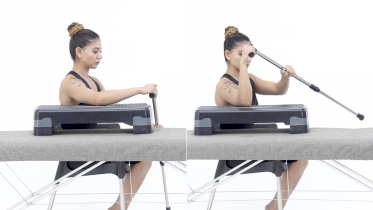
- Sit up tall on a firm bed, bench or chair without arms, with your feet supported. In the video the seat is high, so a step sits under the feet.
- Place the palm of the arm you are working flat on the surface beside you, a little out from your hip, with the fingers pointing away from your body. Your other hand rests in your lap.
- Draw the shoulder blade on the working side a little back and down. The movement is small, and your back stays still.
- Holding the shoulder blade there, slide the hand slowly backward along the surface until it is level with, or just behind, your hip. In the video it stops at the back edge of the bed.
- Slide it forward to the start without letting the shoulder blade shift, then relax and repeat.
What you should feel
Gentle work around and below the shoulder blade on the side you are working. The top of your shoulder and your neck should stay relaxed.
Common mistakes
- Letting the shoulder roll forward or the shoulder blade lift away from the ribs as the hand goes back.
- Hitching the working shoulder up toward your ear as the hand moves.
- Leaning or twisting your trunk to make the hand travel further.
- Pressing down hard through the hand instead of letting it glide.
How often
Many programs use 10 to 15 slow slides, keeping the shoulder blade set throughout, 1 to 3 times a day. Your physio will adjust this.
Stop and check with your physio if
- A sharp pain or a catch at the front of the shoulder as the hand slides back.
- Pain, pins and needles or numbness spreading down your arm or into your hand.
- Pins and needles in your arm or hand that do not go away after you stop, or part of your arm or hand goes numb. Get medical advice the same day. If one side of your face or body suddenly goes numb or weak, or your speech becomes slurred or muddled, call emergency services, even if it goes away.
- A sudden pop or tearing feeling in the shoulder that brings sharp pain, new weakness or trouble lifting the arm. Stop and contact your surgical team the same day, or get medical advice the same day if you have not had surgery.
- The shoulder feels as if it has slipped out of place, looks a different shape or suddenly locks so you cannot move the arm, or your hand turns cold, pale or blue. Go to an emergency department straight away, without driving yourself, and do not try to put the shoulder back in yourself.
From the clinic
The slide is short. What matters is that the shoulder blade stays where you set it while the hand moves, and in the video you can barely see the shoulder blade move at all. Going further back than you can control lets the front of the shoulder poke forward, which is the pattern this exercise is meant to change. A smooth surface helps the hand glide, so a thin towel under the palm on a padded bed or bench is worth trying.
If you are not sure what setting the shoulder blade feels like, practice the seated scapular squeeze first, which moves both shoulder blades with the hands resting on the thighs. Prone scapular retraction works the same muscles lying face down.
After shoulder surgery, including a rotator cuff repair, or after a shoulder fracture or dislocation, follow your surgeon's or physio's plan, and do only the movements and range they have cleared. Many plans allow only passive movement at first, where the arm is moved for you and its muscles stay relaxed. Taking the arm back behind your side is limited early on after some operations, so ask whether this slide is part of your plan yet.
Written and checked by the PocketPhysio editorial team. Last updated 2026-09-28.
This page is general education, not a diagnosis or a personal treatment plan. If you have pain, an injury or a health condition, see a physiotherapist or doctor before starting new exercises.