
Part of Ankle sprain
Ankle proprioception exercises: balance training after a sprain
Warning signs, and when to get help
When can you start balance work after a sprain?
Once you can stand on that leg safely, which for most people is a good deal earlier than they expect and later than the first week.
The US physical therapy guideline does not set a date. What it does is ask for a structured exercise program that includes protected movement, stretching, neuromuscular training, posture re-education and balance training, in the clinic and at home, matched to how severe the injury was and to what the examination found. On timing it is firmer about loading than about exercise: on strong evidence it says loading should be optimized in the acute phase and carried on into the postacute phase, and it reports that exercise programs started early after a sprain brought a faster recovery (Martin and colleagues, 2021). Balance work is one strand of that program, not a separate course that starts when the rest finishes.
In practice the entry test is simple. You can get about without much of a limp, the band work for the ankle muscles feels easy, and you can take your full weight on that leg without it feeling as though it might let go. That is the point the ankle sprain program puts the balance stage at, and if you are not there yet, the movement and strength stages come first.
Two groups should start this differently. If you have fallen in the past year, feel unsteady on your feet, or take medicines that make you dizzy, keep a hand on the support throughout, practice only when someone else is at home, and ask your doctor or physio about a falls check. Ask your physio before the foam pad and single leg balance work as well. And if you have injured a knee in the past, ask your physio before you use a wobble board or a balance board, and read the wobble board section on this page first.
This page is for adults and teenagers aged 16 and over. A child with an ankle injury should be assessed by a doctor or physio before starting any program. If your ankle is broken, or you have had ankle surgery, follow the plan from your surgical team and physio rather than these exercises.
Then there is the ankle that cannot do the first hold at all. Standing on it should feel wobbly, not frightening, and it should not be sharply painful. If it is, that is a reason to be assessed rather than to push on, and the warning list at the foot of this page covers the signs that need acting on today.
Why does the ankle lose its sense of position?
Because a sprain leaves more behind than a stretched ligament. Balance on the injured leg is measurably worse afterward, which is why the guidelines treat it as its own target rather than something that comes back with the strength (Martin and colleagues, 2021).
You can see the result without any equipment. An ankle that is perfectly comfortable walking down a corridor can feel untrustworthy on wet grass, loose gravel or a dark pavement, where the surface keeps changing and the corrections have to happen before you have consciously noticed anything. That gap is not strength and it is not pain. It is why the program runs past the point where the ankle feels fine.
Clinically this is treated as a thing to measure rather than a feeling to describe. The International Ankle Consortium includes static and dynamic postural balance in its rehabilitation oriented assessment, naming the Balance Error Scoring System or the Foot Lift Test for standing still and the Star Excursion Balance Test for balance while moving (Delahunt and colleagues, 2018). The US physical therapy guideline asks for single leg balance to be documented at the start of care and at least twice more during an episode of care (Martin and colleagues, 2021). If you have ever wondered why a physio stands you on one leg and watches a clock, that is why.
OrthoInfo links the two ends of it in one sentence: poor balance often leads to repeat sprains and ankle instability. That is the practical reason to care about a sense you cannot see.
The progression, from both feet to a soft surface
The structure is the same whoever sets it, and it works by taking away the easy information one source at a time.
Start with both feet, then narrow the base: one foot directly in front of the other, which is tandem stance, with fingertips on a counter. Then single leg stance on the injured side, on a firm floor, eyes open. Then the same hold with your eyes closed, which removes the information you have been quietly leaning on. Then a cushion or a folded towel under the foot, which removes the firm floor and makes the ankle do the correcting.
Exercises that can help
Four holds in the order a physio usually builds them. Tandem stance often starts at holds of 10 to 30 seconds, 2 to 3 times with each foot in front, once or twice a day. Single leg stance often starts at 5 to 10 lifts on each leg, holding each one for a few seconds, building toward longer holds. The eyes closed version often starts at short holds of 5 to 10 seconds, building toward 30 seconds, 3 to 5 times on each leg, once a day. On a cushion, holds of 10 to 30 seconds, 2 to 3 times on each leg, once or twice a day are a common starting point. Keep a counter or a sturdy chair within reach for all four, and where this paragraph and an exercise page differ, the exercise page wins. Your physio will adjust this.
The exercises below carry their own stop signs and precautions. Open the line under an exercise and read them before you try it.
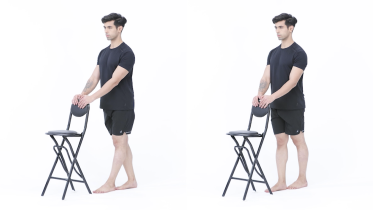 Tandem stance
Stop signs and precautions for the tandem stance
Before you start
- If you have had a hip replacement, get the go-ahead from your surgeon or physio before you try tandem stance. Some operations limit this kind of work for the first months, so the timing depends on your surgery.
When to stop and get help
- You feel dizzy, lightheaded, faint or sick, or the room seems to spin. Hold your support, sit down and get medical advice the same day before you practice again. If you faint, it does not settle within a few minutes of sitting still, your vision suddenly blurs or goes double, or you cannot stand or walk steadily, call emergency services.
- You lose your balance and have to grab the chair hard to stay up.
- New pain in the ankle, knee or hip.
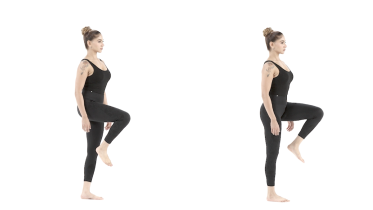 Single leg stance
Stop signs and precautions for the single leg stance
Before you start
- If you have had a hip or knee replacement, or other hip or knee surgery, get the go-ahead from your surgeon or physio before you try single leg stance. Standing on the operated leg alone comes at a set stage of rehab, and some hip operations limit how high the knee can lift in the first months after surgery.
When to stop and get help
- You feel dizzy, lightheaded, faint or sick, or the room seems to spin. Hold your support, sit down and get medical advice the same day before you practice again. If you faint, it does not settle within a few minutes of sitting still, your vision suddenly blurs or goes double, or you cannot stand or walk steadily, call emergency services.
- You lose your balance and cannot steady yourself with your support.
- Sharp pain in the hip, knee or ankle of the standing leg.
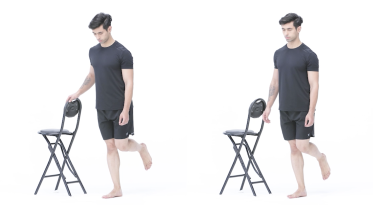 Single leg balance with eyes closed
Stop signs and precautions for the single leg balance with eyes closed
Before you start
- After a hip or knee replacement, standing on the operated leg alone comes at a set stage of rehab, so wait until your surgical team or physio says it is time.
When to stop and get help
- You feel dizzy, lightheaded, faint or sick, or the room seems to spin. Hold your support, sit down and get medical advice the same day before you practice again. If you faint, it does not settle within a few minutes of sitting still, your vision suddenly blurs or goes double, or you cannot stand or walk steadily, call emergency services.
- You lose your balance and have to grab the chair hard to stay up.
- New pain in the ankle, knee or hip of the standing leg.
- Your feet feel newly numb or tingly, or your balance has been slipping over recent weeks. Get medical advice within a few days, and leave out eyes-closed work until you have been checked. If the numbness or tingling spreads quickly up your legs or into your hands, get medical advice the same day. If your legs also feel stiff, heavy or weak, walking suddenly becomes hard, you have trouble breathing or swallowing, or you have trouble controlling your bladder or bowels, call emergency services.
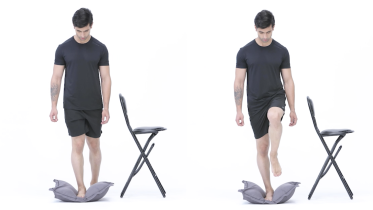 Single leg balance on a cushion
Stop signs and precautions for the single leg balance on a cushion
Before you start
- If you have injured a knee in the past, ask your physio before you add a wobble board: in the trial this training rests on, overuse knee injuries went up among the players who had injured a knee before (Verhagen and colleagues, 2004).
When to stop and get help
- You feel dizzy, lightheaded, faint or sick, or the room seems to spin. Hold your support, sit down and get medical advice the same day before you practice again. If you faint, it does not settle within a few minutes of sitting still, your vision suddenly blurs or goes double, or you cannot stand or walk steadily, call emergency services.
- You lose your balance and have to grab the chair hard to stay up.
- Your ankle gives way, or you feel sharp pain in the ankle or knee.
A few habits make the difference between doing these and getting something from them. Keep a counter or a sturdy chair within reach for every one of them, including the ones that feel easy. Work at the edge of wobbly rather than in comfort, because a hold you can do without a flicker is no longer training anything. And do them often rather than long: a few short holds on most days beats one heroic session a week.
What comes after the cushion is balance while the rest of you is moving, which is where reaching with the other leg and kicking a ball come in, and those are on chronic ankle instability. Hopping and landing are later still, and the stage 4 notes on the ankle sprain program list who needs to check with a clinician before doing any of it. If balance has been a problem for you generally and not just since this sprain, balance and falls prevention is the better page.
Do you need a wobble board?
No. A board is what most people picture when they hear balance training, so that answer needs saying plainly.
The evidence that makes balance training worth doing was mostly collected with one. The trial this field rests on gave 116 volleyball teams either a balance board program or their usual training, 641 players in the intervention teams and 486 in the control teams, and found significantly fewer ankle sprains in the intervention group (Verhagen and colleagues, 2004). The 522 athlete home program used a board too (Hupperets and colleagues, 2009). So a board is a reasonable tool.
It is not a necessary one. The job of the board is to make the surface unpredictable, and a cushion, a pillow or a folded towel does the same for nothing. If you already have a board, use it at the end of the progression rather than the start, and keep something to hold within reach.
One group should ask before using a board at all, and it is a published caution rather than a cautious guess. If you have injured a knee in the past, ask your physio before you use a wobble board or a balance board. In that same volleyball trial, overuse knee injuries went up among the players who had injured a knee before, and its authors wrote that a history of knee injury may be a contraindication for proprioceptive balance board training (Verhagen and colleagues, 2004). That trial tested a board, so it says nothing either way about balance work on the floor or on a cushion. Do the floor and cushion work in the meantime.
Does balance training actually work?
Yes, and the useful part of the answer is who it has been shown to work for.
Pooling 7 randomized trials of moderate to high quality with 3,726 participants, proprioceptive training reduced the rate of ankle sprains, relative risk 0.65 with a confidence interval of 0.55 to 0.77. In the people who had sprained an ankle before, the figure was 0.64. For preventing a first ever sprain it was 0.57, but that estimate came from two trials that were not significant on their own, and the review concluded that the evidence for primary prevention remains inconclusive (Schiftan and colleagues, 2015). A separate meta-analysis of 3,577 athletes found balance training cut sprain risk by 46 percent, relative risk 0.54, against a control condition of no intervention in all of its included studies (Bellows and Wong, 2018).
The guidelines read it the same way round. After a first sprain, the US physical therapy guideline recommends a preventive brace together with proprioceptive and balance focused exercise aimed at the impairments the examination found, on strong evidence. For balance training in people who have never sprained an ankle, the same guideline gives only weak evidence (Martin and colleagues, 2021).
Which is a reassuring place for you to be standing. The population where this work has the strongest numbers is the one that has already rolled an ankle once, and that is the person reading this page.
Two limits travel with those figures. They were nearly all measured in sporting populations, so how well they carry over to somebody who sprained an ankle on a curb is not established. And they count sprains, not how the ankle feels: for an ankle that is already unstable the evidence is thinner than for prevention, which is covered on chronic ankle instability.
How long do you keep it up, and how do you know it is working?
Longer than it takes the ankle to feel better, and there is a published number for it.
The 522 athlete trial ran its unsupervised home program for 8 weeks. Self reported recurrence over the following year fell from 89 of 266 in the control group, which is 33 percent, to 56 of 256 in the intervention group, which is 22 percent, a 35 percent reduction in risk and a number needed to treat of 9 (Hupperets and colleagues, 2009). Eight weeks is a finish line you can put in a diary.
One qualification belongs with that trial. The effect was found in athletes whose original sprain had not been medically treated, and no significant difference turned up between the medically treated athletes in the two groups (Hupperets and colleagues, 2009). Nobody knows exactly why. It is a reason to read the 11 percentage point difference as the result of one trial in one population, not as a promise.
For judging progress, compare sides rather than chasing a sensation. How long you can hold single leg stance on each leg. Whether you can do it with your eyes shut on the injured side for as long as on the other. Whether the cushion version needs a hand.
Those comparisons are the home version of what a physio measures with the tests named above, and the honest reading of them is that getting close to the other leg is the target rather than any published threshold, because no threshold has been published for going back to sport after this injury. That whole question is on ankle sprain return to sport.
Keep something going afterward if your sport involves jumping and turning. No guideline read for this page sets a date to stop. The recommendation that comes nearest is for a brace together with balance focused exercise to lower the risk of the next sprain, and it carries no end point (Martin and colleagues, 2021). Folding a short set into a warm-up is how physios usually keep it going, which is practice rather than a tested plan, and how it sits alongside a brace is on how to prevent ankle sprains. What the overall timeline looks like, including the part that outlasts the pain, is on sprained ankle recovery time.
Related exercise programs
Warning signs
Get emergency help now
- Emergency: the ankle or foot looks deformed or out of place, you heard a crack when you were injured, or the foot is numb, tingling, cold, pale or blue. Go to an emergency department straight away, and do not drive yourself.
- Emergency: if you faint while exercising, call emergency services, even if you feel fine again quickly.
Get help today
- Same day: you could not take 4 steps right after the injury and still cannot, or the back edge or tip of either ankle bone is tender to press. Keep your weight off that foot as much as you can, leave the exercises out, and get it checked for a fracture the same day. These are part of the Ottawa ankle rules, explained on the ankle sprain page.
- Same day: the pain is in the middle of your foot, and the bony bump halfway along the outer edge of the foot or the bony bump on the inner side of the midfoot is tender to press. Keep your weight off that foot as much as you can, leave the exercises out, and get it checked for a fracture the same day, even if you can still walk on it.
- Same day: you felt a pop or snap at the back of your heel or lower calf, or it felt as if someone kicked you there, even if you can still walk and push off. Stop, take the weight off that leg carefully, and go to an urgent care center or emergency department the same day, as this can be a torn Achilles tendon rather than a sprain.
- Same day: the pain is severe and getting worse, or the swelling or bruising is very large. Get medical advice the same day.
- Same day: the ankle or foot is hot, red and swollen, or you have a fever or feel unwell. Get medical help the same day, and go to an emergency department if you feel very unwell. If you have a very high or very low temperature, shivering you cannot control, you are breathing very fast or finding it hard to breathe, you are confused or your speech is slurred, your skin, lips or tongue look blue, gray, pale or blotchy (on brown or black skin this can be easier to see on the palms of the hands or soles of the feet), or you have a rash that does not fade when you press it, call emergency services, as this can be sepsis.
- Same day: a calf or thigh that is newly swollen or getting more swollen, warm, tender, red or darker than usual, has swollen veins that are sore to touch, or has a throbbing or cramping pain that does not fit your injury or condition, or that feels different from normal muscle soreness after exercise. This can be a sign of a blood clot (deep vein thrombosis), especially after surgery, an injury, time in a cast or boot, a long trip or a spell of being much less mobile than usual. Get medical advice the same day. If you are also short of breath or have chest pain, call emergency services.
Book an appointment
- Within a few days: your feet feel newly numb or tingly, or your balance has been slipping over recent weeks. Get medical advice within a few days, and leave out eyes-closed work until you have been checked. If the numbness or tingling spreads quickly up your legs or into your hands, get medical advice the same day. If your legs also feel stiff, heavy or weak, walking suddenly becomes hard, you have trouble breathing or swallowing, or you have trouble controlling your bladder or bowels, call emergency services.
- Within a week or two: the ankle keeps giving way or rolling over, even on flat ground, weeks or months after the sprain. This is not an emergency, but book an assessment with a physio or doctor in the next week or two.
Common questions
Do I need a wobble board?
No, although the trials that give this work its reputation used one. A cushion, a folded towel or a pillow makes the surface wobble in much the same way, and the progression from a firm floor to eyes closed to a soft surface matters more than the equipment. If there is a board in the house, keep a counter within reach and treat it as the last step rather than the first. One group should not use a board without asking first. If you have injured a knee in the past, ask your physio before you use a wobble board or a balance board: in the balance board trial that much of this evidence rests on, overuse knee injuries went up among the players who had injured a knee before, and its authors wrote that a history of knee injury may be a contraindication for proprioceptive balance board training (Verhagen and colleagues, 2004). That trial tested a board, so it says nothing either way about the floor and cushion work.
Should I keep the brace on for the balance exercises?
On whether it stays on for the exercises themselves, no guideline settles it, and the usual practice is to wear it for walking, work and sport and to take it off for the balance work once you can stand on that leg safely, because those exercises are there to make the ankle correct itself. Keep it on for them if the sprain was severe, you were given a stiff brace or a boot, or the ankle feels unsafe without it, and ask your physio which applies to you. The evidence behind that split is in the guideline itself: it recommends a brace together with balance focused exercise after a first sprain, and separately advises against using a support on its own to improve balance and steadiness in an ankle that keeps giving way (Martin and colleagues, 2021). Which brace, and for how long, is on how to prevent ankle sprains.
My ankle does not hurt any more but it still feels unreliable. Why?
Because pain and position sense recover on different clocks, and it is the second one that keeps you upright on a curb. OrthoInfo, the patient site of the American Academy of Orthopaedic Surgeons, puts it bluntly: poor balance often leads to repeat sprains and ankle instability. That feeling of an ankle you cannot trust on grass or gravel, with no pain attached to it, is the thing these exercises are for, and it is also the reason rehabilitation should not stop the week the pain does. If the ankle is actually giving way rather than feeling as though it might, read chronic ankle instability and get it assessed.
Is standing on one leg enough on its own?
It is the right starting point and not the finish. The progression that the trials used took away the easy information first, your eyes, then the firm floor, so the ankle had to do the correcting. Once you can hold the cushion version steadily with a fingertip on the counter, the next step is balance while the rest of you is moving, reaching and kicking with the other leg, and those are set out on chronic ankle instability. Hopping and landing come later again, on the ankle sprain program, which lists who needs to ask a clinician before any hopping at all.
References
- Martin RL, Davenport TE, Fraser JJ, et al. Ankle Stability and Movement Coordination Impairments: Lateral Ankle Ligament Sprains Revision 2021. Journal of Orthopaedic and Sports Physical Therapy. 2021;51(4):CPG1-CPG80. https://doi.org/10.2519/jospt.2021.0302
- Schiftan GS, Ross LA, Hahne AJ. The effectiveness of proprioceptive training in preventing ankle sprains in sporting populations: a systematic review and meta-analysis. Journal of Science and Medicine in Sport. 2015;18(3):238-244. https://doi.org/10.1016/j.jsams.2014.04.005
- Bellows R, Wong CK. The effect of bracing and balance training on ankle sprain incidence among athletes: a systematic review with meta-analysis. International Journal of Sports Physical Therapy. 2018;13(3):379-388. https://pmc.ncbi.nlm.nih.gov/articles/PMC6044595/
- Hupperets MDW, Verhagen EALM, van Mechelen W. Effect of unsupervised home based proprioceptive training on recurrences of ankle sprain: randomised controlled trial. BMJ. 2009;339:b2684. https://doi.org/10.1136/bmj.b2684
- Verhagen E, van der Beek A, Twisk J, Bouter L, Bahr R, van Mechelen W. The effect of a proprioceptive balance board training program for the prevention of ankle sprains: a prospective controlled trial. The American Journal of Sports Medicine. 2004;32(6):1385-1393. https://doi.org/10.1177/0363546503262177
- Delahunt E, Bleakley CM, Bossard DS, et al. Clinical assessment of acute lateral ankle sprain injuries (ROAST): 2019 consensus statement and recommendations of the International Ankle Consortium. British Journal of Sports Medicine. 2018;52(20):1304-1310. https://doi.org/10.1136/bjsports-2017-098885
- American Academy of Orthopaedic Surgeons. Sprained Ankle. OrthoInfo. https://www.orthoinfo.org/bodypart/foot-ankle/sprained-ankle/
Written and checked by the PocketPhysio editorial team. Last updated 2026-11-06.
This page is general education, not a diagnosis or a personal treatment plan. See a physiotherapist or doctor for advice about your own situation.