Diamond push-ups
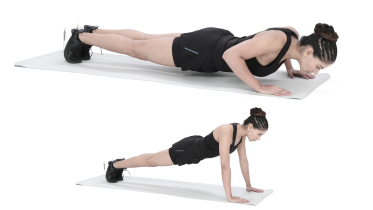
A diamond push-up is a push-up with your hands close together under your chest, the thumbs and index fingers touching to make a diamond shape. You hold your body straight on your toes, lower your chest toward your hands with your elbows tucked in, and press back up. The narrow hands and tucked elbows make the back of the upper arms (triceps) work hard, along with the chest. It is a hard version, usually added once regular floor push-ups feel comfortable.
How to do the diamond push-ups
- Start on a mat on your hands and toes. Place your hands on the floor under your chest, with the tips of your thumbs and index fingers touching to form a diamond.
- Straighten your arms and hold your body straight from your head to your heels, with your feet close together.
- Check where your hands are: as you lower, your chest should come down toward the diamond, not your throat or face. Shift your hands a little toward your feet if needed.
- Take a breath in and let your elbows bend, bringing your chest down toward your hands. Keep your elbows close to your sides so they point back toward your feet.
- Go as low as you can while your body stays straight, then breathe out and press back up to straight arms.
What you should feel
Hard work in the back of your upper arms, with the chest and the front of the shoulders helping. Your stomach works to hold your hips level.
Common mistakes
- Placing the hands under the face or neck, so the head drops toward the floor first.
- Letting the elbows drift out wide.
- Letting the hips sag or the lower back arch as you tire.
- Dropping onto the hands at the bottom instead of lowering with control.
- Holding your breath.
How often
For people ready for this version, 2 to 3 sets of 5 to 10 on 2 or 3 days a week is a common range, stopping each set before your body starts to sag. Your physio will adjust this.
Stop and check with your physio if
- Chest pain or pressure, dizziness or feeling faint, a racing or irregular heartbeat, or being far more out of breath than the effort should cause.
- Sharp pain at the back of the elbow, in the wrist or in the shoulder.
- Numbness, tingling or pain spreading down an arm.
- Pins and needles in your arm or hand that do not go away after you stop, or part of your arm or hand goes numb. Get medical advice the same day. If one side of your face or body suddenly goes numb or weak, or your speech becomes slurred or muddled, call emergency services, even if it goes away.
From the clinic
With the hands together, the wrists bend back under a lot of body weight and the elbows take extra load. If either complains, widen the hands a little so the thumbs no longer touch, or do the same close-hand push-up from your knees or with your hands on a sturdy bench. If you cannot yet do a diamond push-up with a straight body, build up with incline push-ups, knee push-ups and standard push-ups first.
The voice guide says your chest touches the diamond. In the video the chest stops a little above the hands, and that is deep enough. Lower only as far as you stay in control. If you have had shoulder surgery, a dislocated shoulder, or have ongoing elbow or shoulder pain, ask your physio before trying this version.
If your blood pressure runs high or your heart is under a doctor's care, get medical advice before trying diamond push-ups. Breathe out every time you press up, rather than straining with your breath held. If chest pain, pressure or tightness does not ease quickly when you rest, spreads to your arm, neck, jaw, stomach or back, or comes with sweating, feeling sick, feeling light-headed or being short of breath, call emergency services straight away, as this can be a heart attack. If it eases quickly and none of these happen, get medical advice the same day, and do not exercise again until you have been checked. If you faint while exercising, call emergency services, even if you feel fine again quickly.
Written and checked by the PocketPhysio editorial team. Last updated 2026-09-28.
This page is general education, not a diagnosis or a personal treatment plan. If you have pain, an injury or a health condition, see a physiotherapist or doctor before starting new exercises.