Twisting crunch
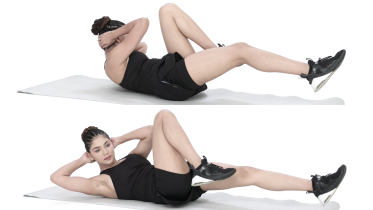
A twisting crunch is a crunch with a turn added. Lying on your back with your knees bent and feet flat, you curl your head and shoulders up and rotate so one shoulder moves toward the opposite knee, then lower and turn to the other side. The muscles down the sides of your waist (obliques) make the turn, and the long muscle at the front (rectus abdominis) makes the curl. Your lower back stays on the mat throughout, and your legs stay still, which makes it steadier than a bicycle crunch.
How to do the twisting crunch
- Lie on your back on a mat with your knees bent and your feet flat, about hip width apart.
- Let your hands take the weight of your head, elbows out wide, without pulling on it.
- Breathe out and curl your head and shoulders off the mat, turning your upper body so your right shoulder comes across toward your left knee. Keep about a fist's width of space between your chin and your chest.
- Keep your lower back pressed into the mat and your feet and hips still. The turn comes from your ribs, not from your elbow reaching across.
- Breathe in and lower slowly, then curl up turning the other way, left shoulder toward right knee. Keep alternating sides, as in the video.
What you should feel
Work along the side of your waist that is turning you, with the front of your stomach helping. Your neck and lower back should feel quiet.
Common mistakes
- Pulling on your head, or jerking the elbow across instead of turning your chest.
- Tucking your chin down onto your chest.
- Letting your lower back or hips lift off the mat as you turn.
- Rushing, so momentum rather than your stomach does the twist.
How often
Many programs start with 2 to 3 sets of 8 to 12 on each side, done slowly, a few days a week. Your physio will adjust this, and may keep you on a plain crunch until that feels easy.
Stop and check with your physio if
- Your neck starts to ache more as you go, or pain, tingling or numbness spreads into an arm.
- Pins and needles in your arm or hand that do not go away after you stop, or part of your arm or hand goes numb. Get medical advice the same day. If one side of your face or body suddenly goes numb or weak, or your speech becomes slurred or muddled, call emergency services, even if it goes away.
- Your lower back hurts as you turn, or pain, tingling or numbness travels down a leg.
- A new swelling or bulge in your belly or groin, or pain near an operation scar.
From the clinic
Think of lifting one shoulder blade and turning it across, rather than aiming an elbow at the knee. The elbow can travel a long way while the chest barely turns, and then the side of your waist does very little. The fist of space under your chin, which the voice guide asks for, keeps your neck from curling too far. If you have high blood pressure, breathe steadily through every repetition and never hold your breath.
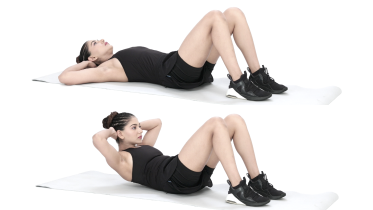
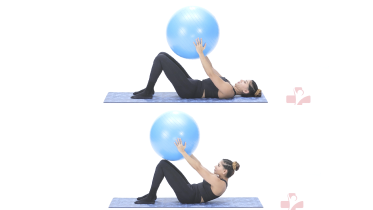
If this is too much for now, get the plain curl right with abdominal crunches first, or try heel touches, which work the sides of the waist with a smaller lift. Bicycle crunches add a pedaling leg movement to the same turn and are harder.
If you have osteoporosis or low bone density, or have had a spine fracture, skip twisting crunches unless your physio has cleared them. Osteoporosis programs often limit repeated forward bending of the spine under load, and a twisting crunch is exactly that movement. The turn makes it more of a concern, because bending forward and rotating together, under the weight of your upper body, is the combination that exercise advice for osteoporosis warns against most. Talk to your physio before you start, too, if you have a disc problem in your lower back or pain running down a leg.
Check with your physio first if you have a hernia, have had stomach or back surgery, or have a separation of the stomach muscles after having a baby (diastasis recti). Each curl raises the pressure inside your stomach, which presses down on the pelvic floor. If you leak urine, or feel heaviness or dragging low in your pelvis, stop and ask your physio about an easier way to train.
In pregnancy, leave twisting crunches out unless your physio or midwife says they are fine. The stomach muscles are stretching at that time, and this exercise strains them. If you are pregnant and past the first three months, check with your physio before exercising flat on your back.
Written and checked by the PocketPhysio editorial team. Last updated 2026-09-28.
This page is general education, not a diagnosis or a personal treatment plan. If you have pain, an injury or a health condition, see a physiotherapist or doctor before starting new exercises.