Downward dog to upward dog
Downward dog to upward dog is a flowing sequence between two shapes that come from yoga. From a plank, you push your hips up and back into an upside-down V (downward dog), return to the plank, then lower your hips toward the floor and lift your chest on straight arms (upward dog). The first shape stretches the backs of your legs, the second the front of your hips and trunk. Your arms carry your weight all the way through, which makes the flow harder than either position on its own.
How to do the downward dog to upward dog
- Lie face down on a mat with your palms flat under your shoulders and your toes tucked under.
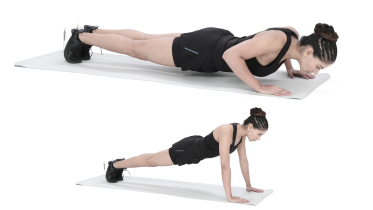
- Press through your hands to lift into a plank, your body in a straight line from head to heels.
- Push your hips up and back into downward dog, pressing your hands into the floor and letting your head hang between your arms. Hold for a breath or two.
- Bring your hips forward and down to return to the plank.
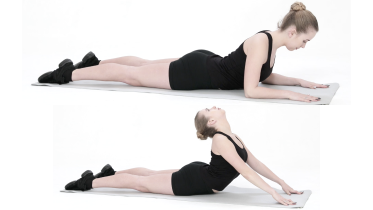
- Keeping your arms straight, lower your hips toward the floor and lift your chest into upward dog. Keep your shoulders down away from your ears and look forward or slightly up, without tipping your head right back. Hold for a breath or two.
- Lower yourself to the mat to rest, then press back up to the plank for the next round.
What you should feel
A stretch along the backs of your thighs and calves in downward dog, and across the front of your hips and stomach in upward dog. Your shoulders, arms and wrists work the whole time. Your lower back may feel a gentle pressure in upward dog, but it should not pinch.
Common mistakes
- Sagging into the lower back in upward dog instead of lifting through the chest.
- Letting the shoulders creep up toward the ears in either position.
- Rushing from one shape to the next instead of moving with control.
- Holding your breath.
How often
Many programs use 5 to 8 slow rounds, holding each position for a breath or two, once a day or a few times a week. Your physio will adjust this.
Stop and check with your physio if
- Chest pain or pressure, dizziness or feeling faint, a racing or irregular heartbeat, or being far more out of breath than the effort should cause.
- A headache, pressure behind the eyes, or blurred vision.
- Sharp or pinching pain in your lower back, or pain, numbness or tingling that spreads into a buttock or leg.
- Pain in your wrists or shoulders that is sharp or builds with each round, or tingling in your hands.
- Pins and needles in your arm or hand that do not go away after you stop, or part of your arm or hand goes numb. Get medical advice the same day. If one side of your face or body suddenly goes numb or weak, or your speech becomes slurred or muddled, call emergency services, even if it goes away.
From the clinic
If this is new to you, get comfortable with each shape on its own first. Practice downward dog for the upside-down V, and the cobra stretch, which keeps your hips on the floor, as a smaller backward bend. In downward dog, heels that stay lifted and knees that bend a little are both fine. Moving slowly between the shapes matters more than how far you go in either one. Pressing up from lying flat into the plank is hard work, so if it is too much, come up onto your hands and knees and step your feet back one at a time instead.
In downward dog your head is lower than your heart. With high blood pressure, glaucoma, recent eye surgery, a history of dizziness or a shoulder problem (including a past shoulder operation or dislocation), get the all-clear from your doctor or physio before trying this sequence. Come out of the position slowly and keep breathing throughout.
Upward dog bends your lower back backward, so ask your physio first if you have spinal stenosis, where the spinal canal has narrowed, or spondylolisthesis, where one vertebra has slipped forward on the one below. The same applies if bending backward sets off back or leg pain.
If you have had a hip replacement, get the go-ahead from your surgeon or physio before you try downward dog to upward dog. Downward dog bends the hips well past a right angle and upward dog takes them back beyond straight, and many surgeons ask you to avoid that for the first months after some operations.
Your wrists and shoulders carry your weight in every position. If your wrists ache, rest on your fists or on sturdy push-up handles instead, so the wrists stay nearly straight. If you are pregnant or have had a baby in the past few months, check with your midwife or physio first, since the sequence starts face down, bends the back and stretches the stomach. If chest pain, pressure or tightness does not ease quickly when you rest, spreads to your arm, neck, jaw, stomach or back, or comes with sweating, feeling sick, feeling light-headed or being short of breath, call emergency services straight away, as this can be a heart attack. If it eases quickly and none of these happen, get medical advice the same day, and do not exercise again until you have been checked. If you faint while exercising, call emergency services, even if you feel fine again quickly.
Written and checked by the PocketPhysio editorial team. Last updated 2026-09-28.
This page is general education, not a diagnosis or a personal treatment plan. If you have pain, an injury or a health condition, see a physiotherapist or doctor before starting new exercises.