Hindu push-ups
A Hindu push-up is a flowing push-up. You start in downward dog with your hips high, swoop down and forward close to the floor, and rise into upward dog with your chest lifted and hips low, then push your hips back up to the start. The shoulders and chest do the heavy lifting, helped by the backs of the arms, and your spine goes from a gentle bend into an arch in every rep. It is an advanced bodyweight exercise, usually tried once ordinary push-ups and both yoga positions feel comfortable.
How to do the hindu push-ups
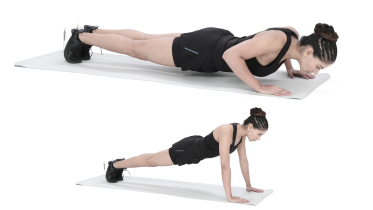
- Start in a push-up position on a mat, hands slightly wider than your shoulders and feet close together. Push your hips up and back into an upside-down V (downward dog), with your arms and legs as straight as feels comfortable. The video starts from here.
- Bend your elbows and lower your head and chest toward the floor just in front of your hands, keeping your hips high as you begin.
- Carry on forward in one smooth swoop, sliding your chest along just above the floor between your hands while your hips come down.
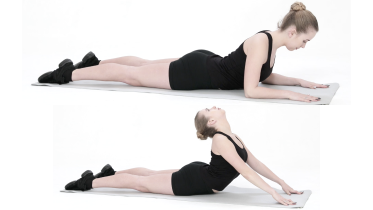
- Straighten your arms and lift your chest into upward dog: hips low, thighs off the floor, toes pressing into the mat and buttocks gently squeezed. The video shows the head tipped back to look up; looking ahead or only slightly up is easier on the neck.
- Keep your arms straight and push through your hands to lift your hips up and back, through a straight-arm plank, into the upside-down V again. You do not swoop back the way you came. Breathe in as you swoop down and out as you push up, then repeat.
What you should feel
Your shoulders and chest work hard, and so do the backs of your upper arms. You may feel a stretch in the backs of your legs in downward dog and across the front of your body in upward dog.
Common mistakes
- Dropping the hips or knees to the floor during the swoop.
- Sagging hard into the lower back in upward dog, instead of reaching the chest forward and up.
- Shrugging your shoulders up toward your ears at the top of the arch.
- Rushing, so the chest crashes toward the floor instead of gliding.
- Holding your breath.
How often
Many programs start with 2 to 3 sets of 5 to 10 slow reps, 2 or 3 times a week, ending each set while the movement is still smooth. Your physio will adjust this.
Stop and check with your physio if
- Chest pain or pressure, dizziness or feeling faint, a racing or irregular heartbeat, or being far more out of breath than the effort should cause.
- Blurred vision, a pounding headache or pressure building behind your eyes.
- Sharp pain in your lower back, a shoulder or a wrist, or pain or tingling that spreads into an arm or down a leg.
- Pins and needles in your arm or hand that do not go away after you stop, or part of your arm or hand goes numb. Get medical advice the same day. If one side of your face or body suddenly goes numb or weak, or your speech becomes slurred or muddled, call emergency services, even if it goes away.
From the clinic
The two end positions can be learned on their own first: downward dog for the upside-down V and the cobra stretch for the arch. Push-ups or knee push-ups build the pushing strength. When you first join the parts together, move slowly and swoop only partway down.
Your head drops below your heart in every rep, in the upside-down V and as you start to swoop down. Check with your doctor or physio before you start if you have high blood pressure, a heart condition, glaucoma or recent eye surgery, or a shoulder problem such as a past dislocation or shoulder operation. The arch in upward dog bends your lower back backward, so if arching makes your back or leg pain worse, or you have been told you have narrowing of the spinal canal (spinal stenosis) or a slipped vertebra (spondylolisthesis), ask your physio before trying it. Come up slowly at the end of a set and keep breathing throughout.
If you have had a hip replacement, get the go-ahead from your surgeon or physio before you try Hindu push-ups. Downward dog bends the hips well past a right angle and upward dog takes them back beyond straight, and many surgeons ask you to avoid that for the first months after some operations.
If you are pregnant or have had a baby in the past few months, check with your midwife or physio first. If your wrists ache, a folded mat under the heels of your hands takes some of the bend out of them. If chest pain, pressure or tightness does not ease quickly when you rest, spreads to your arm, neck, jaw, stomach or back, or comes with sweating, feeling sick, feeling light-headed or being short of breath, call emergency services straight away, as this can be a heart attack. If it eases quickly and none of these happen, get medical advice the same day, and do not exercise again until you have been checked. If you faint while exercising, call emergency services, even if you feel fine again quickly.
Written and checked by the PocketPhysio editorial team. Last updated 2026-09-28.
This page is general education, not a diagnosis or a personal treatment plan. If you have pain, an injury or a health condition, see a physiotherapist or doctor before starting new exercises.