Lying scissor crosses
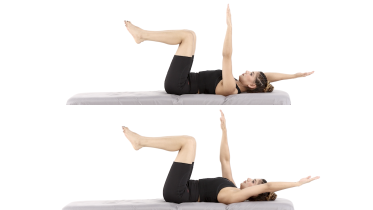
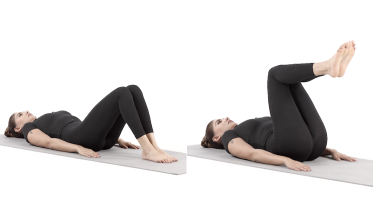
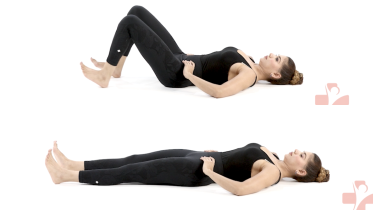
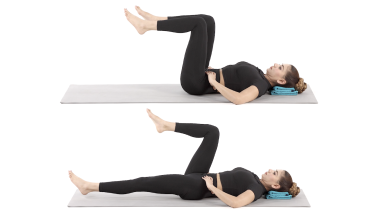
This lying abdominal exercise is a scissor movement for the lower stomach. You lie on your back with your arms spread out to the sides, lift both legs straight and a little way off the floor, then part them like scissors, one leg rising as the other lowers, and bring them back together so they cross in the middle. Your stomach muscles keep your lower back down on the mat while the hip muscles lift, lower and cross the legs. Straight legs held low put a lot of load through the stomach, so it is a hard exercise.
How to do the lying scissor crosses
- Lie on your back on a mat and stretch your arms out to the sides at shoulder height, so your body makes a cross.
- Bend your knees with your feet flat. Lightly lift your pelvic floor and let the lower part of your tummy flatten a little with it, so your lower back settles onto the mat.
- Lift both legs and straighten them so your heels are roughly a foot (30 cm) off the floor. Hold them higher if your back starts to arch.
- Part your legs like opening scissors, one leg lifting higher as the other lowers. Then bring them back together so one crosses over the other in the middle, and part them again. In the video the same leg lifts each time, so swap which leg lifts halfway through the set to work both sides evenly.
- Keep going at a steady pace, breathing throughout, with your lower back on the mat. To finish, bend your knees and put your feet down one at a time.
What you should feel
Hard work low in your stomach and at the front of your hips and thighs as the legs lift and lower, with your inner thighs busy as they cross.
Common mistakes
- Your lower back peeling up from the mat as your legs get tired.
- Holding the legs lower than you can control.
- Letting the lower leg drop toward the floor, or swinging the legs wide and fast instead of moving them under control.
- Holding your breath, or bracing so hard that your stomach domes.
How often
Many programs start with 2 to 3 rounds of 10 to 20 seconds of scissoring, resting between rounds, a few days a week. Your physio will adjust this.
Stop and check with your physio if
- Your lower back starts to hurt, or you get tingling, numbness or pain in a leg.
- A sharp pain at the front of a hip or in the groin.
- A ridge or doming down the middle of your stomach, a new lump in your groin, or pressure low in your pelvis. Stop, and get your physio's advice before you try it again.
From the clinic
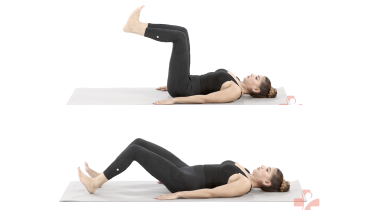
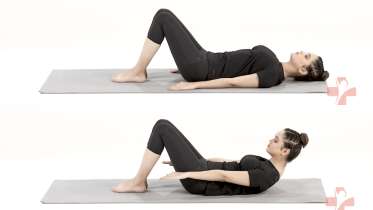
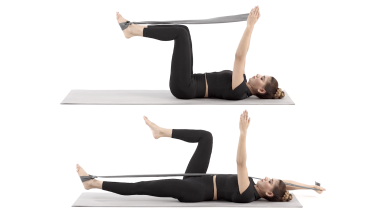
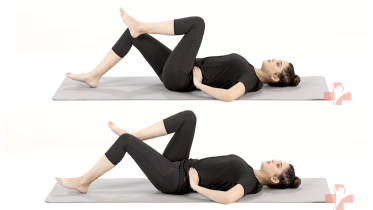
The app calls this simply strengthening the abdominals lying on your back. What the video shows, filmed from the side, is a leg scissor: straight legs held low, one leg rising while the other lowers, then both coming back to cross in the middle. Keep the scissor small and slow, and never let the lower leg sink so far that your back lifts. The height of your legs sets the difficulty. The higher your heels, the easier it is to keep your lower back on the mat, so start higher and bring the legs lower over the weeks as your control improves.
Flutter kicks use the same lifted straight legs in smaller, quicker up and down kicks, with your arms by your sides. If holding both legs up is too much for now, lying alternate heel taps and the dead bug train the same back control with bent knees. If you have high blood pressure, breathe steadily through every repetition and never hold your breath.
If you have had a hip replacement, get the go-ahead from your surgeon or physio before you try this exercise. Each cross takes one leg over the midline of your body, and many surgeons ask you to avoid that for the first months after some operations.
Long legs held low load the stomach wall heavily. If you have a hernia, have had an operation on your stomach or back, or have ongoing lower back pain, check with your physio first. If you have recently given birth, including by cesarean section, or you have a gap down the middle of your stomach muscles (diastasis recti), ask your physio, midwife or doctor first. If you are pregnant, leave this one out unless your midwife or physio says it is fine. If you are pregnant and past the first three months, check with your physio before exercising flat on your back.
Written and checked by the PocketPhysio editorial team. Last updated 2026-09-28.
This page is general education, not a diagnosis or a personal treatment plan. If you have pain, an injury or a health condition, see a physiotherapist or doctor before starting new exercises.