McGill curl-up
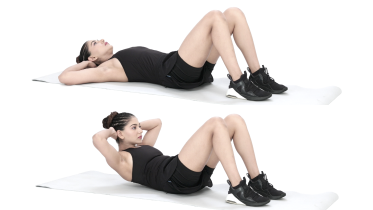
The McGill curl-up is a small, held curl for the stomach muscles. You lie on your back with one knee bent and your hands under your lower back, then lift your head and shoulders only an inch or two and hold. It works the front of the stomach while your lower back keeps its natural curve.
How to do the mcgill curl-up
- Lie on your back with your knees bent and feet flat. Slide both hands, palms down, under the small of your back.
- Straighten one leg along the floor. Keep the other knee bent with that foot flat.
- Look straight up at the ceiling and gently tighten your stomach muscles. Pressing your tongue into the roof of your mouth can help your neck stay steady.
- Lift your head and shoulders an inch or two off the floor as one unit, without tucking your chin.
- Hold the position and keep breathing, then lower slowly and relax.
What you should feel
The front of your stomach working to hold you up. Your neck may feel it a little, but it should not be the part that tires first.
Common mistakes
- Curling up too high. This is a small lift, not a crunch.
- Tucking the chin to the chest or pushing the head forward. Keep your eyes on the ceiling.
- Flattening the lower back into your hands. Your hands are there to keep its natural curve.
- Holding your breath while you stay up.
How often
Many programs use holds of about 5 to 10 seconds, repeated 5 to 10 times, with the bent leg swapped halfway through. Your physio will adjust this.
Stop and check with your physio if
- Your neck aches more with each hold, or pain or tingling runs into your arms.
- Pins and needles in your arm or hand that do not go away after you stop, or part of your arm or hand goes numb. Get medical advice the same day. If one side of your face or body suddenly goes numb or weak, or your speech becomes slurred or muddled, call emergency services, even if it goes away.
- Pain from your back travels down a leg, or the leg goes numb or tingles.
- A bulge or pressure in your stomach wall. Stop and tell your physio.
From the clinic
In the video the elbows stay resting on the floor. Lifting them slightly off the floor during the hold makes it harder, and some programs add that once the basic version feels easy. The curl-up is often done alongside the side plank and the bird dog. If you have been doing abdominal crunches, expect this to move a lot less.
Check with your physio or doctor first after stomach or back surgery, or if you have a hernia or a gap in the stomach muscles after pregnancy (diastasis recti). The same goes if you have osteoporosis, especially after a fracture in your spine, or you are past the first trimester of pregnancy. Your physio may give you a different core exercise.
Written and checked by the PocketPhysio editorial team. Last updated 2026-09-28.
This page is general education, not a diagnosis or a personal treatment plan. If you have pain, an injury or a health condition, see a physiotherapist or doctor before starting new exercises.