Pilates swimming
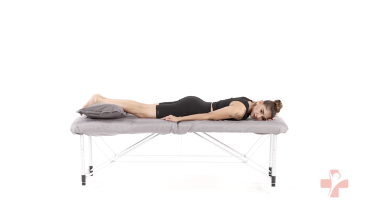
Pilates swimming is a back exercise done lying face down. With your arms reaching past your head, you lift your chest and all four limbs a little off the mat, then flutter one arm and the opposite leg up and down in small, steady pulses, as if swimming. It mainly works the muscles along your back and in your buttocks, with the backs of your shoulders helping. Your trunk stays still while the limbs move. Think of it as a harder relative of the alternating superman.
How to do the pilates swimming
- Lie on your stomach on a mat with your legs straight and a little apart. Stretch your arms out on the mat beyond your head.
- Let your lower tummy draw in gently, without pulling it in hard. Keep your eyes on the mat just in front of you so the back of your neck stays long.
- Lift your chest, both arms and both legs just clear of the mat. Your elbows and knees stay straight, but not locked.
- Start the flutter: one arm and the opposite leg rise a little higher while the other pair dips slightly, then they swap. Keep the pulses small and even, and do not let your hands or feet touch down.
- Breathe in for 5 swaps and out for 5 swaps, as the voice guide describes, while your trunk stays still.
- Let everything down onto the mat to rest between rounds.
What you should feel
Work along your back and in your buttocks. The backs of your shoulders work too. Your lower back will be busy, but it should not pinch or ache.
Common mistakes
- Lifting the chest and legs as high as they go, which forces a deep arch into the lower back.
- Throwing the head back to look ahead. Your gaze stays on the mat.
- Big, fast kicks that rock the body from side to side.
- Holding your breath instead of breathing in time with the pulses.
How often
Many programs start with 2 or 3 rounds of 10 to 20 swaps, resting flat on the mat between rounds, a few days a week. Your physio will adjust this.
Stop and check with your physio if
- Pain spreads down a leg, or you get numbness or tingling in it.
- Back pain that builds as you go, or a sharp pinch in your lower back.
- Pain in your neck or shoulder while your arms are lifted.
From the clinic
If you cannot yet keep everything off the mat at once, begin with the alternating superman, which lifts one arm and the opposite leg at a time with a rest in between. Another easier option is to leave your chest down and flutter only your arms and legs. A few inches of lift is enough. Going higher mostly adds arch to your lower back.
Keeping the chest up holds your back in an arch for the whole round. With spinal stenosis (a narrowed canal around the nerves) or spondylolisthesis (a vertebra that has slipped forward), clear this with your physio first. If you have had a fracture in your spine, check with your physio before you begin.
If you have had a hip replacement, get the go-ahead from your surgeon or physio before you try Pilates swimming. Raising both legs moves the hips back past straight, and many surgeons ask you to avoid that for the first months after some operations.
If you are pregnant, ask your physio before doing exercises that have you lying on your stomach. That position usually becomes uncomfortable as the pregnancy grows, and a hands and knees exercise such as the bird dog is a common swap. If you have high blood pressure, breathe steadily through every repetition and never hold your breath.
Written and checked by the PocketPhysio editorial team. Last updated 2026-09-26.
This page is general education, not a diagnosis or a personal treatment plan. If you have pain, an injury or a health condition, see a physiotherapist or doctor before starting new exercises.