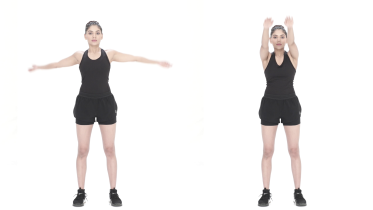
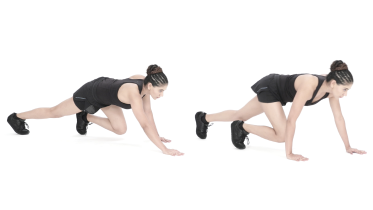
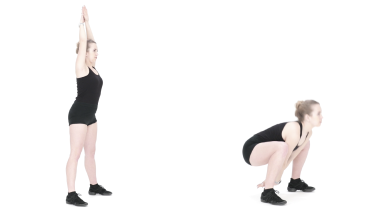
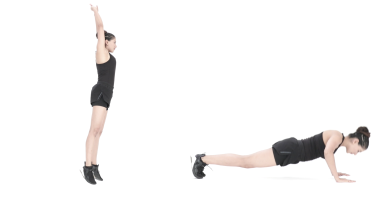
Push up with rotation
A push-up with rotation joins a full push-up to a side plank. You do one push-up on your hands and toes, then turn your body to one side, lift that arm straight up to the ceiling and balance on the other hand and the edges of your feet. You come back to the push-up position, do another push-up, then turn to the other side. The chest, shoulders and backs of the arms do the pressing, and the muscles along the sides of the waist control the turn. It is an advanced exercise for people who can already do regular push-ups with good form.
How to do the push up with rotation
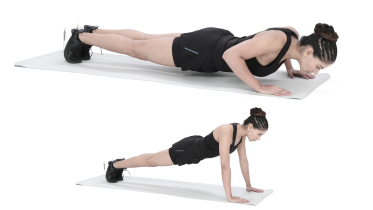
- Start in a push-up position on a mat, hands flat under your shoulders, about shoulder width apart, and up on your toes with your body straight from head to heels.
- Bend your elbows to lower your chest toward the mat, keeping your body in one line, then press back up to straight arms.
- Shift your weight onto your left hand, turn your body to the right and lift your right arm straight up toward the ceiling. Let your feet roll onto their edges so you finish in a side plank with your hips lifted.
- Pause briefly, then turn back and place your right hand on the mat under your shoulder.
- Do another push-up, then turn to the left side in the same way. Keep alternating.
What you should feel
Strong work in your chest, shoulders and the backs of your arms during the push-up, then in the supporting shoulder and along the side of your waist as you turn.
Common mistakes
- Letting the hips sag or drop toward the floor during the turn.
- Swinging round fast instead of turning your whole body as one piece.
- Leaving the supporting hand out in front of the shoulder instead of under it.
- Cutting the push-up shorter as you tire.
- Holding your breath.
How often
Once regular push-ups feel comfortable, many programs use 2 to 3 sets of 4 to 8 repetitions, each one a push-up and a turn, alternating sides, 2 or 3 days a week. Your physio will adjust this.
Stop and check with your physio if
- Chest pain or pressure, dizziness or feeling faint, a racing or irregular heartbeat, or being far more out of breath than the effort should cause.
- Sharp pain in a wrist, elbow or shoulder, especially the one holding you up in the side plank.
- Pain, pins and needles or numbness spreading down your arm or into your hand.
- Pins and needles in your arm or hand that do not go away after you stop, or part of your arm or hand goes numb. Get medical advice the same day. If one side of your face or body suddenly goes numb or weak, or your speech becomes slurred or muddled, call emergency services, even if it goes away.
- Sharp pain in your lower back, or back pain that builds during the set.
- The shoulder feels as if it has slipped out of place, looks a different shape or suddenly locks so you cannot move the arm, or your hand turns cold, pale or blue. Go to an emergency department straight away, without driving yourself, and do not try to put the shoulder back in yourself.
From the clinic
The video and the voice guide match: a full push-up, a turn to one side with the top arm pointing at the ceiling, back down, another push-up, then the other side. Build up to it with standard push-ups and a steady side plank. For an easier version, do the push-ups on your knees, or practice the turn on its own with the side plank with rotation. In the side plank, setting the top foot on the mat in front of the bottom one widens your base.
During each turn one arm holds up your whole upper body. After shoulder surgery, a dislocation or a broken arm, check with your physio before you try this. The turn also twists the spine while it carries load, so with low bone density (osteoporosis), ask your physio whether it suits you. If you have had a fracture in your spine, check with your physio before you begin.
Holding your hips up also works the muscles at the side of the bottom hip, much like a side leg lift. If you have had a hip replacement or other hip surgery, get the go-ahead from your surgeon or physio before you try the push-up with rotation. Some operations limit this kind of work for the first months, so the timing depends on your surgery.
Holding your body off the floor on your hands and toes, then twisting, puts heavy load through the stomach wall. If you are pregnant, have had abdominal surgery or have a hernia, ask your physio or doctor before you try the push-up with rotation. If you have recently given birth, including by cesarean section, or you have a gap down the middle of your stomach muscles (diastasis recti), ask your physio, midwife or doctor first.
If you have high blood pressure, breathe steadily through every repetition and never hold your breath. With a heart condition or high blood pressure, check with your doctor before you start. If chest pain, pressure or tightness does not ease quickly when you rest, spreads to your arm, neck, jaw, stomach or back, or comes with sweating, feeling sick, feeling light-headed or being short of breath, call emergency services straight away, as this can be a heart attack. If it eases quickly and none of these happen, get medical advice the same day, and do not exercise again until you have been checked. If you faint while exercising, call emergency services, even if you feel fine again quickly.
Written and checked by the PocketPhysio editorial team. Last updated 2026-09-28.
This page is general education, not a diagnosis or a personal treatment plan. If you have pain, an injury or a health condition, see a physiotherapist or doctor before starting new exercises.