Spiderman push-ups
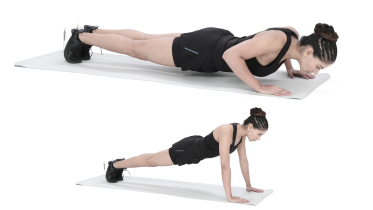
A spiderman push-up is a push-up where, as you lower your chest, you lift one foot and bring that knee out to the side and up toward the elbow on the same side. You take the leg back as you push up, then do the next one with the other knee. As well as the chest, shoulders and backs of the arms, it works your stomach and the sides of your trunk hard, because you hold a straight body on three points while one leg moves. It is an advanced push-up, best tried once ordinary push-ups feel solid.
How to do the spiderman push-ups
- Start in a high plank: hands flat on the floor under your shoulders, arms straight, legs stretched out behind you and your weight on your toes. Your body should form one straight line.
- Breathe in and begin bending your elbows to lower your chest. At the same time, lift one foot and bring that knee out to the side and forward toward the elbow on the same side.
- Keep the knee traveling along the outside of your body, just clear of the floor, and keep your hips level rather than letting them twist or lift.
- Breathe out as you press up through your hands and take the leg back to the start, toes on the floor.
- Do the next push-up with the other knee coming toward the other elbow. The video alternates sides like this, one push-up to each side.
What you should feel
In your chest, the fronts of your shoulders and the backs of your arms, with strong work in your stomach and the sides of your trunk. You may feel a stretch in the inner thigh and hip of the moving leg.
Common mistakes
- Rushing the leg and letting the hips swing or twist toward the floor.
- Dropping the hips, or hitching the bottom up, to make room for the knee.
- Concentrating on the leg and forgetting the push-up, so the chest barely lowers.
- Holding your breath through the whole rep.
How often
Many programs use 2 or 3 sets of 4 to 8 on each side, alternating legs, on 2 or 3 days a week, ending the set once your hips start to twist or sag. Your physio will adjust this.
Stop and check with your physio if
- Chest pain or pressure, dizziness or feeling faint, a racing or irregular heartbeat, or being far more out of breath than the effort should cause.
- Sharp or catching pain in a shoulder, wrist or elbow.
- Sharp pain in the hip or groin of the leg that moves.
From the clinic
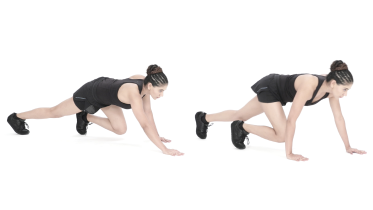
Get the basic push-up steady first, and try mountain climbers to learn the knee movement from a plank without the lowering. An easier way in is to hold the top of the push-up and just bring each knee forward, or to do the full movement with your hands raised on a sturdy bench. Your wrists take your whole weight bent right back, so push-up handles or dumbbells can help if they ache. After a shoulder dislocation or shoulder surgery, or with a painful shoulder, ask your physio before trying this one.
If you have had a hip replacement, get the go-ahead from your surgeon or physio before you try spiderman push-ups. Bringing the knee up toward the elbow bends the hip well past a right angle while it moves out to the side, and many surgeons ask you to avoid that for the first months after some operations. With a heart condition or high blood pressure, check with your doctor before you start. If chest pain, pressure or tightness does not ease quickly when you rest, spreads to your arm, neck, jaw, stomach or back, or comes with sweating, feeling sick, feeling light-headed or being short of breath, call emergency services straight away, as this can be a heart attack. If it eases quickly and none of these happen, get medical advice the same day, and do not exercise again until you have been checked. If you faint while exercising, call emergency services, even if you feel fine again quickly.
Written and checked by the PocketPhysio editorial team. Last updated 2026-09-26.
This page is general education, not a diagnosis or a personal treatment plan. If you have pain, an injury or a health condition, see a physiotherapist or doctor before starting new exercises.