Standing arm weight bearing
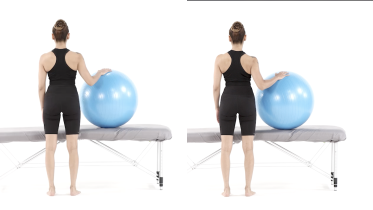
Standing arm weight bearing gets the arms used to taking some of your body weight again. You stand close to a table, put your palms flat on it and lean forward a little, so part of your weight passes down through straight arms into your hands. Your legs still carry most of it, and how far you lean decides how much the arms take. It is often used after a spell of not using an arm, for example after an injury, surgery or a stroke, and it asks the muscles around the shoulder blade to hold the shoulder steady under load.
How to do the standing arm weight bearing
- Stand facing a sturdy table or kitchen counter, close enough that your thighs almost touch the edge. The top should be at about the height of your upper thighs or hips.
- Place your palms flat on the top, one on each side just outside your hips, with your elbows straight but not locked.
- Stand tall, then lean your body forward a little from the ankles so some of your weight moves down through your arms into your hands.
- Keep your shoulders down and away from your ears, and do not let your chest sink between your arms.
- Hold the lean while you breathe normally, then stand upright again to take the weight off.
What you should feel
Pressure through your palms and wrists, and light work around the shoulder blades and in the backs of the upper arms.
Common mistakes
- Letting the chest drop between the arms so the shoulder blades stick out at the back.
- Shrugging the shoulders up as the weight arrives.
- Locking the elbows hard, or letting them buckle.
- Leaning on a table or counter that can slide, tip or roll.
How often
Many programs hold the lean for 10 to 30 seconds and repeat it 5 to 10 times, once or twice a day. Your physio will adjust this, including how far to lean.
Stop and check with your physio if
- A sharp pain or a catch in the shoulder, elbow or wrist.
- The arm gives way, or the shoulder feels loose, as if it could slide out.
- Pain, pins and needles or numbness spreading down your arm or into your hand.
- Pins and needles in your arm or hand that do not go away after you stop, or part of your arm or hand goes numb. Get medical advice the same day. If one side of your face or body suddenly goes numb or weak, or your speech becomes slurred or muddled, call emergency services, even if it goes away.
- A sudden pop or tearing feeling in the shoulder that brings sharp pain, new weakness or trouble lifting the arm. Stop and contact your surgical team the same day, or get medical advice the same day if you have not had surgery.
- The shoulder feels as if it has slipped out of place, looks a different shape or suddenly locks so you cannot move the arm, or your hand turns cold, pale or blue. Go to an emergency department straight away, without driving yourself, and do not try to put the shoulder back in yourself.
From the clinic
The voice guide mentions placing one palm on the table, while the video puts both hands down, and this page follows the video. With both hands on the table the load is shared, which is the gentler place to start. Moving more of your weight across onto one arm is the next step, shown in standing weight shift onto the hands. If bending the wrist back hurts with the palm flat, ask your physio for another hand position before you carry on.
Choose a surface that cannot move, such as a kitchen counter or a solid table set against a wall. If your balance is unsteady, have someone stand beside you the first few times.
After shoulder surgery, including a rotator cuff repair, or after a shoulder fracture or dislocation, follow your surgeon's or physio's plan, and do only the movements and range they have cleared. Many plans allow only passive movement at first, where the arm is moved for you and its muscles stay relaxed. After any of these, or after a broken or dislocated elbow or elbow surgery, check that your plan allows weight through the arm before you lean on it. After a broken wrist, hand or forearm, or surgery on any of them such as a tendon repair, start only when your doctor, surgeon, physio or hand therapist says the bone or repair is ready for this, and follow their plan for how much to do.
This page explains the general technique, not a stroke rehab program. If a stroke or another condition has left one arm weak, your physio or occupational therapist shows you where to place that hand and how far to lean, and whether someone should steady the elbow. Never force weight through a weak arm that is painful or keeps giving way.
Written and checked by the PocketPhysio editorial team. Last updated 2026-09-28.
This page is general education, not a diagnosis or a personal treatment plan. If you have pain, an injury or a health condition, see a physiotherapist or doctor before starting new exercises.