Stir the pot
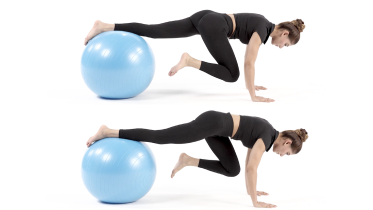
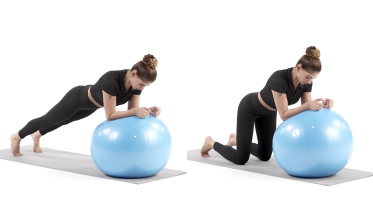
Stir the pot is a plank on a stability ball with a stirring movement added. You rest your forearms on the ball, hold your body straight on your toes, and use your forearms to move the ball in small circles, a couple one way and then a couple the other, like stirring a large pot. Your stomach and the muscles around your shoulder blades work hard to stop your trunk twisting or sagging as the ball moves. It is an advanced core exercise, usually added once a steady plank on the floor is easy.
How to do the stir the pot
- Kneel on a mat facing a stability ball. Rest your forearms on top of the ball with your hands loosely clasped.
- Move your hips forward until your body makes a straight line from your head to your knees. Press your forearms gently into the ball so your shoulders feel strong, not sunk.
- Tighten your stomach and lift your knees off the mat, so you are on your toes in one straight line from your heels to the top of your head.
- Keeping your hips and trunk still, use your forearms to roll the ball in 2 small clockwise circles, then 2 counterclockwise.
- Keep stirring for the time your physio sets, breathing throughout, then lower your knees to the mat and kneel up to rest.
What you should feel
Hard work across your stomach and along the sides of your waist, plus the shoulders and the muscles around your shoulder blades. Your lower back should feel steady, never achy.
Common mistakes
- Making the circles so big that your hips sag or swing.
- Letting your trunk twist or rock with the ball.
- Sinking between the shoulder blades instead of pressing into the ball.
- Holding your breath while you stir.
How often
Many programs start with 20 to 30 seconds of slow stirring, repeated 2 to 3 times with a rest in between, a few days a week. Your physio will adjust this.
Stop and check with your physio if
- Sharp or building pain in your lower back while you stir.
- Pain in a shoulder, or a feeling that a shoulder might slip out of place.
- Chest pain or pressure, dizziness or feeling faint, a racing or irregular heartbeat, or being far more out of breath than the effort should cause.
- The shoulder feels as if it has slipped out of place, looks a different shape or suddenly locks so you cannot move the arm, or your hand turns cold, pale or blue. Go to an emergency department straight away, without driving yourself, and do not try to put the shoulder back in yourself.
From the clinic
The video builds up in stages: kneeling with the forearms on the ball, then a straight line from head to knees, then the knees lifting. Stirring with your knees down is a sensible first version. Stay there until the circles are small and smooth and your hips hold still, then try it on your toes. If holding the ball steady is too much for now, a plank or kneeling plank on the floor, or the stability ball rollout, builds the base.
Pick an anti-burst ball, inflate it until it is firm, and clear the space around you on a floor that does not slip. The shoulders take a lot of your weight on the moving ball, so check with your physio first if you have had shoulder surgery or a dislocation, or your shoulder often hurts. If you have had surgery on your spine, chest or heart in recent months, get the go-ahead from your surgical team or physio first.
This plank loads the stomach wall heavily, and the stirring adds more. If you are pregnant, have had abdominal surgery or have a hernia, ask your physio or doctor before you try stir the pot. If you have recently given birth, including by cesarean section, or you have a gap down the middle of your stomach muscles (diastasis recti), ask your physio, midwife or doctor first. Stop and ask your physio if the middle of your stomach domes or bulges while you stir.
If you have high blood pressure, breathe steadily through every hold and never hold your breath. With a heart condition or high blood pressure, check with your doctor before you start. If chest pain, pressure or tightness does not ease quickly when you rest, spreads to your arm, neck, jaw, stomach or back, or comes with sweating, feeling sick, feeling light-headed or being short of breath, call emergency services straight away, as this can be a heart attack. If it eases quickly and none of these happen, get medical advice the same day, and do not exercise again until you have been checked. If you faint while exercising, call emergency services, even if you feel fine again quickly.
Written and checked by the PocketPhysio editorial team. Last updated 2026-09-28.
This page is general education, not a diagnosis or a personal treatment plan. If you have pain, an injury or a health condition, see a physiotherapist or doctor before starting new exercises.