Vertical leg crunch
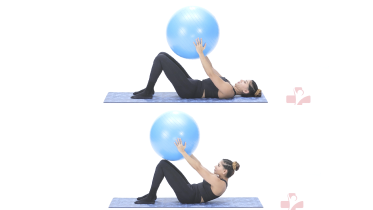
A vertical leg crunch is a crunch done with both legs held straight up toward the ceiling. Lying on your back, you curl your head and shoulders up toward your feet, pause briefly, then lower slowly while the legs stay where they are. The long muscle down the front of your stomach (rectus abdominis) does the curl. The muscles at the front of your hips (hip flexors) help keep the legs up. It asks more than a crunch with your feet on the floor, and tight hamstrings can make the leg position hard to keep.
How to do the vertical leg crunch
- Lie on your back on a mat and rest your hands lightly behind your head, fingers apart, elbows out to the sides.
- Bend your knees and bring them up over your hips, then straighten both legs so they point up at the ceiling, feet together. A small bend in the knees is fine if the backs of your thighs are tight.
- Tighten your stomach gently. Breathe out and curl your head and shoulders up off the mat, bringing your chest toward your thighs.
- Pause for a second or two at the top. Your legs stay still and your hips stay on the mat.
- Breathe in as you lower your shoulders and head slowly back down, keeping the legs up for the next repetition. When the set is done, bend your knees and lower your feet to the mat one at a time.
What you should feel
Work along the front of your stomach, plus some effort at the front of your hips to keep the legs upright and perhaps a stretch in the backs of your thighs. Your neck should stay easy.
Common mistakes
- Pulling your head up with your hands, or squeezing the elbows in toward your face.
- Letting the legs tip toward your face or drift away from you, so the hips rock.
- Swinging up with momentum instead of curling.
- Flopping back down at the end of each curl instead of lowering with control.
- Holding your breath during the pause at the top.
How often
Many programs start with 2 to 3 sets of 8 to 15 slow repetitions, a few days a week. Your physio will adjust this, and may keep you on a crunch with your feet down until that feels easy.
Stop and check with your physio if
- Pain in your neck that grows with each rep, or tingling or numbness running into an arm.
- Pins and needles in your arm or hand that do not go away after you stop, or part of your arm or hand goes numb. Get medical advice the same day. If one side of your face or body suddenly goes numb or weak, or your speech becomes slurred or muddled, call emergency services, even if it goes away.
- Back pain that sharpens, or pain, numbness or tingling that spreads into a leg.
- A bulge in your stomach wall or groin, or a scar from surgery starting to hurt.
From the clinic
Only your upper body moves. The legs just stay where you put them. If they start to wave about, rest, then set them up again. The curl itself is short: once your shoulder blades clear the mat you have gone far enough, and trying to reach higher usually hands the work to your neck. If you have high blood pressure, breathe steadily through every repetition and never hold your breath.
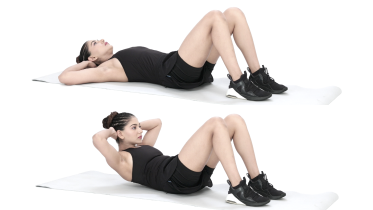
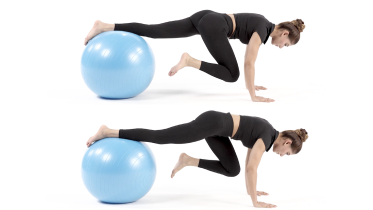
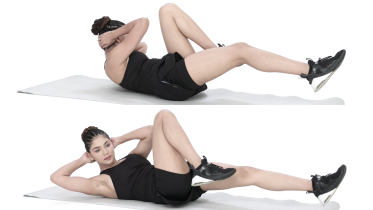
The voice guide links the fingers behind the neck, and in the video the elbows fold in toward the face as she curls. The steps here have your fingers apart, just cradling the head, with the elbows kept wide. That way the hands cannot pull your neck forward. If holding your legs up is hard or your back tires first, abdominal crunches with your feet on the floor or the dead bug are gentler places to start. The reverse crunch works the stomach from the other end, with your head resting on the mat.
If you have osteoporosis or low bone density, or have had a spine fracture, skip vertical leg crunches unless your physio has cleared them. Osteoporosis programs often limit repeated forward bending of the spine under load, and this exercise is exactly that. A disc problem in your lower back, or pain that runs down a leg, is another reason to ask your physio before you start.
If you have a hernia, have had stomach or back surgery, or have a separation of the stomach muscles after having a baby (diastasis recti), check with your physio first. Curling up while you hold your legs in the air raises the pressure inside your stomach, and that pressure bears down on the pelvic floor. If you leak urine or notice a heavy, dragging feeling low in your pelvis, stop and ask your physio for something kinder to the pelvic floor. If you are pregnant, leave vertical leg crunches out unless your physio or midwife says they are fine, as they strain the stomach muscles while those muscles are stretching. If you are pregnant and past the first three months, check with your physio before exercising flat on your back.
If you have had a hip replacement, get the go-ahead from your surgeon or physio before you try vertical leg crunches. Holding both legs straight up bends the hips to a full right angle, and past it if the legs tip toward you, and many surgeons ask you to avoid that for the first months after some operations.
Written and checked by the PocketPhysio editorial team. Last updated 2026-09-28.
This page is general education, not a diagnosis or a personal treatment plan. If you have pain, an injury or a health condition, see a physiotherapist or doctor before starting new exercises.