
Part of Golf injuries: where they land and what the rates mean
Golf mobility: what the hip, mid back and shoulder really need
Warning signs, and when to get help
What does a golf swing actually need to move?
Three regions do most of the work, and they are not equally famous. The hips have to rotate under a fairly still pelvis, inward on one side and outward on the other, twice in each swing. The mid back has to turn, because the lower back is not built to and will give you a fraction of what the thoracic spine will. The shoulders have to let the lead arm travel across the chest and up, and the trail shoulder has to rotate outward to get the club where it is meant to be. Lead and trail come from your stance rather than from left and right: in a right-handed golfer the lead side is the left and the trail side is the right, and a left-handed golfer reads every mention of them the other way round.
You will not find a target in degrees here for any of them. No published figure exists for how much a club golfer needs, and the numbers in circulation come from screening protocols sold by coaching companies rather than from research. Chasing one of those numbers is how people end up stretching a joint that was never the problem.
Comparing your own two sides is more useful, and so is comparing today with three months ago. Golf is asymmetrical, and the 2020 international consensus statement on reporting golf injuries says as much: it asks for both the side and the golfer's handedness to be recorded (Murray and colleagues, 2020). Your left hip and your right hip are doing different jobs, so expect them to measure differently and pay attention when the gap is large.
Will more flexibility add distance?
This is the claim every mobility routine for golfers is built on, and it is the one the research does not support.
A 2024 systematic review with meta-analysis in Sports Medicine identified 3,039 studies and pooled 20 of them to see what physical characteristics actually track with clubhead speed. Eight associations came out significant, reported as pooled z-transformed correlation values rather than raw correlations: lower body strength at 0.47, upper body strength at 0.48, jump displacement at 0.53, jump impulse at 0.82, jumping peak power at 0.66, upper body explosive strength at 0.67, anthropometry at 0.43 and muscle capacity at 0.17. Two did not. Flexibility came out lower by 0.04, with a confidence interval running from lower by 0.33 to higher by 0.26, and balance was similar (Brennan and colleagues, 2024).
Jump impulse topping that list is the part to take away. How hard and fast you can push into the ground is closer to clubhead speed than how far you can reach.
The review is careful on two points of its own. These are associations rather than experiments, so they describe what fast golfers have rather than what making you more flexible would do. And its limitations section says many of the flexibility measures in the included studies were questionable, then recommends the seated thoracic rotation assessment if flexibility is going to be measured at all. So the fair conclusion is that flexibility has not been shown to buy distance, not that it has been proven useless. If distance is the goal, the strength and power work in gym and lifting is where the evidence actually points.
The hip rotation claim, and what it really shows
You will have read that limited hip rotation causes golf back pain. The study behind that line measured something more specific, and more interesting.
Thirty professional male golfers aged 25 to 35, all matched at scratch and all pain free, were split by how much internal rotation their hips had. The group with less than 20 degrees showed significantly greater lumbar flexion during the swing, greater axial rotation to both sides, greater side bending to the right and greater pelvic posterior tilt than the group with 30 degrees or more, along with weaker internal rotators and shorter iliopsoas and hamstrings (Kim and colleagues, 2015).
Read the population before the finding: 30 pain-free professionals in a laboratory. What it shows is that a stiff hip changes where the movement comes from, which is a mechanism to respect. What it does not show is pain, because nobody in the study had any.
When the same question was taken to pain, the answer was different. Pooling four studies of hip range of movement in golfers with and without low back pain found no association, with lead hip internal rotation at a standardized mean difference of 1.25 and a confidence interval crossing zero, trail hip internal rotation at 0.13 with an interval crossing zero too, and both lead and trail external rotation at 0.1, which the review reports as not associated with low back pain either. Two studies did report greater side-to-side asymmetry in hip internal rotation in the groups with back pain, but the data could not be pooled (Smith and colleagues, 2018).
So the defensible position, and the one golf back pain takes too, is this: limited hip rotation changes how your spine moves, it has not been shown to cause your pain, and the asymmetry between your sides has more support behind it than the absolute number on either side.
The weekly job, not the pre-round one
This page and the golf warm up are often treated as the same thing, and keeping them apart is the single most useful thing you can do with them. Mobility is a few sessions a week, done when you are not about to play, aimed at changing how much range you have. A warm-up is ten minutes before you tee off, aimed at getting the range you already have ready to use. Doing one does not cover the other, and a long stretching session immediately before play is the one thing the warm-up evidence actively argues against.
Exercises that can help
Two for the hips, two for the mid back, one for the shoulders and one for trunk control, done on a few days of the week rather than before you tee off. Prone hip rotation often runs at 1 to 2 sets of 10 to 15 slow movements in each direction, the hip flexor stretch at a 20 to 30 second hold repeated 2 to 3 times on each side, thoracic rotation at 8 to 10 slow repetitions on each side, the chair thoracic stretch at holds of about 5 to 10 seconds repeated 3 to 5 times and built up toward 20 to 30 seconds, wall angels at 1 to 3 sets of 8 to 12 slow repetitions, and trunk rotation stabilization at 1 to 3 sets of 8 to 12 slow turns to each side, on 2 or 3 days a week. Trunk rotation stabilization needs a light ball and room to turn, and that is all: the band trunk rotation hold physios often use for the same job needs a second person to pull the band, so it belongs with a partner or at a clinic rather than in a routine you do at home on your own. Read the precautions and stop signs off each exercise page before your first session, because they are specific to the movement and they take priority over anything in this paragraph. Your physio will adjust this.
The exercises below carry their own stop signs and precautions. Open the line under an exercise and read them before you try it.
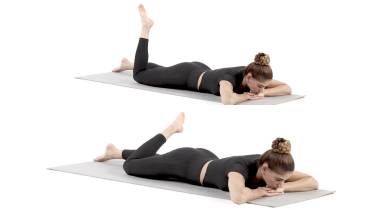 Prone hip rotation
Stop signs and precautions for the prone hip rotation
Before you start
- If you have had a hip replacement, get the go-ahead from your surgeon or physio before you try prone hip rotation. Moving the foot out or across turns the hip inward or outward, and many surgeons ask you to avoid that for the first months after some operations. Some operations limit turning inward and others limit turning outward, so the safe direction depends on your surgery.
- If you have had recent heart or chest surgery, do not lie face down on a healing chest wound. The weight of your chest presses on the wound for as long as you are down there, and pushing up through your arms to get off the bed pulls across the breastbone. Ask your surgeon or surgical team when lying on your front is allowed, and until then ask your physio for another way to do this while you lie on your side, sit or stand. If the breastbone clicks, grinds, shifts or feels as if it is moving while you do it, stop, and contact your surgical team the same day.
When to stop and get help
- You feel sharp or pinching pain in the hip or groin.
- Your knee or lower back hurts in this position.
- Pain spreads down the leg, or you notice numbness or tingling.
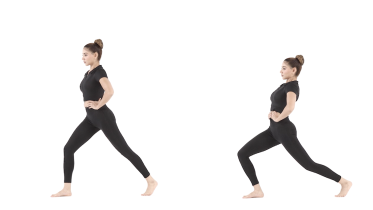 Hip flexor stretch
Stop signs and precautions for the hip flexor stretch
Before you start
- If you have had a hip replacement, get the go-ahead from your surgeon or physio before you try this stretch. Taking the back leg behind the line of your body stretches the front of that hip, and many surgeons ask you to avoid that for the first months after some operations, especially when the hip was replaced from the front.
When to stop and get help
- You feel a sharp or pinching pain in the front of the hip or the groin.
- Your lower back aches or pinches as you push your hips forward.
- Pain, numbness or tingling spreads down the front of the thigh.
- Your front knee hurts as you bend it and push your hips forward.
- You feel dizzy, lightheaded, faint or sick, or the room seems to spin. Stop, sit down and get medical advice the same day before you exercise again. If you faint, it does not settle within a few minutes of sitting still, your vision suddenly blurs or goes double, or you cannot stand or walk steadily, call emergency services.
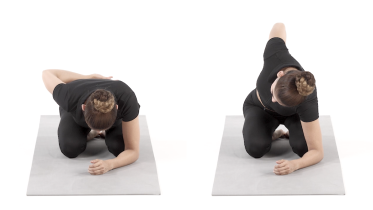 Thoracic rotation
Stop signs and precautions for the thoracic rotation
Before you start
- If you have had a hip replacement, get the go-ahead from your surgeon or physio before you try thoracic rotation. Sitting back toward your heels with your body leaned forward bends the hip well past a right angle, and many surgeons ask you to avoid that for the first months after some operations.
- If you have had surgery on your spine in recent months, get the go-ahead from your surgical team or physio first.
- If you have osteoporosis or a past fracture in the spine, check the range with your physio before you start, as twisting to the end of your range is often limited.
- After recent heart or chest surgery, get your surgeon's or surgical team's okay first, because taking your weight through one arm and turning the chest loads and twists the healing breastbone. If the breastbone clicks, grinds, shifts or feels as if it is moving while you do it, stop, and contact your surgical team the same day.
When to stop and get help
- Sharp pain in your back, ribs or shoulder as you turn.
- You feel dizzy, faint or unsteady. Stop and get medical advice the same day. If you faint, it does not settle within a few minutes of sitting still, or you cannot stand or walk steadily, call emergency services.
- Pain, numbness or tingling spreads into your arm or down your leg.
- Pins and needles in your arm or hand that do not go away after you stop, or part of your arm or hand goes numb. Get medical advice the same day. If one side of your face or body suddenly goes numb or weak, or your speech becomes slurred or muddled, call emergency services, even if it goes away.
- Kneeling or sitting back on your heels hurts your knees.
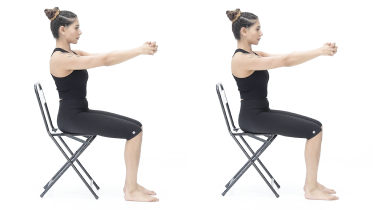 Chair thoracic stretch
Stop signs and precautions for the chair thoracic stretch
Before you start
- After shoulder surgery, including a rotator cuff repair, or after a shoulder fracture or dislocation, follow your surgeon's or physio's plan, and do only the movements and range they have cleared. Many plans allow only passive movement at first, where the arm is moved for you and its muscles stay relaxed. Reaching both arms forward to shoulder height is often one of the later movements to be cleared.
- If you have had surgery on your spine in recent months, get the go-ahead from your surgical team or physio first. After neck surgery or a broken bone in the neck, check with your surgeon or physio before you start.
- After recent heart or chest surgery, get your surgeon's or surgical team's okay first, because reaching both arms forward pulls across the healing breastbone and the chest wound. If the breastbone clicks, grinds, shifts or feels as if it is moving while you do it, stop, and contact your surgical team the same day.
- With low bone density (osteoporosis), ask your physio before you start, because physios often limit how far and how often you round the spine forward.
- If you have had a fracture in your spine, check with your physio before you begin.
When to stop and get help
- You feel dizzy or lightheaded as you bend forward or sit back up. Stop, stay seated and let it pass. If it keeps happening, get medical advice the same day before you try again, and call emergency services if it does not settle within a few minutes of sitting still. If you faint while exercising, call emergency services, even if you feel fine again quickly.
- An electric shock feeling runs down your back or into your arms or legs as your head bends forward. Stop and get medical advice the same day.
- Sharp pain in your neck or upper back instead of a stretch, or pain, pins and needles or numbness spreading down your arm or into your hand.
- Pins and needles in your arm or hand that do not go away after you stop, or part of your arm or hand goes numb. Get medical advice the same day. If one side of your face or body suddenly goes numb or weak, or your speech becomes slurred or muddled, call emergency services, even if it goes away.
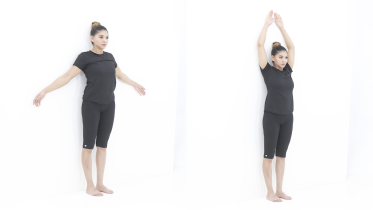 Wall angels
Stop signs and precautions for the wall angels
Before you start
- After shoulder surgery, including a rotator cuff repair, or after a shoulder fracture or dislocation, follow your surgeon's or physio's plan, and do only the movements and range they have cleared. Many plans allow only passive movement at first, where the arm is moved for you and its muscles stay relaxed.
When to stop and get help
- Either shoulder catches or hurts sharply as the arms go up.
- Pins and needles or pain run down an arm into the hand.
- Pins and needles in your arm or hand that do not go away after you stop, or part of your arm or hand goes numb. Get medical advice the same day. If one side of your face or body suddenly goes numb or weak, or your speech becomes slurred or muddled, call emergency services, even if it goes away.
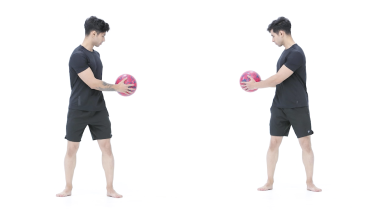 Trunk rotation stabilization
Stop signs and precautions for the trunk rotation stabilization
Before you start
- If you have had surgery on your spine in recent months, get the go-ahead from your surgical team or physio first. If you have had a hip replacement, get the go-ahead from your surgeon or physio before you try trunk rotation stabilization. Turning your body over planted feet can twist the hip joints if your pelvis turns too, and many surgeons ask you to avoid that for the first months after some operations.
- After recent heart or chest surgery, get your surgeon's or surgical team's okay first, because holding the ball out in front and turning from side to side loads and twists the healing breastbone. If the breastbone clicks, grinds, shifts or feels as if it is moving while you do it, stop, and contact your surgical team the same day.
- Turning while you hold a weight out from your body is a movement often limited with low bone density (osteoporosis), so ask your physio first if you have it.
- If you have had a fracture in your spine, check with your physio before you begin.
When to stop and get help
- Sharp pain in your lower back, or pain, tingling or numbness that spreads down a leg.
- You feel dizzy, lightheaded, faint or sick, or the room seems to spin. Stop, sit down and get medical advice the same day before you exercise again. If you faint, it does not settle within a few minutes of sitting still, your vision suddenly blurs or goes double, or you cannot stand or walk steadily, call emergency services.
- You wobble or feel you might lose your balance. Put the ball down and steady yourself, and do the next turns beside a counter.
Each of those exercise pages carries its own precautions and stop signs, and those come before anything in this paragraph. Two of these twist the spine, one of them on your feet with a weight held out in front of you, so with low bone density (osteoporosis) or a past fracture in the spine, check with your physio before you add trunk rotation stabilization, and ask how far to turn in the thoracic rotation, since twisting to the end of the range is usually limited. Ask about the chair thoracic stretch as well, because it rounds the upper back forward and physios often limit how far and how often you do that. After a shoulder dislocation, shoulder surgery or a recent shoulder injury, ask your physio before you take the arms overhead in wall angels. Trunk rotation stabilization is the only one done standing and turning, so do it within arm's reach of a counter or a worktop, and keep a hand near that support if your balance is poor or you have fallen in the past year. Two of them start on the floor, one face down and one kneeling. If getting down to the floor and back up is not something you can rely on, have somebody with you for it rather than doing it alone, and ask your physio which of them you can do from a firm bed instead.
If you have high blood pressure, breathe steadily through every repetition and never hold your breath. With a heart condition or high blood pressure, check with your doctor before you start. If chest pain, pressure or tightness does not ease quickly when you rest, spreads to your arm, neck, jaw, stomach or back, or comes with sweating, feeling sick, feeling light-headed or being short of breath, call emergency services straight away, as this can be a heart attack. If it eases quickly and none of these happen, get medical advice the same day, and do not exercise again until you have been checked.
If you have had a hip or knee replacement, or any other hip or knee surgery, do not take this list as cleared for you: your surgeon's or physio's plan comes first, and golf after a hip or knee replacement is the page for your question.
How to tell a restriction from a habit
Not everything that does not move is tight. Some of it is a position you have stopped visiting, and the two respond differently.
A quick way to tell the difference is to move the joint passively, with your hand or against the floor, and compare that with what you can do actively. If the hip turns further when you help it than when you turn it yourself, the limit is probably control and strength rather than length, and stretching it will not help much. If it stops at the same place either way, and stops with a firm end rather than a painful one, there is more of a case for working on range.
Then watch what happens over weeks rather than minutes. Range that appears during a session and is gone by the next day is normal and not the point. You are looking for a side that was clearly behind the other and is now closer to it.
What should an older golfer work on?
Strength, then rotation, then range, in that order. The clubhead speed review puts strength and power at the top and flexibility nowhere, and increasing age is one of the two factors the back pain research found associated with golf-related low back pain in its pooled data, with a mean age of 51.5 years among the recreational golfers studied (Brennan and colleagues, 2024; Smith and colleagues, 2018).
Keep the sessions short and frequent rather than long and occasional, and expect the hips to be the slowest to change. Strong and steady for older adults carries the strength and balance work with the precautions written for that readership, and the wider picture of what golf asks of a body is on the golf hub.
When to see a physio
Stiffness that has not budged in three months of honest work is a reason to get looked at, and so is a joint that is painful rather than tight. A hip that hurts in the groin when you turn, a shoulder that wakes you, or a mid back that will not turn either way are all worth an assessment rather than another routine from the internet.
A physiotherapist, or a physical therapist in the United States, will measure both sides, work out whether the limit is length, control or the joint itself, and then build the program around the one that is furthest behind, which is something no general list can do. Read the warning list below before your first session and follow the timing each line gives.
Related exercise programs
Warning signs
Get emergency help now
- Emergency: if chest pain, pressure or tightness does not ease quickly when you rest, spreads to your arm, neck, jaw, stomach or back, or comes with sweating, feeling sick, feeling light-headed or being short of breath, call emergency services straight away, as this can be a heart attack. If it eases quickly and none of these happen, get medical advice the same day, and do not exercise again until you have been checked.
- Emergency: any sign of a stroke, even if it goes away. That means a face that droops on one side, an arm you cannot lift or keep up, slurred or muddled speech, weakness or numbness on one side of your body or face, sudden blurred vision, double vision or loss of sight, trouble swallowing, sudden dizziness with unsteadiness or falling over, a sudden severe headache, or a sudden fall where your legs give way but you do not black out (a drop attack). Call emergency services straight away.
- Emergency: pain, tingling, numbness or weakness in both legs, numbness or altered feeling around your genitals or bottom, or new trouble peeing or controlling your bladder or bowels. The same applies if you lose feeling in one leg. Call emergency services or go to an emergency department straight away, and do not drive yourself. These can be signs of pressure on the nerves at the base of the spine (cauda equina syndrome).
- Emergency: you have had a fall or an injury and now have severe hip pain, or you cannot walk or put weight on the leg. Call emergency services or go to an emergency department. This can be a sign of a broken hip (hip fracture).
Get help today
- Same day: a leg or foot that is getting weaker, for example your foot drags, catches on the ground or slaps down when you walk (foot drop). Get medical advice the same day. If the weakness is getting worse by the hour, go to an emergency department.
- Same day: new hip or groin pain after a fall, even a small one, if you are older, have low bone density (osteoporosis) or have taken steroid tablets for a long time, even if you can still walk. Get medical advice the same day, and say that you fell and that your bones are thin. Until it has been checked, stop the exercises and keep as much weight off that leg as you can, using your stick, frame or crutches if you have them and asking someone for help to move about, because a crack in the hip that has not slipped yet can slip when you walk on it, and a hip that has slipped usually needs a bigger operation than one that has not. A broken hip is not always obvious at first, and a first X-ray does not always show it, so if you have been checked and sent home and you still cannot walk on that leg, or the pain is getting worse, go back and say so.
- Same day: back pain after a minor fall or strain if you are older, have low bone density (osteoporosis) or have taken steroid tablets for a long time. Get medical advice the same day. Until it has been checked, stop the exercises and keep away from lifting, bending forward and twisting, because those load a bone in the spine that may be broken.
- Same day: pins and needles in your arm or hand that do not go away after you stop, or part of your arm or hand goes numb. Get medical advice the same day. If one side of your face or body suddenly goes numb or weak, or your speech becomes slurred or muddled, call emergency services, even if it goes away.
- Same day: sudden new dizziness, or feeling faint or unsteady, without any of the stroke signs above. Stop, sit down and get medical advice the same day. If you faint, it does not settle within a few minutes of sitting still, or you cannot stand or walk steadily, call emergency services.
- Same day: a calf or thigh that is newly swollen or getting more swollen, warm, tender, red or darker than usual, has swollen veins that are sore to touch, or has a throbbing or cramping pain that does not fit your injury or condition, or that feels different from normal muscle soreness after exercise. This can be a sign of a blood clot (deep vein thrombosis), especially after surgery, an injury, time in a cast or boot, a long trip or a spell of being much less mobile than usual. Get medical advice the same day. If you are also short of breath or have chest pain, call emergency services.
- Same day: the pain is there at night or at rest and keeps getting worse. If you are being treated for cancer now, contact your cancer team the same day.
Book an appointment
- Within a day or two: the pain is there at night or at rest and keeps getting worse. If you have had cancer, now or in the past, or are losing weight without trying, see your doctor sooner, within a day or two, and mention it. This applies even if the pain is not getting worse.
- Within a few days: the pain is there at night or at rest and keeps getting worse. See your doctor within a few days.
Common questions
Will more flexibility add distance to my golf shots?
On the best available evidence, no, or at least not by itself. A 2024 systematic review with meta-analysis searched 3,039 studies, included 20, and reported significant associations between clubhead speed and lower body strength at a pooled effect size of 0.47, upper body strength at 0.48, jump displacement at 0.53, jumping peak power at 0.66, upper body explosive strength at 0.67 and jump impulse at 0.82, which was the strongest of the lot. Flexibility came out at lower by 0.04, with a confidence interval running from lower by 0.33 to higher by 0.26, and balance was similar, so neither was significantly associated with clubhead speed (Brennan and colleagues, 2024). The review's own limitations section says many of the flexibility measures used in the included studies were questionable and recommends a seated thoracic rotation assessment if flexibility is to be measured at all, so the finding may partly be a measurement problem. It does mean that a stretching routine sold as a distance program is not supported, and the strength and power work in gym and lifting is where the speed evidence points.
How do I improve hip mobility for golf?
Slowly, a few days a week, and in rotation rather than only in straight lines. Prone hip rotation trains turning the thigh in and out, which is the direction a swing uses and the direction most people never work, and the hip flexor stretch opens the front of the hip that sitting all week shortens. The doses above are the ranges from each exercise page, and your physio will adjust them. Two practical points: compare your two sides rather than chasing a number, since the asymmetry is the finding with any support behind it, and expect weeks rather than days, because range gained in one session is mostly borrowed. If one hip is sore rather than stiff, that is a different problem and worth getting assessed instead of stretching harder.
How much thoracic rotation do I need for a golf swing?
No published number exists for a club golfer, and anybody quoting a degree target is quoting a practice protocol rather than a study. It is reasonable to say that the mid back is where the turn should come from, and that when it does not come from there it tends to come from the lower back instead, which is the pattern seen in golfers with limited hip rotation (Kim and colleagues, 2015). A useful self-check without a number: sit tall on a chair, hold a club across your chest, and turn each way to the point where the pelvis wants to follow. If one side turns clearly less than the other, that difference is more informative than the absolute amount. The 2024 clubhead speed review recommends the seated thoracic rotation assessment as the flexibility measure to use, which is the same position (Brennan and colleagues, 2024).
Does shoulder mobility matter for the backswing?
It matters for getting into a decent position without borrowing the range from somewhere else, and that is a different claim from adding speed. The lead arm, the left one in a right-handed golfer, has to travel across the body and up, and the trail shoulder has to rotate outward, so a shoulder that will not do either tends to be compensated for by lifting the arms, bending the lead elbow early or standing up out of the posture. Wall angels are the simplest way to work the overhead direction with the trunk held still, and the dose is on that page. No golf study has tested shoulder range against performance or injury on its own, so treat this as reasoning from the movement rather than a finding. If your shoulder is painful rather than stiff, or wakes you at night, get it assessed instead of pushing it into range.
What should an older golfer work on?
Strength first, then rotation, then the ranges above, and the distance evidence agrees with that order: lower body strength, upper body strength and jump-based power were all significantly associated with clubhead speed while flexibility was not (Brennan and colleagues, 2024). Age is also one of the two things found to be associated with golf-related low back pain in pooled data, with the mean age of recreational golfers in that research being 51.5 years, so the readers most likely to need this page are the ones it was written for (Smith and colleagues, 2018). Work on a few days a week and keep the sessions short rather than doing one long one. Strong and steady for older adults carries the strength and balance side with the precautions written for that readership. If you have had a hip or knee replaced, the page you want is golf after a hip or knee replacement, and your surgical team's plan comes first.
References
- Brennan A, Murray A, Mountjoy M, Hellstrom J, et al. Associations between physical characteristics and golf clubhead speed: a systematic review with meta-analysis. Sports Medicine. 2024;54(6):1553-1577. https://doi.org/10.1007/s40279-024-02004-5
- Kim SB, You JS, Kwon OY, Yi CH. Lumbopelvic kinematic characteristics of golfers with limited hip rotation. American Journal of Sports Medicine. 2015;43(1):113-120. https://doi.org/10.1177/0363546514555698
- Smith JA, Hawkins A, Grant-Beuttler M, Beuttler R, Lee SP. Risk factors associated with low back pain in golfers: a systematic review and meta-analysis. Sports Health. 2018;10(6):538-546. https://doi.org/10.1177/1941738118795425
- Murray A, Junge A, Robinson PG, Bizzini M, et al. International consensus statement: methods for recording and reporting of epidemiological data on injuries and illnesses in golf. British Journal of Sports Medicine. 2020;54(19):1136-1141. https://doi.org/10.1136/bjsports-2020-102380
- NHS. Chest pain. Page last reviewed 8 August 2023. https://www.nhs.uk/symptoms/chest-pain/
- NHS. Symptoms of a stroke. Page last reviewed 12 September 2024. https://www.nhs.uk/conditions/stroke/symptoms/
- NHS. Sciatica. Page last reviewed 03 December 2024. https://www.nhs.uk/conditions/sciatica/
- NHS. DVT (deep vein thrombosis). Page last reviewed 30 April 2026. https://www.nhs.uk/conditions/deep-vein-thrombosis-dvt/
- NHS. Falls. Page last reviewed 6 March 2025. https://www.nhs.uk/conditions/falls/
Written and checked by the PocketPhysio editorial team. Last updated 2026-11-06.
This page is general education, not a diagnosis or a personal treatment plan. See a physiotherapist or doctor for advice about your own situation.