
Part of Golf injuries: where they land and what the rates mean
A golf warm up for 10 minutes, with no driving range
Warning signs, and when to get help
Start with what the evidence does and does not support
This is the weakest evidence base of the six golf pages on this site, and saying so is more useful than pretending otherwise.
Two claims get made for warming up and they are not equally supported. The performance claim has some backing: a systematic review of 23 studies, 9 observational and 14 experimental, concluded that various warm-up protocols may improve golf performance, with the exception of static stretching, which was inferior to other methods and potentially detrimental. The injury claim does not: the same review found the studies on warm-up behavior and golf-related injury mixed and inconclusive (Ehlert and Wilson, 2019).
The same review also recorded something every club golfer will recognize. Many golfers either do not warm up regularly or warm up only briefly. So this is not a page arguing against a well-established habit. It is a page about a habit most people skip.
What the one randomized trial found, and what it did not
One trial exists, and what matters is the detail inside it.
Forty-five Japanese high school golfers from three schools were randomized to a golfer's low back pain exercise prevention program, with 23 in that group, or to a sham warm-up built to look like the real one, with 22 in that group, for 12 weeks. It was double blind, the sham was supervised by a physical therapist with more than ten years of experience, the warm-up actually got done before 71.1 percent of the exercise group's golf sessions and 74.1 percent of the sham group's, the survey response rate across the twelve weeks was 94.0 percent, and no adverse events were reported (Hamada and colleagues, 2025; correction 2026).
Those last figures come from the correction the journal published in June 2026, not from the paper as it first appeared. The correction restates the response rate, the proportion of days played, the warm-up completion rates and the injury rates per 1,000 exposures, and it leaves both primary results untouched, so the two numbers below are the ones the trial reported in the first place and still reports now.
Now the result, in two halves. The number of people who developed low back pain did not differ significantly: 5 in the exercise group against 8 in the sham group, an odds ratio of 0.486 with a p value of 0.279. The number of episodes of low back pain did differ, and by a lot: 16 against 100, an odds ratio of 0.157 with a p value below 0.001.
Those two sentences are the page. The fair reading is that the program did not stop people getting back pain, and that the golfers doing it had far fewer episodes over the twelve weeks. Anyone who compresses that into warming up prevents back pain has dropped the half that matters.
Carry the population with you as well. These were adolescents on school golf teams, 12 of whom in each group had already had low back pain in the past year, and 45 participants is 45. Club golfers in their fifties and sixties are a different group entirely, and nobody has tested them.
The trial that would answer it for adults has been designed. A Dutch protocol describes a cluster randomized trial in 28 golf clubs with 11 golfers per club, aged 45 or over, using 6 exercises taking at most 10 minutes, with golf injury prevalence measured every fortnight over five months (Gladdines and colleagues, 2022). A search for its results on 6 November 2026 returned the protocol only, so as things stand the answer is not available.
How do you warm up for golf?
Three parts, in this order, and the order matters more than the contents.
Get warm: 2 to 3 minutes
Walk briskly from the car park with the trolley, or march on the spot beside the first tee. What you want is mild warmth and breathing you can hear. Nothing in the rest of this works properly while you are cold, and on a cold morning this is the part to lengthen rather than the part to cut.
Move the ranges the swing uses: 4 to 5 minutes
Next, take the hips, the mid back and the shoulders through their range slowly and without load. The spine rounds and arches, the hips go across and around, the feet step sideways, and the shoulder blades and arms work back and out.
Stay smooth, stay inside a range that does not bite, and keep anything done on one leg next to something you can hold. Nothing here is held for a minute: these are movements rather than stretches.
Build up to playing speed: 2 to 3 minutes
Now rehearse the golf swing itself, starting slower than feels necessary. Half swings with a wedge, then three quarter swings, then a couple at playing pace. Then the same progression with a mid iron, and only then a driver if you use one off the first tee.
Most club golfers skip exactly this part and then treat the first two holes as the warm-up, which is the version that catches people out, because the first tee shot is usually the fastest, fullest movement of the day.
What if there is no driving range?
Nothing much is lost. The range is useful for finding your timing and it is the easiest part of this to replace.
Swing a club instead of hitting balls, exactly as above, in the practice net or beside the tee. Add putts and chips if there is a green, because they warm the hands, wrists and forearms and tell you something about the pace of the greens. If you only have four minutes, use them on getting warm and on half swings, and leave the rest.
A second round on the same day needs much less. A few minutes of easy movement and some half swings will do if you have not cooled down, and rather more if you have been sitting in the clubhouse for an hour.
Exercises that can help
One to get warm, two for the spine and hips, one for the footwork and one for the shoulders, in the order on this page. Marching on the spot often runs at 30 seconds to 1 minute, or 10 to 20 lifts on each leg, repeated 2 to 3 times, the cat-camel at 5 to 10 slow cycles, the lunge with twist at 2 to 3 sets of 6 to 10 on each leg, side stepping at 2 to 3 lengths of about 10 to 15 steps each way, and the band pull-apart at 2 to 3 sets of 10 to 15 with a light band. Before a round you will do fewer of each and move on faster, since this is a warm-up rather than a training session. Read the precautions and stop signs off each exercise page before your first session. Your physio will adjust this.
The exercises below carry their own stop signs and precautions. Open the line under an exercise and read them before you try it.
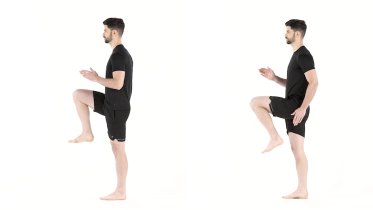 Marching on the spot
Stop signs and precautions for the marching on the spot
Before you start
- If you have had a hip replacement, get the go-ahead from your surgeon or physio before you try marching on the spot. A high knee lift can bend the hip past a right angle, and many surgeons ask you to avoid that for the first months after some operations.
When to stop and get help
- You feel dizzy, lightheaded, faint or sick, or the room seems to spin. Hold your support, sit down and get medical advice the same day before you practice again. If you faint, it does not settle within a few minutes of sitting still, your vision suddenly blurs or goes double, or you cannot stand or walk steadily, call emergency services.
- You feel unsteady or close to falling.
- Sharp pain in the hip, knee or lower back.
- Chest pain or pressure, dizziness or feeling faint, a racing or irregular heartbeat, or being far more out of breath than the effort should cause.
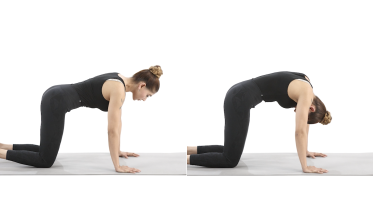 Cat-camel stretch
Stop signs and precautions for the cat-camel stretch
Before you start
- If you have had a hip replacement, get the go-ahead from your surgeon or physio before you try this one. Getting down onto your hands and knees and back up again bends the hip deeply and turns it inward at the same time, which is the position many surgeons ask you to avoid for the first months after some operations. After a hip or knee replacement, kneeling may not be comfortable yet either.
- After a broken wrist, hand or forearm, or surgery on any of them such as a tendon repair, start only when your doctor, surgeon, physio or hand therapist says the bone or repair is ready for this, and follow their plan for how much to do.
- If you have had surgery on your spine in recent months, get the go-ahead from your surgical team or physio first.
- After recent heart or chest surgery, get your surgeon's or surgical team's okay first, because taking your weight through both arms on your hands and knees and then arching your chest open loads and stretches the healing breastbone. If the breastbone clicks, grinds, shifts or feels as if it is moving while you do it, stop, and contact your surgical team the same day.
- If you have low bone density (osteoporosis) or have had a fracture in your spine, keep the rounding small and check the range with your physio before you start.
- If you have been told you have narrowing of the spinal canal (spinal stenosis) or a forward-slipped vertebra (spondylolisthesis), ask your physio before you add the arching half of this one, because bending backward often aggravates both.
- If you are pregnant, check with your midwife or physio before you start.
When to stop and get help
- Rounding or arching gives you sharp pain. Go back to the range that feels easy.
- Pain travels down your leg, or you feel numbness or tingling.
- Moving your head makes you dizzy. Keep it in line with your back instead. If you faint while exercising, call emergency services, even if you feel fine again quickly.
- Kneeling hurts your knees or leaning on your hands hurts your wrists. Your physio can suggest a padded surface or a different position.
- Numbness around your genitals or bottom, new trouble with your bladder or bowels, pain, tingling, numbness or weakness in both legs, or loss of feeling in one leg. Call emergency services or go to an emergency department straight away, and do not drive yourself.
- Your leg or foot gets weaker, for example your foot drags, catches on the ground or slaps down when you walk (foot drop). Get medical advice the same day. If the weakness is getting worse by the hour, go to an emergency department.
- An electric shock feeling runs down your back or into your arms or legs as your head bends forward. Stop and get medical advice the same day.
- You are pregnant and notice bleeding or fluid leaking from your vagina, regular painful tightenings, tummy pain that does not settle when you rest or comes with lower back pain, or a change in your baby's usual movements, such as moving less than usual. Stop and contact your midwife or maternity unit straight away. Do the same for a severe headache, problems with your vision such as blurring or flashing lights, pain just below your ribs, or sudden swelling of your face, hands or feet, which can be signs of pre-eclampsia. Call emergency services if the bleeding is heavy, the tummy pain is severe, bleeding or tummy pain comes with pain in your shoulder or feeling sick, faint or dizzy, or a headache comes on suddenly and is very severe.
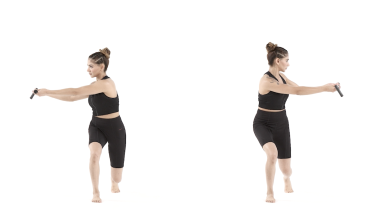 Lunge with twist
Stop signs and precautions for the lunge with twist
Before you start
- If you have had a hip replacement, get the go-ahead from your surgeon or physio before you try the lunge with twist. Some operations limit this kind of work for the first months, so the timing depends on your surgery.
- With low bone density (osteoporosis) or a past fracture in the spine, check with your physio before you add the twist, and ask how far to turn.
When to stop and get help
- Sharp pain in your knee, hip or back, or pain that shoots down a leg.
- Your knee gives way, or you lose your balance and have to grab something to stay up.
- You feel dizzy or lightheaded as you turn. If you faint while exercising, call emergency services, even if you feel fine again quickly.
- Chest pain or pressure, dizziness or feeling faint, a racing or irregular heartbeat, or being far more out of breath than the effort should cause.
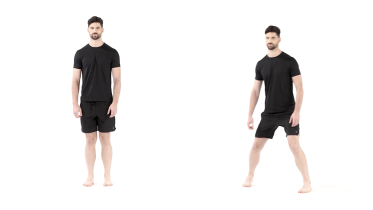 Side stepping
Stop signs and precautions for the side stepping
Before you start
- If you have had a hip replacement or other hip surgery, get the go-ahead from your surgeon or physio before you try side stepping. Some operations limit this kind of work for the first months, so the timing depends on your surgery. If the operation was done through the side of the hip (a lateral approach), the muscles at the side of the hip were detached and repaired. Exercises that make them work hard, like this one, are then often held back for around the first 6 weeks. After knee surgery or a knee replacement, wait until your surgeon or physio clears you for weight bearing work from side to side.
When to stop and get help
- You feel dizzy, lightheaded, faint or sick, or the room seems to spin. Hold your support, sit down and get medical advice the same day before you practice again. If you faint, it does not settle within a few minutes of sitting still, your vision suddenly blurs or goes double, or you cannot stand or walk steadily, call emergency services.
- You start to lose your balance.
- Sharp pain in the hip, groin or knee.
- Pain running down the leg, or the leg going numb or tingly.
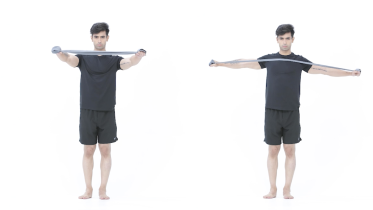 Band pull-apart
Stop signs and precautions for the band pull-apart
Before you start
- If you have had shoulder surgery, or the shoulder has dislocated or feels loose, ask your physio before you try it.
- After recent heart or chest surgery, get your surgeon's or surgical team's okay first, because pulling the band apart with straight arms pulls out across the healing breastbone. If the breastbone clicks, grinds, shifts or feels as if it is moving while you do it, stop, and contact your surgical team the same day.
- If you have high blood pressure, breathe steadily through every repetition and never hold your breath.
When to stop and get help
- A sharp pain or catch in the shoulder comes on during the pull.
- You feel dizzy, faint or unsteady. Stop and get medical advice the same day. If you faint, it does not settle within a few minutes of sitting still, or you cannot stand or walk steadily, call emergency services.
- Tingling or pain spreads down either arm.
- Pins and needles in your arm or hand that do not go away after you stop, or part of your arm or hand goes numb. Get medical advice the same day. If one side of your face or body suddenly goes numb or weak, or your speech becomes slurred or muddled, call emergency services, even if it goes away.
- Pain at the front of the shoulder comes on each time the arms open wide.
Each exercise page carries its own precautions and stop signs, and those come before anything in this paragraph. Wear your golf shoes or flat shoes that grip, and keep a trolley, a cart, a bench or a fence post within reach for the marching, the lunge with twist and the side stepping, since each of those puts your weight on one leg at a time. If your balance is poor, you have fallen in the past year, or you often feel unsteady, keep a hand on that support throughout and ask your physio before you let go.
The cat-camel moves a spine that is unloaded, which is the gentlest item here, and the lunge with twist is the one with real load in it. The cat-camel is also the only item here that needs the floor, so it belongs at home or in the clubhouse rather than on wet grass beside the tee, and if getting down and up is hard you can make the same rounding and arching movement standing, with your hands on your thighs. With low bone density (osteoporosis) or a past fracture in the spine, ask your physio how far to turn before you add the twist, and keep the rounding small in the cat-camel, which carries the same gate on its own page. After a shoulder dislocation, shoulder surgery or a recent shoulder injury, ask your physio before the band pull-apart.
If you have high blood pressure, breathe steadily through every repetition and never hold your breath. With a heart condition or high blood pressure, check with your doctor before you start. Stop and sit down for chest pain or pressure, dizziness or feeling faint, a racing or irregular heartbeat, or being far more out of breath than the effort should cause. If chest pain, pressure or tightness does not ease quickly when you rest, spreads to your arm, neck, jaw, stomach or back, or comes with sweating, feeling sick, feeling light-headed or being short of breath, call emergency services straight away, as this can be a heart attack. If it eases quickly and none of these happen, get medical advice the same day, and do not exercise again until you have been checked.
If you have had a hip or knee replacement, or any other lower limb surgery, do not treat this list as cleared for you: your surgeon's or physio's plan comes first, and golf after a hip or knee replacement is the page for that question.
Where the long stretches go
After the round, not before it. The review above found static stretching the one approach that came out worse than the alternatives before performance, so a two minute hamstring hold on the first tee is working against you (Ehlert and Wilson, 2019).
Afterward is a different matter, and a dip in power costs nothing once the card is signed. If stiffness is your real problem rather than your warm-up, that is weekly work and it lives on golf mobility. A back that needs twenty minutes before it will turn is not a warm-up problem either, and golf back pain is where that goes.
When to see a physio
See someone when the warm-up stops being a formality. Ten minutes that used to be enough and now is not, a calf that tightens every round, a shoulder that will not go overhead without a wince, or a hip that needs coaxing every morning are all worth an assessment rather than more minutes.
Come sooner if you have gone over on the course, or if you have quietly stopped using a club because of what the last shot felt like. A physiotherapist, or a physical therapist in the United States, can watch you swing, work out which link is stiff or weak, and build the ten minutes around that rather than handing you a general list. The rest of the sport, including what the injury figures actually say, is on the golf hub. One thing a warm-up is not is the way back from a knock to the head: if a ball or a club has caught you, the return runs through the staged process at concussion recovery and return to play rather than through loosening off on the first tee. Read the warning list below before your next round and follow the timing on each line.
Related exercise programs
Warning signs
Get emergency help now
- Emergency: if chest pain, pressure or tightness does not ease quickly when you rest, spreads to your arm, neck, jaw, stomach or back, or comes with sweating, feeling sick, feeling light-headed or being short of breath, call emergency services straight away, as this can be a heart attack. If it eases quickly and none of these happen, get medical advice the same day, and do not exercise again until you have been checked.
- Emergency: any sign of a stroke, even if it goes away. That means a face that droops on one side, an arm you cannot lift or keep up, slurred or muddled speech, weakness or numbness on one side of your body or face, sudden blurred vision, double vision or loss of sight, trouble swallowing, sudden dizziness with unsteadiness or falling over, a sudden severe headache, or a sudden fall where your legs give way but you do not black out (a drop attack). Call emergency services straight away.
- Emergency: after a ball, a club, a collision or a fall to the face, any change to your sight, severe pain in the eye, a headache or finding light hard to bear, feeling sick or being sick, an eye you cannot move or keep open, or blood or pus coming from the eye. The same applies if something has pierced the eye or hit it at high speed, or if a strong chemical has gone into it. Go to an emergency department or call emergency services straight away, and do not drive yourself.
- Emergency: after a knock to the head, being very drowsy or finding it hard to keep your eyes open, confusion, a fit (seizure), new weakness or numbness anywhere in your body, new trouble understanding, speaking, walking or keeping your balance, new problems seeing or hearing, clear fluid coming from your ears or nose, bleeding from your ears or bruising behind them, a black eye when your eye was not hit, a dent in your head or a wound with something stuck in it, or a change in behavior. Call emergency services straight away. These can be signs of an injury to the brain.
- Emergency: after a knock to the head, you were knocked out, even for a moment, you cannot remember what happened just before or after, you have had a headache ever since, or you are being sick (vomiting). The same applies, even if you feel fine, if you take medicine that thins your blood, other than aspirin on its own, have a bleeding or clotting condition, have had brain surgery in the past, or had been drinking alcohol or taking drugs when it happened. Go to an emergency department straight away, and do not drive yourself.
- Emergency: you have had a fall or an injury and now have severe hip pain, or you cannot walk or put weight on the leg. Call emergency services or go to an emergency department. This can be a sign of a broken hip (hip fracture).
- Emergency: you fell and cannot remember the fall or how it happened. Go to an emergency department straight away, and do not drive yourself. You may have blacked out or hit your head without knowing it.
Get help today
- Same day: you have had a knock to the head and you take aspirin on its own, without any of the emergency signs above. Get medical advice the same day. Aspirin on its own is the only blood thinning medicine left out of the emergency line above, and the NHS still asks anybody taking a medicine that thins the blood to get urgent advice after a head injury.
- Same day: a sudden pop or snap at the back of your ankle or heel, a feeling that someone kicked you there, or sudden pain there after which you cannot push off or rise onto your toes on that leg. Stop, take the weight off that leg carefully and go to an urgent care center or emergency department the same day, even if you can still walk, as this can be a torn Achilles tendon.
- Same day: sudden new dizziness, or feeling faint or unsteady, without any of the stroke signs above. Stop, sit down and get medical advice the same day. If you faint, it does not settle within a few minutes of sitting still, or you cannot stand or walk steadily, call emergency services.
- Same day: you blacked out or fainted, even for a moment. Get medical advice the same day. Call emergency services instead if the person is not breathing, cannot be woken within 1 minute, has not fully recovered or has trouble speaking or moving, has chest pain or a pounding, fluttering or irregular heartbeat, fainted while exercising or lying down, is shaking or jerking, or was badly hurt.
- Same day: new hip or groin pain after a fall, even a small one, if you are older, have low bone density (osteoporosis) or have taken steroid tablets for a long time, even if you can still walk. Get medical advice the same day, and say that you fell and that your bones are thin. Until it has been checked, stop the exercises and keep as much weight off that leg as you can, using your stick, frame or crutches if you have them and asking someone for help to move about, because a crack in the hip that has not slipped yet can slip when you walk on it, and a hip that has slipped usually needs a bigger operation than one that has not. A broken hip is not always obvious at first, and a first X-ray does not always show it, so if you have been checked and sent home and you still cannot walk on that leg, or the pain is getting worse, go back and say so.
- Same day: back pain after a minor fall or strain if you are older, have low bone density (osteoporosis) or have taken steroid tablets for a long time. Get medical advice the same day. Until it has been checked, stop the exercises and keep away from lifting, bending forward and twisting, because those load a bone in the spine that may be broken.
- Same day: pins and needles in your arm or hand that do not go away after you stop, or part of your arm or hand goes numb. Get medical advice the same day. If one side of your face or body suddenly goes numb or weak, or your speech becomes slurred or muddled, call emergency services, even if it goes away.
- Same day: a calf or thigh that is newly swollen or getting more swollen, warm, tender, red or darker than usual, has swollen veins that are sore to touch, or has a throbbing or cramping pain that does not fit your injury or condition, or that feels different from normal muscle soreness after exercise. This can be a sign of a blood clot (deep vein thrombosis), especially after surgery, an injury, time in a cast or boot, a long trip or a spell of being much less mobile than usual. Get medical advice the same day. If you are also short of breath or have chest pain, call emergency services.
Book an appointment
- Within a few days: you have had a fall, even if you were not hurt, or you keep tripping, stumbling or feeling that your legs might give way. Book an appointment with your doctor within a few days and ask about a falls assessment. Tell them about every fall, even the ones where you were not hurt.
Common questions
How long should a golf warm up be?
Ten minutes is a reasonable target for a club golfer, and the only figure with a study attached points the same way. A retrospective cohort of 703 golfers, interviewed with a six page questionnaire over two seasons, reported a positive effect from warming up, conditional on the routine running to at least 10 minutes, and put it no more strongly than that (Gosheger and colleagues, 2003). A later review describes that effect as fewer than half the injuries per player in golfers warming up for more than 10 minutes, which is that review's reading of the full text rather than a figure in the original abstract, so we attribute it to them (Lindsay and Vandervoort, 2014). Both are retrospective and based on what golfers remembered, which is a long way from a trial. Treat 10 minutes as a sensible target rather than a threshold, and if you only have four minutes, get warm and hit some half swings rather than skipping it.
Does a warm-up prevent golf injuries?
Nobody knows, and the people best placed to say so have written it down. The protocol for a Dutch randomized trial, published while that trial was still recruiting, says plainly that nothing yet shows a warm-up program prevents golf injuries and that the field holds no randomized trial of the question at all (Gladdines and colleagues, 2022). A systematic review of 23 golf warm-up studies found the work on warm-up behavior and golf injury mixed and inconclusive (Ehlert and Wilson, 2019). The figure people quote in support is an odds ratio of 45.2 from a survey of 522 women golfers in Australia, in which golfers who did not warm up regularly were more likely to report an injury in the previous year, with a confidence interval running from 13.5 to 151.7; that is a cross-sectional self-report design and its own authors said prospective studies were needed, so it is not a causal finding and must not be read as one (Fradkin, Cameron and Gabbe, 2007). Warm up because the first tee shot is a fast, full-range effort from cold, not because a page promised you fewer injuries.
What if there is no driving range?
Then nothing important is lost, because the range is the least necessary part. Get warm walking from the car park, do the movement work beside the first tee or in the practice net, and use clubs instead of balls: a wedge swung at half speed, then three quarters, then a couple at playing pace, then the same with a mid iron. If you can hit a few putts and chips, that is the best use of five spare minutes, since it warms the hands and the wrists and tells you something about the greens. The order matters more than the equipment: temperature, then range, then speed.
Should you stretch before golf?
Keep long held stretches out of it and leave them for afterward. The 2019 systematic review found that dynamic warm-ups, and those including resistance exercise, tended to improve golf performance, while static stretching was inferior to other methods and potentially detrimental (Ehlert and Wilson, 2019). That does not make stretching bad for you, it makes a long hold immediately before a fast, powerful movement the wrong place for it. Move the joints through their range instead, keep anything you do hold brief, and put the long calf, hip and shoulder holds after the last green, where a temporary dip in power costs you nothing. The weekly range work, which is a different job, is on golf mobility.
What should an older golfer do before a round?
The same three parts, with more time on the first one and a hand on something for anything done on one leg. Older golfers are the biggest group on a weekday course and the ones most likely to arrive straight from a car, so lengthen the walking, keep a layer on until you are properly warm, and do the swings in smaller steps rather than going from nothing to a driver. Keep a trolley, a bench, a fence post or a cart within reach for the lunge with twist and the side stepping, and keep hold of it if your balance is poor or you have had falls. If you have had a hip or knee replaced, your surgical team's plan comes before this page, and golf after a hip or knee replacement is the page to read. Strong and steady for older adults carries the strength and balance work that makes the warm-up easier.
References
- Ehlert A, Wilson PB. A systematic review of golf warm-ups: behaviors, injury, and performance. Journal of Strength and Conditioning Research. 2019;33(12):3444-3462. https://doi.org/10.1519/JSC.0000000000003329
- Hamada Y, Akasaka K, Okubo Y, Hattori H, et al. Warm-up program for adolescent golfers reduces low back pain: a double-blind, randomized controlled trial. Translational Sports Medicine. 2025;2025:6993582. https://doi.org/10.1155/tsm2/6993582
- Correction to: Warm-up program for adolescent golfers reduces low back pain: a double-blind, randomized controlled trial. Translational Sports Medicine. 2026;2026:9763731. https://doi.org/10.1155/tsm2/9763731
- Gladdines S, von Gerhardt AL, Verhagen E, Beumer A, et al. The effectiveness of a golf injury prevention program (GRIPP intervention) compared to the usual warm-up in Dutch golfers: protocol design of a randomized controlled trial. BMC Sports Science, Medicine and Rehabilitation. 2022;14(1):144. https://doi.org/10.1186/s13102-022-00511-4
- Gosheger G, Liem D, Ludwig K, Greshake O, Winkelmann W. Injuries and overuse syndromes in golf. American Journal of Sports Medicine. 2003;31(3):438-443. https://doi.org/10.1177/03635465030310031901
- Lindsay DM, Vandervoort AA. Golf-related low back pain: a review of causative factors and prevention strategies. Asian Journal of Sports Medicine. 2014;5(4):e24289. https://doi.org/10.5812/asjsm.24289
- Fradkin AJ, Cameron PA, Gabbe BJ. Is there an association between self-reported warm-up behaviour and golf related injury in female golfers? Journal of Science and Medicine in Sport. 2007;10(1):66-71. https://doi.org/10.1016/j.jsams.2006.04.001
- NHS. Chest pain. Page last reviewed 8 August 2023. https://www.nhs.uk/symptoms/chest-pain/
- NHS. Symptoms of a stroke. Page last reviewed 12 September 2024. https://www.nhs.uk/conditions/stroke/symptoms/
- NHS. Eye injuries. Page last reviewed 12 March 2026. https://www.nhs.uk/conditions/eye-injuries/
- NHS. Head injury and concussion. Page last reviewed 29 May 2025. https://www.nhs.uk/conditions/head-injury-and-concussion/
- NHS. Fainting. https://www.nhs.uk/symptoms/fainting/
- NHS. Falls. Page last reviewed 6 March 2025. https://www.nhs.uk/conditions/falls/
- NHS. DVT (deep vein thrombosis). Page last reviewed 30 April 2026. https://www.nhs.uk/conditions/deep-vein-thrombosis-dvt/
Written and checked by the PocketPhysio editorial team. Last updated 2026-11-06.
This page is general education, not a diagnosis or a personal treatment plan. See a physiotherapist or doctor for advice about your own situation.