
Lunge with twist
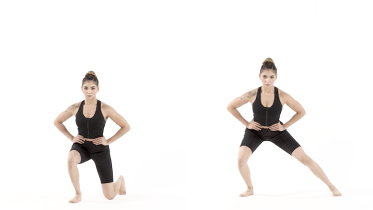
The lunge with twist is a forward lunge with a turn of the upper body added at the bottom. Holding a stick level in both hands, you step forward, lower into the lunge and rotate your chest toward the front leg, then the other way, before you push up to standing. Your legs do the lunge while the muscles around your waist control the turn, and the front knee has to stay steady as your body rotates above it. It tends to come after the plain lunge in knee, hip and sports programs.
How to do the lunge with twist
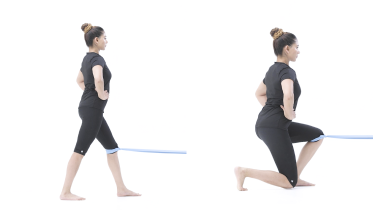
- Stand tall with your feet about hip width apart, holding a broomstick or light pole level in front of your hips with both hands, about shoulder width apart. Have a counter or rail within reach for your first sessions.
- Take a long step forward. As you step, lift the stick to chest height, as in the video.
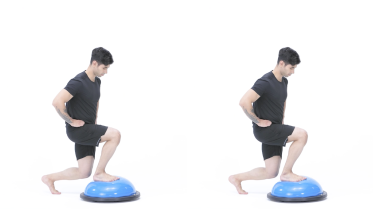
- Lower your hips straight down between your feet, bending both knees toward a right angle, or only as far as feels steady. Keep the front knee over your ankle and pointing straight ahead.
- At the bottom, straighten your arms and turn your chest and the stick toward the side of your front leg. Let your head and shoulders follow the stick while your hips and front knee keep facing forward.
- Turn back to the middle, then turn slowly the other way, toward the side of your back leg, as in the video, and come back to the middle again.
- Push through the front foot to step back to standing and lower the stick. Do your reps on one leg, then switch legs.
What you should feel
Work in the thigh and buttock of the front leg, and in the muscles around your waist as you turn. A light stretch at the front of the back hip is common.
Common mistakes
- Taking a short step, so the front knee drifts well past the toes.
- Letting the front knee roll inward as your body turns.
- Swinging the stick fast, so the twist comes from the hips and knees instead of the upper body.
- Leaning forward over the front thigh instead of staying tall.
How often
A common range is 2 to 3 sets of 6 to 10 on each leg, on 2 or 3 days a week, turning slowly and pausing briefly at the end of each twist. Your physio will adjust this.
Stop and check with your physio if
- Sharp pain in your knee, hip or back, or pain that shoots down a leg.
- Your knee gives way, or you lose your balance and have to grab something to stay up.
- You feel dizzy or lightheaded as you turn. If you faint while exercising, call emergency services, even if you feel fine again quickly.
From the clinic
Learn the forward lunge or the split squat without the turn first. For your first sessions, stand side on to a kitchen counter so you can grab it if you wobble, and start with a smaller step and a smaller turn. If your balance is not what it was, or you have had a fall recently, keep close to the support the whole time and check with your physio before going further.
The turn happens while your spine and legs are carrying your weight in a lunge. With low bone density (osteoporosis) or a past fracture in the spine, check with your physio before you add the twist, and ask how far to turn. If you have had a hip replacement, get the go-ahead from your surgeon or physio before you try the lunge with twist. Some operations limit this kind of work for the first months, so the timing depends on your surgery.
Written and checked by the PocketPhysio editorial team. Last updated 2026-09-26.
This page is general education, not a diagnosis or a personal treatment plan. If you have pain, an injury or a health condition, see a physiotherapist or doctor before starting new exercises.
.png)