
Pelvic floor exercises after prostate surgery: the start, the dose and the evidence
Warning signs, and when to get help
When do pelvic floor exercises start after prostate surgery?
If you have had prostate or other urological surgery, Continence Health Australia's advice is to wait until your surgeon has checked your healing before starting pelvic floor exercises, and the timings and the program come from the team that operated. That gate comes before everything else on this page.
After it, the only specific timing we could find in a guideline is European, and where it sits in that guideline matters as much as what it says. The European Association of Urology's 2024 guideline on male lower urinary tract symptoms asks for pelvic floor muscle training as soon as possible after the operation and puts a figure on it, "between seven and ten days after the withdrawal of the urethral catheter". That sentence is in the part of the section where the panel summarizes the research, sourced to a 2015 meta-analysis, and not in the recommendation, which carries no date at all.
We have now read that meta-analysis in full, and the seven to ten days in it is a description rather than an instruction: it is when training began in three of the trials the authors pooled, named in contrast with a fourth trial that started its men an average of four to five years after surgery, and what the authors drew from the comparison was only that programs should start as soon as possible after surgery (Fernandez 2015). Nobody in this chain recommends a date. It is the guideline's reading of the evidence rather than a graded instruction, and a unit that starts you earlier or later is not contradicting a recommendation.
Read the figure twice all the same. The clock starts when the catheter comes out, not on the day of the operation, so the two dates sit as far apart as your catheter stays in.
How long that is depends on your surgeon. In a survey of 94 urologists who do robot-assisted prostate removal, most took the catheter out five to seven days after the operation, 6 of the 94 took it out sooner than five days, and 30 of the 94 left it in longer than seven days (Khanmammadova 2026). So the same seven to ten days counted from the catheter lands in a different week for different men, which is the plainest reason the date your own unit gives you is the one that counts.
It also helps to know what the catheter is doing there. Taking the prostate out means joining the bladder back onto the urethra, and the catheter sits across that join while it heals, which is why nearly a third of the surgeons in the same survey X-rayed the bladder before taking the catheter out. The healing the catheter was there for is largely behind you by the time it comes out, and what sets the date after that is your unit's protocol rather than a milestone anybody has measured.
Hospital leaflets on this subject vary, and several of them say in their own text that instructions differ between units and that the local ones win. So if you were given a date, use it. If you were given nothing, the European figure is a reasonable thing to take back to the team and ask about.
What the operation changes, and why the exercises aim at it
The prostate sits below the bladder, with the tube that carries urine out (the urethra) running through it. POGP's 2021 leaflet for men describes valves at the base of the bladder and underneath the prostate gland that stop urine leaking, and parts of the pelvic floor muscle that wrap around those valves to help keep them closed. Removing the prostate takes some of that closing mechanism with it.
What remains has to do more of the job than it used to, and it is the muscle this program trains. That is also why the leak turns up on effort and in standing rather than while you are lying still, and why the stages below are ordered by position rather than by how hard the exercises are. If you want the plain account of where these muscles are and what they do, our pelvic floor weakness program covers it for men and women.
Do pelvic floor exercises work after prostate surgery?
The fair summary is that they appear to speed the return of continence rather than change where a man ends up, and that even this rests on evidence nobody involved calls strong. Both halves are below, because either one on its own points you the wrong way.
The European Association of Urology recommends offering pelvic floor muscle training, alone or combined with biofeedback or electrical stimulation, to men having a radical prostatectomy, and the stated purpose in the guideline is to speed the recovery from incontinence. The strength rating it carries is Weak. That is the guideline's own label, printed in its own text, not our reading of it.
Then the trials. A Cochrane review of conservative management after prostate surgery, covering 50 trials and 4,717 men, found no evidence across eight trials that pelvic floor muscle training, with or without biofeedback, beat control in men who were still incontinent up to twelve months after a radical prostatectomy: 57 percent against 62 percent still incontinent, risk ratio 0.85 with a confidence interval from 0.60 to 1.22, rated moderate quality (Anderson 2015). Across the trials that took all men after a radical prostatectomy, aimed at prevention as well as treatment, the same review found moderate evidence of benefit, 10 percent against 32 percent incontinent at one year, risk ratio 0.32 from 0.20 to 0.51. The denominator is the difference between those two figures: the first is men already leaking, the second is every man coming out of the operation.
The review's own caution travels with that second figure, the 10 percent against 32 percent: it was not supported by the pad test data from the same trials, and the risk of bias assessment showed methodological limitations. Cochrane's searches ran in February 2014, which is why this page carries the European guideline's 2024 reading of the same literature alongside it.
A large British trial tested the therapy as a service, at several centers. MAPS randomized 391 men who were still leaking six weeks after a radical prostatectomy, giving half of them four one-to-one therapy sessions over three months and the others standard care with lifestyle advice. At twelve months, 76 percent of the therapy group and 77 percent of the control group were still incontinent (Glazener 2011). The population is the part that gets dropped whenever the 76 is quoted: these were men whose leaking had already failed to settle by six weeks, which is a harder group than every man leaving hospital after the operation.
An umbrella review then gathered 18 systematic reviews and meta-analyses on the question, covering 29,925 patients, and described them as "all of which were of critically low methodological quality" (Yang 2023). That is the authors' verdict on their own included studies, and it is the most honest single sentence available about this whole body of work. Those same authors still concluded that the training has a good effect on leaking after a radical prostatectomy, which is this literature in one paper: a positive conclusion resting on evidence its own reviewers put at the bottom of the quality scale.
Two things come out of that. In the trials, the control groups were improving as well, which is how a study can show real improvement in both arms and no difference between them, and it is why speeding recovery is a different claim from more men ending up dry. The European guideline also notes two randomized trials in which written instructions alone produced improvement similar to supervised training, which matters if a page and a leaflet are what you have.
The number most men want, how many are dry a year after the operation, is the one this literature handles worst. The encouraging percentages in circulation have no traceable source behind them, and the 76 percent above comes from men picked out for still leaking at six weeks, so those two do not answer the same question, and quoting them as though they did is how a reader ends up with false reassurance or a false scare.
One trial does report a whole unselected group over time. ProtecT randomized 1,643 men whose cancer was found through PSA testing, 553 of them to have the prostate removed, and sent them all the same questionnaires for six years (Lane 2016). In that group, use of one or more absorbent pads a day was 1 percent before treatment, 46 percent at six months, 26 percent at a year, 21 percent at two years, 20 percent at three years and 17 percent at six years (Donovan 2016).
Three things travel with those numbers. They are the direction in a group of men and not your own odds. What was counted is each man's own answer about pads on a questionnaire, not a dry test and not a pad count, so it is not the same measurement your clinic may ask you for. And the operations were mostly open, 324 of the 553 open retropubic against 25 robot-assisted, which the authors set beside how much the surgery has changed since. The earliest point in the series is six months, so it says nothing about the first weeks either.
How many, how long, how often
Two national sources write a dose for men, and they do not write the same one. Continence Health Australia hands you numbers to start from. POGP asks you to find your own hold and your own count first, then build toward a target. Neither is wrong, and a man given one of them in clinic should not read the other and conclude he has been misinformed.
| What to count | Continence Health Australia (Australia) | POGP men's leaflet (UK, 2021) |
|---|---|---|
| Long hold | 3 seconds at first, building to 5 to 8 seconds | the hold you can manage now, building toward up to 10 seconds |
| Long squeezes in a set | 3 to 5, building to 8 to 10 | your own number first, building toward up to 10 |
| Rest between long squeezes | as long as you held for | at least 5 seconds |
| Quick squeezes | optional, 3 to 5 building to 8 to 10 | up to 10 short squeezes after the long ones |
| How often | 3 sets a day | at least 3 times a day |
Start at the bottom of whichever column your own team pointed you at, and treat the right-hand numbers as somewhere to arrive rather than somewhere to begin. If nobody pointed you at either, use POGP's way in, because it starts from you rather than from a number: find the hold you can manage comfortably today, then count the squeezes you can repeat at that same quality. Stop one squeeze before the one that comes out weaker or shorter than your first, and that number is your dose rather than the number you can force out. The sources agree on the rest of it: three times a day, resting between squeezes for at least as long as you held and never less than 5 seconds, which is the longer of the two rests in the table. If your hold is two seconds at first, two seconds is your dose.
After an operation the surgical team's instructions come first, and a pelvic health physiotherapist will adjust the numbers once you have one. If nobody has referred you, ask the team that operated, or the urology or cancer nurse specialist looking after you, for that referral, and use your own numbers until then.
The rest between squeezes is the easiest line to skip, and it is in both doses for a reason. A squeeze you cannot let go of is a squeeze you are no longer in control of, and the next one in the set will be weaker because the muscle never came back to rest. If squeezing brings on pain in your pelvis, perineum or testicles, or you cannot feel the muscles let go at all, that pattern is in the warning list on this page: stop the squeezes and get it looked at rather than adding repetitions, because it needs the opposite treatment.
Neither source promises a date, and the two of them set different expectations. POGP tells you to expect to notice an improvement over 3 to 6 months of practice, while Continence Health Australia says many men see results within weeks. After an operation the slower figure is the one to plan around, and the point of knowing it is that it tells you when nothing changing is worth reporting rather than waiting out.
Pelvic floor exercises before prostate surgery: is it worth it?
Both answers to this are true at once, which is why it has its own section.
The European Association of Urology states, at level 1b, that pre-operative training "does not confer additional benefit" for men having a radical prostatectomy. Against that, a 2026 meta-analysis of six studies found better continence recovery at 3 months in men who trained beforehand, an odds ratio of 1.52 with a confidence interval from 1.05 to 2.20, and no significant difference at 1 month, at 6 months or at 12 months (Terzoni 2026). The umbrella review above reached the same shape of conclusion in its own words, that "Preoperative PFMT sometimes, but not always, showed the potential to improve urinary incontinence", PFMT being the abbreviation both documents use for pelvic floor muscle training.
Put together: training before the operation may bring continence back sooner in the early months, and has not been shown to change the twelve-month result. One practical point sits alongside that. It comes from practice, not from a trial. A muscle is easier to find and learn before an operation than in the first sore, swollen week after one, so a man who has already practiced the squeeze has one less thing to learn when the catheter comes out.
How to use this program
Pick the stage that matches where you are, which for almost everyone reading this soon after the operation is stage 1. Move up when the current stage is easy and nothing is sorer the next morning.
Each exercise page gives a typical starting dose, and the pelvic floor squeezes themselves are the part with the evidence behind them. The other exercises are there to help you keep the squeeze going while you breathe, sit up and then stand, so do not let them replace it. Breathe normally through every repetition rather than holding your breath, especially if you have high blood pressure.
None of this is personal advice, and it cannot see your operation notes. If the team that operated gave you a different program, theirs is the one to follow, and this page is then useful for the questions to ask them.
The exercise program
The exercises below carry their own stop signs and precautions. Open the line under an exercise and read them before you try it.
Stage 1: Lying down, once your team has given you the go-ahead
Start here, and not before the team that operated has checked your healing and told you to begin. Both exercises are done lying on your back, so nothing is holding your body up and your attention can go on the lift and on letting it go again. The breathing exercise is in this stage because the squeeze is timed with the breath out, and holding your breath instead is one of the mistakes listed on the exercise page itself. Use the bottom of the range on the breathing exercise page and build from there. For the squeeze itself, take your numbers from the dose section above rather than from its exercise page, whose range starts at 8 squeezes three times a day: that is the number both national sources build men up to, not the one they start you on. In the first weeks do both of these on a bed rather than on the floor, so you are not getting down and back up again while your tummy is still sore.
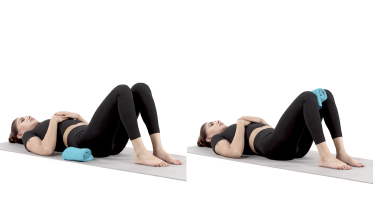 Pelvic floor exercise lying down
Stop signs and precautions for the pelvic floor exercise lying down
Before you start
- After surgery on your bladder, prostate, womb or pelvic floor, start when your surgical team says so.
- If you are pregnant or have given birth in the last few months, check with your physio or midwife first, so the exercise can be checked and adapted for you.
- If you are pregnant and past the first three months, check with your physio before exercising flat on your back. Your physio can show you the same squeeze sitting up or lying on your side.
When to stop and get help
- Pain in your pelvis or pelvic floor, or a feeling of heaviness, dragging or bulging low down in the pelvis. Stop and tell your physio.
- Your lower back or hips start to ache and it builds as you carry on.
- Numbness around your genitals or bottom, new trouble with your bladder or bowels, pain, tingling, numbness or weakness in both legs, or loss of feeling in one leg. Call emergency services or go to an emergency department straight away, and do not drive yourself.
- You are pregnant and notice bleeding or fluid leaking from your vagina, regular painful tightenings, tummy pain that does not settle when you rest or comes with lower back pain, or a change in your baby's usual movements, such as moving less than usual. Stop and contact your midwife or maternity unit straight away. Do the same for a severe headache, problems with your vision such as blurring or flashing lights, pain just below your ribs, or sudden swelling of your face, hands or feet, which can be signs of pre-eclampsia. Call emergency services if the bleeding is heavy, the tummy pain is severe, bleeding or tummy pain comes with pain in your shoulder or feeling sick, faint or dizzy, or a headache comes on suddenly and is very severe.
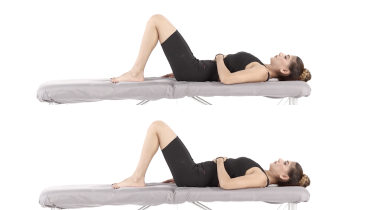 Diaphragmatic breathing
Stop signs and precautions for the diaphragmatic breathing
Before you start
- If lying flat makes you more short of breath, do not lie flat for this. Sit upright in a chair or prop yourself on pillows instead, which works just as well for learning the pattern. Being short of breath when you lie down, waking at night needing to sit up to breathe, more swelling in your ankles or legs, or gaining weight quickly over a few days are all reasons to get medical advice the same day rather than to practice through, because the NHS lists breathlessness when lying down among the reasons to get urgent advice.
- If you are pregnant and past the first three months, check with your physio before exercising flat on your back.
When to stop and get help
- Your fingers or the skin around your mouth start to tingle, or you feel light-headed or spaced out. This can mean you are breathing too fast or too deeply, so stop and let your breathing go back to normal. If it has not settled within a few minutes, get medical advice the same day. If you faint, or the numbness or tingling is on one side of your face or body, call emergency services, even if it goes away.
- You suddenly become short of breath, your chest feels tight or heavy, or you are far more short of breath than usual. Stop, rest and use your breathing control. Call emergency services if the breathlessness came on suddenly, your chest feels tight or heavy, your breathing does not go back to normal, you are gasping, choking or cannot get your words out, you have pain that spreads to your arms, back, neck or jaw, you feel suddenly confused or very drowsy, or your lips or skin turn very pale, blue or gray (on brown or black skin this can be easier to see on the palms of the hands). If everything settles quickly, get medical advice the same day before you do these exercises again.
- Chest pain or pressure, dizziness or feeling faint, a racing or irregular heartbeat, or being far more out of breath than the effort should cause.
Stage 2: Sitting up, with something else going on
Move up when you can find the squeeze lying down and feel the muscles drop back to rest afterward. Sitting up is harder than lying down, so expect the hold to be shorter here and keep the numbers honest rather than copying the ones you managed in bed. The seated breathing exercise gives you somewhere to practice the timing upright, and the gentle tummy draw-in teaches you to work low in the abdomen without bearing down. Leave the draw-in out and ask your surgical team first if your wounds are still sore or anyone has limited what your abdomen can do.
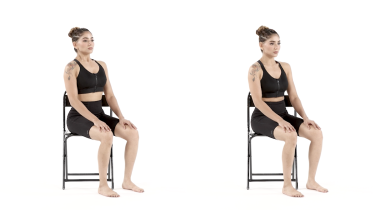 Breathing control
Stop signs and precautions for the breathing control
Before you start
- If you are pregnant and past the first three months, check with your physio before exercising flat on your back.
When to stop and get help
- Your fingers or the skin around your mouth start to tingle, or you feel light-headed or spaced out. This can mean you are breathing too fast or too deeply, so stop and let your breathing go back to normal. If it has not settled within a few minutes, get medical advice the same day. If you faint, or the numbness or tingling is on one side of your face or body, call emergency services, even if it goes away.
- You suddenly become short of breath, your chest feels tight or heavy, or you are far more short of breath than usual. Stop, rest and use your breathing control. Call emergency services if the breathlessness came on suddenly, your chest feels tight or heavy, your breathing does not go back to normal, you are gasping, choking or cannot get your words out, you have pain that spreads to your arms, back, neck or jaw, you feel suddenly confused or very drowsy, or your lips or skin turn very pale, blue or gray (on brown or black skin this can be easier to see on the palms of the hands). If everything settles quickly, get medical advice the same day before you do these exercises again.
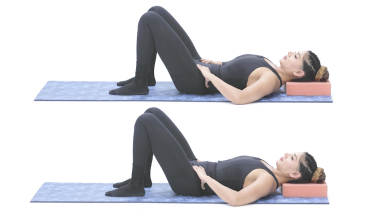 Transverse abdominis activation
Stop signs and precautions for the transverse abdominis activation
Before you start
- If you have had surgery on your spine in recent months, get the go-ahead from your surgical team or physio first.
- If you have had surgery on your tummy or your pelvis in recent months, including removal of the prostate, a hysterectomy or a cesarean, get the go-ahead from your surgical team or physio first.
When to stop and get help
- Your back pain increases during or after the exercise.
- Pain spreads down your leg, or you get numbness or tingling.
- You feel pressure or bulging in your stomach wall or pelvic floor. Tell your physio about this.
Stage 3: Effort, and the movements that make you leak
This stage waits for the surgical team to clear general activity, because lifting your hips and pushing out of a chair are effort, and what your abdomen and pelvis can take in the weeks after an operation is their call and not ours. Move up when you can hold your squeeze sitting without holding your breath, and if nobody has given you a date or a limit, ring the team that operated, or the urology or cancer nurse specialist looking after you, and ask what you can lift and push, from what date, and what counts as heavy for you. Keep breathing through every repetition and never hold your breath to help the effort, because pushing down is the opposite of the lift the exercise page asks you for. The point of the stage is not the two exercises themselves but the habit of holding a gentle squeeze through the moment you would otherwise leak, which is usually standing up, lifting something or the first few steps after sitting for a while. Practice it where it happens to you.
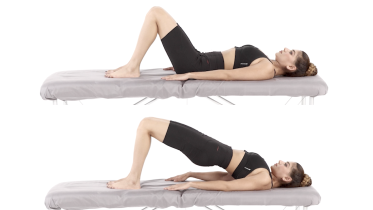 Glute bridge
Stop signs and precautions for the glute bridge
Before you start
- After hip, knee or back surgery, your surgeon's protocol decides when you can start bridges. Once you are past the first three months of pregnancy, check with your physio before exercising flat on your back.
- A bridge needs the knee bent to about 90 degrees before you lift, so if you have had knee surgery and been given a limit on how far the knee may bend, leave this one out and ask your surgeon or physio whether the bend it needs is allowed yet.
When to stop and get help
- You feel back pain rather than buttock work, even when you lift a little lower.
- Pain spreads down the leg or you get numbness or tingling.
- Your hamstrings (the back of the thighs) cramp. This is a common complaint with bridges, and bringing your feet a little closer to your bottom often eases it.
- Pain in the knee itself, or a knee that swells or is clearly more painful the next morning. The position holds the knee bent throughout, so after knee surgery stop and check with your surgeon or physio before you try it again.
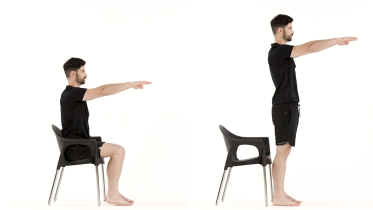 Sit to stand
Stop signs and precautions for the sit to stand
Before you start
- After a knee fracture or knee surgery, including a knee replacement, follow your surgeon's or physio's plan, and start this exercise only when they have cleared you.
- If you have had a hip replacement or other hip surgery, get the go-ahead from your surgeon or physio before you try sit to stand. Standing up from a low seat bends the hip past a right angle, and many surgeons ask you to avoid that for the first months after some operations. Ask them how high your seat should be. If you are pregnant, check with your midwife or physio before you start.
- Set up before the first stand: use a chair that will not slide, ideally with its back against a wall, and have someone nearby, or set the chair beside a kitchen counter you can reach, if you are not sure of your balance or you have fallen in the past year. Wear flat shoes that fit well and grip the floor, not socks, tights or bare feet.
When to stop and get help
- You feel dizzy, lightheaded or faint as you get up. Sit back down and wait for it to pass. If it does not pass within a minute or two, or it keeps happening, get medical advice the same day before you practice again. If you faint, or it does not settle within a few minutes of keeping still, call emergency services.
- Sharp pain in the knee, hip or lower back.
- Your knee gives way or you feel you might fall.
- Chest pain or pressure, dizziness or feeling faint, a racing or irregular heartbeat, or being far more out of breath than the effort should cause.
- You are pregnant and notice bleeding or fluid leaking from your vagina, regular painful tightenings, tummy pain that does not settle when you rest or comes with lower back pain, or a change in your baby's usual movements, such as moving less than usual. Stop and contact your midwife or maternity unit straight away. Do the same for a severe headache, problems with your vision such as blurring or flashing lights, pain just below your ribs, or sudden swelling of your face, hands or feet, which can be signs of pre-eclampsia. Call emergency services if the bleeding is heavy, the tummy pain is severe, bleeding or tummy pain comes with pain in your shoulder or feeling sick, faint or dizzy, or a headache comes on suddenly and is very severe.
When squeezing is not the answer
Some symptoms after prostate surgery are not a weak pelvic floor and do not improve with more squeezes. A weak or stop-start stream, a bladder that will not empty, blood in your pee or a fever each have post-operative causes that need their own checks, not more squeezing, and the team that operated is who to tell.
One pattern is the other way round. A few drops that escape just after you think you have finished is called post-micturition dribble, and POGP's leaflet lists it among the symptoms of a weak pelvic floor and gives a squeeze for it: once you have finished peeing, tighten the muscles firmly to clear the last drops. If those drops come with a weak or stop-start stream, or with a feeling that you have not emptied, that is the emptying picture in the warning list on this page and it needs checking rather than more squeezes. If you cannot tell which of the two you are, treat it as the second and get it checked.
The difference between a floor that cannot close and a stream that cannot get out matters more here than anywhere, because the two feel vaguely similar and the treatments point in opposite directions. Our page on the signs of a weak pelvic floor sets out that distinction and the male symptom list in full.
Three other patterns are not this program's job, and each has a page of its own. Pain in the pelvis, or a sense that you can never fully relax down there, may be an overactive floor rather than a weak one, and tight or weak pelvic floor explains why strengthening is the wrong treatment for it. Straining, constipation or difficulty emptying the bowel is covered on pelvic floor weakness, constipation and bowel control. Leaking that comes with a sudden, strong need to go, rather than on effort, is a different type of incontinence, and the different types, along with bladder training for urgency, are set out on our page on urinary incontinence and pelvic floor training, which is written for women and is where those definitions live on this site. Read it for the definitions and for the bladder training, and take your squeeze numbers from the dose section on this page rather than from that one, because its doses are written for a woman who has not had an operation.
When to contact your surgical team, a physio or a doctor
In the first weeks the team that operated is your first call, not a physio and not this page. Ask them, or the urology or cancer nurse specialist looking after you, for a referral to a pelvic health physiotherapist (physical therapist) if nobody has offered one, and ask them again if your leaking is not changing at all over the months rather than slowly settling. NICE asks UK services to make sure that people with prostate cancer who have troublesome urinary symptoms after treatment can reach specialist continence services for assessment and conservative treatment, which it says may include pelvic floor muscle re-education and bladder retraining. That is recommendation 1.3.39, also stamped 2008, so it is something to ask for rather than a favor.
If you have had a sling or an artificial urinary sphincter fitted, it is worth knowing where the parts of it sit, because that is what the warning list means by the operation site. An artificial urinary sphincter has a cuff around the urethra, a small balloon that keeps the cuff filled, and a pump in your scrotum that you squeeze when you want to pee, and one of the adjustable slings is topped up through a port in the scrotum as well (Kosuru 2026). So pain or swelling in the scrotum after one of those operations is pain or swelling at the operation site, and it goes to the team that fitted the device the same day rather than being put down to the exercises. One more thing is worth carrying in your head, and it is the kind of thing nobody mentions until it matters: if you have an artificial urinary sphincter, nobody should pass a catheter into your bladder until the cuff has been switched off, because catheterisation without deactivating the cuff is one of the recognized causes of the cuff wearing through the urethra (Martins 2024). Staff who have never met the device will not know it is there unless you say so.
Surgical options exist for stress leaking that will not settle, and it is better to know about them now than to find out years later. NICE, in the UK, recommends referring people with prostate cancer and intractable stress incontinence to a specialist surgeon to consider an artificial urinary sphincter, and advises against injecting bulking agents into the distal urinary sphincter for this group. Both of those recommendations carry a 2008 stamp in the guideline, so they are best read as a referral pathway and an entitlement rather than as a current summary of the evidence, and the conversation belongs with your surgeon.
Before you go back to heavy lifting or the gym, the load question has its own answer, and lifting weights with a weak pelvic floor covers how to stage it. Your surgeon's dates come first.
Settle two load questions with the team before you need the answers. The first is lifting. Ask what your limit is, what counts as heavy for you, and the date it changes, because none of the sources on this page sets a figure after this operation and what units tell men differs, so the only limit that applies to you is your own surgeon's. This page deliberately gives no number for that reason.
The second load question is straining on the toilet, which is the load most men meet in the first weeks without planning for it, and both of the sources this page uses for the exercises name it. POGP's leaflet says straining to empty your bowels may weaken the pelvic floor muscles and to get advice if you are often constipated, and Continence Health Australia lists constipation and straining among the things that stop a pelvic floor working well. So if you are straining, treat it as part of this problem rather than a separate one and ask about it, because it is easier to sort out early than to work against for months.
The warning list below is a different matter and comes before any of this: red flags in physiotherapy explains why we keep that list apart from the advice.
One line in that list needs a word here, because at first read it will look like you. Read it with this in mind: if you cannot tell whether what you have is the expected kind or the emergency kind, go by the list and not by this paragraph. Leaking once the catheter is out is the expected state after this operation, and so is trouble getting an erection and trouble ejaculating. None of those on its own is an emergency, and all three belong with the team that operated.
The emergency version is a different thing: control you had and have suddenly lost, or any of those symptoms arriving alongside back pain, sciatica, leg symptoms, or a change in feeling around your genitals, inner thighs or bottom. We have not narrowed that line for this page, deliberately, because pressure on the nerves at the base of the spine does not always hurt much and a man who talks himself out of it loses time he cannot get back. So if you cannot tell which of the two you are, go by the list and not by this paragraph.
For physiotherapists
The European Association of Urology's 2024 male LUTS guideline carries the recommendation to offer pelvic floor muscle training, alone or with biofeedback or electrostimulation, to men undergoing radical prostatectomy to speed recovery from incontinence, at a strength rating of Weak. The seven to ten days after catheter withdrawal figure is in the same section's narrative summary, sourced there to a 2015 meta-analysis (Fernandez 2015), and not in the recommendation, which states no timing, so it is worth quoting to a patient as a reading of the evidence rather than as a graded instruction.
The Fernandez meta-analysis is about whether training works rather than when it starts, and its abstract carries no seven to ten day figure. Its full text, read through an archived copy of the publisher's page, settles where the number came from: the authors report that in three of the four training-versus-control trials they pooled, treatment began between seven and ten days after withdrawal of the urethral catheter, and they name that in contrast with the fourth, which started its men an average of four to five years after surgery. What they conclude from the comparison is that programs should start as soon as possible after surgery, with no window attached. So the figure describes three trial protocols, the guideline's narrative carried it forward in a sentence that reads like an instruction, and no document in the chain grades a start date. Worth knowing before quoting it, because a patient who has been given a different date has not been given a worse one.
What the 2015 abstract does put a number on is the dose: programs of at least three sets of 10 repetitions a day appeared to improve the continence rate, which is the one piece of frequency evidence on this page that comes from a pooled analysis rather than from a national leaflet. The guideline's summary of evidence puts pre-operative training at level 1b for no additional benefit, and also records, at level 1b, conflicting evidence on whether adding bladder training, electrostimulation or biofeedback improves on training alone.
Biofeedback is where the readable sources disagree most plainly. The European guideline calls the evidence conflicting, the NHS page on non-surgical treatment for incontinence says there is not much good evidence that biofeedback offers a significant benefit, and the umbrella review found it appeared to add benefit over training alone in the short and medium term while rating every included study critically low in quality. None of that supports a confident position either way.
Two caveats belong in a conversation with a patient who has read the pessimistic headlines. The Cochrane review's searches closed in February 2014, and MAPS recruited men who were still incontinent at six weeks and tested four therapist contacts, so its authors' conclusion about cost effectiveness is about that service model in a setting where exercise information is already widely available, rather than about whether the muscle responds to training. The European guideline's note that written instructions alone matched supervised training in two randomized trials points the same way, and is the strongest argument for making the instructions good.
Warning signs
Get emergency help now
- Emergency: you cannot pee at all, especially if your lower tummy feels full and painful. Call emergency services or go to an emergency department straight away, and do not drive yourself.
- Emergency: if you have an artificial urinary sphincter, the device with a pump in your scrotum that you squeeze when you want to pee, and you cannot pee at all, call emergency services or go to an emergency department straight away, and do not drive yourself. Say that you have an artificial urinary sphincter as soon as you arrive, and say it again before anyone passes a tube (catheter) into your bladder for any reason, because the cuff around the tube that carries your urine out (the urethra) has to be switched off first. Passing a catheter through a cuff that is still closed is one of the recognized causes of the cuff wearing through that tube (erosion), and the staff in front of you will not know the device is there unless you tell them. If you were given a card or a letter about the device, show it, and if you are not sure you have been understood, ask for a urologist or the urology team on call to be involved before any catheter goes in, because a catheter placed by someone not trained in the device is one of the listed risks for that erosion.
- Emergency: numbness, tingling or altered feeling around or under your genitals, between your inner thighs, or around your bottom (anus), for example it feels different when you wipe after using the toilet. Call emergency services or go to an emergency department straight away, and do not drive yourself. This can be a sign of pressure on the bundle of nerves at the base of the spine (cauda equina syndrome), which needs emergency treatment.
- Emergency: you suddenly cannot control your bladder or bowels at all. The same applies to new leaking of pee or poo, new trouble starting to pee, not being able to feel yourself peeing, not noticing when you need to poo, a new change in how your genitals feel during sex, new trouble getting or keeping an erection, new trouble ejaculating, or new trouble reaching orgasm, if it comes with back pain, sciatica, or pain, tingling, numbness or weakness in one or both legs. Call emergency services or go to an emergency department straight away, and do not drive yourself. These can also be signs of cauda equina syndrome.
- Emergency: sciatica in both legs, or pain, tingling, numbness or weakness in both legs. The same applies if you lose feeling in one leg. Call emergency services or go to an emergency department straight away, and do not drive yourself.
- Emergency: you have had cancer, now or in the past, and your back or neck pain feels like a tight band around your body, or you have new or worsening pain spreading down an arm or leg, weakness, numbness, pins and needles or a loss of feeling in your arms or legs, trouble walking, or trouble controlling your bladder or bowels. Those symptoms count on their own, with or without back or neck pain. Call your cancer team's emergency number straight away, or go to an emergency department if you do not have one or cannot get through, and do not drive yourself. This can be cancer pressing on the spinal cord (metastatic spinal cord compression), which needs treatment straight away.
- Emergency: since any operation in your pelvis, including an operation for prolapse or for leaking, removal of the womb (hysterectomy) or removal of the prostate gland, you have pain in your tummy or pelvis that is severe or came on suddenly, a wound from the operation that opens up, bleeding that suddenly becomes much heavier or that soaks a pad within an hour, or you feel faint, dizzy or breathless, your heart is pounding, or you feel very unwell. Stop your pelvic floor exercises and call emergency services or go to an emergency department straight away, and do not drive yourself.
- Emergency: leaking that starts suddenly in an older person who is also newly confused or agitated, very drowsy, or has trouble speaking. Call emergency services or go to an emergency department straight away. This can be a sign of a serious infection or another illness that needs urgent treatment.
Get help today
- Pain or burning when you pee together with a high or very low temperature, feeling hot or cold and shivery, or pain in your back just under the ribs. Get medical advice the same day, as this can be a kidney infection. If you also become confused, very drowsy or have trouble speaking, call emergency services or go to an emergency department straight away.
- Same day: since an operation for leaking, such as a sling or an artificial urinary sphincter, you have a fever or feel hot, cold or shivery, bleeding or a discharge that smells from the wound, a wound from the operation that is oozing or whose edges are coming apart, new or worsening pain or swelling around the operation site, including in your scrotum, or pain in your pelvis that is new or getting worse quickly. Stop your pelvic floor exercises and contact your surgical team, or the ward you went home from, the same day, and if you cannot reach them get medical help the same day anyway, for example at urgent care or an emergency department. These can be signs of an infection or of bleeding from the repair. If the pain becomes severe or comes on suddenly, a wound from the operation opens up, the bleeding suddenly becomes much heavier, or you feel faint, dizzy, breathless or very unwell, call emergency services or go to an emergency department straight away rather than waiting for a call back, and do not drive yourself.
- Same day: since an operation in your pelvis for any other reason, for example removal of the womb (hysterectomy) or removal of the prostate gland, you have a fever or feel hot, cold or shivery, heavy bleeding, discharge that smells, a wound from the operation that is oozing or whose edges are coming apart, or pain in your pelvis that is new or getting worse quickly. Stop your pelvic floor exercises and contact your surgical team, or the ward you went home from, the same day, and if you cannot reach them get medical help the same day anyway, for example at urgent care or an emergency department. These can be signs of an infection or of bleeding. If the pain becomes severe or comes on suddenly, a wound from the operation opens up, the bleeding suddenly becomes much heavier, or you feel faint, dizzy, breathless or very unwell, call emergency services or go to an emergency department straight away rather than waiting for a call back, and do not drive yourself.
- Same day: since any operation in your pelvis, a calf or thigh that is newly swollen or getting more swollen, warm, tender, red or darker than usual, has swollen veins that are sore to touch, or has a throbbing or cramping pain that does not fit your injury or condition, or that feels different from normal muscle soreness. Stop your pelvic floor exercises and get medical advice the same day, because surgery in the pelvis raises the risk of a blood clot (deep vein thrombosis). If you are also short of breath or have chest pain, call emergency services.
- Blood in your pee, which may look pink, red or dark brown, even a small amount, even once, and even with no pain. Get medical advice the same day. It needs checking even if it goes away.
- Same day: leaking that starts suddenly or gets much worse over a few days in an older person, without any of the signs above. Get medical advice the same day, as this can be caused by a urine infection or a medicine.
- Same day: new back, hip or pelvic pain and you have had cancer, now or in the past. Get medical advice the same day and mention your cancer history. If you are being treated for cancer now, contact your cancer team the same day.
- Pain at night or at rest that keeps getting worse. If you are being treated for cancer now, contact your cancer team the same day.
- Same day: pain at night or at rest that keeps getting worse. If you have had cancer, now or in the past, get medical advice the same day and mention it, even if the pain is not getting worse. Do the same if you have back, hip or pelvic pain and are losing weight without trying, even if it does not hurt at night.
Book an appointment
- Pain at night or at rest that keeps getting worse. See your doctor within a few days.
- Routine: since an operation for leaking, such as a sling or an artificial urinary sphincter, the leaking you had it done for has come back or is getting worse, or you have new pain, new bleeding, or new trouble peeing or pooing. Stop your pelvic floor exercises and book an appointment with your surgical team rather than waiting for your next routine review. A repair can give way and a device can stop working, and after mesh surgery these are also the symptoms a specialist checks the mesh for. Which of those it is takes an examination, and it is not something this page or a physiotherapist can tell you.
- Routine: new trouble emptying your bladder or your bowels, a weak or stop-start stream, dribbling after you think you have finished, or a feeling that you have not emptied. Book an appointment with your doctor rather than doing more pelvic floor squeezes, because a flow or emptying problem has its own causes. If you are passing only small amounts and your lower tummy feels full or swollen, or you are leaking all the time without feeling the need to go, get medical advice the same day.
- Routine: pain in your pelvis, perineum, testicles or back passage that squeezing brings on or makes worse, or a feeling that you can never fully let go down there. Stop the squeezes and book an appointment with a pelvic health physiotherapist or your doctor, because an overactive pelvic floor needs the opposite treatment from a weak one.
- Routine: the leaking is getting worse rather than slowly easing, it has not started to change at all after a couple of months of practice, or it is deciding what you do day to day. Book an appointment with the team that operated rather than adding repetitions, and ask for a referral to a pelvic health physiotherapist (physical therapist) if nobody has offered you one. Leaking that is not settling has its own causes and its own treatments, including surgical ones, and which of those fits you takes an assessment.
Common questions
Do I start pelvic floor exercises before or after the catheter comes out?
After. If you have had prostate or other urological surgery, Continence Health Australia's advice is to wait until your surgeon has checked your healing before you start pelvic floor muscle exercises. The European Association of Urology's 2024 guideline then names between seven and ten days after the urethral catheter is withdrawn, which is the only specific figure in a guideline we could read, although it sits in that guideline's narrative run through the studies rather than in its graded recommendations or its summary of evidence table. In the meta-analysis the guideline took it from, that figure describes when three of the pooled trials started their men rather than a date anybody recommends. It counts from the catheter rather than from the operation, and how long your catheter stays in is your surgeon's decision, so the two of those together are why the unit's own date beats the figure. If the unit that operated gave you a different date, use theirs. This is the catheter question only: whether training in the weeks before the operation was worth doing is a separate one, and it has its own answer below.
How many pelvic floor squeezes should I do after prostate surgery?
The two sources written for men give two different doses. Continence Health Australia starts you at a 3 second hold, 3 to 5 squeezes in a set and 3 sets a day, building toward holds of 5 to 8 seconds and 8 to 10 squeezes, resting as long as you held. POGP, the UK pelvic health physiotherapy group, asks you to find your own hold and your own number first, then build toward up to 10 long squeezes of up to 10 seconds followed by up to 10 short ones, at least 3 times a day. Both are on this page in full, along with a way in for a man who was given neither, and a pelvic health physiotherapist will adjust them once you have one.
Should I have done pelvic floor exercises before the operation?
It would not have been wasted, and it has not been shown to change where you end up. The European Association of Urology grades the evidence at level 1b that pre-operative training does not confer additional benefit for men having a radical prostatectomy. A 2026 meta-analysis of six studies found better continence recovery at 3 months in the men who trained beforehand, an odds ratio of 1.52 with a confidence interval from 1.05 to 2.20, and no significant difference at 1, 6 or 12 months. If nobody offered it to you, you have not lost the twelve-month result.
Are Kegel exercises after prostate surgery the same as pelvic floor exercises?
They are the same exercises under a different name, and Kegel is the word used most in the USA and Canada. The guidelines and leaflets written for men after prostate surgery, including the European guideline, POGP and Continence Health Australia, all say pelvic floor muscle exercises or training, which is why that is the wording used here. Nothing about the dose or the timing changes with the word.
Can I do too many pelvic floor exercises?
More is not better, and both national doses are built to be worked up to rather than jumped into. Each of them puts a rest between squeezes, and Continence Health Australia's is as long as the hold itself, because a muscle that is not allowed to let go stops lifting. If squeezing brings on pain in the pelvis, makes emptying harder, or you cannot feel the muscles release at all, that pattern needs assessing rather than more repetitions, and our page on whether a pelvic floor is tight or weak explains why the two problems need opposite treatment.
Why is the leaking worse by the evening, or when I stand up?
Nothing in the sources written for men measures that pattern, so no honest answer can tell you why it happens to you. What both of them do say is to practice where the leak happens, which is why the exercises move from lying to sitting to standing and then into the movement that catches you out. Leaking that is getting worse rather than slowly easing is a question for the team that operated, not a reason to add repetitions.
References
- European Association of Urology. EAU Guidelines on Management of Non-neurogenic Male LUTS. Update April 2024, section 5.6.3.2.3. https://d56bochluxqnz.cloudfront.net/documents/full-guideline/EAU-Guidelines-on-Non-Neurogenic-Male-LUTS-2024.pdf
- National Institute for Health and Care Excellence. Prostate cancer: diagnosis and management (NG131). Recommendations 1.3.39, 1.3.40 and 1.3.41, all stamped 2008. https://www.nice.org.uk/guidance/ng131/chapter/Recommendations
- Anderson CA, Omar MI, Campbell SE, Hunter KF, Cody JD, Glazener CM. Conservative management for postprostatectomy urinary incontinence. Cochrane Database of Systematic Reviews. 2015;1(1):CD001843. doi:10.1002/14651858.CD001843.pub5
- Glazener C, Boachie C, Buckley B, et al. Urinary incontinence in men after formal one-to-one pelvic-floor muscle training following radical prostatectomy or transurethral resection of the prostate (MAPS): two parallel randomised controlled trials. Lancet. 2011;378(9788):328-337. doi:10.1016/S0140-6736(11)60751-4
- Donovan JL, Hamdy FC, Lane JA, et al. Patient-Reported Outcomes after Monitoring, Surgery, or Radiotherapy for Prostate Cancer. New England Journal of Medicine. 2016;375(15):1425-1437. doi:10.1056/NEJMoa1606221. Pad use figures read from the full author manuscript in PubMed Central, PMC5134995.
- Lane A, Metcalfe C, Young GJ, et al. Patient-reported outcomes in the ProtecT randomized trial of clinically localized prostate cancer treatments: study design, and baseline urinary, bowel and sexual function and quality of life. BJU International. 2016;118(6):869-879. doi:10.1111/bju.13582
- Terzoni S, Maruccia S, Di Prisco L, et al. Preoperative Pelvic Muscle Training for Continence Recovery After Prostatectomy: Yet Another Meta-Analysis? Neurourology and Urodynamics. 2026;45(1):127-136. doi:10.1002/nau.70167
- Fernandez RA, Garcia-Hermoso A, Solera-Martinez M, Correa MT, Morales AF, Martinez-Vizcaino V. Improvement of continence rate with pelvic floor muscle training post-prostatectomy: a meta-analysis of randomized controlled trials. Urologia Internationalis. 2015;94(2):125-132. doi:10.1159/000368618
- Yang JM, Ye H, Long Y, et al. Effect of pelvic floor muscle training on urinary incontinence after radical prostatectomy: an umbrella review of meta-analysis and systematic review. Clinical Rehabilitation. 2023;37(4):494-515. doi:10.1177/02692155221136046
- Khanmammadova N, Wang J, Nguyen TT, et al. How I do it: a survey of practice patterns in robot-assisted radical prostatectomy. Journal of Robotic Surgery. 2026;20(1):1145. doi:10.1007/s11701-026-04080-3
- Kosuru S, Ozcelik C, Wong TR, Mordukhovich I, Khanmammadova N, Isali I. Comparative analysis of male stress urinary incontinence treatments: a review of efficacy, safety, and clinical outcomes. Current Urology. 2026;20(3):155-164. doi:10.1097/CU9.0000000000000321
- Martins FE, Bernal J, Tryfonyuk L, Holm HV. Artificial urinary sphincter and stricture disease: surgical principles in management. Translational Andrology and Urology. 2024;13(8):1717-1728. doi:10.21037/tau-23-16
- Continence Health Australia. Pelvic floor exercises for men. https://www.continence.org.au/living-with-incontinence/pelvic-floor-exercises/pelvic-floor-exercises-for-men/
- Pelvic, Obstetric and Gynaecological Physiotherapy (POGP). Pelvic floor muscle exercises and advice for men. 2021. https://thepogp.co.uk/Resources/122/pelvic_floor_muscle_exercises_for_men/
- National Institute for Health and Care Excellence. Spinal metastases and metastatic spinal cord compression (NG234). Published September 2023. https://www.nice.org.uk/guidance/ng234
- NHS. Urinary incontinence: treatment. Page last reviewed 15 June 2023. https://www.nhs.uk/conditions/urinary-incontinence/treatment/
Written and checked by the PocketPhysio editorial team. Last updated 2026-11-03.
This page is general education, not a diagnosis or a personal treatment plan. See a physiotherapist or doctor for advice about your own situation.