
Part of Pregnancy back and pelvic pain
How to sleep with pelvic girdle pain in pregnancy
Warning signs, and when to get help
How to sleep with pelvic girdle pain tonight
Side lying, two pillows, and a plan for turning over. That is the whole of it, and the order matters: get the position right, then deal with the moving, because the moving is where the pain lives.
Two things come before any of it, and they are the reason this paragraph is here rather than further down. If the pain at the front of your pelvis arrived in a single moment, with a crack, pop or tearing feeling, or a leg will not take your weight, do not try to rearrange yourself in bed. Stay on your side with your knees together, contact your maternity unit straight away, and call emergency services if you cannot stand or walk at all or there is nobody to help you move. And if anything else in the warning list at the foot of this page is happening tonight, bleeding, fluid, tightenings before 37 weeks, a change in your baby's movements, a severe headache or vision changes, make that call first. The pillows will still be there afterwards.
Lie on your side. Pick the less painful side if one of them is clearly better, which is what the RCOG suggests, and otherwise pick the side that lets you reach the lamp and your water without stretching across the bed. Bend your knees and hips a little rather than lying straight out. Put a pillow between your knees, and a second one under your bump.
From about 28 weeks of pregnancy the NHS advises going to sleep on your side rather than on your back, because it says sleeping on your back after that point can double the risk of stillbirth. So use the side set-up above, with a pillow between your knees and your top knee level rather than dropped, and leave lying on your back until after the birth. The NHS also says not to worry if you wake up on your back: settle onto your side again and carry on.
One caveat before you rearrange your bed. None of this has been tested against anything else in women with pelvic girdle pain. It comes from the NHS, the RCOG and hospital physiotherapy services, and from what works in clinic, which is a reasonable place to start and not the same as proof. Change one thing a night, so you can tell which change helped.
Setting up the side-lying position
The pillow between your knees is the one that earns its place, and most of the time it is too thin.
Its job is to stop the top leg sliding forward and down across the lower one, because that movement rolls your pelvis round and twists the joints that hurt. The Western Australian physiotherapy service that writes on pelvic girdle pain says to have your top knee and toes in line with your hip when you lie on your side, and adds that you may need two pillows for it. Toes as well as knee: a knee propped at the right height with the foot hanging off the end of the pillow still drags the leg round from the ankle. So use something that reaches from your knees to your ankles, or stack two.
The pillow under the bump takes the forward drag off the front of your pelvis and your low back. The NHS asks for both in the same breath: support your bump with a pillow, keep your knees and legs bent, and put another pillow between your legs. The RCOG suggests a pillow under the bump and between the legs as well.
Two smaller additions are worth a try, and neither is evidence based, so drop them if they do nothing. A thin, folded towel in the hollow of your waist if you have a long gap between your ribs and hip. And a pillow behind your back to lean into, which gives you something to settle against instead of holding yourself still.
Which side, left or right? That one nobody can decide for you. Left is the side you will see recommended most often, and for sleeping position the NHS itself says either side is better than the back, with no preference between them. With pelvic girdle pain, comfort decides.
How do you turn over in bed without the pain?
Slowly, with your knees together, and with the pillow staying where it is.
The sequence that works in clinic: stop before you turn and bend both knees up, so your legs move as a pair rather than one at a time. Keep the pillow clamped between your knees, which is what stops them parting halfway round. Turn your shoulders, hips and knees together as one piece, as though your whole trunk were in a cast. Then resettle the pillows on the new side before you let your top leg relax. POGP advises keeping the knees together and turning slowly, and the Western Australian service makes the same point about the pillows: keep them between your knees when you turn.
Two practical things make it easier. A full-length pillow travels with you far better than a small one, which falls out mid-turn and leaves you half rolled with your knees apart, which is the position that hurts most. And the fewer layers of tucked-in bedding over your legs, the less the sheets pin your top leg while your hips are trying to follow your shoulders.
If turning over is the single worst moment of your night, say so at your next appointment, in those words. It is one of the movements a pelvic health physio can work on directly, and it is specific enough to be useful to them.
Getting in and out of bed
Rolling first, then rising, with no twisting in between.
The method is the one in the log roll: knees bent, shoulders and hips turning together onto your side, lower legs sliding towards the edge, hands pushing you up. Lying down is the same thing in reverse, and the NHS week 27 advice means you then settle onto your side rather than staying on your back once you are in. When you are standing, the Western Australian service adds the step people miss: move your feet rather than twisting your body towards the door.
Stand up off both feet. Bring them level and fairly close together before you push up from the edge of the bed, rather than setting one foot back and driving off it, because a staggered stance sends most of the load through one side of your pelvis, and uneven loading is what this pain reacts to. The same applies to the last step back into bed.
One thing changes all of this. If the pain at the front of your pelvis arrived in a single moment, with a crack, pop or tearing feeling over your pubic bone, or you cannot stand or put weight on a leg, do not try to find a way out of bed on your own. Read the warning list below instead: contact your maternity unit straight away, and while you wait, lie on your side with your knees together and a pillow between them, get help to move, and do not stand on one leg or let your legs come apart. If you are on your own, stay where you are and make the call from there, and call emergency services if you cannot stand or walk at all. Going from lying to standing is one of the movements that hurts most when that joint has separated, and standing on one leg is often impossible with it (Stolarczyk and colleagues, 2021).
Three things make night trips cheaper. Sit on the edge of the bed for a moment before you stand, because the first weight-bearing step is often the sore one and it is better taken on purpose. Put a light where you can reach it without rolling back over. And keep what you need on your side of the bed, so you are not reaching across it at 4am.
Getting in and out of bed
One movement from the main program belongs on this page, because you will use it several times a night. The log roll takes you from lying to sitting on the edge of the bed with your knees together and no twisting, and the same steps in reverse put you back down. Run through it two or three times in the evening, while the light is on and you are not desperate for the toilet, so your body knows the pattern when it is dark. Leave the rehearsals, though, if the pain at the front of your pelvis came on in a single moment or you cannot put weight on a leg: that belongs with the warning signs below, and what it needs is a call to your maternity unit rather than practice, with help to move if there is someone with you and emergency services if there is not. The exercise page carries its own cautions, and your physio will adjust this.
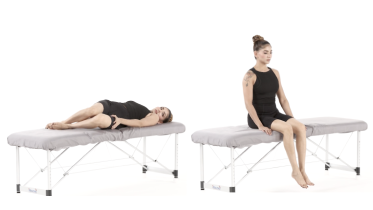 Log roll out of bed
Why is pelvic girdle pain worse at night?
Because the day loads it and the night moves it.
Pelvic girdle pain builds through the day in most women, so you get into bed with a pelvis that has already paid for the stairs, the shopping and the standing. Then bed turns out to be full of the exact movements the NHS and POGP name as the ones that set this pain off: turning over, and moving the legs apart. Add the trips to the toilet, which the NHS lists among the ordinary reasons sleep breaks up in later pregnancy, and a night can contain more painful transfers than an afternoon does.
The research tells you how common the problem is rather than why. In a population study of 2,816 women at week 32 of pregnancy, 61.9 percent met the criteria for insomnia on the scale used, with a mean score well above the general population, and pelvic girdle pain and low back pain were associated with insomnia (Dorheim and colleagues, 2012). That is a questionnaire association, not a mechanism, and it should not be read as proof that the pain is what wakes you.
The same study is worth reading for the other thing it found. Depressive symptoms were present in 14.6 percent of those women and were strongly associated with insomnia in late pregnancy (Dorheim and colleagues, 2012), and the NHS says plainly that sleeplessness alongside other symptoms, such as feeling hopeless or losing interest in things you used to enjoy, can be a sign of depression, and that there is treatment that helps.
So if your nights are broken and the pain is only part of why, the pain-shaped fixes here will only take you part of the way. The rest is a conversation with your midwife or doctor, and low mood is part of that conversation rather than something to get through on your own. The warning list below says what not to wait on.
How to sleep with pregnancy back pain as well
Most women with pelvic girdle pain have some back pain too, and a few of the fixes are different.
For the back, the NHS adds the mattress: use one that supports you properly, and if yours is too soft, a piece of hardboard underneath will firm it up. It also names rest, particularly later in pregnancy, and keeping the back straight and well supported when you sit.
The generic position and pillow question, the one that is not about pregnancy at all, is covered properly on the best sleeping position for lower back pain, and if the pain runs down a leg then sleeping with sciatica is the closer fit. Both of those describe back-lying set-ups, so read them with the 28 week advice above in front of you: if you are more than about 28 weeks pregnant, use the side position with a pillow between your knees rather than the back ones they describe.
There is separate advice for lying flat on your back to rest or exercise, which is not the same question as how you sleep. From the second trimester on, the obstetric guideline for Australia and New Zealand (RANZCOG) advises against long spells of exercise lying flat on your back, because the weight of the growing uterus can obstruct the blood returning to your heart. The NHS puts the limit at a few minutes flat on your back in later pregnancy, because it can make you dizzy and is not good for the baby. If an exercise is only done lying on your back, RANZCOG says it can be done sitting or standing instead, and UK pelvic health physiotherapy guidance (POGP) suggests an upright position or lying on your left side, with a change of position if you feel dizzy or unwell.
If mornings are the worst part of your day rather than the nights, lower back pain in the morning deals with that pattern, and hip pain at night covers pain at the side of the hip outside pregnancy, which is a different problem that often arrives alongside this one, although that page sends pregnant readers back to this program.
One hip pattern belongs on neither page. Pain in one hip or groin that is worse when you put weight on that leg, that makes you limp, and that the pillows and the pacing are not touching, is in the warning list below, and what it needs is a review rather than another week of rearranging the bed. Pregnancy and the weeks after the birth can bring on a temporary weakening of the bone at the top of the thighbone, which is uncommon, carries a risk of fracture that is significantly higher in pregnancy than outside it, and is found on an MRI scan (Morton and Savard-Heppel, 2024). It is often read as pelvic girdle pain for weeks, which is why it is worth saying the pain is in your hip rather than only your pelvis.
What to do when you cannot sleep at all
Stop fighting the bed, and make the hour you are awake cheaper.
Get up rather than lying there turning over, since every turn costs you something. Sit upright somewhere comfortable with your feet supported, and go back when you feel sleepy rather than when you think you should. The NHS advice for pregnancy sleep is worth having on a night like this: try to relax before bedtime so you are not wide awake, avoid tea, coffee and cola in the evening, and do not nap in the afternoon or evening, because that is what leaves you not tired at bedtime. It also says to rest as much as you can during the day and to sit with your feet up, which is not a consolation prize when the nights are gone.
While you are up, reset the bed rather than climbing back into the same arrangement: pillow between the knees long enough to reach the ankle, pillow under the bump, nothing tucked tightly over your legs.
Then tell someone, which is the step most women leave far too long. POGP advises speaking to your midwife or GP first if the self-help advice is not improving things or if your sleep and daily activities are affected, and the NHS says to contact your midwife or GP if pelvic pain makes it hard to move around or to turn over in bed. A pelvic health physio can look at the movements that wake you, and the RCOG lists what physiotherapy may offer, including advice on movements to avoid, exercises, hands-on treatment, and a support belt or crutches.
On the belt, one piece of evidence is worth knowing before you buy one for the nights. In a trial of 90 pregnant women with pelvic joint pain, all three groups were given muscle-strengthening exercises and advice on daily activities, and two also wore a rigid or a non-rigid pelvic support belt. Every group improved on every measure, and the belts did not add to the effects of the exercise and advice on anything except average pain (Depledge and colleagues, 2005). That study was not about wearing one in bed, which nobody we can cite has tested, so ask your physio before you sleep in anything. NICE suggests considering referral to physiotherapy for exercise advice, a non-rigid pelvic support belt, or both, for pregnancy-related pelvic girdle pain (NICE NG201), which is the route to a belt that fits and is the right kind.
The rest of the practical day, the stairs, the car, the dressing and the pacing, is on the main pelvic girdle pain page. If you are also asking whether the pain in the night could be something else, pelvic girdle pain or contractions is the page for that, and the warning signs below say what does not wait until morning.
Related exercise programs
Warning signs
Get emergency help now
- Emergency: anything that looks life threatening, at any stage of pregnancy. Call emergency services without stopping to work out which line below fits: 999 in the UK, 112 in the UK and anywhere in Europe, 911 in the United States and Canada, 000 in Australia, 111 in New Zealand. Say how many weeks pregnant you are, and say it again to each new person you speak to (NHS).
- Emergency: heavy bleeding from your vagina, for example soaking a pad soon after you put it on, or any bleeding with severe pain in your tummy, pain in your shoulder, or feeling sick, faint or dizzy. Call emergency services straight away.
- Emergency: pelvic or pubic pain that has suddenly left you unable to stand, walk or put weight on one or both legs. Call emergency services if you cannot stand or walk at all, or you cannot get to a hospital safely. Until help reaches you, stay where you are rather than trying to get yourself up: lie on your side with your knees together and a pillow between them, and do not stand on one leg or let your legs come apart.
- Emergency: a very high or a very low temperature, shivering you cannot control, breathing very fast or finding it hard to breathe, being confused or slurring your speech, skin, lips or a tongue that look blue, gray, pale or blotchy (on brown or black skin this can be easier to see on the palms of the hands or soles of the feet), or a rash that does not fade when you press it. Call emergency services, as this can be sepsis.
- Emergency: you suddenly become short of breath, you get chest pain or pain in your upper back that may be worse when you breathe in, you cough up blood, your heart is beating very fast, or you faint. Call emergency services straight away, even if your leg looks normal. These can be signs of a blood clot in the lungs (pulmonary embolism).
- Emergency: numbness, tingling or altered feeling around or under your genitals, between your inner thighs, or around your bottom (anus), for example it feels different when you wipe after using the toilet. Call emergency services or go to an emergency department straight away. This can be a sign of pressure on the bundle of nerves at the base of the spine (cauda equina syndrome), which needs emergency treatment.
- Emergency: you find it hard to start peeing, cannot pee, cannot feel yourself peeing or cannot control when you pee, or you do not notice when you need to poo or cannot control when you poo, and this is not normal for you. The same applies to a new change in how your genitals feel during sex, or new trouble getting an erection or ejaculating. Call emergency services or go to an emergency department straight away. These can also be signs of cauda equina syndrome.
- Emergency: sciatica in both legs, or pain, tingling, numbness or weakness in both legs. The same applies if you lose feeling in one leg. Call emergency services or go to an emergency department straight away.
- Emergency: you have thoughts of ending your life or of harming yourself or your baby and feel you might act on them, you have already harmed yourself, or you do not feel you can keep yourself or your baby safe. Call emergency services or go to an emergency department straight away.
- Emergency: pain in your lower tummy or pelvis that is severe, is getting worse, or hurts when you move or touch the area, or that comes with feeling faint, dizzy or lightheaded, passing out, pain at the tip of your shoulder, trouble breathing, heavy bleeding from the vagina, or sudden confusion. Call emergency services or go to an emergency department straight away. Tell them if there is any chance you are pregnant.
- Emergency: hip or groin pain on one side that suddenly becomes much worse, or a leg that will not take your weight at all. Go to an emergency department straight away, and say you are pregnant and that the top of the thighbone may be involved, because pregnancy can weaken the bone there and weakened bone can crack. Call emergency services if you cannot stand or walk at all, or cannot get there safely.
- Emergency: you have a lump in your groin and the pain in it is severe or came on suddenly, you cannot poo or pass wind at all, you are vomiting blood or your vomit looks like coffee grounds, or you have suddenly become confused. Call emergency services or go to an emergency department straight away, and do not try to push the lump back in yourself. A hernia that has become trapped can block the bowel or cut off the blood supply to whatever is caught in it (NHS).
- Emergency: you have had cancer, now or in the past, and your back or neck pain feels like a tight band around your body, or comes with pain spreading down an arm or leg, weakness, numbness or pins and needles in your arms or legs, trouble walking, or trouble controlling your bladder or bowels. Call your cancer team's emergency number straight away, or go to an emergency department if you do not have one or cannot get through. This can be cancer pressing on the spinal cord (metastatic spinal cord compression), which needs treatment straight away.
Get help now, day or night
- Who to call for every line below that says to contact your midwife or maternity unit: call them straight away, day or night, on the number in your maternity notes. In the first 12 weeks, before your first midwife appointment, the NHS routes these calls to a GP surgery or an early pregnancy unit, and from 12 to 19 weeks to a midwife or an early pregnancy unit, so you do not need a maternity unit of your own yet to be seen. Outside the UK, call your obstetrician, or the maternity or labor and delivery unit where your birth is booked. If you cannot reach anyone and you are worried, call NHS 111 in the UK, and anywhere, go to your maternity unit or an emergency department rather than waiting at home (NHS).
- Any bleeding or spotting from your vagina, even if it is light and you have no pain. Contact your midwife or maternity unit straight away.
- Your waters break, or you have a gush or trickle of fluid from your vagina, at any stage of pregnancy. Contact your midwife or maternity unit straight away.
- Before 37 weeks, you have regular tightenings or contractions, period-type pains, or backache that is not usual for you. Contact your midwife or maternity unit straight away, as this can be a sign of early (premature) labor.
- New back pain in the second or third trimester (from 13 weeks), even if you think it is PGP or ordinary backache. Contact your midwife or maternity unit straight away, as it can be a sign of early labor. Once they have checked it, follow their advice about when to call again.
- Your baby is moving less than usual, you cannot feel your baby moving anymore, or the usual pattern of movements has changed. Contact your midwife or maternity unit straight away, even in the middle of the night. Do not wait until the next day, and do not use a home heartbeat monitor to check.
- A severe headache that does not go away with simple painkillers, problems with your vision such as blurring or flashing lights, pain just below your ribs, sudden swelling of your face, hands or feet, being sick (vomiting), heartburn that does not go away with heartburn medicines, or feeling very unwell. Contact your maternity unit straight away, as these can be signs of pre-eclampsia, which needs checking and treating quickly. The same applies to a headache after an epidural or spinal anesthetic that gets worse when you sit or stand up and eases when you lie down. Call emergency services if you have a fit (seizure), or a headache that came on suddenly and is very severe. Call emergency services too if you have a headache with a stiff neck and either a high temperature or bright light hurting your eyes, as this can be meningitis.
- You are out of breath when you lie down, or breathlessness comes with dizziness. Contact your maternity unit straight away. If you are severely short of breath when you are resting, or so breathless that you are gasping or cannot get your words out, call emergency services. Feeling a little more out of breath as your baby grows is common, but this pattern needs checking.
- Tummy pain that does not go away after you have rested for 30 to 60 minutes, or that comes with lower back pain, vaginal discharge that is unusual for you, regular cramping or tightenings, pain when you pee, or needing to pee suddenly or more often than usual (NHS). The same applies to back or pelvic pain that comes on suddenly, is getting worse quickly or is much worse than your usual pain. Contact your maternity unit straight away. Call emergency services if the tummy pain is severe, any pain comes with bleeding from your vagina, or tummy pain comes with pain in your shoulder or feeling sick, faint or dizzy.
- Pelvic or pubic pain that came on in a single moment, for example during the birth, a fall or a wide step, with a crack, pop or tearing feeling over your pubic bone. Contact your maternity unit straight away, and ask them to check the joint at the front of your pelvis. While you wait, keep off it rather than walking it off: lie on your side with your knees together and a pillow between them, get help to move if there is someone with you, and do not stand on one leg or let your legs come apart. If you cannot stand or walk at all, or you cannot get to a hospital safely, call emergency services. Separation of that joint (pubic symphysis diastasis) is uncommon, is not the same as the pelvic girdle pain this page is about, is confirmed on a scan rather than by how much it hurts, and is first treated with a pelvic support belt and side lying, so ask about a belt at that appointment (Stolarczyk 2021). Pain that has built up over days or weeks, even when it is severe, is the usual pattern of pelvic girdle pain.
- Back pain with a high temperature (38C or above), feeling hotter than usual or shivery, pain or burning when you pee, pee that looks cloudy, pink, red or brown, or pain in one or both sides of your back just under the ribs. Contact your midwife, maternity unit or doctor straight away, as this can be a urine or kidney infection, which is usually treated easily once someone has seen you (NHS). Call emergency services instead if you have any of the signs of sepsis in the emergency warnings above.
- A calf or thigh that is newly swollen or getting more swollen, warm, tender, red or darker than usual, has swollen veins that are sore to touch, or has a throbbing or cramping pain that does not fit your injury or condition, or that feels different from normal muscle soreness after exercise. This can be a sign of a blood clot (deep vein thrombosis), especially after surgery, an injury, time in a cast or boot, a long trip or a spell of being much less mobile than usual. Get medical advice the same day. If you are also short of breath or have chest pain, call emergency services. Pregnancy and the first 6 weeks after giving birth also make a clot more likely, so if you are pregnant or gave birth in the last 6 weeks, contact your maternity unit, midwife or GP straight away.
- You fall, or your bump is knocked or hit, for example in a car accident, even if you feel fine. Contact your maternity unit straight away so you and your baby can be checked.
- Lower tummy or pelvic pain and you are pregnant or think you might be. Contact your midwife or maternity unit straight away if you are pregnant, or get medical advice the same day if you might be. Pain low in the tummy early in pregnancy needs checking, because a pregnancy can grow outside the womb (ectopic pregnancy).
Get help today
- Same day: dizziness, lightheadedness or feeling faint while you are exercising, or the room seems to spin. Stop, and sit down or lie on your side until it passes. Contact your midwife or maternity unit the same day, and do not exercise again until you have been checked, as dizziness is one of the signs to stop exercising in pregnancy. If you faint, it does not settle within a few minutes of keeping still, or you cannot stand or walk steadily, call emergency services.
- Same day: a leg or foot that is getting weaker, for example your foot drags, catches on the ground or slaps down when you walk (foot drop). Get medical advice the same day. If the weakness is getting worse by the hour, go to an emergency department.
- Thoughts of suicide or of harming yourself or your baby, even if you do not plan to act on them. Get urgent help the same day from your GP, midwife or health visitor, or NHS 111 in the UK. In the UK, you can also talk to Samaritans on 116 123.
- Same day: a lump in your groin that becomes painful, hard or red, that you cannot push back in, or that comes with a bloated tummy, feeling or being sick, constipation or a high temperature. Get medical help the same day, in person rather than by phone, for example at urgent care or an emergency department, as these can mean a hernia has become trapped (NHS). Do not try to push the lump back in yourself.
- Same day: new back pain and you have had cancer, now or in the past. Get medical advice the same day and mention your cancer history. If you are being treated for cancer now, contact your cancer team the same day.
Book an appointment
- Broken sleep with low mood, feeling hopeless, or losing interest in things you used to enjoy. Speak to your doctor or midwife, because the NHS says sleeplessness alongside other symptoms can be a sign of depression, and there is treatment that helps. Do not wait for your next appointment if it is getting worse.
- Low mood, anxiety or stress that is affecting your day to day life, or pain that is causing you considerable distress. Tell your midwife or doctor and ask what support is available, because this is part of what gets treated rather than something to put up with (NHS; RCOG; POGP).
- Within a few days: hip or groin pain, usually on one side, that is worse when you put weight on that leg, that makes you limp or need a stick or crutch, or that has not eased with position changes and pacing. Ask your midwife or doctor for a review, and say the pain is in your hip rather than only your pelvis. While you wait, take the weight off that leg where you can: lean on a crutch, a stick, a shopping cart or a stroller, use the rail and one step at a time on stairs, sit down for jobs you would do standing on one leg, and do not push through pain you have to limp on. Pregnancy and the weeks after the birth can cause a temporary weakening of the bone at the top of the thighbone, which is uncommon, is often read as pelvic girdle pain for weeks, and shows up on an MRI scan, which is the test to ask about when hip pain has no other explanation (Morton 2024). If the pain suddenly becomes much worse, or that leg will not take your weight at all, do not wait for the review: go to an emergency department straight away, as the emergency warnings above say.
- Within a few days: a new lump or swelling in your groin, especially one that gets bigger when you cough, sneeze or stand and smaller when you lie down. Tell your midwife or doctor, because a lump there needs examining rather than explaining, and an ultrasound scan is what separates swollen veins alongside the round ligament from a hernia (Yeo 2021). Do not try to push the lump back in yourself, and use the same day line above instead if the lump becomes painful, hard or red or you cannot push it back in.
Common questions
What is the best way to sleep with pelvic girdle pain?
On your side, with the pillows doing the work. A pillow between your knees is the one that matters most, and it needs to be thick enough, or long enough, to keep your top knee and toes in line with your hip rather than letting the top leg slide forward across the lower one. A hospital physiotherapy service in Western Australia says you may need two pillows for that, and it is right. A second pillow goes under your bump. The RCOG suggests lying on the less painful side, with a pillow under your bump and between your legs, and the NHS asks for the bump supported, the knees and legs bent, and a pillow between the legs. From about 28 weeks of pregnancy the NHS advises going to sleep on your side rather than on your back, because it says sleeping on your back after that point can double the risk of stillbirth. So use the side set-up above, with a pillow between your knees and your top knee level rather than dropped, and leave lying on your back until after the birth. The NHS also says not to worry if you wake up on your back: settle onto your side again and carry on. No trial has compared these set-ups against each other in pelvic girdle pain, so start here and adjust one thing at a time.
How do you get out of bed with pelvic girdle pain?
Roll before you rise, and keep your knees together while you do it. Bend both knees up, keep the pillow between them, turn your shoulders and hips together onto your side as one piece, then let your lower legs slide towards the edge of the bed while you push yourself up with your hands. A hospital physiotherapy service in Western Australia describes the same move and adds the bit people forget: once you are up, move your feet rather than twisting on the spot. Then sit on the edge of the bed for a moment before you stand, because the first step is often the worst one. Push up with both feet level and fairly close together rather than with one foot set back, so the effort does not go through one side of your pelvis. The log roll is this movement broken down, and it is worth two or three rehearsals in the evening so your body knows it in the dark. One exception: if the pain at the front of your pelvis came on in a single moment, with a crack, pop or tearing feeling over your pubic bone, or you cannot stand or put weight on a leg, do not get yourself up. Contact your maternity unit straight away, stay on your side with your knees together and a pillow between them, and get help to move. If you are on your own, or you cannot stand or walk at all, call emergency services instead of trying to get up.
Why is pelvic girdle pain worse at night?
Two things stack up. The first is the day you have just had: pelvic girdle pain tends to build as the hours pass, so the same number of stairs costs more at 10pm than at 8am, and you arrive in bed with a pelvis that is already sore. The second is that bed is full of the movements this pain dislikes. The NHS and POGP both name turning over in bed and moving the legs apart among the things that set pelvic girdle pain off, and a night contains a dozen of each, plus the trips to the toilet that the NHS says are part of broken sleep in pregnancy. What we can point to in the research is the size of the problem rather than its cause. In 2,816 women surveyed at week 32 of pregnancy, 61.9 percent met the criteria for insomnia, and pelvic girdle pain and low back pain were associated with insomnia (Dorheim and colleagues, 2012). That is an association in a questionnaire study, not proof that the pain causes the broken sleep, and it does not tell you that any position fixes it.
Can I sleep on my back with pelvic girdle pain?
From about 28 weeks of pregnancy the NHS advises going to sleep on your side rather than on your back, because it says sleeping on your back after that point can double the risk of stillbirth. So use the side set-up this page gives, with a pillow between your knees and another under your bump, and leave lying on your back until after the birth. The NHS also says not to worry if you wake up on your back: settle onto your side again and carry on. Earlier in pregnancy the question is comfort rather than safety, and many women with pelvic girdle pain find the back position no kinder anyway, because getting into it and out of it involves exactly the leg movements that hurt. For resting and exercising flat on your back there is separate advice. From the second trimester on, the obstetric guideline for Australia and New Zealand (RANZCOG) advises against long spells of exercise lying flat on your back, because the weight of the growing uterus can obstruct the blood returning to your heart. The NHS puts the limit at a few minutes flat on your back in later pregnancy, because it can make you dizzy and is not good for the baby.
Does a pregnancy pillow help pelvic girdle pain?
It can, and nothing we can cite says the expensive ones beat the pillows already on your bed. What decides it is the shape, not the brand. The job of the pillow between your legs is to stop the top leg dropping across the lower one, which means it has to be thick enough to hold the knee at hip height and long enough to support the shin and ankle too, otherwise the knee stays level and the foot still drags the leg round. Two ordinary pillows stacked do that. A full-length pillow does it in one piece and is easier to keep hold of when you turn over. A pillow under the bump takes the drag off the front, and some women add a thin one at the small of the back. If you buy nothing, buy nothing: try the pillows you own for a few nights first, and keep whichever arrangement you wake up less sore from.
References
- NHS. 27 weeks pregnant: the best sleeping positions during pregnancy. Best Start in Life week by week guide to pregnancy. https://www.nhs.uk/best-start-in-life/pregnancy/week-by-week-guide-to-pregnancy/2nd-trimester/week-27/
- NHS. Tiredness and sleep problems in pregnancy. Page last reviewed 11 March 2024. https://www.nhs.uk/pregnancy/common-symptoms/tiredness/
- NHS. Pelvic pain in pregnancy. Page last reviewed 12 December 2022. https://www.nhs.uk/pregnancy/common-symptoms/pelvic-pain/
- NHS. Back pain in pregnancy. Page last reviewed 10 January 2024. https://www.nhs.uk/pregnancy/common-symptoms/back-pain/
- NHS. Exercise in pregnancy. Page last reviewed 24 September 2026. https://www.nhs.uk/pregnancy/keeping-well/exercise/
- NHS. Pregnancy symptoms you need to get help for. Page last reviewed 24 June 2026. https://www.nhs.uk/pregnancy/common-symptoms/pregnancy-symptoms-you-need-to-get-help-for/
- NHS. Premature labour and birth. Page last reviewed 10 January 2024. https://www.nhs.uk/pregnancy/labour-and-birth/premature-labour-and-birth/
- NHS. Pre-eclampsia. Page last reviewed 23 March 2026. https://www.nhs.uk/conditions/pre-eclampsia/
- NHS. Your baby's movements. Page last reviewed 8 July 2024. https://www.nhs.uk/pregnancy/keeping-well/your-babys-movements/
- Royal College of Obstetricians and Gynaecologists (RCOG). Pelvic girdle pain and pregnancy. Patient information leaflet. June 2015. https://www.rcog.org.uk/for-the-public/browse-our-patient-information/pelvic-girdle-pain-and-pregnancy/
- Pelvic, Obstetric and Gynaecological Physiotherapy (POGP). Pregnancy related pelvic girdle pain and low back pain during pregnancy and after having a baby. https://thepogp.co.uk/patient_information/womens_health/pregnancy_pgp_lbp.aspx
- Pelvic, Obstetric and Gynaecological Physiotherapy (POGP). Supine lying during pregnancy. Good practice statement. Journal of Pelvic, Obstetric and Gynaecological Physiotherapy. 2018;122:77-83. https://thepogp.co.uk/_userfiles/pages/files/journals/122/gps7unb278sdc9.pdf
- National Institute for Health and Care Excellence. Antenatal care (NG201). Published 19 August 2021. https://www.nice.org.uk/guidance/ng201
- Royal Australian and New Zealand College of Obstetricians and Gynaecologists (RANZCOG). Exercise during pregnancy (C-Obs 62). Developed July 2016, reviewed March 2020. https://ranzcog.edu.au/wp-content/uploads/2022/05/Exercise-during-pregnancy.pdf
- Fiona Stanley Fremantle Hospitals Group, WA Health. Manage pelvic girdle pain. Last updated 16 December 2025. https://fsfhg.health.wa.gov.au/Our-services/Maternity/Pregnancy-care/Physiotherapy-during-pregnancy/Manage-pelvic-girdle-pain
- Dorheim SK, Bjorvatn B, Eberhard-Gran M. Insomnia and depressive symptoms in late pregnancy: a population-based study. Behavioral Sleep Medicine. 2012;10(3):152-166. https://doi.org/10.1080/15402002.2012.660588
- Depledge J, McNair PJ, Keal-Smith C, Williams M. Management of symphysis pubis dysfunction during pregnancy using exercise and pelvic support belts. Physical Therapy. 2005;85(12):1290-1300. https://doi.org/10.1093/ptj/85.12.1290
- Stolarczyk A, Stepinski P, Sasinowski L, Czarnocki T, Debinski M, Maciag B. Peripartum pubic symphysis diastasis, practical guidelines. Journal of Clinical Medicine. 2021;10(11):2443. https://doi.org/10.3390/jcm10112443
- Morton A, Savard-Heppel J. Transient osteoporosis of the hip in pregnancy. Obstetric Medicine. 2024;17(4):188-193. https://doi.org/10.1177/1753495X241236222
- NHS. Ectopic pregnancy. Page last reviewed 23 August 2022. https://www.nhs.uk/conditions/ectopic-pregnancy/
- NHS. Hernia. Page last reviewed 19 May 2026. https://www.nhs.uk/conditions/hernia/
- NHS. Inguinal hernia repair. Page last reviewed 28 February 2025. https://www.nhs.uk/tests-and-treatments/inguinal-hernia-repair/
- Yeo JHL, Tashi S. A rare but noteworthy diagnosis for lumps in the groin during pregnancy: round ligament varices. American Journal of Case Reports. 2021;22:e934313. https://doi.org/10.12659/AJCR.934313
Written and checked by the PocketPhysio editorial team. Last updated 2026-10-23.
This page is general education, not a diagnosis or a personal treatment plan. See a physiotherapist or doctor for advice about your own situation.