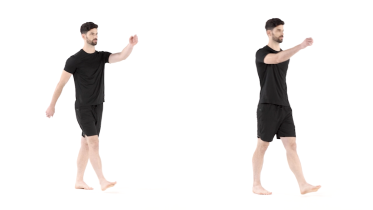
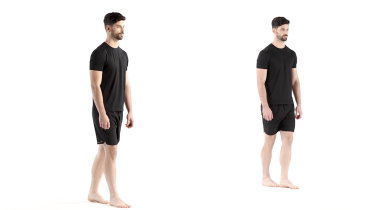
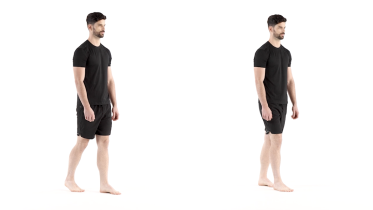
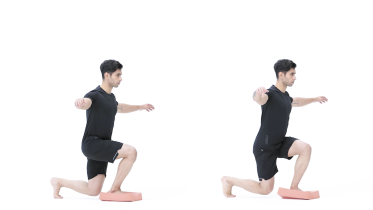
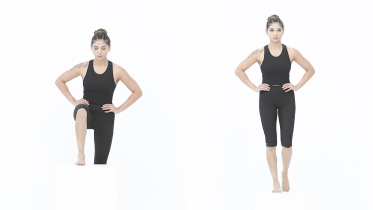
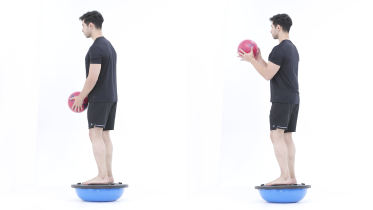
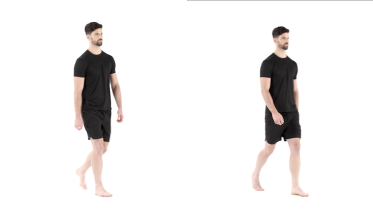
Crossover step-up
A crossover step-up is a step-up done from the side. You stand beside a low step, bring the far leg across your body onto it, rise up, then step down on the other side. Crossing over means the muscles at the side of the hip have to work to keep your pelvis level and your knee lined up. Knee and hip programs often use it as the next step after a standard step-up.
How to do the crossover step-up
- Stand side-on, right next to a low, stable step.
- Lift the leg farther from the step, bring it across in front of the other leg, and place the whole foot on the step.
- Push down through that foot to rise onto the step. Keep the kneecap pointing over your second toe all the way up.
- Bring the other leg over and step down to the floor on the far side, so you finish standing beside the step on the opposite side.
- Keep your hips level and your body facing straight ahead the whole time, then repeat going back the other way.
What you should feel
Effort in the thigh and buttock of the leg that crosses onto the step, and at the side of that hip as it holds your pelvis level.
Common mistakes
- Turning the hips and body to face the step instead of staying square.
- Letting the knee on the step collapse inward on the way up.
- Springing up off the foot that stays on the floor.
- Choosing a step too high to cross onto with control.
How often
Many programs start with 1 to 3 sets of 6 to 10 crossings in each direction, on a low step. Your physio will adjust this.
Stop and check with your physio if
- Your knee buckles, or you get a sharp pain at the knee or hip.
- Kneecap pain that gets worse rep by rep.
- You feel dizzy, or you catch your foot on the step and stumble. If you faint while exercising, call emergency services, even if you feel fine again quickly.
From the clinic
Get the ordinary step-up right first. The crossover adds a sideways balance challenge on top of it. The video shows no support nearby, but at home use a step next to a wall or banister you can touch, and make sure the step cannot slide. If you have had a fall in the past year or feel unsteady on your feet, keep one hand on the support throughout and ask your physio whether this is the right exercise for you yet.
If you have had a hip replacement, get the go-ahead from your surgeon or physio before you try crossovers. Bringing the leg across in front of the other one takes it across the middle of your body while the hip is bent and carrying your weight, and many surgeons ask you to avoid that for the first months after some operations. For another way to train knee control on a step without crossing, see the lateral step-down with band.
Written and checked by the PocketPhysio editorial team. Last updated 2026-09-26.
This page is general education, not a diagnosis or a personal treatment plan. If you have pain, an injury or a health condition, see a physiotherapist or doctor before starting new exercises.