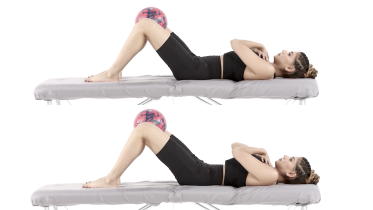
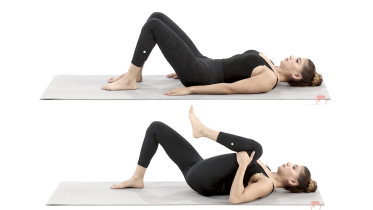
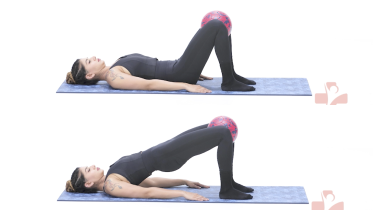
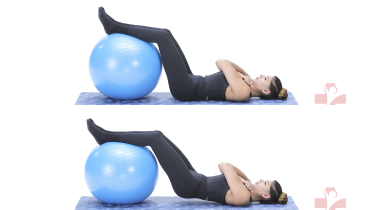
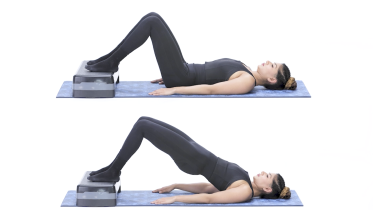
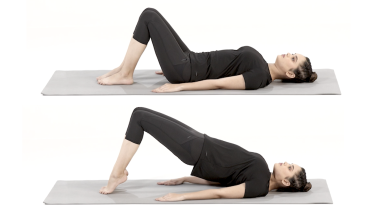
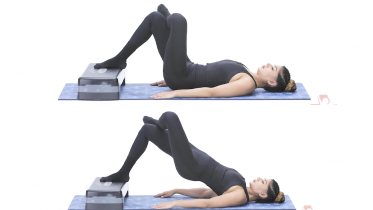
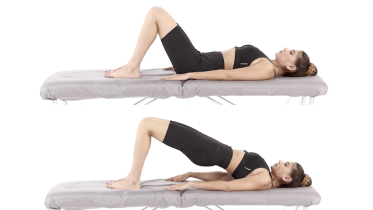
Isometric hip extension against a ball
This is a buttock exercise where the hip stays still. You lie on your back with one foot on a large exercise ball propped against a wall, then press your heel into the ball as if pushing it away from your hip. The ball does not move, so the big buttock muscle (gluteus maximus) works without the joint moving. That is what isometric means.
How to do the isometric hip extension against a ball
- Place a large exercise ball against a wall. Lie on your back on a mat with your feet toward the ball. A small pillow under your head is fine.
- Put the sole of the foot of the leg you are working on the ball, with the hip bent and the knee bent to about a right angle. Bend the other knee and rest that foot flat on the floor.
- Gently tighten your stomach and let your shoulders and arms relax.
- Press your heel into the ball by tightening the buttock on that side. Think of pushing the ball away by straightening from the hip, not the knee, and keep the back of the thigh as relaxed as you can.
- Hold the press for a few seconds while you keep breathing, then relax fully before the next one.
What you should feel
Tightening in the buttock of the leg on the ball. A little effort in the back of the thigh is normal, but the buttock should do most of the work.
Common mistakes
- Pushing by straightening the knee, which moves the effort into the front of the thigh.
- Lifting your hips off the mat or arching your lower back.
- Holding your breath as you press.
- Pushing so hard that the back of the thigh cramps. A moderate press is enough to start.
How often
Many programs start with holds of 5 to 10 seconds, repeated 5 to 10 times on each side, once or twice a day, and build up to longer holds of 20 to 30 seconds as it gets easier. Your physio will adjust the hold, the effort and the number of reps.
Stop and check with your physio if
- Sharp pain in the hip, groin or buttock, or pain that builds with each hold.
- You feel it in your lower back rather than your buttock.
- Numbness, tingling or pain travelling down the leg.
From the clinic
Holds like this are often given early in rehab, when moving the hip through its full range is still sore. Start with a medium effort rather than your hardest push, and only build up if it stays comfortable. Breathe normally through every hold, especially if you have high blood pressure. Once it is easy, the glute bridge works the same muscle through movement.
If you have had a hip replacement or other hip surgery, get the go-ahead from your surgeon or physio before you try this exercise. This position bends the hip to around a right angle, and many surgeons ask you not to bend it further than that for the first months after some operations. If you are pregnant and past the first three months, check with your physio about exercising flat on your back.
Written and checked by the PocketPhysio editorial team. Last updated 2026-09-26.
This page is general education, not a diagnosis or a personal treatment plan. If you have pain, an injury or a health condition, see a physiotherapist or doctor before starting new exercises.