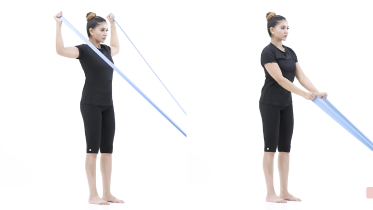
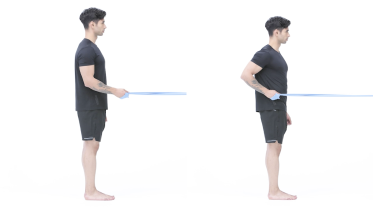
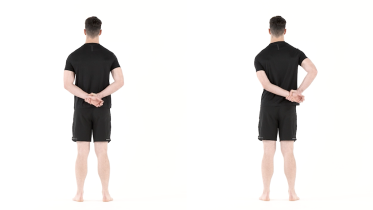
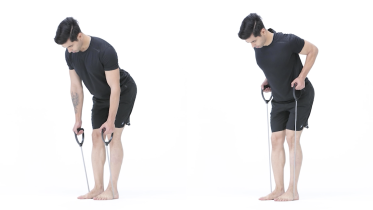
Straight arm chest stretch
The straight arm chest stretch works on the front of the chest and shoulder, mostly the middle part of the large chest muscle (pectoralis major). You stand side on to a door frame, hold it with your arm straight and out to the side at about chest height, then turn your body away until the chest opens. Keeping the elbow straight also brings the front of the upper arm into the stretch.
How to do the straight arm chest stretch
- Stand side on to a door frame, about an arm's length away, with the side you want to stretch nearest to it.
- Reach out to the side and hold the frame with that hand, elbow straight, at about chest height. In the video the arm is close to level with the shoulder.
- Take a small step forward with the leg closest to the frame.
- Lift your chest and slowly turn your body away from the frame until you feel a stretch across the chest and the front of the shoulder.
- Hold it while you breathe steadily, then turn back, let go and lower the arm.
What you should feel
A stretch across the chest on the side of the straight arm, often reaching into the front of the shoulder and upper arm.
Common mistakes
- Holding the frame above shoulder height, which strains the front of the shoulder.
- Twisting quickly or bouncing into the turn.
- Letting the shoulder roll forward or lift toward the ear.
- Leaning the whole body forward instead of turning the chest away.
How often
Often held for 20 to 30 seconds and repeated 2 to 3 times on each side that needs it, once or twice a day. Your physio will adjust this.
Stop and check with your physio if
- A sharp pain, pinch or catch at the front of the shoulder.
- Tingling, numbness or heaviness comes on in your arm or hand while you hold the stretch.
- Your shoulder starts to feel loose, as if it could slip out.
- Pins and needles in your arm or hand that do not go away after you stop, or part of your arm or hand goes numb. Get medical advice the same day. If one side of your face or body suddenly goes numb or weak, or your speech becomes slurred or muddled, call emergency services, even if it goes away.
- The shoulder feels as if it has slipped out of place, looks a different shape or suddenly locks so you cannot move the arm, or your hand turns cold, pale or blue. Go to an emergency department straight away, without driving yourself, and do not try to put the shoulder back in yourself.
From the clinic
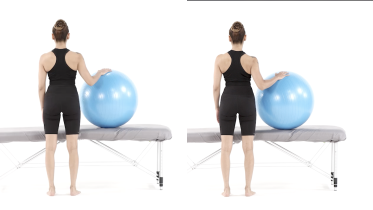
The video is filmed against a plain background, so the frame is hard to see. Watch the hand instead: it sits level with the shoulder or a little lower. Compared with the pec stretch, where the elbow is bent and the forearm rests on the wall, a straight arm is a longer lever. The stretch builds faster, and a small turn is often all you need.
A straight arm held out to the side also pulls on the nerves that run down into the hand. If your hand starts to tingle, turn back a little or soften the elbow until it settles.
With the arm out to the side and your body turning away from it, the shoulder is taken toward its most common dislocation position. If your shoulder has dislocated before or feels loose, talk to your physio before you try this stretch. After shoulder surgery, including a rotator cuff repair, or after a shoulder fracture or dislocation, follow your surgeon's or physio's plan, and do only the movements and range they have cleared. Many plans allow only passive movement at first, where the arm is moved for you and its muscles stay relaxed.
Written and checked by the PocketPhysio editorial team. Last updated 2026-09-28.
This page is general education, not a diagnosis or a personal treatment plan. If you have pain, an injury or a health condition, see a physiotherapist or doctor before starting new exercises.